
The Dictatorship
Trump’s US Open visit sparks boos and long security lines…


NEW YORK (AP) — President Donald Trump was loudly booed at the men’s final of the U.S. Open on Sunday, where extra security caused by his visit led to lines long enough that many people missed the start of play, even after organizers delayed it.
Wearing a suit and long, red tie, Trump briefly emerged from his suite about 45 minutes before the match started and heard a mix of boos and cheers from an Arthur Ashe Stadium that was still mostly empty. No announcement proceeded his appearance, and it was brief enough that some in the crowd missed it.
U.S. President Donald Trump attended the U.S. Open tennis match in New York on Sunday and got a mixed reaction from the crowd. He later said that he didn’t know what to expect, but that the fans were ‘great.’
Trump appeared again to more boos before the National Anthem. Standing in salute, the president was shown briefly on the arena’s big screens during the anthem, and offered a smirk that briefly made the boos louder.
When the anthem was over, the Republican pointed to a small group of supporters seated nearby, then sat on the suite’s balcony to watch the match intently. He mostly didn’t applaud, even following major points that energized the rest of the crowd as Spain’s Carlos Alcaraz bested Jannik Sinner of Italy.
Trump was shown on the big screen again after the first set ended, and elicited a roar of louder boos and some piercing whistles. He raised his left fist in salute as the noise continued in the stadium, which with a capacity of 24,000 is one of the largest in tennis.
The president later moved back inside the suite, where he was seen seated at a table with family members and appeared to be eating, but he was back in his seat shortly before match point. Cameras briefly flashed on Trump as Alcaraz celebrated, but his reaction to the conclusion was as muted as it had been throughout most of the match. This time, there was little crowd reaction, too.
Organizers pushed the start of the match back half an hour to give people more time to pass through enhanced screening checkpoints reminiscent of security at airports. Still, thousands of increasingly frustrated fans remained in line outside as the match got underway. Many seats, especially those in upper rows, stayed empty for nearly an hour.
The Secret Service issued a statement saying that protecting Trump “required a comprehensive effort” and noting that it “may have contributed to delays for attendees.”
“We sincerely thank every fan for their patience and understanding,” it said.
Trump attended the final as a guest of Rolex, despite imposing steep tariffs on the Swiss watchmaker’s home country. The U.S. Tennis Association also tried to limit negative reaction to Trump’s attendance being shown on ABC’s national telecast, saying in a statement before play began: “We regularly ask our broadcasters to refrain from showcasing off-court disruptions.”
The reactions to Trump didn’t ultimately constitute big disruptions, though.
Going to the U.S. Open was the latest example of Trump having built the bulk of his second term’s domestic travel around attending major sports events rather than hitting the road to make policy announcements or address the kind of large rallies he so relished as a candidate.
Since returning to the White House in January and prior to Sunday’s U.S Open swing, Trump has gone to the Super Bowl in New Orleans and the Daytona 500as well as UFC fights in Miami and Newark, New Jerseythe NCAA wrestling championships in Philadelphia and the FIFA Club World Cup final in East Rutherford, New Jersey. Some of those crowds cheered him, but people booed him at other events.
The president accepted Rolex’s invitation despite his administration imposing a whopping 39% tariff on Swiss products. That’s more than 2 1/2 times higher than levies on European Union goods exported to the U.S. and nearly four times higher than on British exports to the U.S.
The White House declined to comment on Trump accepting a corporate client’s invitation at the tournament, but the president has had few qualms about blurring lines between political and foreign policy decisions and efforts to boost the profits of his family business. He’s tirelessly promoted his cryptocurrency interests and luxury golf propertiesand even announced that the U.S. will host the Group of 20 summit in December 2026 at his Doral golf resort in Florida.
No large street protests against Trump could be seen from the tournament’s main stadium on Sunday. But attendees also steered clear of wearing any of the the Republican’s signature “Make America Great Again” caps.
A 58-year-old tennis fan originally from Turin, Italy, came from her home in the Boston area to watch the final and said that when she bought a U.S. Open cap, she went with a fuchsia-hued one so it wouldn’t be mistaken for the signature darker color of MAGA hats.
“I was careful not to get the red one,” said the fan, who declined to give her name because of her employer’s rules about being publicly quoted.
Among those attending with Trump were White House press secretary Karoline Leavitt, Attorney General Pam Bondi, Treasury Secretary Scott Bessent, special envoy Steve Witkoff and Susie Wiles, the White House chief of staff. Trump spent various portions of the match engaged in conversation with many of those around him.
Elsewhere in the crowd were a slew of celebrities — some of whom publicly backed then-Vice President Kamala Harris during last year’s election. Among them were Pink, Bruce Springsteen and Shonda Rhimes. In pre-match interviews shown on large stadium screens with the likes of Martha Stewart and Jon Hamm, the questions asked stuck to tennis and pop culture — not Trump and politics.
The president nonetheless was excited enough about his trip to tell reporters on Air Force One during the flight to New York when the plane flew over Ashe stadium — though the covered roof kept those inside from reacting.
Trump was once a U.S. Open mainstay, but hadn’t attended since he was booed at a quarterfinals match in September 2015, months after launching his first presidential campaign.
The Trump Organization once controlled its own U.S. Open suite, which was adjacent to the stadium’s television broadcasting booth, but suspended it in 2017during the first year of Trump’s first term. The family business is now being run by Trump’s sons with their father back in the White House.
Trump was born in Queens, home of the U.S. Open, and for decades was a New York-area real estate mogul and, later, a reality TV star. Attending the tournament before he was a politician, he usually sat in his company’s suite’s balcony during night matches and was frequently shown on the arena’s video screens.


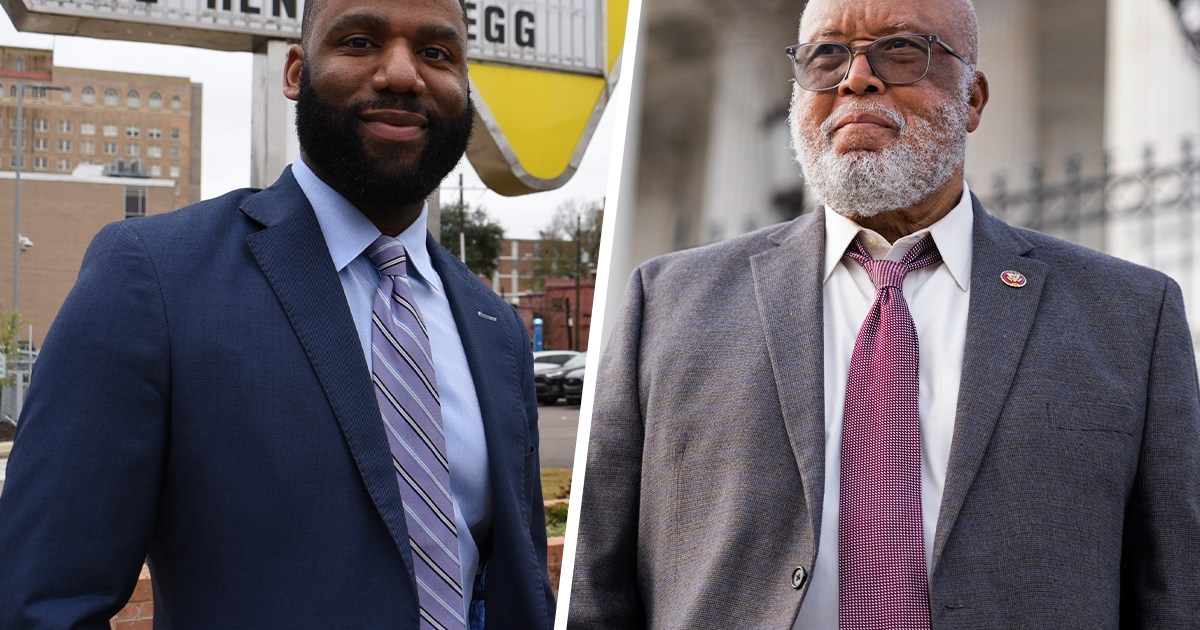
The next test of whether a new generation of Democrats can unseat members of the old guard comes Tuesday, in a battle over who will represent much of western Mississippi in the U.S. House.
The race to represent the state’s 2nd Congressional District features 34-year-old Evan Turnage — a former lawyer in the offices of Senate Minority Leader Chuck Schumer, D-N.Y. and Sen. Elizabeth Warren, D-Mass. — mounting a longshot bid to replace 78-year-old incumbent Rep. Bennie Thompson. Whoever wins the Tuesday primary will almost certainly win the general election in the solidly Democratic district. (A third candidate, Petris Williams III, is also running in the Democratic primary.)
Turnage has branded himself as a fresh alternative to Thompson, alleging the incumbent hasn’t done enough to reduce poverty and other issues in the majority Black district — which has ranked among the poorest nationwide — during his 33 years in the seat.
“People in this district are ready for change,” Turnage told MS NOW in a phone interview on Monday. “This is the poorest district in the poorest state in the country, and it’s been like that for my entire life. People want better.”
Turnage is one of more than 80 Gen Z and millennial Democrats mounting primary contests this year against veteran House Democrats, according to data released last month by the Democratic political fundraising platform Oath. Others include Melat Kiros, a 28-year-old, Justice Democrats-backed lawyer and barista taking on 68-year-old Rep. Diana DeGette in Colorado in June; and Justin Pearson, a 31-year-old state legislator in Tennessee vying to replace Rep. Steve Cohen in August and backed by both Justice Democrats and Leaders We Deserve, the political action committee founded by 25-year-old Democratic activist David Hogg.
Progressive power broker Sen. Bernie Sanders, D-Vt., has also endorsed a small handful of the candidates taking on House Democrats, including Donavan McKinney, a Michigan state representative running in the state’s 13th district; and 32-year-old Nida Allam, a member of the Durham County Board of Commissioners who lost a tight race to oust Rep. Valerie Foushee in North Carolina last week. (Spokespeople for Sanders did not respond to requests for comment from MS NOW.)
Usamah Andrabi, communications director for Justice Democrats, told MS NOW the deep field of young primary challengers shows that “voters are overwhelmingly ready to usher in a new generation of leadership in this party.”
But he added that the group is not “simply looking to replace old incumbents with young incumbents,” and is instead focused on backing candidates who oppose “democratic corporatism and billionaire greed” and display “moral and political courage.”
“It does us no good to replace aging corporate shills with youthful corporate chills,” Andrabi said. “The problem is that the Democratic Party is overrun with corporate shills.”
“People in this district are ready for change,” Turnage told MS NOW in a phone interview on Monday. “This is the poorest district in the poorest state in the country, and it’s been like that for my entire life. People want better.”
In Mississippi, Thompson has leaned on his experience in Washington, which has included wielding significant power as the first Black Democrat to represent the state in Congress. He’s currently the ranking member on the House Homeland Security Committee, and formerly served as chair of the Select Committee on Jan. 6.
In an emailed statement to MS NOW, Thompson did not directly address the arguments Turnage has made about the need for generational change.
“Elections are about giving people a choice, and I respect that process. I have always run my campaigns by focusing on the needs of the people of Mississippi’s Second Congressional District and the work we’ve done together,” Thompson said. “There is always more to be done, and I remain committed to continuing that progress. Ultimately, I trust the voters of the district to look at the record and make the choice they believe is best for their communities.”
Tough Democratic primaries for some veterans is a hallmark of the 2026 midterm election cycle.
But the recent outcomes of some of these early races underscore the uphill battles younger candidates like Turnage face — and emphasize that they do not all share the same strategies for unseating older incumbents.
In North Carolina, Allam’s race against Foushee was widely seen as a bellwether for how far a left-wing challenger could go in a bid to oust an establishment Democrat in a deep blue district.
And in Texas, Rep. Christian Menefee, the 37-year-old elected to the House in a special election earlier this year, and Rep. Al Green, who has served in Congress for more than two decades, will head to a May runoff election to represent a newly-redrawn district after neither cleared earned 50% of votes in their race last week. (Menefee came out on top, earning about 46% of votes to Green’s 44%, according to the Associated Press.)
Similarly to Allam, Turnage has taken direct aim at his opponent in emphasizing the benefit of electing a millennial to Congress.
“People in my age group are the first age group in generations in America who are expected to have less wealth than their parents, expected to have lower life expectancy than their parents, and that is because of failed leadership from the current generation,” Turnage said.
Both he and Allam also criticized their opponents’ reliance on big-money donors.
Turnage noted that Thompson’s top donor is a group associated with Aflac, the insurance company, and that he has taken thousands from corporate political action committees. (Campaign filings show that, as of last month, Turnage had about $40,000 cash on hand and $85,000 in debts, compared to Thompson’s $1.5 million on hand.)
Allam — who did not respond to repeated inquiries from MS NOW — criticized Foushee for receiving support from outside groups aligned with AIPAC, the pro-Israel lobby. (Allam had close to $229,000 on hand last month and $86,000 in debts, compared to Foushee’s approximately $184,000 on hand.)
Menefee, on the other hand, swatted away questions about his candidacy representing a generational shift, telling MS NOW in an interview last week that he sees his challengers as President Donald Trump and the Republicans who supported gerrymandering the district in which he’s running rather than Green.
“Our support in this race has been intergenerational,” Menefee said.
“We’ve focused very heavily on making sure that folks know that I’m looking to bring new strategies to standing up to the Trump administration,” he added.
Green, on the other hand, has criticized Menefee for missing several votes during his first couple months in Congress, and has said he is proud of his own voting record; he has also claimed, “I am the generational change.”
When it comes to critiques of big-money donors in the Texas race, it is Menefee who has fielded criticism for earning the support of the cryptocurrency lobby — though he has said he was “not at all cognizant” of the financial power they wield.
For the Justice Democrats and the candidates they back, big-money is an ever-present obstacle. Still, Andrabi said, we “want to win every campaign we run.”
But the group also sees Allam’s loss to Foushee — by a single percentage point, compared to a 9-point difference in 2022 — as a win. They also take credit for pushing Foushee to denounce U.S. funding of the Israeli military and regulate artificial intelligence, two issues she said are among her priorities in her statement celebrating her victory.
“If nothing else,” Andrabi said, “we are showing Democratic incumbents that what they are doing is wholly insufficient for their own voters.”
In Mississippi, Turnage has been trying to send the same message to Thompson. But he said he did not seek out the support of groups like Justice Democrats because he did not want “to nationalize this race.”
“We are focused on the issues in Mississippi,” he said.
Still, Turnage said he finds hope in both Allam’s close race and the fact that Menefee — who Turnage said is a friend — will proceed to the runoff.
“I think it’s just another sign that, especially here in the South, people are ready for a new generation of leadership,” Turnage said.
Julianne McShane is a breaking news reporter for MS NOW who also covers the politics of abortion and reproductive rights. You can send her tips from a non-work device on Signal at jmcshane.19 or follow her on X or Bluesky.
The Dictatorship
Georgia’s special election shows a better way to vote, but not everyone gets to use it
The race to replace former Rep. Marjorie Taylor Greene is a doozy.
After the firebrand Georgia Republican resigned in January, nearly two dozen Republicans and Democrats filed to run for her seat, ranging from the usual local elected officials and business leaders to a farmer, a horse trainer and a travel consultant.
With no candidate likely to win an outright majority on Tuesday, the top two will face off in a runoff on April 7.
Every year, about a dozen special elections like this are held to fill House seats left vacant because a lawmaker accepted another government appointment, died or resigned, as Greene did in January.
These elections can cost hundreds of thousands of dollars to run. Turnout is typically low — about half that of the previous regular election — and even lower when there is a runoff. In states without runoffs, the winner of a multicandidate race may not even win a majority of the votes cast, meaning they were chosen by a fraction of a fraction of the district’s voters.
The state’s Republicans aren’t keen on talking about it, because it refutes a major GOP talking point on election reform.
Georgia has found a solution to almost all of these problems. But there’s a catch: Only members of the military and voters who live overseas can use it. And Republicans in the state are pushing to ban it for everyone else.
The solution is called ranked-choice voting, and it works pretty similar to the runoff Georgia’s regular voters will likely face in a month for Greene’s seat.
Instead of casting a second ballot, military and overseas voters simply rank the field of candidates in order of their preference. (For example: 1) the farmer, 2) the horse trainer, 3) the travel consultant.) If no candidate gets 50%, the lowest-ranked candidate is removed, and the second choices of their voters are reassigned. (So if the farmer came in last, your vote now goes to the horse trainer.) Some advocates refer to this as an “instant runoff,” since it works the same way as a runoff.
This works well for military voters, who must receive a ballot at least 45 days before a federal election under federal law so that they have enough time to receive it, fill it out and return it. In Texas, which doesn’t have a ranked-choice ballot for military voters, the alternative is to hold the runoff much later. This is why Sen. John Cornyn, R-Texas, and Texas Attorney General Ken Paxton won’t face off for the Republican Senate nomination until late May, which can create problems for the eventual nominee.
Ranked-choice voting isn’t just convenient for military voters, though. Research has also shown that it can boost turnoutreduce negative campaigningincrease the number of women and minority candidates, eliminate the “spoiler effect” of third-party candidateselect more moderates and make governing more bipartisan. That’s why it’s used in elections from the New York City Democratic mayoral primary won by Zohran Mamdani to statewide races in Maine and Alaska to Australian national elections. It’s even used to determine the Academy Award for Best Picture and the Heisman Trophy.

To be fair, there are some drawbacks. It’s a little more expensive, takes longer to count and can be more work for voters — although polls show that most people who’ve used it found it “easy.” and want to keep it.
For many Republican lawmakers, though, ranked-choice voting is a nefarious plot. Sen. Tom Cotton, R-Ark., has called it a “naked power grab” by liberals “hoping to split the conservative vote” and elect Democrats. Gov. Kay Ivey, R-Ala., called it “complicated and confusing” and argued it “makes winners out of losers.” The Republican National Committee adopted a resolution that said it amounted to “voter suppression” and put elections in the hands of “confusing technology” and “unelected bureaucrats.”
Opposition to ranked-choice voting has quickly become an article of faith in the GOP. Earlier this month, Indiana became the 19th state to ban the use of ranked-choice voting, even at the local level.
In quieter moments away from the spotlight, some Republicans seem to understand its benefits. During the pandemic, the Indiana Republican Party used ranked-choice voting to streamline its virtual state convention in 2020. The Virginia GOP had no problem with it the following year when it chose Glenn Youngkin as its nominee for governor after five rounds of ballot counting. And Utah has long used it at state conventions.
But the biggest tell is its use for military and overseas voters in six statesincluding Georgia as well as Alabama, Arkansas, Louisiana, Mississippi and South Carolina. Of those states, only Georgia and South Carolina haven’t banned the use of rank-choice voting in all other situations, and Republican lawmakers in both states are currently considering bans.
There’s really no argument being made against ranked-choice voting that holds for members of the military but not for the public at large. Either it’s a partisan scheme to elect Democrats that is too confusing, suppresses voters and empowers nefarious bureaucrats — or it’s not. The only argument would be that it’s much more convenient for voters deployed to another country but not worth the hassle for voters back home, but that’s not what Republicans have argued.
The biggest fear among Republicans seems to be that ranked-choice voting will help elect Democrats, but a recent survey of research by the Institute of Government and Public Affairs at the University of Illinois-Chicago found there’s no evidence that it helps or hurts either party.
In fact, the only candidates that it seems to hurt are ideological extremists who disdain bipartisanship and struggle to reach out to their rival’s supporters. Lawmakers who continue to oppose it may be telling on themselves more than they realize.
This is a preview of MS NOW’s Project 47 Newsletter. As President Trump continues implementing his ambitious agenda, get expert analysis on the administration’s latest actions and how others are pushing back sent straight to your inbox every Tuesday. Sign up now.
Ryan Teague Beckwith is a newsletter editor for MS NOW. He has previously worked for such outlets as Time magazine and Bloomberg News. He teaches journalism at Georgetown University’s School of Continuing Studies and is the creator of Your First Byline.
The mass deportation sweeps integral to meeting Stephen Miller’s goals have slowed substantially after last month’s federal retreat from Minnesota. It’s the biggest setback the White House deputy chief of staff has faced in his bid to purge the country of millions of immigrants. But as the highly visible raids featuring Immigration and Customs Enforcement and Border Patrol have receded, it would be unwise to mistake a change in tactics with a change in Miller’s overall strategy and goals.
If there were one word to describe the Trump administration’s deportation campaign months before its surge into Minnesota, it would be “unsubtle.” The quota of arrests Miller had set — 3,000 per day by June, double his demand for 1,500 daily in January — required ICE to ditch its longstanding methods. Rather than targeting specific individuals, it adopted mass roundups of immigrants as its standard operating procedure.
If there were one word to describe the Trump administration’s deportation campaign months before its surge into Minnesota, it would be “unsubtle.”
The sight of these indiscriminate, and yet highly discriminatory, arrests helped tank President Donald Trump’s approval ratingespecially toward his immigration policies. Border Patrol chief Greg Bovino’s self-important, heavy-handed antics helped add fuel to the growing embers of public discontent toward the federal interventions. That discontent swelled into outrage when federal immigration agents killed two Minneapolis residents within the span of two weeks. Reportedly it was Miller behind the initial claim that one of those victims, Alex Pretti, was a “domestic terrorist,” a false charge that helped galvanize the opposition to ICE’s tactics.
Withdrawing from Minnesota last month was the first of several major setbacks for Miller’s policies. The Department of Homeland Security is still partially shutdown as Senate Democrats hold up funding in hopes of instituting new reforms on ICE and Border Patrol. Meanwhile, the department itself is soon to be without a leader after Kristi Noem’s firing last week, with no hearing scheduled to get her replacement confirmed.

According to The New York TimesICE pulling back on massive city-wide operations and returning to more targeted arrests has had an impact Miller must hate:
In February, Immigration and Customs Enforcement officers arrested roughly 11 percent fewer people per day than they had the previous month, according to internal government figures reviewed by The New York Times. The drop was driven in part by ICE arresting fewer immigrants without criminal records, the data show. Overall, arrests have fallen to their lowest levels since September.
While any drop off is encouraging, the danger in this moment is that the “softer touch” Trump said his administration needed will be mistaken as a reversion to the norm. According to the Times’ review of ICE data, in February, agents were still detaining about 1,115 people daily, which remains “about four times as high as they were during the last year of the Biden administration.” And 40% of the people ICE arrested in February had no criminal recordonce again exposing the lie in Trump’s claims that only the “worst of the worst” were being targeted.
The public’s opinion soured toward the brutish show of force Miller’s demands required, but there’s no guarantee that the public will maintain that disapproval as the memory of heavily armed agents patrolling city streets fades. And while Sen. Thom Tillis, R-N.C., suggested Sunday that Miller needs to be firedhe made clear he has issue with the administration’s methods, not its goal.
“We’ve lost the debate over immigration and deportations,” Tillis told CNN. “I believe that we should deport everyone that we can find that came across the borders during the Biden administration. But we’ve got to be smart, use our limited resources, go after the most dangerous first.”
The upside for Miller is that while he may have lost several recent battles, the war is still ongoing.
That’s almost exactly how Trump sold Americans on his mass deportation scheme, only for Miller to carry out the real agenda of hitting a million deportations a year, no matter who got caught up in the dragnet.
The upside for Miller is that while he may have lost several recent battles, the war is still ongoing. After all, he still has three more years and billions of dollars already appropriated to ICE and DHS more broadly to help bring to life his vision of an America purged of its immigrants. Even though ICE and Border Patrol are at least temporarily restrained, DHS is still procuring warehouses and factories to convert into the detention facilities that Miller seeks to fill.
Meanwhile, hundreds of immigrants are still being rounded up daily despite committing no crime. The comparative quiet on city streets isn’t being matched in the cries of anguish of families who know a loved one won’t be coming home. Even if the deportation figures aren’t rising as fast as Miller would like, the sum of lives forever changed by his cruelty won’t be receding anytime soon.
Hayes Brown is a writer and editor for MS NOW. He focuses on politics and policymaking at the federal level, including Congress and the White House.
- The Blue Light News Poll – Feb 2026
- House GOP eyes reconciliation process to pass Middle East war aid
- Countries confirm biggest emergency oil release in history
- House Oversight chair moving quickly to schedule Epstein testimony with Bondi, Lutnick
- One obstacle for Trump’s AI power pledge: The neighbors
- Cornyn backs ending filibuster as he courts Trump’s endorsement
- ‘Damaging and punishing’: Birth control clinics serving millions face federal funding cliff
- Capitol agenda: GOP wants to move past the SAVE America Act
- John Thune says he’s ready to take the filibuster heat
- Pelosi backs former Capitol Police officer over Hoyer’s preferred successor in Maryland
-

 The Dictatorship1 year ago
Luigi Mangione acknowledges public support in first official statement since arrest
-

 Politics1 year ago
Former ‘Squad’ members launching ‘Bowman and Bush’ YouTube show
-

 Politics1 year ago
Blue Light News’s Editorial Director Ryan Hutchins speaks at Blue Light News’s 2025 Governors Summit
-

 Politics1 year ago
Former Kentucky AG Daniel Cameron launches Senate bid
-

 The Dictatorship6 months ago
Mike Johnson sums up the GOP’s arrogant position on military occupation with two words
-

 The Dictatorship1 year ago
Pete Hegseth’s tenure at the Pentagon goes from bad to worse
-

 Politics11 months ago
Democrat challenging Joni Ernst: I want to ‘tear down’ party, ‘build it back up’
-
Uncategorized1 year ago
Bob Good to step down as Freedom Caucus chair this week