
The Dictatorship
Trump signs order to speed review of psychedelics, including ibogaine

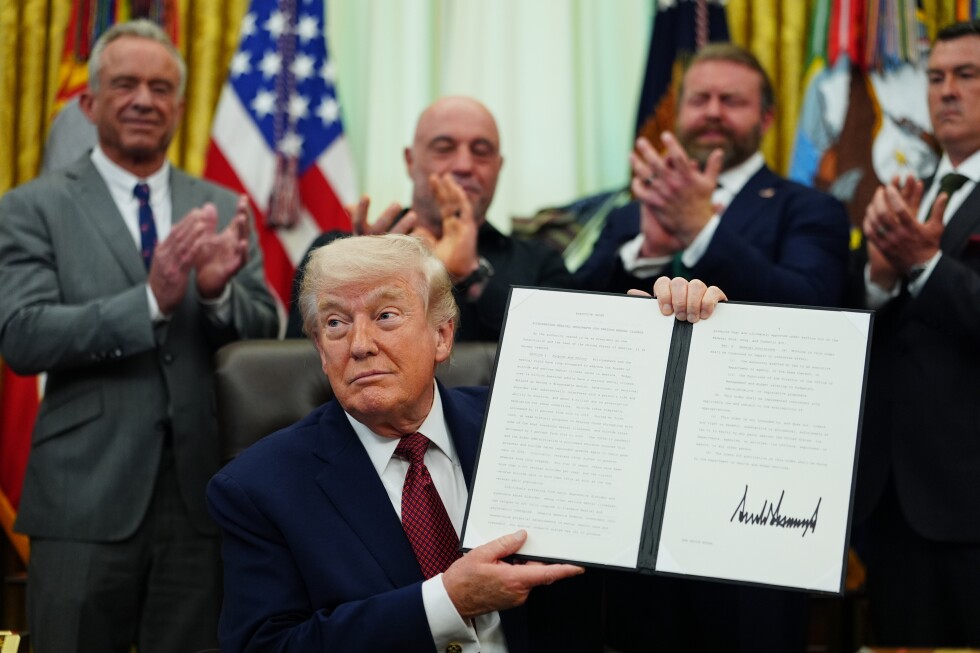
WASHINGTON (AP) — President Donald Trump on Saturday directed his administration to speed up reviews of certain psychedelic drugs, including ibogaine, which recently has been embraced by combat veterans and conservative lawmakers despite having serious safety risks.
Ibogaine and other psychedelics remain banned under the federal government’s most restrictive category for illegal, high-risk drugs. But the administration is taking steps to ease restrictions and spur research on using the drugs for medical purposes, including conditions like severe depression.
“Today’s order will ensure that people suffering from debilitating symptoms might finally have a chance to reclaim their lives and lead a happier life,” Trump said as he signed an executive order on the drugs. The Republican president said his directive will help “dramatically accelerate” access to potential treatments. “If these turn out to be as good as people are saying, it’s going to have a tremendous impact,” he said.
Veteran organizations and psychedelic advocates have long contended that ibogaine, which is made from a shrub native to West Africa, has great promise for hard-to-treat conditions such as post-traumatic stress disorder and opioid addiction.
Trump’s announcement follows pledges by Health Secretary Robert F. Kennedy Jr. and other administration officials to ease access to psychedelics for medical use, an issue that has won rare bipartisan support.
Joining Trump in the Oval Office were his top health officials, conservative podcaster Joe Rogan and Marcus Luttrell, the former Navy SEAL whose memoir about a deadly mission in Afghanistan was the basis of the film “Lone Survivor.” Rogan said he texted Trump information on ibogaine and the president responded: “Sounds great. Do you want FDA approval? Let’s do it.”
“You’re going to save a lot of lives through it,” Luttrell told Trump during the ceremony. “It absolutely changed my life for the better.”
The Food and Drug Administration next week will issue national priority vouchers for three psychedelics, which the agency’s commissioner, Marty Makary, said will allow certain drugs to be approved quickly “if they are in line with our national priorities.” The vouchers can cut review times from several months to a period of weeks. It is the first time the FDA has offered that fast-tracking to any psychedelics.
The FDA is also taking steps to clear the way for the first-ever human trials of ibogaine in the U.S.
Trump’s action surprised many longtime advocates and researchers in the psychedelic fieldgiven that ibogaine is known to sometimes trigger potentially fatal heart problems. The National Institutes of Health briefly funded research on the drug in the 1990s, but discontinued the work due to ibogaine’s “cardiovascular toxicity.”
Sign up for Morning Wire: Our flagship newsletter breaks down the biggest headlines of the day.
“It’s been incredibly difficult to study ibogaine in the U.S. because of its known cardiotoxicity,” said Frederick Barrett, director of the Johns Hopkins Center for Psychedelic and Consciousness Research. “If the executive order can pave the way for doing objective, scientific research with this compound, it would help us understand whether it is truly a better psychedelic therapy than others.”
No psychedelic has been approved in the United States, but a number of them are being studied in large trials for various mental health conditions, including psilocybin, MDMA and LSD. All those drugs remain illegal, classified as Schedule I substances alongside drugs such as heroin. Two states — Oregon and Colorado — have legalized psychedelic therapy with psilocybin.
Ibogaine was first used by members of the Bwiti religion in African nations like Gabon during their religious ceremonies.
In recent years, U.S. veterans have reported benefiting from the drug after traveling to clinics in Mexico that administer it.
Backing from veterans groups and former Texas Gov. Rick Perry led to a law last year providing $50 million for ibogaine research in that state. Perry, who co-founded a group called Americans for Ibogaine, recently appeared on Rogan’s podcast, making the case for reducing federal limits on the drug. It was his second time talking about ibogaine on the popular podcast in the past two years.
Trump’s order calls on the Department of Health and Human Services to direct at least $50 million to states that have enacted or are developing programs to advance psychedelic drugs for serious mental illness. It’s described as a federal-state partnership to provide funding, technical assistance and data sharing.
Ibogaine is known to cause irregular heart rhythms and has been linked to more than 30 deaths in the medical literature, according to the Multidisciplinary Association for Psychedelic Studies, a nonprofit that conducted some early studies in patients outside the U.S.
The group’s co-executive director, Ismail Lourido Ali, said Trump’s order might encourage other states to follow the Texas model.
“The stigma around Schedule I drugs is significant,” Ali said. “It feels like this would give pretty substantial cover for Republican governors and legislatures to step into the ring in terms of funding research programs at their universities.”
Owners of ibogaine clinics said the impact of the order will not be immediate.
“There will be no insurance coverage, it will still be considered unapproved and non-covered care,” said Tom Feegel of Beond Ibogaine, which operates a clinic in Cancun, Mexico. “But what it does mean is that ibogaine shifts from being fringe and underground to being federally acknowledged.”
Feegel says his clinic treated 2,000 people with ibogaine last year for between $15,000 and $20,000 per person. The company also gave free treatment to about 100 veterans.
Clinics that use the drug typically monitor patients’ heart readings and have emergency medical equipment on hand.
One of the only recent studies conducted by U.S. researchers found that veterans treated with ibogaine showed improvements in symptoms of traumatic brain injury, including PTSD, depression and anxiety. The Stanford University study was small — enrolling 30 veterans who received the drug in Mexico. It did not include a placebo group for comparison, an essential feature of rigorous medical research. Patients in the study received a combination of ibogaine mixed with magnesium intended to reduce heart risks.
___
The Associated Press Health and Science Department receives support from the Howard Hughes Medical Institute’s Department of Science Education and the Robert Wood Johnson Foundation. The AP is solely responsible for all content.


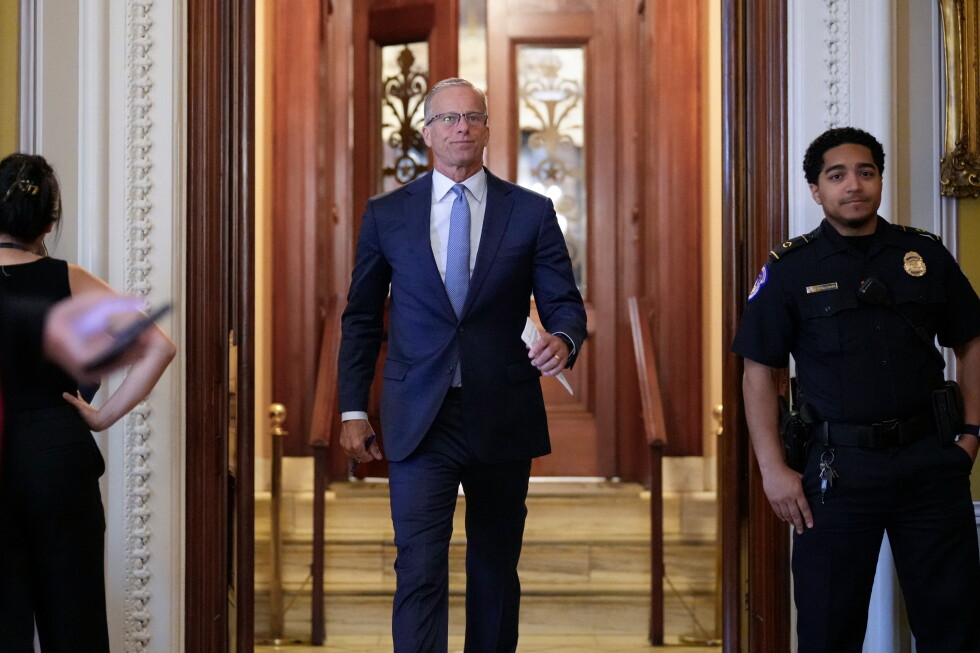
WASHINGTON (AP) — The relationship between President Donald Trump and Senate Republicans neared a breaking point this week as he upended their efforts to speedily confirm one of his own nominees and said he would not sign the renewal of a key surveillance law unless they agree to new terms.
Trump’s overnight social media post Wednesday that he was delaying Jay Clayton’s nomination to become national intelligence director, just hours before the U.S. attorney’s confirmation hearing, further strained relations between the Senate and White House that have been worsening for weeks. Later that day, some Republican senators who have been hesitant to challenge the president directly on the Iran was were blunt in their criticism of his deal to end it.
“This is the worst foreign policy blunder in decades,” Sen. Bill Cassidy, R-La., said in a post on X.
The open tensions are an almost complete reversal from a year ago when Senate Republicans worked closely with Trump on a complicated effort to push through his massive package of spending and tax cuts.
At the time, criticism of the president was almost nonexistent among Republicans on Capitol Hill, and they planned to highlight passage of that bill in the midterms. But as the November election draws closer and Republicans are trying to defend their majorities, Trump is instead needling Congress with his demands and reversals, driving several Republican senators to disparage his actions publicly for the first time.
“I think somebody’s not dialing the president into the complexities of what he’s done here,” Sen. Thom Tillis, R-N.C., said Wednesday after Clayton’s confirmation was postponed. “I mean, my God.”
The slow unraveling of what once seemed like an airtight alliance between the executive and legislative branches in a Republican-led Washington extends to their policy priorities.
Trump appears to have lost interest in most of the GOP agenda and has become almost singularly focused on his voting legislation to require proof of citizenshipwhich has almost no chance of passing. At the same time, he has asked members of Congress to fund parts of his White House ballroom projectallow a temporary intelligence director that none of them like and cede their powers on the Iran war.
The growing rift has brought much of the Senate’s business to a halt and put Republicans who are up for reelection this year on the defensive. It has also put pressure on Senate Majority Leader John Thune, who has been up-front with Trump about what he can and cannot do in the Senate.
Trump pressures Thune on voting bill
Trump has pressured Thune relentlessly to scrap the filibuster and pass the strict proof-of-citizenship legislation, called the SAVE America Act. Thune, R-S.D., has told Trump publicly and privately that the votes are not there for either step. Still, Trump has kept up the push.
In a social media post Thursday, Trump said he would be “the last Republican president” if the voting bill does not pass.
“Senate Majority Leader John Thune, and the Republican Senate, must not let this ‘carnage’ happen,” Trump said. “They will go down on the wrong side of History, as will all Republicans who just stood by and watched.”
Nonetheless, Trump has yet to go after the well-liked Republican leader on a personal basis, as he often did with Thune’s predecessor, Sen. Mitch McConnell, R-Ky.. Trump once called McConnell a “ dour, sullen, and unsmiling political hack.”
Trump and Thune talk frequently, even as Thune is sometimes giving the president news he does not want to hear. As Trump pushed for the voting bill, Thune scheduled weeks of floor time to consider it, an effort to make clear that the Senate was supportive, even if the votes are lacking.
Missouri Sen. Eric Schmitt, one of the president’s closest allies in the Senate, said he has never heard Trump say anything negative about Thune.
“It’s a difficult position,” Schmitt said of Thune’s role in the Senate. “I think they have a good working relationship.”
One of Thune’s closest allies, Republican Sen. Mike Rounds of South Dakota, said the even-keeled leader is the “right person at the right time.”
“In the Capitol today, he is the stable force,” Rounds said. “In Washington, D.C., today, he is the stable force.”
No signs of revolt among Senate GOP
There were no signs of a revolt within the GOP conference, for now, despite Trump’s pressure.
Thune “has managed it better than anyone else could manage it,” said Cassidy, who has become a more frequent Trump critic since a primary loss to a Trump-backed challenger.
Criticism of Trump has at times surfaced even among his closest Senate allies, especially with his proposed $1.776 billion settlement fund for his political allies and his pick for acting intelligence director, Bill Pulte, who has no known intelligence experience.
But the rift with Trump has also stoked some new internal tensions.
Several Republican senators criticized Sen. Mike Lee, R-Utah, who has waged an online campaign to eliminate the filibuster and pass the SAVE America Act, in a private conference lunch this week for stoking dissension within the party in an election year.
Unbowed, Lee has kept up his social media campaign, including a post Friday on X in which he said that giving up because Republicans lack the votes is a “recipe for failure.”
Texas Sen. John Cornyn, one of those who spoke out at the meeting, replied that it is Lee’s job to find the votes, “if you can.”
“Can’t just complain about others,” Cornyn posted. “Prove us wrong.”
Trump’s dwindling number of allies
Some Senate Republicans have made clear they have no plans to separate themselves from Trump.
As several of his colleagues criticized Trump’s agreement with Iran this week, first-term Sen. Bernie Moreno, R-Ohio, aggressively defended it on social media.
“Let’s get the Nobel Peace Prize ready!” Moreno posted on X.
But Trump has far fewer of those Senate allies than he did when they narrowly passed the tax and spending cuts legislation a year ago. That is in part because he has picked off some of the most loyal Republican votes himself.
Both Cassidy and Cornyn lost in primaries last month after Trump endorsed their opponents. Tillis announced he was not running for reelection last year after Trump repeatedly criticized him on social media.
Now all three have become frequent critics.
Shortly after his election loss, Cornyn posted on social media a fable about a frog and a scorpion. The scorpion asks the frog to carry it across a river, according to the fable, and then stings the frog in the middle of the river, “dooming them both.”
“The dying frog asks the scorpion why it stung despite knowing the consequence,” Cornyn’s post read. “To which the scorpion replies: ‘I am sorry, but I couldn’t help myself. It’s my character.’”
___
Associated Press writer Kevin Freking contributed to this report.
ByDarryl Robertson
From the start, Shawn “Jay-Z” Carter has been consistent that his primary concern in life is making even more money. “I’d rather die enormous than live dormant,” he raps on “Can I Live?” That’s one of the songs on his 1996 debut masterpiece, “Reasonable Doubt,” which is mostly about him making the transition from drug dealer to musical artist. And “Can’t Knock the Hustle,” the first song on that album, is his declaration that no one can criticize him for how he accumulates wealth.
But 30 years later, people are knocking Jay-Z’s hustle. The hip-hop legend and media mogul is partnering with Target to push out a new collector’s item: a 30th-anniversary edition of “Reasonable Doubt” on vinyl. When Target ended its diversity, equity and inclusion (DEI) initiatives during the first days of the second Trump administration, Levy Armstrong to someMonique Cullars-Doty and Jaylani Hussein, stood outside Target’s headquarters in Minneapolis and announced that a nationwide boycott would begin on Feb. 1, 2025. Later, the Rev. Jamal Bryant, a prominent Black pastor in Atlanta, also called for a boycott. Target suffered declining store traffic and significantly fewer sales.
“Can’t Knock the Hustle” is his declaration that no one can criticize him for how he accumulates wealth.
In March, when Bryant announced an end to the boycott, Levy Armstrong wrote in an op-ed for MS NOW that Bryant had “no authority” to end the boycott and that it continues. “Why should we end the boycott now when Target hasn’t changed any of the policies that caused us to launch the boycott?”
This isn’t the first time Jay-Z has seen an opportunity for himself with an institution catching the brunt of Black people’s anger. As many Black people were boycotting the NFL for its mistreatment of quarterback Colin Kaepernick after he kneeled during the national anthem, Jay-Z’s Roc Nation brand announced a partnership with the NFL to plan its Super Bowl halftime shows. “I think we’ve moved past kneeling,” Jay-Z said then. “I think it’s time to go into actionable items. I don’t want people to stop protesting at all. Kneeling is a form of protest. I support protests across the board. We need to shed light on the issue, and I think everyone knows what the issue is.”

Jay-Z has consistently shown that he will choose partnership over principles, as “Point of View” host Natalya Somers recently noted: “We’ve seen when Colin Kaepernick was going through it with the NFL, and ended up being blackballed, and didn’t come to his defense. And now, right in the middle of his very own people being in the middle of a Target boycott, he is partnering with Target.”
Minneapolis-based Target has not only been criticized for abandoning its DEI initiatives but also has been accused of not standing up for immigrant communities during the ramped-up ICE raids in Minnesota earlier this year.
As impressive as Jay-Z’s ability to rap is, and as powerful as his story is about his rise from drug dealer to billionaire, he is a prime example of why we shouldn’t treat entertainers as political leaders, especially not an entertainer who candidly rapped, “I’m not a businessman, I’m a business, man.”
Jay-Z isn’t the only Black music artist to partner with Target. J.Cole partnered with the retail giant to exclusively sell vinyl copies of his latest album, “The Fall-Off” and to sell the 10th anniversary of 2014’s“Forest Hill Drive.” Kendrick Lamar’s 2024 album “GNX” is also being sold on vinyl exclusively at Target. But Jay-Z has enough money and clout to play by his own rules. He could have chosen another retailer if he had wanted to.
Jay-Z made a guest appearance on a 2006 song by Nas called “Black Republican.” In the chorus, we hear him say, “I feel like a Black Republican, money I got comin’ in / Can’t turn my back on the hood, I got love for them.”
The part about money coming in is obviously still true. But some of his decisions should make us question his claim that he can’t turn his back on the hood.

Darryl Robertson
Darryl Robertson is a freelance writer, a research assistant for The New York Times, a section editor for Souls and a student at Columbia University. His research interests include hip-hop and understanding how the Black Power movement services its communities. He is also interested in understanding how social, geographical and historical factors contribute to hip-hop.
The Dictatorship
Elon Musk’s right-wing cheerleaders are deeply offended by criticism of his trillionaire status
Elon Musk’s new status as the world’s first trillionaire has unsurprisingly generated strong criticismmuch to the horror of his loudest fans, who view pretty much any criticism of Musk as an attack on freedom and prosperity.
Some Musk detractors lamented the very existence of a trillionaire as an obscenity, when millions of Americans live one broken bone or illness away from financial ruin. Surely if a rising tide lifts all boats, then one man becoming a trillionaire — roughly tripling his net worth since bankrolling President Donald Trump’s 2024 campaign — ought to mean there’s enough wealth to trickle down to provide basic social services for the tens of millions of Americans struggling to make rent every month? Perhaps if one man’s businesses have been subsidized for years by billions of dollars from U.S. taxpayersand whose net worth exceeds the GDP of all but 19 countriesthen maybe there’s enough left over for average Americans to receive the kind of basic health coverage that’s a staple of every Western capitalist democracy but our own?
No! That’s just jealous, parasitic commie talk from people who hate “the accomplishments of great men,” say Musk’s right-wing fans — who are often beneficiaries of billionaires’ largesse themselves.

Among the self-parodic headlines: the National Post’s “Here’s how to properly love Elon Musk, the world’s greatest entrepreneur,” The Spectator’s “Why can’t Elon Musk’s critics just be pleased for him?”, The Federalist’s “Leftist Freak Out Over Elon Musk’s Trillionaire Status Embodies Their Hatred For Success.”
Joel Berry, former managing editor of The Babylon Bee (MAGA’s one-joke answer to The Onion), posted to X, “The government takes over one trillion every year from hardworking taxpayers to fund welfare recipients. Elon has never taken a single cent from me.”
In fact, Temporary Assistance for Needy Families, or TANF, — the cash payments that are commonly referred to as “welfare” — pays out just over $8 billion per year. Families below the poverty line receive anywhere between $162 to $915 per month, depending on the state, according to a 2024 report by the Congressional Research Service. Meanwhile “in 2024 alone, federal and local governments committed at least $6.3 billion to Musk’s companies, the highest total to date,” according to reporting by The Washington Post.
That’s just jealous, parasitic commie talk from people who hate “the accomplishments of great men,” say Musk’s right-wing bootlickers — who are often beneficiaries of billionaires’ largesse themselves.
The reality of one man being roughly three times richer than the next plutocrat is, as Musk is wont to say, “concerning.” That this man’s wealth is inextricably tied to businesses with sweetheart government contracts and miniscule tax rates, even more so. The fact that this same man is a manic poster on social media, where he frequently endorses racist tropes and amplifies right-wing conspiracy theories, is written off by many Musk apologists as just the price of working with a capitalist visionary. But Musk is legitimately dangerous.
After his money helped Trump take back the White House, the president authorized Musk to create the so-called Department of Government Efficiency, which recklessly destroyed many legitimate agencies that provided real, tangible value to America and its security — and not just stock holders’ bottom lines. The destruction of the U.S. Agency for International Development (which had a budget of about $34 billion a year) is estimated to have led to the deaths of hundreds of thousands of peoplehindered America’s (and the world’s) ability to respond to public health crises (like the recent Ebola outbreak) and created a power vacuum in many parts of the world that was quickly filled by local warlordsreligious extremist groups and China.
Musk is attempting to impose his extreme politics outside the U.S. as well. A giddy booster for the far-right Alternative for Germany, or AfDwhose members he implored to get over their guilt for their nation’s not-too-distant Nazi past, Musk has since turned his sights on the U.K., where last year he told a crowd of over 100,000 at a far-right rally, “Whether you choose violence or not, violence is coming to you. You either fight back or you die, that’s the truth, I think.” Just last week, Musk egged on racist, far-right mobs rampaging through Belfasteven using his Nazi-friendly platform X to post locations for the mobs to organize.
The Verge recently published an article by TC Sottek titled, “The world’s first trillionaire is a killer.” This sparked performative outrage from some of Musk’s right-wing influencer pals, who accused the outlet of “hoping to inspire the next Luigi Mangione” and referred to Musk’s critics as “vile soul-sucking wreckers who despise all excellence.”

But Sottek makes a good case to back up the article’s provocative headline. Musk, he notes, called USAID a “criminal organization” that he was “feeding … into the wood chipper” — evoking a gruesome murder in the film, “Fargo.” Musk’s killing of USAID led to what experts estimate is close to a million deaths in a little more than a year, mostly children, due to preventable diseases.
Sottek continues:
The intentional destruction of the ability to save lives and reduce suffering is psychopathic behavior — the kind that would prevent any rational, kind person from giving power to anyone capable of it. But here we are. And while there has always been a class of mega-rich menaces, including horrible racists in power who are indifferent to suffering, we seem to be crossing the Rubicon with Musk. Few people in history, if ever, will have accumulated the same combination of wealth, media power, and government influence.
I’m having trouble spotting a falsehood in that passage. And I cannot take seriously the protestations from groupies of the richest and most powerful people in the world, who claim that strident criticisms of their heroes — including the use of labels like “Nazi” and “fascist” — are tantamount to inciting violence.
On Wednesday, Musk referred to the Federal Trade Commission “as modern day Mengeles, an utterly evil organization.” You see, the MAGA civility cops’ ethos holds that any comparisons between them and Nazis and killers should be criminalized. But at the same time, their enemies — including people just a little weirded out by the fact that the world’s first trillionaire is such an unstable and vicious person — are so dangerous that no softer descriptions will suffice.

That’s how they justify likening Musk’s critics to both Nazis and communists, while simultaneously claiming Musk’s life is threatened because those critics noted the fact that his reckless actions, in fact, did lead to pointless death and unspeakable destruction.
It’s hard to choose what’s more distasteful — treating the world’s richest man, whose wealth is increasingly tied to the fortunes of the U.S. government, as some kind of heroic, revolutionary figure, or whitewashing the consequences that his thoughtless, erratic, grievance-based decision-making has wreaked on some of the world’s most vulnerable people. Either way, Musk’s superfans continue to outdo themselves in the field of caping for power while somehow attempting to pose as “anti-elites.”
Anthony L. Fisher is a senior editor and opinion columnist for MS NOW.
- World Cup fuels ticketing reform demands
- Friction between President and Republicans growing…
- White House scheduled to meet with groups on AI and kids’ safety bills
- Senate Armed Services chair slams Iran peace deal
- Tom Kean Jr. will return June 30 to House, spokesperson says
- White House delivers Iran agreement to Congress

- Jay Clayton nomination remains up in the air, Thune says
- Smallest team, biggest pitch
- In the World Cup’s missing country, failure sparks bitter political battle
- The happiest World Cup game
-

 Politics1 year ago
Former ‘Squad’ members launching ‘Bowman and Bush’ YouTube show
-

 The Dictatorship1 year ago
Luigi Mangione acknowledges public support in first official statement since arrest
-

 Politics1 year ago
Former Kentucky AG Daniel Cameron launches Senate bid
-
Uncategorized2 years ago
Bob Good to step down as Freedom Caucus chair this week
-

 The Dictatorship1 year ago
Pete Hegseth’s tenure at the Pentagon goes from bad to worse
-

 The Josh Fourrier Show2 years ago
DOOMSDAY: Trump won, now what?
-

 Politics1 year ago
Blue Light News’s Editorial Director Ryan Hutchins speaks at Blue Light News’s 2025 Governors Summit
-

 The Dictatorship9 months ago
Mike Johnson sums up the GOP’s arrogant position on military occupation with two words