
Congress
Trump SEC pick wants to ditch landmark climate disclosure rule

President-elect Donald Trump’s choice to lead the Securities and Exchange Commission has been a vocal critic of the financial regulator’s recent effort to require companies to disclose their risks from climate change.
Paul Atkins, a Republican whom President George W. Bush named to the SEC in 2002, is best known as an advocate for cryptocurrency since leaving the commission in 2008. He’s also assailed the SEC’s controversial climate-disclosure rule as a burden to corporate America.
Finalized in March under Biden SEC Chair Gary Gensler, the rule would require publicly traded companies to divulge details about the risks that climate change poses to their business. The SEC paused the rule in April amid lawsuits from Republican state attorneys general and a company led by Chris Wright, Trump’s pick for Energy secretary.
Atkins, who founded the financial sector consultancy group Patomak Global Partner, is a “proven leader for common sense regulations,” Trump said in announcing the selection Wednesday.
“He believes in the promise of robust, innovative capital markets that are responsive to the needs of Investors, & that provide capital to make our Economy the best in the World,” Trump wrote on Truth Social. “He also recognizes that digital assets & other innovations are crucial to Making America Greater than Ever Before.”
Environmental groups and advocates for sustainable investing criticized Atkins’ selection and urged the Senate to reject him, saying he would gut efforts to promote investing based on environmental, social and governance considerations, known as ESG.
“Atkins’ mission to roll back accountability and transparency should raise alarm for the future of responsible investing,” said Kyle Herrig, a spokesperson for Unlocking America’s Future, which promotes ESG investing and has run ads supporting the SEC climate-disclosure rule.
Atkins would “surely put a stop to any progress on ESG [principles], which are critical for building a resilient American financial system, protecting the financial security of America’s retirees, and maintaining America’s leadership on the global stage,” Herrig said in a statement.
Before the SEC climate disclosure rule was finalized, Atkins and Republican SEC Commissioner Hester Peirce had argued that it could harm investors because of the complexity and uncertainty of accurately gauging climate risks. Trump appointed Peirce, who was seated in 2018.
Atkins rejected the contention that investors are demanding climate disclosures. He accused the SEC of conflating the demands of both politically motivated investors and climate advocacy groups with the larger market.
“It’s a roundabout way through regulation of disclosure to try to regulate or influence greenhouse gas emissions by themselves, which is delegated by Congress to another agency of the United States government, and that’s namely the EPA,” Atkins said at a virtual panel discussion in 2022 run by the conservative American Enterprise Institute.
Atkins wrote a Wall Street Journal opinion column in 2022 urging the SEC to “retract and rethink its planned disclosure rule.” He joined a comment letter with other former SEC commissioners opposing the rule.
During a Federalist Society webinar in July, Atkins called it a “huge rule that would completely upend corporate disclosure.” He said the rule, which the SEC had recently paused, would expand disclosure “and really make things revolve around climate disclosure and all sorts of subjective and very hypothetical effects.”
Testifying before Congress in 2019, Atkins told lawmakers that more mandatory disclosures would be burdensome for companies and would dissuade them from going public. Atkins was testifying against Democratic-led legislation that would have required public companies to provide more information about their environmental and social effects and vulnerabilities.
Atkins would replace Gensler, who championed the climate disclosure rule and has been leading a crackdown on the crypto industry. Gensler, nominated by President Joe Biden, announced in November that he would step down on Inauguration Day.
The SEC’s five commissioners are appointed for five-year terms, which can be extended, and are politically balanced so that no more than three commissioners are from the same party. Although Gensler’s term runs into 2026, he followed a long practice of SEC chairs resigning when a new president takes office.
Trump, who once expressed skepticism about power-hungry cryptocurrencies, received billions of dollars from the industry for his 2024 campaign and said he would launch his own cryptocurrency business.
Mining cryptocurrency requires high-powered computers that consume a vast amount of electricity. U.S. operations currently account for as much as 2.3 percent of total U.S. electricity usage, according to the U.S. Energy Information Administration. That’s equivalent to the demand from Utah or West Virginia.


ALBANY, New York — In a time of massive political upheaval, Gov. Kathy Hochul is selling herself as a conventional politician.
Thrust into the job five years ago, Hochul is running for a second full term without the baggage of Andrew Cuomo, her scandal-scarred predecessor. She has a package of policy wins to tout — like banning cellphones in schools, no-cost child care and an effort to lower car insurance rates. A prodigious fundraiser, Hochul also has a mammoth cash advantage over her Republican rival, Nassau County Executive Bruce Blakeman.
Yet there are nagging worries among New York Democrats.
Frustrated voters are rejecting incumbents and establishment-backed candidates. An ascendant left is putting centrist Democrats on their back foot and providing a convenient foil for Republicans to exploit. Sweeping affordability woes and the perception that people are less financially secure than prior generations are driving voters to embrace populist, charismatic candidates.
And then there’s New York City Mayor Zohran Mamdani, a democratic socialist who has formed a steady, pragmatic relationship with the governor, but is nevertheless highly polarizing to moderate Jewish voters and the business community. Blakeman has sought to leverage that by frequently blaming both Hochul and Mamdani for crime and high taxes.
Ratcheting up the pressure is Hochul’s need to perform well at the top of the ticket and help push down-ballot Democrats over the finish line, including those in moderate suburban enclaves. Success would enable the governor to reverse the perception — stoked by former House Speaker Nancy Pelosi four years ago — that her 2022 campaign’s weak showing against Republican Lee Zeldin kept the House in GOP hands.
Hochul’s campaign referred Blue Light News to an ally, Democratic Rep. Pat Ryan, for comment.
“Voters are increasingly calling BS on the sort of typical politicians and the establishment is not delivering,” he said. “The reason why Gov. Hochul is in such a strong position is because she’s so ruthlessly focused on delivering and she has delivered.”
New York is home to a handful of contested House districts that will potentially determine which party controls the chamber and the course of President Donald Trump’s final two years in office. Those stakes have led Hochul to significantly expand the New York Democratic Party’s infrastructure — long a political fiefdom solely meant to aid a governor — to support local candidates.
To win reelection by a comfortable margin — her supporters believe it should be by at least 10 points — Hochul must hold together an increasingly fraught Democratic coalition, riven by debates over socialism, Israel and how aggressively to fight Trump.
“Kathy Hochul has prided herself on being a mom governor and you see those motherly attributes coming out in how she runs the government,” said former New York City Council Speaker Christine Quinn, a Hochul ally. “She’s someone who keeps all the balls in the air at one time, but simultaneously unites everybody. It’s about the grind and moving forward. It’s not about giving grand speeches or winning over the media with flashiness — it’s about getting it done.”
Hochul, a 68-year-old moderate who has spent much of her professional life in elected office, would appear to be an unlikely fit for this tumultuous moment. The mild mannered Buffalo-native does not lean on bombast. And she can appear purposefully hokey, like in her recent video with actor Kevin Bacon to promote the repeal of an anti-dancing regulation in bars.
This sedate public persona hasn’t lit voters aflame. A Siena Research Institute survey last month found her drawing only 49 percent of the vote to Blakeman’s 39 percent. Just 48 percent of voters in this deep blue state have a favorable view of her, even as many of her policies — like attempts to curb Trump’s deportation campaign and a data center moratorium — are popular.
Republicans want to capitalize on her so-so polling and persistent voter fears over public safety. They have hammered the governor over the cost of living in a deeply expensive state, blaming her for rising utility costs. Blakeman’s light-on-policy campaign has pledged to cut utility bills in half and significantly reduce taxes without explaining how he would accomplish either task.
The 70-year-old Republican nominee has hugged Trump tightly during the campaign, showing no daylight with the president even as gas prices have soared due to the war in Iran and upstate farmers have decried the impact of his tariff regime. Blakeman hosted Trump at an August campaign-style rally in which Republican speakers blasted Democrats over public safety with cheering police officers behind them.
Hochul’s campaign is eagerly highlighting the Trump-Blakeman dynamic: One of her first TV ads concludes with Blakeman declaring “peace, love and Donald Trump.”
“Everyone wants to talk about individual issues, but this is still an election on where Donald Trump stands with voters in New York — whether Democrats perceive the governor will be a voice in opposition to Donald trump or if Bruce Blakeman is going to be in lockstep with his policies,” said Jay Martin, a strategist who is working on a pro-Hochul super PAC. “That’s really the question that’s going to be answered.”
Blakeman is considered by Republicans to be their best bet to bolster down-ballot GOP candidates, especially on bellwether Long Island, where Democratic Reps. Tom Suozzi and Laura Gillen are trying to hold their suburban swing seats. Blakeman has touted his ability to twice win purplish Nassau County, where Mamdani remains a deep concern for suburban voters. Those vulnerable House Democrats, as well as upstate congressional contender Blake Gendebien, have kept Hochul at arm’s length — an indication they believe her presence would hurt their chances of winning.
The Republican’s campaign, meanwhile, has eagerly laced into Mamdani and his alliance with Hochul. Blakeman has churned out videos produced with artificial intelligence depicting a smiling mayor and governor walking together. He pledged to repeal a surcharge on costly second homes in New York City that was proposed by Hochul and enthusiastically cheered by Mamdani.
And Blakeman slammed the governor for appearing at an Islamic cultural center in a head scarf, calling her “Hijab Hochul.”
“Less than two weeks before the 25th anniversary of 9/11, this kind of political pandering is especially tone-deaf,” he posted on X.
(Hochul’s campaign was quick to amplify that Blakeman appeared in religious garb while attending a Sikh center.)
After Trump posted about the hard scarf photo, Hochul responded: “I’ll never apologize for treating people of any faith with dignity, no matter how Islamophobic you and your enablers are.”
While significantly lagging the governor in fundraising, Blakeman has deep-pocketed allies, including New York Knicks owner James Dolan, the top donor to a super PAC supporting the GOP nominee’s bid. And Republicans believe there is a path, given the Democratic Party’s factionalism and voters’ affordability woes that have proven troublesome to incumbents.
“He needs to raise more money to do the traditional ways of introducing him as a viable alternative to Kathy Hochul — I think he is, but obviously money is the next star that has to align,” former Republican Rep. Tom Reed said. “He doesn’t have to match her one to one. The path is aligning itself.”
Blakeman will also need to win over pockets of voters who have traditionally supported Democrats — moderates who are uncomfortable with the party’s leftward drift in the Trump 2.0 era and continue to be concerned with the cost of living. And while Republicans haven’t won a statewide race since 2006, public polling this year shows independent voters are consistently disgruntled with the direction of the state.
“The traditional red-versus-blue analysis is going out the door,” Reed said. “You saw Trump tap in with the African-American vote, the trades — it’s a reflection of that,” Reed said. “It’s an opportunity for those of the silent majority that are just sick and tired of the status quo, big party bosses, they think they can just phone it in and not listen to the people of New York.”
But Zeldin’s 2022 bid — conducted in the middle of Joe Biden’s single-term presidency — still had trouble making sufficient in-roads in Democratic-dominated New York City.
Mamdani’s successful mayoral campaign last year signaled a different kind of political realignment. He knit together a coalition of mostly young voters upset with costs and highly skeptical of establishment politicians like his main opponent, Cuomo.
But Mamdani’s rise has also unnerved New York’s large Jewish population. Business leaders have been uneasy with his unapologetic battle cry to raise taxes on wealthy people and large corporations. And he has struggled to win over older Black and Latino voters — people who’ve traditionally been the backbone of the New York Democratic Party.
The governor sidestepped what stood to be a divisive primary fight when Lt. Gov. Antonio Delgado dropped his long-shot bid after Mamdani and Rep. Alexandria Ocasio-Cortez endorsed her reelection. Hochul’s team purposefully declined to directly attack Delgado — a strategic decision that helped keep the party together. She’s been able to work well with the mayor, forgoing the historic tensions that arise between governors and mayors. Unlike some moderate Democrats, Hochul has not excoriated the hard left in her party while making clear she disagrees with them on issues like Israel and hiking taxes.
Hochul told Blue Light News in August that she expects Mamdani will be “helpful” to her campaign. But it’s an open question as to whether the mayor’s supporters can be sufficiently marshaled to support his Albany ally. At the same time, Hochul must delicately thread a needle to ensure that she does not alienate those within her own coalition who are disquieted by Mamdani’s success.
“Mamdani is a double-edged sword for the governor,” said Evan Thies, a Democratic strategist and former political adviser to ex-Mayor Eric Adams. “The numbers show he can turn out Democratic voters for her in the city — but also that he can hurt her elsewhere.”
James Talarico is planning to counterprogram President Donald Trump’s GOP midterms convention in Dallas with a focus on affordability.
The idea from the Texas Democratic Senate candidate and seminarian: host a statewide “Love Thy Neighbor” food drive to offer a contrast with Republicans coming to town and highlight the high cost of groceries, according to plans shared first with Blue Light News.
“Next week, billionaire mega-donors and their puppet politicians will gather at a convention in Dallas to clink champagne glasses and toast their own corruption. They’re paying $20,000 for entry to a Billionaire Ball celebrating corrupt tariffs, billionaire tax breaks, and a new forever war that are all driving grocery costs through the roof,” Talarico said in a statement to Blue Light News. “We’ll be doing something different. We’re bringing Republicans, Democrats, and Independents together to collect groceries for our neighbors who have been screwed over by corrupt politicians.”
The campaign said it will “mobilize volunteers to collect, sort, and donate groceries for middle class Texans struggling with the high price of groceries.” The event will last from Sunday, Sept. 6 through Wednesday, Sept. 9 — the same day the GOP convention kicks off.
Talarico is also expected to field media interviews in a large warehouse near the convention.
“Texans across the political spectrum will come together to build community, show up for their neighbors, and take power back for working people,” the campaign said in a statement.
A recent poll conducted by Texas Public Opinion Research poll released last week showed Talarico leading ,his opponent Texas Attorney General Ken Paxton, 48 percent to 42 percent.
Trump this week said he would campaign for Paxton soon.
Congress
‘I don’t think anyone is really comfortable’: Democrat leading on AI raises alarms at Trump, Zuckerberg call
A House Democrat trying to lead her party on artificial intelligence policy sent a warning shot Friday to tech CEOs trying to undermine efforts to regulate the fast-growing technology.
In an interview, Rep. Lori Trahan raised alarm bells over a POLITICO report detailing attempts by Meta CEO Mark Zuckerberg to personally discourage President Donald Trump from moving ahead with plans to establish an independent AI regulator modeled after the Financial Industry Regulatory Authority, or FINRA.
“I don’t think anyone is really comfortable when they see tech executives who are sitting on the stage at the president’s inauguration, and have had to pay millions of dollars to this fund and that fund, calling the shots,” said the Massachusetts Democrat.
Allowing Zuckerberg to call the shots on the proposed AI commission would be tantamount to “a complete abdication of Congress,” Trahan continued. She also suggested would use her perch on the House Energy and Commerce Committee to work with other Democrats to haul in industry executives like Zuckerberg to testify, should Democrats win back the House majority in the midterms.
“Congress’ job is to do oversight and to have those hearings,” she said. “And I think we would learn a lot from those hearings so that we can put pen to paper on thoughtful proposals. So yes, there have been a number of people, myself included, who have called for those hearings, and I think we’re going to continue to do that.”
Trahan is poised to be a major player in the coming weeks and months when it comes to AI, especially if Democrats prevail in the November elections and are forced to solidify a position on the subject; the party is currently all over the map.
Unlike other Democrats who have retreated to their corners to work on partisan proposals, Trahan has gone out on a limb by crossing the aisle to broker a deal on a bipartisan AI safety bill with Rep. Jay Obernolte (R-Calif.) — a package that was originally met with disdain by members of both parties.
She announced this week she would opt out of a run for a place in House Democratic leadership after being widely expected to make a play in the next Congress — in part, she said, to continue working on AI issues.
But Trahan’s comments Friday illustrate the deep distrust among Democrats, herself included, over the GOP approach to AI regulation — from Republicans waffling on whether they support the proliferation of data centers to Trump’s recent call with Zuckerberg.
Her calls are consistent with left-leaning members like Rep. Greg Casar, a Texas Democrat and chair of the Congressional Progressive Caucus, who has been at the forefront of the most aggressive proposals to crack down on top tech companies.
“The CEOs of Anthropic and OpenAI say that cutting edge AI could be as dangerous as nuclear weapons,” Casar said Thursday on X in response to the Blue Light News report. “But Trump is conspiring with billionaires for this technology to be regulated like … Hollywood movies.”
Trahan said Friday that “reasonable people can disagree on what regulatory construct we come up with” governing development and use of AI.
But, she added, “what I don’t think the American people agree with is that Mark Zuckerberg and President Trump are going to figure that out on a phone call.”
- Kathy Hochul is trying to hold the center in a disruptive political age
- Gavin Newsom’s first 2028 test: This fall, in Nevada
- Sen. Kennedy rails against AI developers as ‘high IQ stupid people’
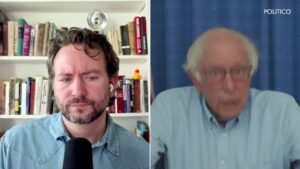
- ‘We are winning elections’: Bernie Sanders on Democrats’ progressive wing
- The Norwegian gas plant that could safeguard Europe from Trump
- NATO races to guard against Russian nuclear subs without the US
- Confirmation of measles death gives Pennsylvania governor another chance to call out RFK Jr.
- How Talarico is countering Trump’s midterms convention
- ‘I don’t think anyone is really comfortable’: Democrat leading on AI raises alarms at Trump, Zuckerberg call
- Trump wants the Postal Service to radically overhaul mail voting. But ballots are already going out.
-

 Politics2 years ago
Former ‘Squad’ members launching ‘Bowman and Bush’ YouTube show
-
Uncategorized2 years ago
Bob Good to step down as Freedom Caucus chair this week
-

 Politics2 years ago
Former Kentucky AG Daniel Cameron launches Senate bid
-

 The Josh Fourrier Show2 years ago
DOOMSDAY: Trump won, now what?
-

 The Dictatorship2 years ago
Luigi Mangione acknowledges public support in first official statement since arrest
-

 The Dictatorship2 years ago
Pete Hegseth’s tenure at the Pentagon goes from bad to worse
-

 Politics2 years ago
Blue Light News’s Editorial Director Ryan Hutchins speaks at Blue Light News’s 2025 Governors Summit
-

 The Dictatorship12 months ago
Mike Johnson sums up the GOP’s arrogant position on military occupation with two words