
The Dictatorship
Trump administration’s crackdown on pro-Palestinian campus activists faces federal trial

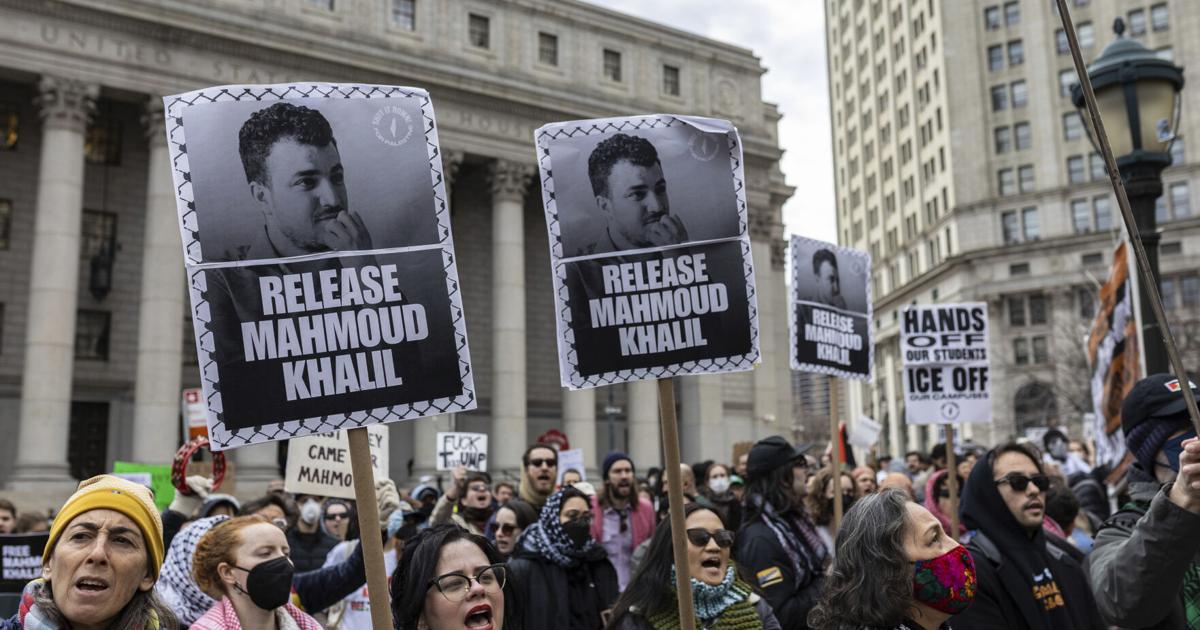

BOSTON (AP) — Plaintiffs in a lawsuit challenging the Trump administration campaign of arresting and deporting faculty and students who participated in pro-Palestinian demonstrations argued Monday it was an orchestrated effort that has stifled free speech at universities around the country.
The lawsuit, filed by several university associations against President Donald Trump and members of his administration, is one of the first to go to trial. Plaintiffs want U.S. District Judge William Young to rule the policy violates the First Amendment and the Administrative Procedure Act, a law that governs the process by which federal agencies develop and issue regulations.
“Not since the McCarthy era have immigrants been the target of such intense repression for lawful political speech,” Ramya Krishnan, senior staff attorney at the Knight First Amendment Institute, told the court. “The policy creates a cloud of fear over university communities, and it is at war with the First Amendment. The First Amendment forecloses viewpoint discrimination; it forecloses retaliation; and it forecloses government threats meant to coerce silence.”
In response, lawyers for the government argued that no such policy exists and that the government is enforcing immigration laws legally and is doing so to protect national security.
“There is no policy to revoke visas on the basis of protected speech,” Victoria Santora told the court. “The evidence presented at this trial will show that plaintiffs are challenging nothing more than government enforcement of immigration laws.”
Since Trump took office, the U.S. government has used its immigration enforcement powers to crack down on international students and scholars at several American universities.
Trump and other officials have accused protesters and others of being “pro-Hamas,” referring to the Palestinian militant group that attacked Israel on Oct. 7, 2023. Many protesters have said they were speaking out against Israel’s actions in the war.
Plaintiffs single out several activists by name, including Palestinian activist and Columbia University graduate Mahmoud Khalil, who was released last month after spending 104 days in federal immigration detention. Khalil has become a symbol of Trump ’s clampdown on campus protests.
Tufts University student from Turkey, Rumeysa Ozturk, who was arrested by immigration agents while walking along a street in a Boston suburb, talks to reporters on arriving back in Boston, May 10, 2025, a day after she was released from a Louisiana immigration detention center on the orders of a federal judge. (AP Photo/Rodrique Ngowi, File)
Tufts University student from Turkey, Rumeysa Ozturk, who was arrested by immigration agents while walking along a street in a Boston suburb, talks to reporters on arriving back in Boston, May 10, 2025, a day after she was released from a Louisiana immigration detention center on the orders of a federal judge. (AP Photo/Rodrique Ngowi, File)
The lawsuit also references Tufts University student Rumeysa Ozturk, who was released in May from Louisiana immigration detention. She spent six weeks in detention after she was arrested walking on the street of a Boston suburb. She claims she was illegally detained following an op-ed she co-wrote last year that criticized the school’s response to Israel’s war in Gaza.
The plaintiffs also accused the Trump administration of supplying names to universities whom they wanted to target and launching a social media surveillance program. They used Trump’s own words in which he said after Khalil’s arrest that his was the “first arrest of many to come.”
The first witness in the case, Megan Hyska, a green card holder from Canada who is a philosophy professor at Northwestern University, detailed how the efforts to deport Khalil and Ozturk prompted her to significantly scale back her activism.
Before Trump took office, she had supported student encampments at Northwestern, had taken part in scores of protests against police brutality and in support of Palestinians and had been active in the Chicago chapter of Democratic Socialists of America. But after Khalil and Ozturk were detained, Hyska testified, she refrained from publishing an opinion piece critical of the Trump administration, chose not to take part in some anti-Trump protests and has decided against traveling back to Canada.
“It became apparent to me, after I became aware of a couple of high profile detentions of political activists, that my engaging in public political dissent would potentially endanger my immigration status,” Hyska said.
A government lawyer tried to undermine her testimony, confirming that she had not been contacted by anyone from the government asking her to stop her activism. The lawyer also referenced two letters Hyska had signed after the arrest of the activists to suggest she continued to be politically active — prompting Hyska to say those letters were directed to Northwestern administrators, not the general public.
The second witness, Nadje Al-Ali, a green card holder from Germany who is a professor at Brown University, also detailed how the immigration policy had a chilling effect on her work.
Following the arrest of Khalil and Ozturk, Al-Ali said she canceled a planned research trip and a fellowship to Iraq and Lebanon over fears “stamps from those two countries would raise red flags” upon her return to the United States. She also dropped plans to write an article that was to be a feminist critique of Hamas and declined to take part in anti-Trump protests.
“I felt it was too risky,” Al-Ali said of the Hamas article. “I felt that would increase my visibility and profile and risk I would be associated with pro-Palestinian speech and be targeted.”
The trial continues Tuesday with Al-Ali on the stand. Several more witnesses are expected to testify tis week about the impact the immigration campaign has had on their activism.


The Dictatorship
Iran moves to take permanent control of Strait of Hormuz, a vital shipping choke point
Iran announced on Thursday that it was drafting a “protocol” that would allow it to “monitor transit” by oil tankers through the Strait of Hormuzthe strategic waterway Tehran has shut downsending oil and gas prices soaring in the U.S. and across the world.
Kazem Gharibabadi, Iran’s deputy foreign minister for legal and international affairs, said tanker traffic through the narrow route “should be supervised and coordinated” between Iran and Oman, the two countries that border the strait, according to a translation of a report from Iran’s state news agency cited by CNBC.
“Of course, these requirements will not mean restrictions, but rather to facilitate and ensure safe passage and provide better services to ships that pass through this route,” Gharibabadi said according to the report.
President Donald Trump has suggested that the U.S. may leave it to other countries to end Iran’s de facto blockade of the strait, which it enforces by firing missiles at tankers. Trump has called on European nations to do so, but experts say Europe lacks the military resources to halt Iranian attacks on tankers for the long term.
Iranian and Omani officials did not respond to requests for comment from MS NOW.
For decades, the strait has been an international waterway, controlled by no country, that ships from all nations could transit.

Gregory Brew, a senior Iran and oil analyst at the Eurasia Group, said that if Iran manages to take control of the Strait of Hormuz permanently, it would be a “colossal win” for the country.
“It’s a massive strategic win, given that Iran has demonstrated that it can close the strait,” Brew told MS NOW. “It’s a huge financial win.”
Brew added that if Iran gains long-term control of the straitit would be more powerful than it was before the Trump administration attacked it. Iran’s parliament passed a law to begin charging “tolls” of up to $2 million per ship, which could mean as much as $100 billion in annual revenue — or the equivalent of Iran’s current annual oil export earnings.
“It’s not innocuous,” Brew said, referring to the protocol announced on Thursday. “Iran has passed legislation and is now claiming to be coordinating with Oman in establishing joint management of the Strait of Hormuz.”
Brew predicted that Oman, which has less oil and wealth than other Gulf nations, may be willing to accept a temporary arrangement that could help end the conflict.
“The Omanis are probably hedging; they’ve always tried to manage their relationship with Iran, and they lose relatively little by cooperating with Iran right now to ease pressure on the strait,” Brew said. “The bigger question is whether they continue to cooperate after the war.”
Ted Singer, a former senior CIA official who oversaw the agency’s operations in the Middle East, said Iranian officials are likely trying to see what they can achieve.
“I wouldn’t see this as a fork in the road,” Singer told MS NOW.
Singer, who served as a CIA station chief in five different countries over a 35-year career, said Iranian officials could be trying to stoke division between gulf countries.
“The Iranians are good at doing more than one thing at a time,” he said. “Why not stake out a maximalist position on tolls, then toss out options to roil the waters?”
The United Arab Emirates, for example, is adamantly opposed to Iran taking control of the strait.
“The Iranians play multi-dimensional chess,” said Singer, now a senior adviser to the Chertoff Group, a security consulting firm run by Michael Chertoff, who served as secretary of Homeland Security in the George W. Bush administration.
“Try to create division between Oman and the rest of the Gulf countries,” Singer said. “Why not fiddle around with this and see if something sticks?”

David Rohde
David Rohde is the senior national security reporter for MS NOW. Previously he was the senior executive editor for national security and law for NBC News.
Ian Sherwood is the director of international newsgathering for MS NOW, a former executive editor for NBC News and a former deputy Washington bureau chief for the BBC.
Today’s edition of quick hits.
* Targeting Iranian infrastructure: “President Trump celebrated the destruction of a bridge near Tehran on Thursday, warning on social media that there was ‘much more to follow.’ The attack on the B1 bridge between Tehran and the nearby city of Karaj killed eight people and wounded 95, according to Fars, a semiofficial Iranian news agency.”
* I don’t think the speech worked: “The price of oil rose sharply and stocks wavered on Thursday after President Trump, in an address from the White House the day before, said the war against Iran was ‘nearing completion’ but failed to offer a concrete timeline and committed to more attacks. In the 19-minute address, Mr. Trump said U.S. forces would hit Iran ‘extremely hard over the next two to three weeks.’”
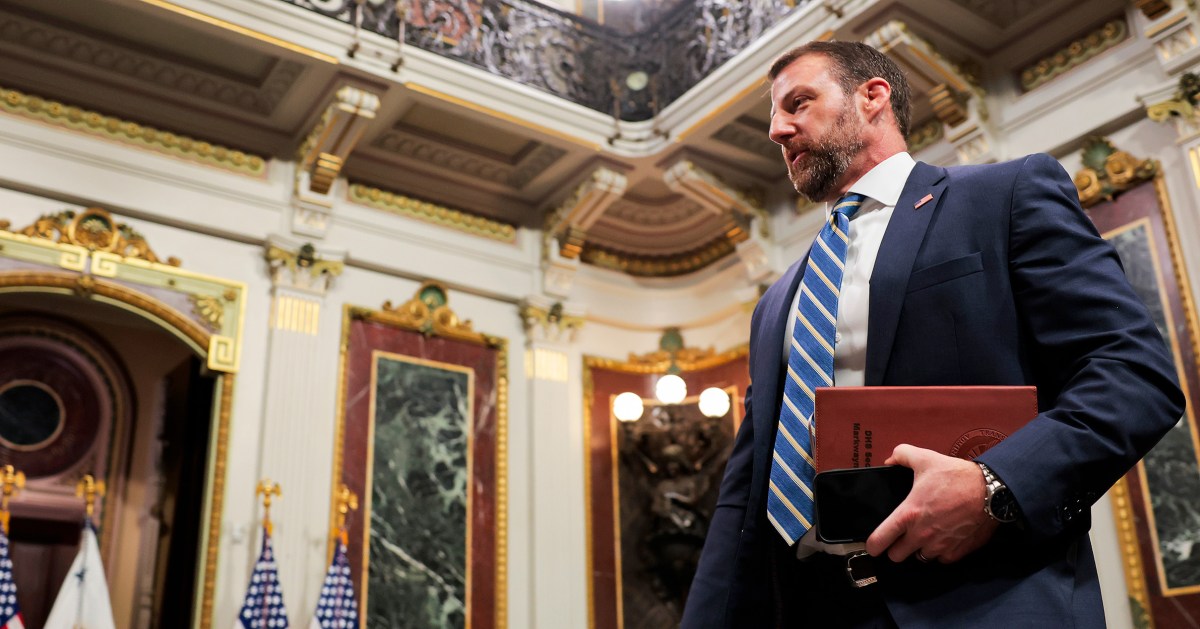
* Reversing one of Noem’s worst ideas: “Homeland Security Secretary Markwayne Mullin on Wednesday rescinded a rule that DHS expenditures over $100,000 be personally approved by his office, ending a widely criticized policy implemented by his predecessor Kristi Noem that critics said put a particular burden on the Federal Emergency Management Agency ’s work aiding disaster response and recovery.”
* The latest on the ballroom: “Donald Trump’s handpicked National Capital Planning Commission voted Thursday to authorize the president’s plan to erect a gilded 90,000-square-foot White House ballroom in place of the historic East Wing, which was destroyed last fall to make way for the ballroom.”
* Remember when Congress, by constitutional mandate, had the power of the purse? “President Donald Trump said Thursday he will soon sign an order to pay all Department of Homeland Security employees who have gone without paychecks during the record-long partial government shutdown that has reached 48 days.”
* A year after “Liberation Day,” there’s fresh tariff news: “President Donald Trump announced Thursday he will levy tariffs as high as 100 percent on some name-brand pharmaceuticals and is adjusting tariffs on products that contain steel and aluminum, the administration’s first move to expand duties since the Supreme Court dealt his trade agenda a blow in February.”
* The latest from Artemis II: “NASA’s latest update about the Artemis II moon mission shows a breathtaking view of Earth as the Orion capsule with four astronauts on board orbits tens of thousands of miles above. Hitching a ride beyond Earth’s atmosphere atop NASA’s powerful Space Launch System rocket, the three Americans and one Canadian selected for the mission are preparing to begin heading toward the moon.”
See you tomorrow.
Steve Benen is a producer for “The Rachel Maddow Show,” the editor of MaddowBlog and an MS NOW political contributor. He’s also the bestselling author of “Ministry of Truth: Democracy, Reality, and the Republicans’ War on the Recent Past.”
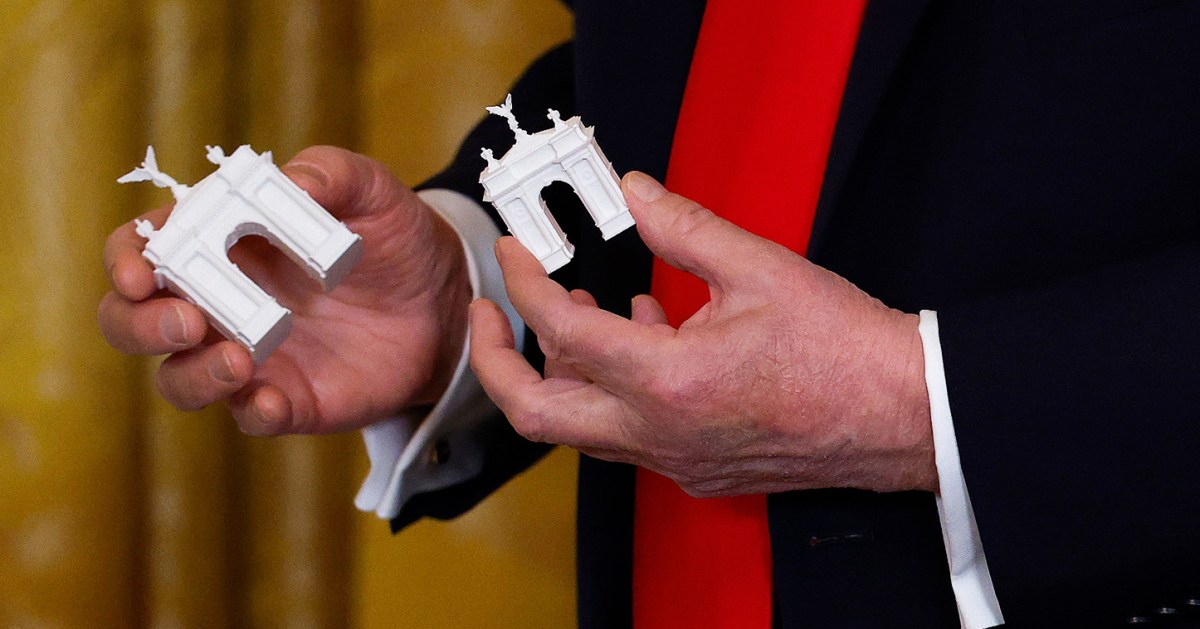
A federal judge is weighing whether the Trump administration can legally build a 250-foot arch just across the Potomac River from the Vietnam and Lincoln memorials, as three veterans who fought in Vietnam have argued the project would violate federal law and permanently alter one of the country’s most sacred landscapes.
Judge Tanya Chutkan declined on Thursday to issue a preliminary injunction, instead asking the parties to report by 5 p.m. on Friday whether they can agree to halt groundbreaking while the case proceeds. If no agreement is reached, she will ask the executive branch to provide supplemental sworn declarations disclosing any awards, grants, contracts, permits or other relevant information related to the arch’s construction.
The suit was brought by three Vietnam War veterans and an architectural historian, who argued the project would obstruct views of the Vietnam War and Lincoln memorials from Arlington National Cemetery. The plaintiffs contended the planned arch would violate federal laws governing historic sites and monuments, and the White House cannot lawfully proceed without congressional authorization.
The plaintiffs cited Trump’s various Truth Social posts and public statements to support their claim that construction is underway, pointing to design specifications, a target completion date of July 4 and renderings backed by a White House fact sheet. They also argued the National Park Service must sign off on any use of the land before construction begins.
President Donald Trump told reporters in January that his proposed arch “will be the most beautiful in the world,” and is already “being built.” He also shared renderings of the arch on his Truth Social account.
The government’s attorney, Bradley Craigmyle, argued that Trump’s media and social media statements constitute hearsay. Chutkan pushed back sharply, saying Trump’s posts are admissible as statements by a party. Throughout the hearing, Craigmyle argued the project is in the conceptual phase despite the president’s statements.
Today’s hearing comes as the National Capital Planning Commission voted 9-1, with two abstentions, to approve construction for Trump’s 90,000-square foot ballroom at the White House, clearing the final procedural hurdle for the project. Chutkan referenced the ballroom case during the hearing, saying, “If we haven’t had the whole White House ballroom situation, this might be a little more academic than it is now.”
Selena Kuznikov contributed to this article.
Peggy Helman is a desk associate at MS NOW.
- Republicans want to go it alone on ICE funding. It might be a slippery slope.
- Why Republicans aren’t rushing to save Trump’s ballroom
- Why Republicans aren’t rushing to save Trump’s ballroom
- Nuclear rockets, moon bases and NASA’s Mars plan
- Florida’s budget stalemate takes on Cherfilius-McCormick probe-related twist

- House Republicans kvetch anew about DHS funding plan
- Why Republicans aren’t rushing to save Trump’s ballroom
- Artemis II astronauts rocket toward the moon after spending a day around Earth
- What to know about Todd Blanche, acting AG after Bondi firing
- Moulton: Trump ‘resorting to war crimes’ to get out of Iran war
-

 Politics1 year ago
Former ‘Squad’ members launching ‘Bowman and Bush’ YouTube show
-

 The Dictatorship1 year ago
Luigi Mangione acknowledges public support in first official statement since arrest
-

 Politics1 year ago
Former Kentucky AG Daniel Cameron launches Senate bid
-

 The Dictatorship7 months ago
Mike Johnson sums up the GOP’s arrogant position on military occupation with two words
-

 Politics1 year ago
Blue Light News’s Editorial Director Ryan Hutchins speaks at Blue Light News’s 2025 Governors Summit
-

 The Dictatorship1 year ago
Pete Hegseth’s tenure at the Pentagon goes from bad to worse
-
Uncategorized1 year ago
Bob Good to step down as Freedom Caucus chair this week
-

 Politics12 months ago
Democrat challenging Joni Ernst: I want to ‘tear down’ party, ‘build it back up’