
Congress
Treasury pick Bessent to meet with Senate GOP leaders this week

Scott Bessent, President-elect Donald Trump’s choice to run the Treasury Department, is planning to meet with Senate Republican leaders later this week, kicking off Capitol Hill outreach as his confirmation process begins.
Bessent plans to meet with incoming Senate Majority Leader John Thune and Sen. John Barrasso, who is set to become the No. 2 Republican, according to Raj Shah, a Trump transition spokesperson. Punchbowl earlier reported the meetings.
Since winning the hard-fought battle to be Trump’s pick for the preeminent economic role, Bessent has already met separately with his home-state lawmakers, South Carolina Republican Sens. Tim Scott and Lindsey Graham.
Bessent, a hedge fund manager, has drawn praise from Republican senators and Wall Street executives, who view him as a steady steward of the economy with deep experience in financial markets. He has avoided the criticism that Trump’s other, more controversial picks for top roles in his administration have faced, including Pete Hegseth as Defense secretary, Tulsi Gabbard as director of national intelligence, and Robert F. Kennedy Jr. as HHS chief.
If confirmed, Bessent will be poised for a leading role as Republicans hash out major legislation to extend their 2017 tax cuts and debate ways to implement Trump’s campaign promises to eliminate taxes on tips, overtime and Social Security payments.
But his confirmation process could also highlight some of the fissures among Republicans over Trump’s economic ideas such as across-the-board tariffs and eroding the independence of the Federal Reserve.
Bessent has been a defender of Trump’s hawkish trade policies, calling massive tariffs a key negotiating tool. And earlier this year he pitched the concept of Trump nominating a “shadow Fed chair” to sideline Jerome Powell before his term expires in 2026, though he later said he had dropped the idea.
Democrats like Sens. Ron Wyden and Elizabeth Warren criticized Bessent’s Wall Street ties and role as a wealthy political donor, though they haven’t said they’ll vote against him.


House Speaker Mike Johnson suggested that he could leave Congress if Democrats regain control — the farthest he has gone in acknowledging what he would do in a GOP House minority.
“Heaven forbid, if we lose this majority or whatever, I don’t know what my next chapter of life is,” Johnson said in an interview with Fox News posted this week. “If God moves on our hearts and says we should, you know, go back to my hometown of Shreveport and start a lawn business, I’ll do that with equal fervor.”
In the past, the Louisiana Republican has steered clear of the hypothetical.
Johnson also did not rule out a run at minority leader, instead telling Fox News that House Republicans will hold onto the majority and he will stay speaker.
“I’m going to be the speaker in the next Congress,” Johnson said, when asked if he would run. “I’m not going to talk about the scenario where we don’t win the House, because I am laser-focused on winning the House.”
With the midterms less than a month away, Republicans are doing everything they can to salvage their chances of maintaining their majority in an unfavorable political environment.
As some Republicans privately worry about their chances of holding onto the House, many believe jockeying for a GOP minority leader race is already underway.
House Majority Leader Steve Scalise and Judiciary Chair Jim Jordan are potential names floating around to take over. House Whip Tom Emmer (R-Minn.) had also been named as an option, though he could also run to stay as whip.
All three House Republicans have been campaigning across the country in the lead-up to the election. If Republicans lose the House, GOP members will begin the race for minority leader almost immediately when they return to Washington.
Republicans have a massive campaign cash advantage going into the final stretch before Election Day, but a new Blue Light News poll shows they aren’t yet capturing voters’ attention.
More than 70% of poll respondents who had seen ads said they’d either seen more spots in support of Democrats or an equal amount between the parties over the past week — including ads on television, social media, or any other platform. Only 24% said they’d seen more ads for Republicans.
The numbers are striking considering Republican-aligned groups had triple the amount of cash on hand compared to their Democratic rivals going into the final months of the campaign. That figure includes the $400 million war chest that President Donald Trump’s MAGA Inc. super PAC reported over the summer, for which Dems have no equivalent.
Republicans have been racing to saturate key battlegrounds — and even some deep-red districts and states — with GOP messages in the final weeks before the midterms to counterbalance the favorable political environment for Democrats.
One reason GOP ad dollars could be getting less bang for their buck may lie in ad rates: direct campaign accounts from prolific individual fundraisers — Georgia Sen. Jon Ossoff or Texas Senate candidate James Talarico, for example — can buy ads at cheaper rates.
Timing may be another reason: Trump’s super PAC waited until recent weeks to start buying ads through affiliate groups, when rates were already high close to the election.
“It’s competition that drives [rates] up to these ridiculous amounts, and then when super PACs come in late with these reservations, it’s even more than a two times disadvantage,” Jeff Burton, GOP campaign strategist and president of Maven Advocacy Partners said in an interview.
Burton said Republican candidates will need to rethink spending strategies to catch voters’ attention in the final stretch. Still, having a cash advantage might only take some so far, he said, citing the massive outspending Michigan’s Abdul El-Sayed and Texas’ Ken Paxton overcame in their respective primaries.
“I think you’ll see a lot of these campaigns diversifying, paying for grassroots, paying for different mediums to try to reach voters,” Burton said.
The poll was conducted by surveying U.S. adults online between Oct. 3-5 with PF Global.
What else we’re watching:
— FIRST IN IC: DEMS WANT A GOP APOLOGY TO JACK SMITH — Senate Judiciary Democrats are asking chair Chuck Grassley to issue an apology to former special counsel Jack Smith on behalf of GOP committee members and Sen. Eric Schmitt. A letter from committee Democrats to Republicans, obtained exclusively by Blue Light News also demands Grassley turn over the underlying records Schmitt used last month to levy false allegations against Smith of secretly attending an NBA game in Atlanta to conspire with local prosecutors about convicting Trump.
— HILL LOBBIES FOR UKRAINIANS IN U.S. — Lawmakers afraid the Trump administration will cancel protections for Ukrainian seeking refuge in the U.S. want the president to consider another option: Do nothing. The administration has until Oct. 19 to renew or cancel temporary protected status for more than 100,000 Ukrainians in the U.S. who fled the war still ravaging their country. While a number of lawmakers on both sides of the aisle are hoping Trump will renew the permission, some also support a backup option — letting the status expire without formally canceling it, triggering an automatic six-month extension.
Chris Marquette, Eric Bazail-Eimil and Andrew Howard contributed to this report.
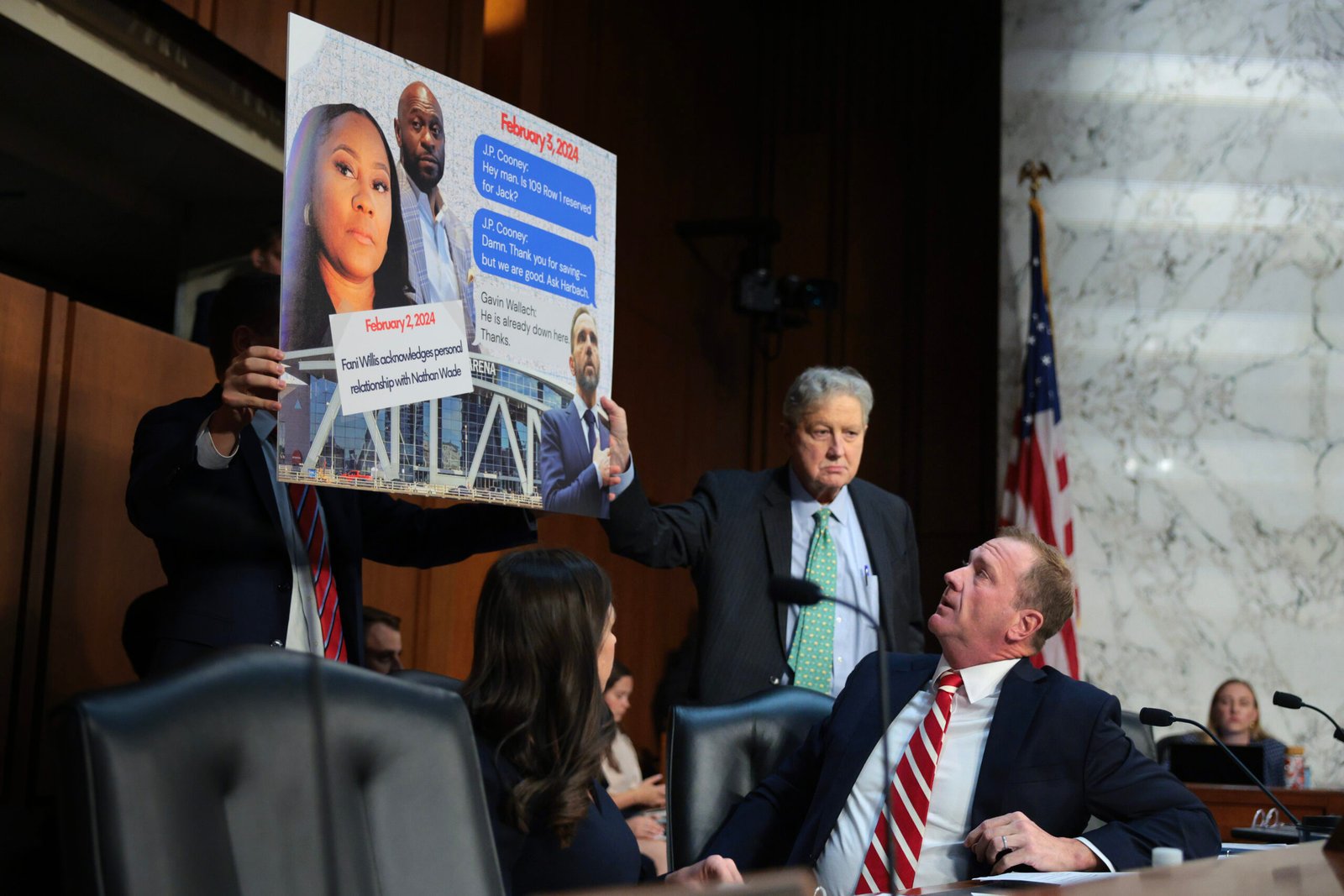
Senate Judiciary Democrats are asking chair Chuck Grassley to apologize to Jack Smith on the behalf of his GOP committee members — especially for Sen. Eric Schmitt, the Missouri Republican who falsely accused Smith of secretly attending an NBA game in Atlanta to conspire with local prosecutors about bringing charges against President Donald Trump.
The letter, spearheaded by ranking member Dick Durbin of Illinois and obtained exclusively by Blue Light News, also demands Grassley turn over the underlying records Schmitt used during a hearing last month to levy the false allegations against Smith, the Biden-era special counsel investigating whether Trump sought to overturn the results of the 2020 election and mishandled classified documents.
The episode, Democrats wrote, “caused needless confusion, slowed down the business of the Committee, introduced the possibility that false information would be entered uncontested into the record, and created an embarrassing stain on one of the most important committees in Congress.”
The Democratic letter to Republicans marks an escalation of the typical bickering between the two parties. It’s also reopening a not-yet-closed wound for Republicans, whose efforts to damage Smith’s reputation during their high-profile hearing were blunted by Schmitt’s error.
Congressional Republicans have for years been working to undermine Smith’s investigations as politically motivated, and many GOP senators on the Judiciary Committee hoped to use their hearing with Smith to catch him in either a lie or an admission he weaponized the judicial system against Trump.
To that end, Schmitt used a giant poster to display images of text messages from Smith’s team in an attempt to prove the special counsel was in Atlanta on Feb. 3, 2024, for an NBA basketball game between the Atlanta Hawks and the Golden State Warriors — scheduled around the same time local prosecutor Fani Willis, who was working to convict Trump over his 2020 election subversion scheme, was facing damaging questions about her conduct.
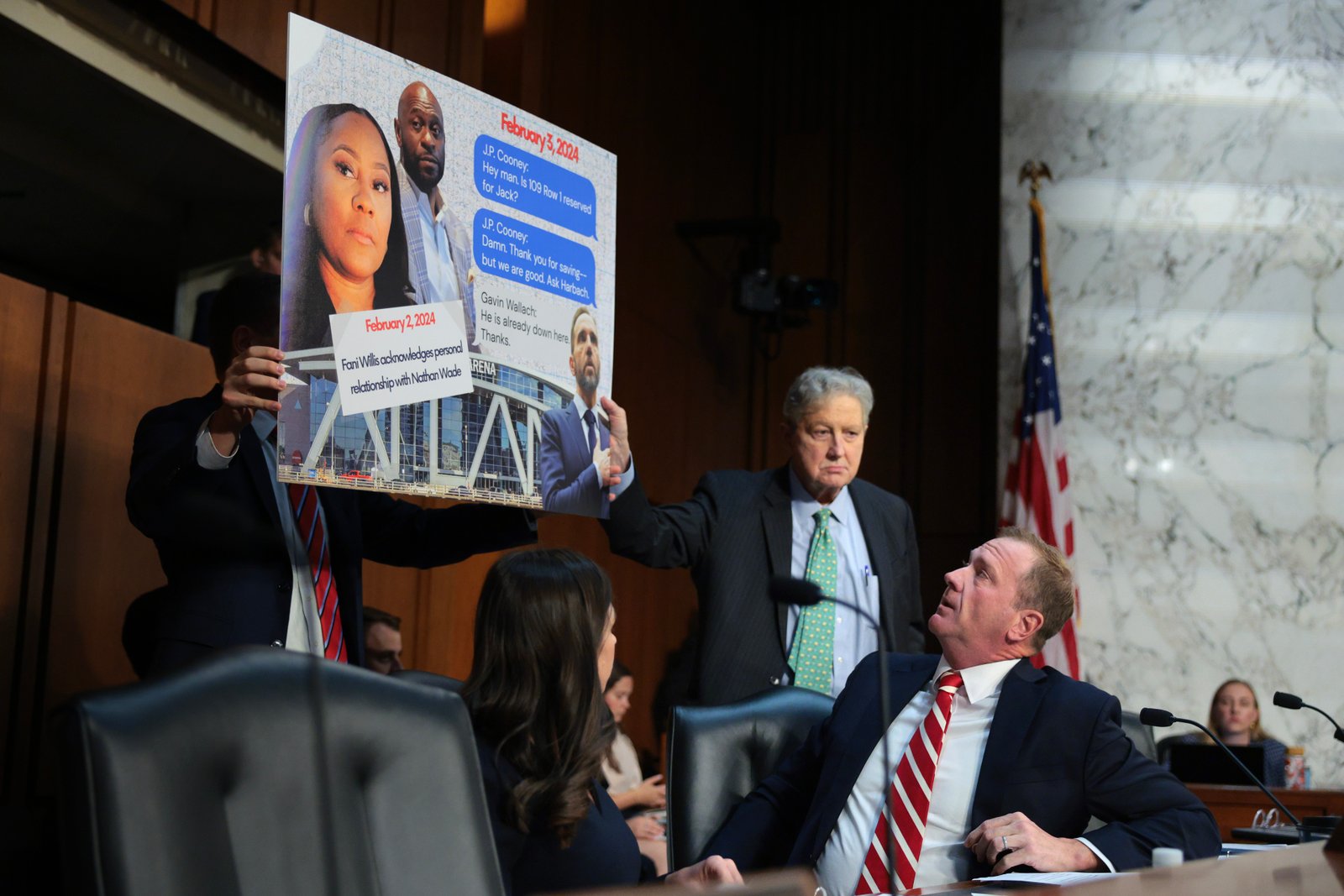
Smith ultimately clarified he did not attend the NBA game on that date but was instead at a women’s basketball game at the University of Maryland between the Terrapins and the University of Iowa Hawkeyes, then led by star player Caitlin Clark. The exchange went viral and Schmitt continues to show no regret for his apparent misunderstanding.
The text messages “established only that Senator Schmitt had not done the basic due diligence of verifying a document before relying on it,” the Democrats wrote in their letter to Grassley, adding that, “nonetheless, Senator Schmitt incorrectly asserted to Mr. Smith, ‘I think you’ve already perjured yourself,’ and inexcusably branded him ‘a dirtbag,’ language which is beneath the dignity of this Committee and the Senate.”
And because Democrats didn’t have advance access to the materials Schmitt referenced in his presentation during the hearing, they said they were “were forced to synthesize these baseless accusations and respond in real time.”
Democrats also took aim at another record they say was not shared with them ahead of time: a readout of an Aug. 17, 2024, phone call between Smith and the Public Integrity Section of the Justice Department, which Schmitt and fellow Missouri GOP Sen. Josh Hawley both referred to during the Senate Judiciary hearing.
The notes from that phone call, which Hawley mentioned during his questioning of Smith, indicated the Public Integrity Section advised Smith to wait to file an updated indictment against Trump until after the 2024 presidential election. Smith had originally sought to file an amended indictment in the 2020 election subversion case following the Supreme Court’s ruling that Trump had broad immunity for official actions undertaken as president.
Smith testified during the hearing that several drafts of a superseding indictment were passed back and forth before one was ultimately approved and filed in August 2024.
“We ask that you immediately provide all committee records that you have withheld, commit to fully complying with Senate Rules … going forward, and apologize to Mr. Smith on behalf of the Committee,” the Senate Judiciary Democrats wrote.
Clare Slattery, a spokesperson for Grassley, said in a statement, “it’s Jack Smith who owes an apology to the thousands of Americans he and his staff ran roughshod over.”
Spokespeople for Smith, Schmitt and Hawley did not immediately respond to requests for comment.
- Hegseth: Military will publicly execute Fort Hood shooter
- Mike Johnson voices uncertainty about his future if GOP loses control
- Capitol agenda: GOP ads have yet to overwhelm voters, poll finds
- Justice Democrats announce new executive director

- Iran’s drones reveal US military weakness
- Democrats call on Chuck Grassley to apologize to Jack Smith for basketball gaffe
- Iowa’s Ashley Hinson slams the savings habits of millennials
- Trump approved Ohio disaster aid ahead of rally
- Clean energy group sets its sights on a new GOP target: Lauren Boebert
- Blakeman’s campaign finance mess
-

 Politics2 years ago
Former ‘Squad’ members launching ‘Bowman and Bush’ YouTube show
-
Uncategorized2 years ago
Bob Good to step down as Freedom Caucus chair this week
-

 The Josh Fourrier Show2 years ago
DOOMSDAY: Trump won, now what?
-

 The Dictatorship2 years ago
Pete Hegseth’s tenure at the Pentagon goes from bad to worse
-

 Politics2 years ago
Former Kentucky AG Daniel Cameron launches Senate bid
-

 The Dictatorship2 years ago
Luigi Mangione acknowledges public support in first official statement since arrest
-

 Politics2 years ago
Blue Light News’s Editorial Director Ryan Hutchins speaks at Blue Light News’s 2025 Governors Summit
-

 The Dictatorship1 year ago
Mike Johnson sums up the GOP’s arrogant position on military occupation with two words