
Politics
This blue state is the first to grapple with megabill response

Democrats have been warning for months that President Donald Trump’s “big, beautiful bill” would wreak havoc on state budgets.
But Colorado is the first state to call lawmakers back to the Capitol to grapple with the ramifications of the massive federal tax and spending bill.
In a special session that began Thursday, the Democratic-led state Legislature is considering bills to cover a budget gap of roughly $1 billion by increasing taxes, reallocating funding and tapping the state’s reserves — as well as set the stage for future cuts. The session — which is also attempting to address artificial intelligence policy — is expected to continue at least through Tuesday.
“The only reason we’re even talking about this is because HR1 passed,” Democratic Gov. Jared Polis told Blue Light News on Thursday, referring to the GOP megabill. “[It] not only increased the federal deficit by trillions of dollars, but also increased the state deficit by hundreds of millions of dollars.”
Republicans top legislative priority — or HR1, passed in July — extended Trump’s 2017 tax cuts and made major cuts to social safety net programs. The bill’s passage came after most states had already set their budgets for the current fiscal year, and now many have been scrambling to sort out how it impacts their finances this year and down the road.
Colorado’s response will likely serve as a preview of how other states will address the financial ramifications in the coming months.
The financial adjustments being made by Colorado lawmakers in the special session only address the short-term impacts of the bill, and legislators say they are only the first of many changes their state will undergo as a result of the legislation.
Colorado legislators and the governor told Blue Light News that the special session was necessary because changes to the federal tax code — which the state’s tax code is tied to — are estimated to reduce the state’s income tax revenue by as much as $1.2 billion. That could create a deficit of about $750 million in the budget passed in April. Add on funds to fill in cuts to school lunch programs and to soften the looming rise of health insurance premiums due to smaller federal subsidies and it’s estimated that Colorado faces a financial gap of more than $1 billion.
To address the shortfall, legislators are proposing a range of solutions: selling tax credits to increase funds for health care, raising taxes on the state’s highest earners, ending some tax incentives and reallocating funds from less critical programs like the reintroduction of gray wolves.
“Can we fix it 100 percent? No,” House Majority Leader Monica Duran said in an interview on Thursday. “But we’re trying to make it less painful for everyone.”
Sarah Mercer of Denver-based lobbying firm Brownstein Hyatt Farber Schreck describes the funding strategy as “a third, a third, a third” — filling equal portions of the budget hole by closing tax exemptions, tapping the state’s reserves and cutting costs.
The budget cuts, however, would come later, through a bill already advancing through the Legislature that would allow Polis to propose mid-year cuts if the state cannot meet its fiscal obligations. The governor would still need to work with the legislature’s Joint Budget Committee to enact those cuts.
“It gives the governor some pretty unusual powers that the governor has not had before,” Mercer explained. “What is really the full scope of this new power, and when else might it be used in the future?”
Colorado Republicans, meanwhile, are accusing Democrats — who hold a trifecta in the state government — of mishandling the state budget and then trying to pass the blame onto Washington.
“For years, Democrats at the Capitol have spent beyond their means and ignored Republican solutions. Now, they want taxpayers to bail them out,” House Minority Leader Rose Pugliese said in a press release. Colorado House Republicans’ communications team did not respond to an interview request.
Mercer said some of the shortfall may stem from funding that states like Colorado received from Biden’s Inflation Reduction Act — which was used to fund some programs and has since run out.
“I think [lawmakers] did try to think through and craft programs that were limited,” Mercer said. “[But] I think our government and our budget did grow a little bit as well during that time.”
State Rep. Shannon Bird, vice chair of the Joint Budget Committee who is vying for the congressional seat currently held by GOP Rep. Gabe Evans, pushed back on the notion that one-time federal dollars led to this problem.
“To the extent that we understood funds to be one time … Colorado, I believe, did a very fair job of using that money either for infrastructure investment or just to fund one time grants,” Bird said, pointing the finger instead at withheld funding that the state expected to be ongoing, like school grants and Medicaid dollars.
Why Colorado faces this financial dilemma
The Colorado tax code’s direct relationship to the federal tax code led it to this point. The state automatically adopts any changes to federal tax code, and also is one of just a handful of states that uses federal tax rates for state taxes. That means the minute the federal tax code changes, so do Colorado’s taxes — leaving a shortfall where the state expected a surplus.
To make matters more complicated, in 1992 Colorado passed the taxpayer bill of rights. It requires the state to ask permission from the voters for any tax changes via ballot measure. When the state increased taxes on cigarettes and other tobacco products to pay for universal preschool in 2020, for example, voters had to approve the proposal via ballot measure before it became law.
To that end, the Legislature over the weekend approved a bill that would allow leftover revenue from a ballot measure already approved for November — which would increase taxes on residents with taxable incomes over $300,000 — to be used for school meals. If approved by voters, it could provide an additional $95 million annually to the state’s healthy school meals program, Healthy School Meals For All. The legislature on Friday also approved a bill to fund Medicaid reimbursements for Planned Parenthood.
The state is also concerned about a possible increase to health insurance premiums. Because Congress has yet to renew higher federal health care subsidies for Obamacare plans that expire at the end of this year, the costs for consumers are expected to substantially increase. Colorado’s insurance division estimated in July that premiums would rise 28 percent on average in the state and as much as 38 percent in the state’s more rural western slope.
“I’m hopeful that the United States Congress takes action and renews the [health care] tax credits,” Polis said. There has been some talk on Capitol Hill of finding another vehicle for the subsidies, but it’s unclear if Congress will act before the year’s end, and Colorado lawmakers are looking to soften the blow by selling tax credits.
“We’ll do what we can,” Polis added. “It’s not going to negate those huge increases, but it’ll at least reduce them.”
The Legislature is also considering removing some tax incentives, including breaks for companies that employ a certain percentage of Coloradans and deductions that allow retailers to cover the cost of collecting taxes, to increase the state’s revenues.
But there are many more details that Colorado will need to iron out in the months and years to come.
“A lot of these cuts will likely need to be ongoing cuts, not just for the current year,” Polis said, explaining that they couldn’t continue to dip into the reserve indefinitely. “The reserve is there for a recession. And this is not a recession. This is caused by HR1.”


The Illinois primaries have seen gobs of spending, both in the highly-watched Senate race and further down the ballot in competitive open House seats.
Groups affiliated with the American Israel Public Affairs Committee have poured millions of dollars into key contests, potential 2028er and Democratic Gov. JB Pritzker has found himself at odds with several prominent Black leaders in the state, and generational fights continue to plague the Democratic Party post-2024.
Here’s what Blue Light News is watching today.
Can AIPAC avoid another fumble?
AIPAC faced backlash from moderate Democrats last month after inadvertently boosting a progressive candidate in New Jersey who said Israel has committed a genocide in Gaza. It’s hoping not to make the same mistake again.
The group is facing a major test of its political muscle in Illinois as Democrats increasingly scrutinize Israel and AIPAC itself. It’s spending heavily in several House races, most notably in the contest to replace retiring Rep. Jan Schakowsky in the 9th district.
But Democratic strategists have warned that the group’s attacks on Evanston Mayor Daniel Biss — the grandson of a Holocaust survivor who has criticized Israel — have created a late opening for progressive insurgent Kat Abughazaleh, a Palestinian-American who’s an even more vocal critic, rather than effectively boosting the AIPAC-preferred candidate, state Sen. Laura Fine. AIPAC has made a sharp pivot in the final stretch of the campaign, turning its focus squarely on Abughazaleh instead.
“There’s been a strategy shift,” said a person directly familiar with AIPAC’s thinking, granted anonymity to discuss private conversations. “Our primary goal in Illinois is to prevent potential ‘Squad’ members from being elected to Congress.”
The big question for Tuesday will be whether that change in strategy happened too late to avoid another embarrassment for AIPAC.
Will JB’s involvement help or hurt him?
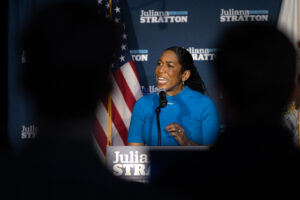
Pritzker has been vocally supporting, and heavily funding, Lt. Gov. Juliana Stratton’s campaign for Senate against Reps. Raja Krishnamoorthi and Robin Kelly. That move has rankled some prominent Black leaders.
“A sitting governor shouldn’t be heavy-handing the race,” Congressional Black Caucus Chair Yvette Clarke, whose caucus is supporting Kelly, told Punchbowl earlier this month. “Quite frankly, his behavior in this race won’t soon be forgotten.”
The worry from Black Democrats is that Kelly and Stratton — both Black women — could end up splitting the Black vote, with Pritzker’s endorsement driving that wedge further. That may help Krishamoorthi win the race and kill their chances of electing a Black woman to the Senate this cycle.
Krishnamoorthi has led most public polls of the race and had a big cash advantage early on, allowing him to get up on TV earlier than his opponents. Pritzker’s money has helped Stratton close the gap, while Kelly sits in third in most public polls.
“People are conflicted as to whether or not they should go with the best candidate who they like, or do they go with what the polls are saying as the most viable candidate,” former Democratic Chicago Mayor Lori Lightfoot, who supports Kelly, said in an interview last week. “That’s the tension and the conflict that I’m hearing kind of across the board, but particularly among Black Illinoisans.”
What do all the races say about the future of the Democratic Party?
Both the Israel debate and racial tensions — as well as the growing generational divide in the Democratic Party — have dominated Illinois’ primary contests.
Tuesday’s results will be another early test, following Texas earlier this month, for where the party is headed as it still grapples with across-the-board losses to Republicans in 2024.
How do the outside influences fare?
More than $35 million has been poured into TV ads on Illinois races, according to AdImpact, with tech interests leading the way: pro-AI and pro-Crypto industry groups have combined to spend more than $15 million. It’s a dizzying sum that has shocked many veteran Illinois political strategists who are long accustomed to bruising campaigns.
Some candidates have openly courted — and practically begged for — support from these groups. Former Rep. Jesse Jackson Jr. — who is running to reclaim the IL-02 seat he once held — used AI in an ad to enhance former Rep. Bobby Rush’s voice (D-Ill.) after it was damaged from treatment he underwent to battle throat cancer.
The groups’ huge spending to get allies in Congress could shape the heated policy debate over how to regulate two fast-growing industries. How well their chosen candidates fare will help guide their future spending later this year.
Who turns out?
Turnout among Hispanic voters was a strong point for Democrats in the Texas primary, not to mention several special elections in recent months, driven by backlash to the Trump administration’s aggressive immigration enforcement along with continued economic uncertainty.
We will see whether that continues in Tuesday’s primaries, particularly in Chicagoland — which was shaken by a deportation blitz of its own last fall but where most of the primaries are for safe blue seats.
There’s also the question of turnout in primaries where support for Israel has been a major issue. A Senate primary should bring voters to the polls across the state, but Blue Light News will be watching for how much higher turnout is in the 2nd, 7th, 8th and 9th districts to gauge how much Democrats’ intraparty disagreements about the issue — and the flood of outside money that has come with that — uniquely drives voting.
Alec Hernández and Jessica Piper contributed to this report.
CHICAGO — The American Israel Public Affairs Committee is making a nearly $22 million bet in Illinois that its money, if not its policy views, can still hold sway in Democratic politics.
In three of the four Illinois House races it’s targeting, AIPAC appears to be using shell PACs to largely conceal where that money is coming from rather than spend from its main super PAC vehicle, United Democracy Project. Like in other recent contests, their ads focus on anything but Israel.
But AIPAC appears at risk of inadvertently helping the candidate most hostile to its views in the race to replace retiring Rep. Jan Schakowsky — just as it did in New Jersey last month. The group has taken a sharp tactical shift in recent days, pivoting from attacking a Jewish candidate who has criticized Israel and focusing instead on a Palestinian-American candidate who has been more outspoken.
Interviews with a dozen Democratic elected officials, candidates and strategists — including both supporters and critics of Israel — revealed growing concerns about AIPAC’s interventions. Strategists warn that AIPAC’s attacks on Evanston Mayor Daniel Biss, the grandson of a Holocaust survivor, created an opening for progressive social media influencer Kat Abughazaleh, a Palestinian-American who is a vocal critic of Israel and appears to have late momentum in the race, over AIPAC’s preferred candidate, more moderate state Sen. Laura Fine. In the past week, the group has pulled down all of its anti-Biss messaging, but it could prove too late.
“There’s been a strategy shift,” said a person directly familiar with AIPAC’s thinking, granted anonymity to discuss private conversations. “Our primary goal in Illinois is to prevent potential ‘Squad’ members from being elected to Congress.”
Tuesday’s primary will be the first test of AIPAC’s political muscle in the 2026 primary season after amassing nearly $100 million in its warchest, even as polls show more and more Democrats have negative views of Israel — and of the group itself.
“AIPAC may deliver another candidate who is plainly not on their agenda and … the concerns about their interventions within the primary electorate are only going to intensify,” said David Axelrod, a longtime Chicagoan and former senior adviser in President Barack Obama’s administration. “These ads are not branded as AIPAC for a reason, so there’s a recognition that they are a controversial presence in Democratic primaries.”
AIPAC recently spent $2 million to sink former Rep. Tom Malinowski (D-N.J.) in a special election primary. Malinowski, a pro-Israel moderate who would not support unconditional aid to Israel, lost to Analilia Mejia, a progressive organizer who has said Israel committed genocide in Gaza. The move infuriated centrist Democrats, who saw it as a spectacular self-induced fumble — and are worried it may be happening again.
“No one wants to see another New Jersey 11 … and everyone should be concerned about it happening,” said one Democratic donor adviser close to AIPAC who was granted anonymity to speak candidly about the dynamics.
The organization has become increasingly controversial on the left for its full-throated support of Israel’s war in Gaza and is facing a new layer of hostility in the wake of Israel’s joint attack with the U.S. in Iran. Among Democrats, 62 percent think America is too supportive of Israel, compared with just 22 percent who think the support is about right and 8 percent who think it’s not supportive enough, according to a Quinnipiac University poll released last week.
Democratic candidates and strategists expect AIPAC to intervene in a range of House primaries in the coming months, as well as the Senate primaries in Michigan and Minnesota. They’re watching to see how the group’s interference plays with voters amid the backdrop of the war.
“You’re going to see more of this unfortunately” across the country, said former Chicago Mayor Rahm Emanuel, a noted Democratic strategist now weighing a run for president, of the influx of outside spending — from AIPAC to crypto groups. “Illinois is literally the first stop on the way to an ugly future, where billionaires will be the dominant players and candidates will be pawns in their world.”
In Illinois, an AIPAC-aligned super PAC called Elect Chicago Women, had spent heavily against Biss on TV and digital ads, while also spending more than $4 million on TV ads and mailers boosting Fine. In recent days, another AIPAC-aligned group, Chicago Progressive Partnership, put out ads attacking Abughazaleh and propping up another progressive in the race, Bushra Amiwala, in an apparent effort to split the vote.
Local strategists noted the abrupt shift when the Biss attacks stopped earlier this month.
“It looks like they’re changing their tactics” after the New Jersey backfire, said an Illinois Democratic lawmaker, granted anonymity to discuss the issue candidly. “Is there evidence that [AIPAC] is adapting and taking lessons from the last election? Yes.”
Biss, for his part, predicted there would be “backlash” to AIPAC’s moves in Illinois in future primaries.
“They’ve chosen to make clear that it’s unacceptable to them to have members of Congress who don’t believe in a no strings attached blank check of military aid to the current Israeli government, no matter what they do in Gaza,” Biss said “So that’s what people in the district and around the country will be interested to see what the outcome is.”
Abughazaleh sees the shift to attack her as a sign that AIPAC is “panicking” to control the race. “They’re realizing that they didn’t take us seriously, and that people aren’t looking for the status quo. So they are panicking,” she said in an interview.
Fine has opposed adding conditions to U.S. aid to Israel, though she has expressed general frustration at the role of “dark money” and the lack of transparency from political action committees, saying it’s “a big problem in our political system.”
AIPAC’s super PAC declined to comment on its involvement in Illinois, including its use of pop-up super PACs to filter funds to candidates. AIPAC spokesperson Deryn Sousa said in a statement, “Our members are focused on building strong bipartisan support for the U.S.-Israel partnership in the 120th Congress.”
The group is also spending heavily for its preferred candidates in the races to fill seats left open by Reps. Robin Kelly and Raja Krishnamoorthi, who are running for the Senate, and Danny Davis, who is retiring.
AIPAC’s allies are not confident about their chances in Kelly’s district. The group is backing Cook County Commissioner Donna Miller, but former Rep. Jesse Jackson Jr. (D-Ill.) has been bolstered by more than $1 million in spending from a pro-cryptocurrency super PAC. Plus, he has sky-high name recognition, especially in the wake of the recent death of his father, the Rev. Jesse Jackson Sr.
Pro-Israel Democrats feel more confident their preferred candidates can win in two other races.
Chicago City Treasurer Melissa Conyears-Ervin has benefited from nearly $5 million in positive ads from AIPAC’s main super PAC, United Democracy Project, in a crowded 13-candidate primary for Davis’ seat. State Rep. La Shawn Ford has strong name recognition in the district and Davis’ endorsement, but he has struggled to keep up with fundraising.
In Krishnamoorthi’s district, moderate former Rep. Melissa Bean has benefited from nearly $4 million in supportive messaging from the “Elect Chicago Women” group that’s also supporting Fine in the 9th.
AIPAC’s critics argue that the group’s moves in Illinois, particularly concealing the funding sources of its super PACs, demonstrate that “they themselves understand how toxic they are,” said Jeremy Ben-Ami, president of the progressive J Street group, which bills itself as “pro-Israel, pro-peace.”
“In every part of their political work, they’re doing this surreptitiously,” he added.
Jessica Piper and Andrew Howard contributed reporting.
President Donald Trump’s so-called Religious Liberty Commission, which is filled with right-wing zealotsappears to be coming apart at the seams.
Last week’s resignation of Sameerah Munshi, formerly the only Muslim woman selected as one of the commission’s advisers, underscores the religious divisions that are causing disarray for the panel and the conservative movement more broadly.
Munshi is a conservative activist who has advocated for allowing parents to opt out of lesson plans related to LGBTQ+ issues, a stance the White House has praised for its rejection of “radical gender ideology.” She said her resignation was due to two things: the commission’s expulsion of conservative activist Carrie Prejean Boller and the Trump administration’s war with Iran.
I recently wrote about how Boller’s removal, which followed a heated argument at a commission hearing over antisemitism, has fueled allegations of anti-Catholicism within the MAGA movement. Boller recently appeared on an episode of Tucker Carlson’s podcast for a chummy chat about her removal. And Rep. Thomas Massie, R-Ky., requested last week that the House Oversight and Judiciary committees review her ouster.
In addition to that, Trump’s Religious Liberty Commission is being sued over its lack of diversity. (The White House has said the panel is intended to reflect a “diversity of faith traditions, professional backgrounds and viewpoints.”)
So Munshi’s resignation is just the latest negative publicity for the commission.
“I resign in protest of two deeply troubling developments: the official removal of Carrie Prejean Boller for her deeply held beliefs about Palestine and the federal government’s illegal war against Iran, undertaken without clear constitutional or congressional authorization,” Munshi wrote on Substack.
“Ultimately, I will have to stand before God and answer to Him for my role in this commission,” she added. “I ask His forgiveness if I have legitimized their evil or the evil of this administration in any way. I ask Him to keep my intentions pure and to guide me toward paths that bring true benefit to my community.”
Boller’s removal has also helped fuel right-wing antipathy toward the Rev. Paula White, who Boller has said was behind a “witch hunt” that led to her ouster. During their conversation, Boller and Carlson took turns bashing White, a controversial preacher of the prosperity gospel who has served as religious adviser to Trump.
Some evangelicals in the MAGA movement were apoplectic when White was chosen to lead the White House Faith Office. And now it appears the chickens have come home to roost as her involvement with Trump’s White House threatens the MAGA movement’s religious coalition.
Ja’han Jones is an MS NOW opinion blogger. He previously wrote The ReidOut Blog.
- Poland is a model for economic growth

- Trump says he may delay China trip as Iran war roils oil prices

- 5 things to watch in Tuesday’s Illinois primaries
- AIPAC faces its biggest test this year in Illinois
- Right-wing Muslim activist resigns from Trump’s Religious Liberty Commission

- Monday’s Mini-Report, 3.16.26

- Right-wing Muslim activist resigns from Trump’s Religious Liberty Commission
- Jesse Jackson’s family grapples with Illinois Senate endorsement controversy
- Johnson on Trump’s Hormuz plan
- House Budget chair eyes more safety-net cuts for second megabill
-

 The Dictatorship1 year ago
Luigi Mangione acknowledges public support in first official statement since arrest
-

 Politics1 year ago
Former ‘Squad’ members launching ‘Bowman and Bush’ YouTube show
-

 Politics1 year ago
Blue Light News’s Editorial Director Ryan Hutchins speaks at Blue Light News’s 2025 Governors Summit
-

 Politics1 year ago
Former Kentucky AG Daniel Cameron launches Senate bid
-

 The Dictatorship6 months ago
Mike Johnson sums up the GOP’s arrogant position on military occupation with two words
-

 The Dictatorship1 year ago
Pete Hegseth’s tenure at the Pentagon goes from bad to worse
-

 Politics11 months ago
Democrat challenging Joni Ernst: I want to ‘tear down’ party, ‘build it back up’
-
Uncategorized1 year ago
Bob Good to step down as Freedom Caucus chair this week