
Politics
The problems with polling are real. Trust me, I’m a pollster.

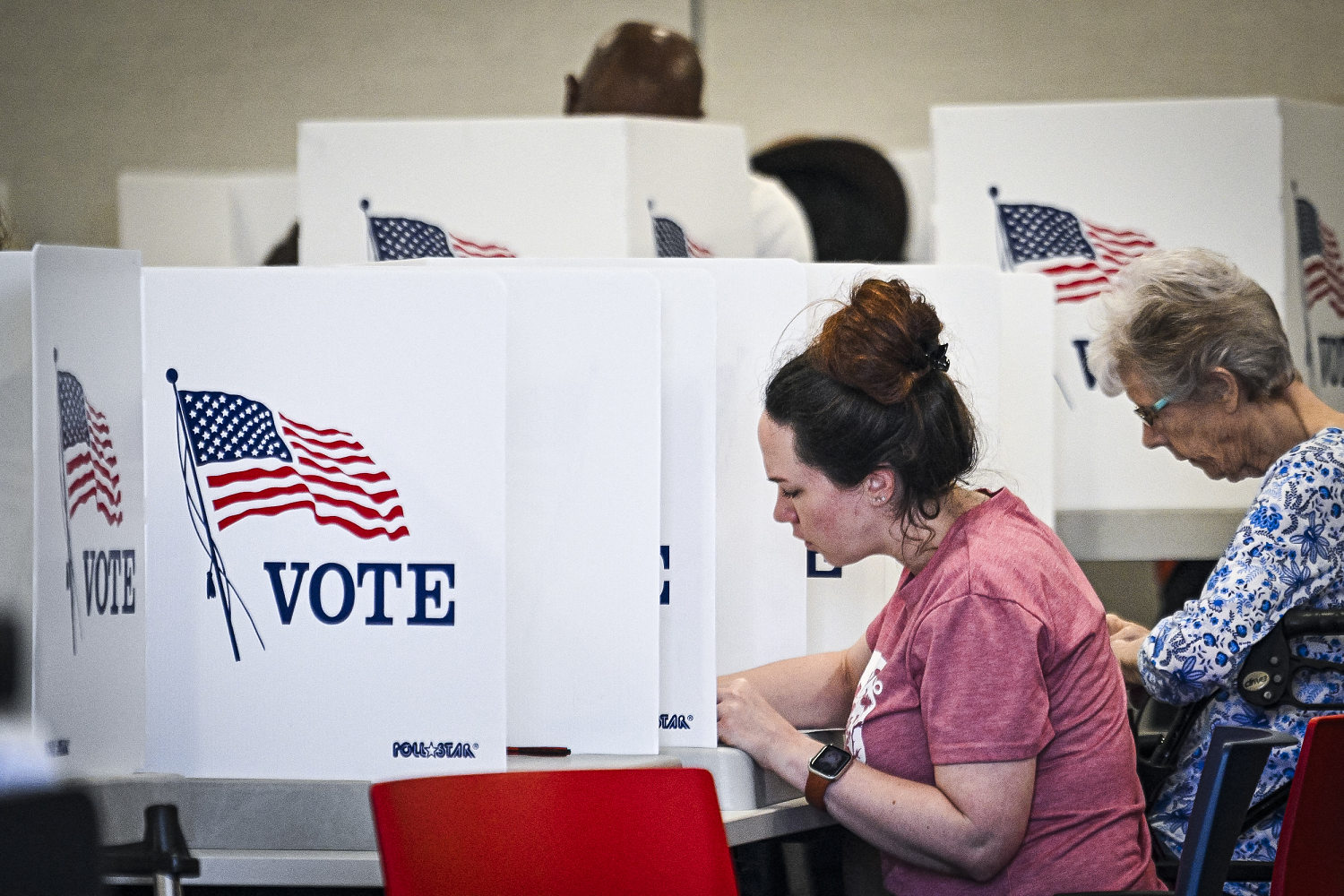
Anxiety about the 2024 election is high. Both sides know that their candidate might lose — and they want polls to tell them just how scared to be.
Right now, polls give us the clearest answers to those questions. But there’s a problem: Every year, polling gets tougher. We pollsters face three core challenges that threaten the accuracy of all political surveys. Nobody has solved them, and it’s not clear anyone can.
Here’s what we’re up against:
Challenge #1: Almost nobody wants to talk to pollsters — and those who do might be weirdos.
Polling is built on a simple idea: If we talk to a representative, miniature version of a state or country, we can estimate what the whole state or country thinks. It’s like getting a sample at an ice cream shop: one well-mixed spoonful tells you what a whole cone will taste like.
Nonresponse makes good data rare and expensive.
But it’s getting tougher to reach the people needed to build that mini-country or mini-state. Response rates — how often people are willing to pick up a cold call or answer a text from us — have been dropping for decades. The response rates for Pew Research Center’s telephone surveys plunged from 36% in 1997 to 6% in 2018. Nate Cohn of The New York Times reported a 0.4% response rate to his polls in 2022. And any pollster will tell you response rates are low this year as well.
Nonresponse makes good data rare and expensive. Polls are costly, in part, because we spend so much money sending out unanswered texts or making calls that get sent straight to voicemail. And as polls get more expensive, media organizations will either sponsor fewer surveys or opt for polls that reduce costs by cutting corners.
But even when a group can afford to field a poll, nonresponse creates huge potential data problems.
When only 1 out of 100 people take a poll, pollsters have to make statistical adjustments. Some — such as getting the right demographic mix — are easy. If a pollster just can’t reach enough Latino, working class, young or rural voters, they often give the underrepresented voters they did contact a little more weight in their calculations. Weighted polls give each demographic a more accurate amount of say, even though some groups were harder to contact.
Other adjustments are not so easy.
Suppose a pollster has the right demographic mix in their poll but mostly happens to interview, for lack of a better description, nerdy rule-followers. This pollster might miss cranky, anti-establishment Trump voters — and risk undercounting the Trump vote for the third election straight.
It’s almost impossible to directly adjust for this type of issue. The census helps us calculate how many 18- to 34-year-olds should be in a poll, but not how many cranks and nerds. So pollsters have to get creative with math — which leads to another issue.
Challenge #2: We have to model our way around the fact that nobody talks to us. That’s risky.
The most common response to this problem — a shortage of pro-Trump, anti-institution Republicans in the 2020 polls — is weighting by “recalled vote.” Essentially, pollsters ask people how they voted in 2020 and try to get the right number of Trump and Biden voters in their sample.
Everyone is using math to adjust for the sad fact that normal people don’t take surveys.
Though I’ve used this tactic in some polls, there are downsides. Respondents don’t always correctly recall whom they voted for. Every estimate of how many Trump or Biden voters will vote again in 2024 is just that — an estimate. The list goes on.
That being said, many reputable pollsters say that weighting by recalled vote improved the accuracy of past surveys. And pollsters that only weight by party — and not recalled vote — might fail to fully address problems that damaged the industry’s credibility four years ago.
There’s no right answer. Everyone is using math to adjust for the sad fact that normal people don’t take surveys. And every pollster is on edge because, if we make the smallest mistake, we’ll be punished for years.
Challenge #3: Elections are closer than ever, so “the polls” will almost certainly be “wrong.”
The last true blowout presidential win was Ronald Reagan’s 1984 re-election. The last 40 years have seen the most consistently competitive presidential races in living memory. That’s bad news for polls — which are blunt instruments rather than precision predictors.
When a pollster randomly samples the electorate, they can — through no fault of their own — accidentally pick up a few too many voters from one side or the other. When we try to poll an upcoming election, we’re making (fallible) projections about who will and won’t turn out. And there’s plenty more uncertainty — from nonresponse, decisions around weighting and more — that’s just not easy to communicate to the lay reader.
In a race this tight, in which survey after survey has Harris and Trump dead even in the swing states, a good pollster could do everything right, yet still miss the result by a point or two and face years of ridicule from a huge audience of readers.
But we pollsters can’t look at these problems, yell “it’s not fair!” and go home. I’ve built election forecast models, and I’ve seen firsthand that polls are the best tool for predicting elections. More importantly, they’re the only way to ask members of the public what they think on any question, in real time.
The problems with polling are real. Maybe at some point, nonresponse or some other issue will become unsolvable and cause a catastrophic, industrywide collapse. But unless that happens, we’ll need to keep polling, because nothing else quite does what polls do.
David Byler
David Byler is chief of research at Noble Predictive Insights, a non-partisan polling firm anchored in the Southwest. He was previously a data columnist for the Washington Post.


In the 15 days since President Donald Trump launched Operation Epic Fury on Iran, Sen. Ruben Gallego (D-Ariz.) is approaching nearly a dozen media appearances, offering his often visceral reaction to the conflict.
Gallego, a 46-year-old combat veteran who deployed to Iraq as an infantryman in 2005, has emerged as a blunt, clear voice for the Democratic Party on foreign policy, speaking as someone whose own generation experienced the forever wars.
There he was on BLN’s “The Source with Kaitlin Collins” saying Secretary of State Marco Rubio was doing “CYA” and noting that the “MAGA base is pissed.” There he was sitting down with the AP speaking “as someone who lives with PTSD,” adding “it’s not been an easy week.” And there he was on Derek Thompson’s podcast, speaking about “going town to town searching for insurgents” 21 years ago, “but there was no clear direction of what victory looked like, what the end goal was, what was going to be the after-action report on Iraq.”
Gallego isn’t alone. Sen. Mark Kelly (D-Ariz.), a Navy captain who flew combat missions during Operation Desert Storm in 1990, has also racked up a run of high-profile media appearances, as has former Transportation Secretary Pete Buttigieg, a U.S. Navy Reserve intelligence officer who deployed to Afghanistan. Maryland Gov. Wes Moore, who served in Afghanistan in the Army’s 82nd Airborne, went on local radio this week to link Americans’ affordability woes to the war.
In a year after many Democrats pined for a metaphorical fighter, the party is now having a conversation with itself about whether it needs a literal fighter — a veteran who can speak with credibility on issues of war and national security.
In an interview with Blue Light News, Gallego spoke of “dodging bullets, IEDs, RPGs, clearing towns and then coming back to the same towns with insurgents” and of “losing friends and still not understanding what the end goal was the whole time.”
“It leaves a mark on you, and you start seeing it happening again, you know, you don’t really think about the politics,” Gallego said. “You think about the people who are going to be potentially dying. And that’s why I think I was not hesitant to speak my mind on that.”
Later this month in San Antonio, Texas, Gallego will join VoteVets Action for its third town hall featuring potential 2028 Democratic presidential candidates, promising “fresh voices to the national conversation — those who have worn the uniform and served alongside us, who connect with everyday Americans others can’t,” according to a promotional video. (They’ve also done town halls with Buttigieg and Michigan Sen. Elissa Slotkin.)
“On foreign policy, the Dems need a candidate who is seen as strong/tough — not in rhetoric or bravado political platitudes but who conveys a sense of judgement and resolve with which voters connect instinctively,” said Doug Wilson, the former assistant secretary of Defense for Public Affairs during the Obama administration and co-lead of Buttigieg’s 2020 foreign policy team.
The “Iran war underscores the need” for such a candidate, Wilson added.
Whomever the Democrats select as their nominee could potentially face a Situation Room-steeped ticket deep with national security credentials, including a Marine Iraq war veteran in Vice President JD Vance or Rubio, with his secretary of State experience.
Depending on how the many conflicts the U.S. is engaged in at the moment resolve, that experience could cut against them.
But right now, Democrats who can match those bona fides have some currency others without them can’t.
“That’s obviously going to be helpful to them,” said Matt Bennett, co-founder of the center-left think tank Third Way. “It’s gonna be a big part of what they’re talking about for the next little while. But you know, how long does it last? We just don’t know, right? In my professional lifetime, foreign policy stuff and national security has mattered in a presidential race once — in 2004. That’s it. Otherwise, it comes up, but it’s not driving the conversation.”
Some potential Democratic candidates without such credentials have still managed to break through amid the Iran news cycle. Sen. Jon Ossoff (D-Ga.) has said the White House has treated aspects of the war “as a video game,” in a clip gaining traction on X. “When American service members killed in action are returning to the United States in flagged-draped coffins, and even more Americans have lost limbs or suffered terrible brain injuries or are fighting for their lives, this White House treats war like a game, and it’s a disgrace,” Ossoff said.
When asked whether military service is an essential for the party’s eventual nominee, Gallego acknowledged there is a benefit for someone who can “speak with that type of credibility.”
“I’m not the type of person that’s like, ‘you have to be a veteran — Iraq War veteran,’” Gallego said. “This is a democracy. We’re still one, and there’s a lot of people that can bring valuable experience and knowledge. But you know, someone that actually has a nuanced understanding of foreign policy; that doesn’t go to the total knee-jerk reactionism that sometimes we see where we go to the point of, you know, isolationism; or the other way, where we go to full neocon. There needs to be a very balanced way to how we approach the world.”
Like this content? Consider signing up for Blue Light News’s Playbook newsletter.

A longshot elections bill and an uphill reconciliation fight dominated the yearly policy conference…
Read More
The president has called on Republicans to pass the SAVE America Act…
Read More
- The Latest: US hits pro-government demonstration in Iran as war threatens global economy

- 2028 Dem veteran? Uncle Sam wants you.
- House Republicans find it difficult to focus on rising costs as they plot 2026 agenda

- Cornyn backs ending filibuster as he courts Trump’s endorsement

- Capitol agenda: GOP wants to move past the SAVE America Act

- Data center moratorium gains traction among Hill progressives

- ‘I’m glad I’m not on the ballot’: Senate GOP worries about its midterm edge
- House Republicans find it difficult to focus on rising costs as they plot 2026 agenda
- One month later, White House and Democrats no closer to ending the DHS shutdown
- House Republicans find it difficult to focus on rising costs as they plot 2026 agenda
-

 The Dictatorship1 year ago
Luigi Mangione acknowledges public support in first official statement since arrest
-

 Politics1 year ago
Former ‘Squad’ members launching ‘Bowman and Bush’ YouTube show
-

 Politics1 year ago
Blue Light News’s Editorial Director Ryan Hutchins speaks at Blue Light News’s 2025 Governors Summit
-

 Politics1 year ago
Former Kentucky AG Daniel Cameron launches Senate bid
-

 The Dictatorship6 months ago
Mike Johnson sums up the GOP’s arrogant position on military occupation with two words
-

 The Dictatorship1 year ago
Pete Hegseth’s tenure at the Pentagon goes from bad to worse
-

 Politics11 months ago
Democrat challenging Joni Ernst: I want to ‘tear down’ party, ‘build it back up’
-
Uncategorized1 year ago
Bob Good to step down as Freedom Caucus chair this week