The Dictatorship
The fundamental flaw in Trump’s ‘major combat operations’ against Iran

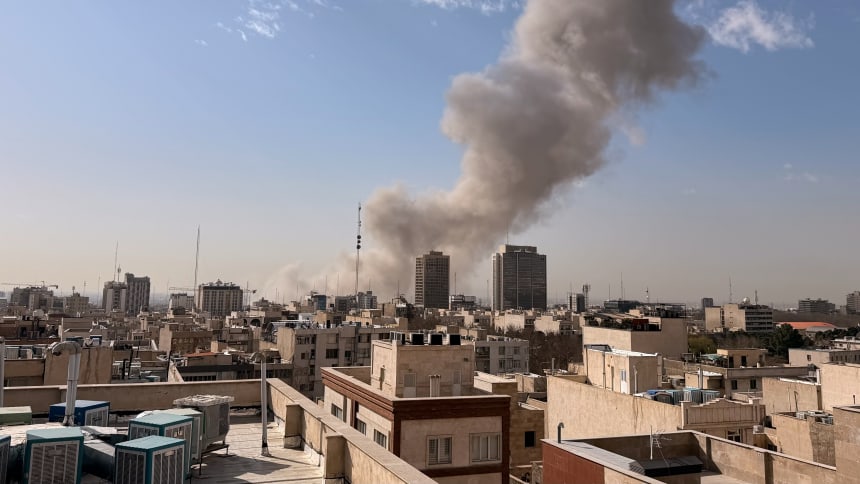
Now we’ve done it. The United States, under the leadership of President Donald Trump, has launched “major combat operations” in Irancould be sending us right back into the quagmire of regime change in the Middle East. Simply because he wants to and he can.
Unlike the “Coalition of the Willing,” which put ground troops into Iraq, or the NATO coalition that invaded Afghanistan after 9/11 — instances for which U.S. leaders built campaigns to get the buy-in of allies and the public — Trump has unilaterally and erratically led the U.S. into conflict. The “concept of a plan” and being “locked and loaded” — both phrases Trump has used to describe his policies — is not a strategy for toppling the regime or keeping the U.S. from being mired in foreign wars.
The “concept of a plan” and being “locked and loaded” — both phrases Trump has used to describe his policies — is not a strategy for toppling the regime or keeping the U.S. from being mired in foreign wars.
We’ve been waiting for weeks to see if Trump’s threat of strikes would become real. In January, Trump suggested he would act in support of Iranian protesters, who, despite these threats from the U.S. president, are still being jailed and killed by the Iranian regime. More recently, Trump said that targeted strikes would gain concessions from Iran in nuclear negotiations. But at no point has the American public heard their commander in chief explain why now, and to what end?
Forcing change in Iran is not a one-strike-and-done endeavor. Look no further than this past June, when the U.S. launched dramatic strikes on Iran’s Fordow nuclear facilityan act that did not end Iran’s ability to enrich uranium. While Trump said Iran’s program was obliteratedinternational inspectors have not been allowed into the country to verify such claims.

The people of Iran have certainly wanted change. Two significant protest movements have erupted in Iran in recent years: the 2022 national uprising of women across generations demanding basic freedom and the more recent protests against corruption and economic hardship. In both instances, thousands of people demanded change from a regime that remains intransigent and violent toward its own people. None of this is new or unexpected.
In some corners, Trump’s bluster has reignited a long-standing belief that the U.S. military can be a force for good in the world. The idea of a noble U.S. military intervening to save women or to free a community is not new: Women’s groups were part of the drumbeat toward U.S. strikes in Afghanistan.
On Saturday, Trump announced on Truth Social that Supreme Leader Ayatollah Khamenei had been killed in the strikes, an announcement later confirmed by Iranian state media. But the idea of “regime change” led by the U.S. military has two potent, cautionary tales for this generation of Americans: ISIS grew out of the devastation of the Iraq war and after 20 years, Afghanistan returned to Taliban brutality. And that was when the U.S. had massive support of allies and the American public.
Political solutions, negotiated by diplomats of multiple parties, is how global policy solutions have advanced in recent years. The U.N. climate change negotiations brought together more than 130 countries to reduce carbon emissions. The original Iran nuclear deal brought together European countries and Russia in a system that constrained and verified Iran’s nuclear ambitions. But Trump does not like diplomatic solutions, at least not those developed by other presidents, and has removed the United States from a variety of international agreements.
And the Trump administration was back at the negotiating table only briefly — weighed down by past broken agreements and failed military interventions. Negotiators prefer to be in the position of holding an “or else” card in their back pocket, which is the looming threat of a capable military. In Iran, though, the U.S. alone does not have the obvious military advantage; even American war hawks concede that Iran runs a very capable militaryas well as a network of terrorist assets that threatens U.S. bases and civilians across the Middle East, and has the ability to cause economic and digital havoc. So U.S. strikes necessitate coordinating with Israel and other allies, automatically making this a regional conflict.
The idea of “regime change” led by the U.S. military has two potent, cautionary tales for this generation of Americans: the failure to establish safety in Iraq and the return of Afghanistan to Taliban brutality.
Although tempers seemed to cool a few weeks agowhen negotiations toward a new nuclear deal restarted in earnest, the progress did not meet Trump’s preferred pace. Iran’s foreign minister blamed the U.S. negotiating teamsaying on Feb. 20 that the U.S. “has not asked for zero enrichment.” With the basic contours of a diplomatic discussion still under debate, strikes of this magnitude make compromise impossible. No one who gets attacked with missiles turns to negotiation as the next step; they usually want to save face and hit back hard. This means Trump’s military intervention has likely disrupted any hope of talks moving forward and instead gives Iran the excuse it’s long wanted to attack U.S. military bases and its allies, Israel and Saudi Arabia.
Which brings us to the continued challenge of Trump’s approach to Iran: While the regime in Tehran has patience, strategic coordination and zero tolerance for dissent, Trump has been impulsive and inconsistent, and has yet to settle on a long-term goal. The most immediate outcome of this strike could be to rally the Iranian people around their flag, while upping America’s economic uncertainty and moral isolation across the board.
Nayyera Haq is a global affairs journalist.