
Politics
The Democrats’ Black voter crisis is overblown

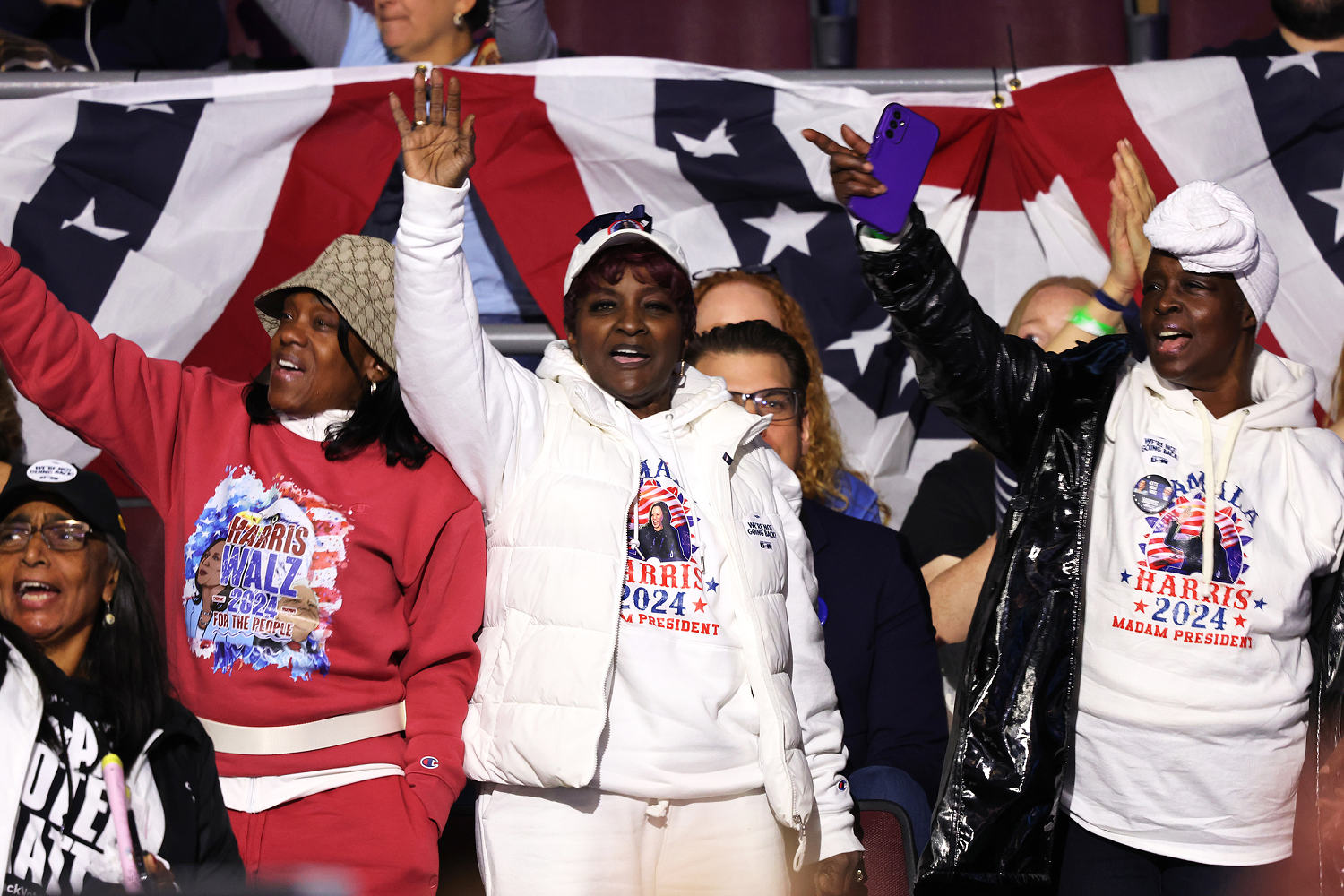
Do the Democrats have a Black voter problem? If you’re plugged into the political news cycle, it certainly feels like they do. Former President Donald Trump has been boasting that he has “gone through the roof with Black men.” His predecessor, former President Barack Obama, has been admonishing Black men for seeming to balk at supporting Democratic presidential nominee Kamala Harris. Pundits have seized on the issue as an unexpected weakness for Harris and her party. In what may have been a response to all the hubbub, Harris released a policy rollout specifically aimed at appealing to Black men.
But Democrats ought to tune out Trump’s taunting and not panic. The general outlook of the political scientists I spoke to is that there isn’t enough reliable data to suggest that Harris is facing an emergency situation with Black voters. In fact, they pointed out that there are indicators that Harris could be on track to match Biden’s performance in 2020. (On average, exit polls found that Biden received the support of 87% of Black voters, while Trump received 12%.) That’s not to say that Harris should take the Black vote for granted or that she should neglect targeted outreach in Black communities. But fixating on questionable data over how much of the Black male vote she’ll get can distract from a lot of bigger issues that the party is facing.
The bigger issue comes down to whether Harris can turn out Black voters in big numbers.
A lot of the alarmist headlines are based on comparisons of previous elections to this year’s polls. That’s comparing apples and oranges: Polls are deeply flawed tools for predicting turnout. Hillary Clinton in 2016 and Joe Biden in 2020 overperformed with Black voters compared to polls prior to the election, said Christopher Towler, a professor at Sacramento State University who runs the Black Voter Project. Part of the reason is that polling captured sentiment from Black voters who were less supportive of Democrats but also less likely to vote. That very well could be happening this time as well.Another issue is that a lot of the national polls involve extrapolating off a relatively small number of Black respondents. “It tends to be the case in typical news media polls that Black men are under-sampled,” Chryl Laird, a political scientist at the University of Maryland, College Park, told me. That can distort numbers dramatically. Trump’s apparent doubling of Black supporters could potentially be explained by the margin of error with a small sample.
Towler’s Black Voter Project involves longitudinal and large-scale panel surveys of Black voters. His larger sample size makes his numbers more reliable, and his findings from a survey conducted from late July through mid-August found that Harris’ numbers were not necessarily in a dire state: Among likely Black voters asked who they’d vote for if they had to vote that day, 81% said they’d vote for Harris and 11% said Trump; 4% said they weren’t sure, 2% said they would vote for then-independent candidate Robert F. Kennedy Jr., 1% said they’d vote for Cornel West and 1% said they would not vote. (When given only the choice of Harris or Trump, the split was 84% for Harris and 12% for Trump.) Those numbers do not suggest that Democrats should panic. The survey began just days after Harris entered the race and ended shortly after she’d entered, and the results left her with room to grow. Trump’s support among Black voters in that survey roughly tracks with the level of support he got in 2020 and is a far cry from the shocking figures seen in national polls taken around the same time that used a smaller sample of Black voters.
Another poll focused specifically on a large set of Black voters in swing states, conducted in October by Howard University’s Initiative on Public Opinion, found that Harris had 84% support, Trump had 8%, and 8% remained undecided. Given trends in how Black voters generally break for Democrats, statistically speaking the undecided voters are most likely going to either break for Harris or not vote, Towler said.
Put it together and the more reliable statistics from larger samples of Black voters do not forecast a massive, game-changing defection to Trump. The bigger issue comes down to whether Harris can turn out Black voters in big numbers.
It cannot be ruled out that Harris could underperform Biden with Black voters, and Black men in particular. But that might be the wrong way to look at the issue, considering other trends in Democrats hemorrhaging voters. Harris seems to be performing worse among men overall than Biden was earlier in the race, according to successive New York Times-Siena polls. And Democrats continue to struggle to find a way to fight off Trump’s domination among non-college-educated voters. Focusing on small percentage drops of Black men — the population of voters who turn out second only to Black women in supporting Democrats — may obscure the bigger, more worrying trend lines that Democrats face. Based on what we know, it’s blinkered to argue that the Democrats’ crisis is with Black voters.
It is striking that Harris looks like she’s not coming close to generating “the Obama effect” among Black voters — in 2008, he garnered the support of 95% of Black voters and generated historic turnout. A number of factors could be at play. Obama may have monopolized the excitement of being the first Black president (who also disappointed many on the left and oversaw a massive drop in Black wealth while in office). Obama had more time and more charisma on his side. And sexism against Harris could be suppressing enthusiasm about her.
Either way, with the tight margins of the race, Harris’ ability to generate high Black turnout will be crucial. That means making sure to spend more resources on targeting Black voters with the right messaging and get-out-the-vote operations. Neither history nor the evidence, however, suggests Trump’s support from Black men is anywhere close to going through the roof.

Zeeshan Aleem is a writer and editor for BLN Daily. Previously, he worked at Vox, HuffPost and Blue Light News, and he has also been published in, among other places, The New York Times, The Atlantic, The Nation, and The Intercept. You can sign up for his free politics newsletter here.


Susan Collins on Trump, tariffs and her fight for Maine
lead image
LAS VEGAS — Vice President JD Vance tried to make inroads with Jewish Republicans. Not everyone is sold.
Vance’s closed-door speech at the Republican Jewish Coalition’s annual leadership summit Monday night went a long way in alleviating top pro-Israel donors’ concerns about his support for the U.S.-Israeli relationship, and it cemented their view that Vance would be a preferable choice to whomever the Democratic Party nominee is in 2028.
But some attendees still have questions for Vance — particularly around his relationship with conservative pundit Tucker Carlson, who has long drawn ire from the Republican Jewish leaders for his criticism of Israel and outraged many when he hosted the antisemite Nick Fuentes for a lengthy podcast interview last year.
“He allayed a lot of concern, but he failed to address his relationship with Tucker Carlson, and that left a lot of people wondering why,” said Josh Katzen, a real estate developer and member of the RJC board, speaking in his personal capacity.
Vance, the current front-runner for the Republican nomination in 2028, has long faced skepticism from Jewish Republicans who question his commitment to the U.S.-Israeli relationship and his response to antisemitism within the GOP. In his speech Monday, he took both issues head-on, and largely appeased the skeptical crowd with his answers, declaring that “Jew-hatred is corrosive to the soul” and saying Republicans need to articulate to young Americans why an alliance with Israel is in the best interest of the U.S.
But his meandering response to a question about Carlson and other podcasters left some in attendance yearning for more.
“A few names: Tucker Carlson, Megyn Kelly, Joe Rogan, Nick Fuentes. They have platformed antisemites,” former Sen. Norm Coleman (R-Minn.), the RJC’s board chair, asked Vance. “How do you draw the line, in terms of … the platforms that you appear on?
“I recognize a lot of people in this room may disagree with things that Tucker Carlson or Megyn Kelly or Joe Rogan have said,” Vance said, before pivoting to discuss Rogan and Fuentes, saying those are “two very, very different categories of people” and suggesting people like Rogan should be reasoned with, even when there are disagreements.
The answer was not sufficient to some, who wonder about his longtime relationship with Carlson. Vance was a regular on Carlson’s Fox News show and creditedCarlson for helping carry him to victory in his 2022 U.S. Senate primary in Ohio. In 2024, Carlson pushed for Trump to pick Vance as his running mate.
“JD Vance allying himself with an individual who has called for Trump’s immediate removal from office will make it harder for many of us Jewish conservatives to consider his candidacy,” said Shabbos Kestenbaum, a pro-Israel campus activist who spoke at the Republican National Convention in 2024 and spoke at last year’s RJC conference. “We hope this issue is resolved quickly so we can focus on policy, not personality.”
Eric Levine, a major GOP donor and member of the RJC board, said Vance could’ve had “an incredible Sister Souljah moment” if he took on Carlson.
“In my view, on the issue of Jews and Israel, there is no difference between Hasan Piker, Zohran Mamdani, Abdul El-Sayed and the DSA writ large on the one hand and Tucker Carlson, Nick Fuentes, Marjorie Taylor Green and neo-Nazis on the other hand,” said Levine, speaking in his personal capacity. “That is why I wish the vice president had unambiguously separated himself and condemned Tucker by name.”
Conservative radio host Sid Rosenberg also wasn’t satisfied. Just hours after urging RJC attendees in a speech onstage to “give Vance a chance,” he was critical of how Vance handled that opportunity.
“He had a chance to hammer @TuckerCarlson and @megynkelly but instead spent all his time defending @joerogan over Nick Fuentes,” Rosenberg wrote on X. “Look, he’s still better than any Democrat candidate but I don’t think he wowed the STRONG Jews in the room tonight.”
Carlson, in a text message, said, “An organization that promotes and defends genocide is continuing to insist that they’re the real victims? I can’t imagine who buys this nonsense anymore.”
Human rights groups have accused Israel of genocide over its conduct in the war in Gaza, which the country’s leaders vehemently deny. Vance’s office did not respond to a request for comment for this story.
An individual close to Vance, granted anonymity to describe sentiment within the vice president’s orbit, said there was no illusion Vance would win over every person in attendance, “or that every single person would love every single answer.”
“The goal was to lower the temperature, extend an olive branch, and make clear that the vice president is an ally, not an enemy,” the person said, arguing that goal was “achieved.”
Sam Markstein, spokesperson for the RJC, emphasized that the organization is a coalition.
“There will always be many opinions within the organization,” Markstein said. “In an hour when too many public figures are walking away from the Jewish community and the U.S.-Israel relationship, the Republican Jewish Coalition will always stand with the leaders who show up. Vice President JD Vance shows up — and received multiple standing ovations with thunderous applause.”
Vance, who was elected to the Senate in 2022, faces a fundamental disadvantage among potential Republican 2028ers: He’s still a relative newcomer to the Republican political scene.
Others, like Secretary of State Marco Rubio and Sen. Ted Cruz (R-Texas), have developed relationships with pro-Israel Republicans in both the Jewish and evangelical Christian communities for years, going well back before their respective 2016 presidential runs. Rubio has pushed to revoke visas from individuals accused of promoting antisemitism or supporting terrorism. Cruz has publicly sparred with Carlson, criticizing him of antisemitism. A Cruz-aligned nonprofit recently launched to take on right-wing antisemitism.
Vance’s speech was his first at an RJC leadership summit, though he attended in 2022. It was the first time since 2019 a sitting president or vice president attended the conference, which draws some of the country’s most influential Republican donors.
Not being a favorite among RJC leaders wasn’t an impediment to Donald Trump’s political outsider 2016 presidential bid. During that campaign, he was accused of invoking antisemitic stereotypes during a speech to the RJC and in a social media post. But upon taking office, he formed a strong relationship with Israeli Prime Minister Benjamin Netanyahu, culminating in the Abraham Accords and moving the U.S. embassy from Tel Aviv to Jerusalem. Speakers at the RJC’s two-day summit this week frequently referred to Trump as the most pro-Israel president in U.S. history.
But Rubio and Cruz have been fixtures at past iterations of the RJC’s annual leadership summit, and they maintain strong ties with the group’s leadership. (None have announced whether they’ll seek the presidential nomination, though Rubio has stated he will not run if Vance does.)
Many attendees said Rubio is still the favorite amongst the crowd.
“Every time Marco Rubio’s name is mentioned in this conference, there’s a spontaneous round of applause,” said Katzen, the RJC board member. Indeed, when Rosenberg urged attendees to welcome Vance in a speech Monday, he mentioned the hypothetical, “If Marco Rubio was here tonight—” and was drowned out by applause.
Should Rubio not run for the nomination against Vance, other observers think Cruz will have the inside lane among the RJC crowd.
“Ted Cruz is loved here, and he deserves to be loved here,” said Levine, prior to Vance’s speech. “Look, if it’s Cruz and Vance, I expect that this crowd would be 90 percent Cruz.”
Ari Fleischer, an RJC board member and a former White House press secretary, said Vance made inroads — but building a relationship with the pro-Israel community takes time.
“It’s fair to say hearts and minds are changing, but I think it’s also fair to say that when you come before the Republican Jewish Coalition, it’s like when you come to New Hampshire to campaign,” Fleischer said. “After the third or fourth time, we let you know how you’re doing.”
LAS VEGAS — Vice President JD Vance has faced skepticism from some in the Jewish Republican community. He waded directly into the fray Monday — and was met with raucous applause.
In a closed-door appearance at the Republican Jewish Coalition leadership summit, Vance addressed what he called the “elephant in the room”: Israel’s plummeting favorability among young Americans, according to one people in the room for Vance’s speech, granted anonymity to describe an off-record conversation, and audio of the event obtained by Blue Light News. Vance also discussed rising antisemitism.
“There is a growing suspicion among, I would call it, under-40s of the U.S.-Israel relationship,” Vance said in a moderated conversation with former Sen. Norm Coleman (R-Minn.), chair of the RJC board. “I think my view is, what we have to do is articulate why this is in the best interest of the United States of America, and actually get out there and talk about the ways in which it is in the best interest of the United States of America.”
Vance noted that Republicans must “talk about the concrete alignment of interest and to hook a relationship on that, rather than something that may have made a lot of sense rhetorically 30 or 40 years ago, but just doesn’t have … the same purchase as it did 30 or 40 years ago because the country is different and because young people are looking at this in a different way.”
Vance’s appearance at the annual RJC confab — hosted at the Venetian Resort, developed by the late GOP megadonor Sheldon Adelson — came as a surprise to many in the pro-Israel community, with which Vance has shared a sometimes tumultuous relationship. Vance, the current frontrunner for the Republican presidential nomination in 2028, will likely need to shore up support from the community to succeed Trump.
The hesitancy toward Vance among some in pro-Israel circles boiled up in recent months over Vance’s dovishness on the Iran war and his criticism of Prime Minister Benjamin Netanyahu’s Israeli government. But other concerns go back further, centered on his longtime relationship with Israel-skeptical pundit Tucker Carlson and the way he’s addressed antisemitic incidents or statements.
Some pro-Israel megadonors, like billionaire hedge fund manager Ken Griffin, have already signaled they’d support Secretary of State Marco Rubio in 2028 over Vance. (Neither Vance nor Rubio have announced whether they’ll seek the presidential nomination, though Rubio has stated he will not run if Vance does.)
But Vance’s speech was met with applause inside the cavernous convention hall where it was delivered, and praise outside of it.
“He hit a home run with the crowd,” Sen. Jim Banks (R-Ind.) told reporters after the speech, noting Vance received “several standing ovations.”
The Jewish community has “a great ‘bullshit detector,’ to understand when they’re being pandered to,” said Matt Brooks, CEO of the RJC. “And I don’t believe that anybody will come away from this meeting thinking that they were pandered to. I think they will come away from this conversation with a sense that the vice president really gets it and gets us.”
Last year, the RJC’s leadership summit was centered on combatting antisemitism within the Republican Party, and leaders took aim at Carlson and others. Vance has been an ally of Carlson’s, and when Coleman asked Vance about podcasters like Carlson, Vance gave a winding answer.
“I recognize a lot of people in this room may disagree with things that Tucker Carlson or Megyn Kelly or Joe Rogan have said,” Vance said, before focusing on Rogan and Fuentes, saying they are “two very, very different categories of people.”
“I think it’s a mistake to sort of say we’re going to write Joe Rogan off because he said something that we don’t like,” he said. “I think the best approach is to actually go in there and talk to him and make the argument as best as you can.”
Vance directly condemned some antisemitic theories like blood libel, saying it is the exact opposite of the Christian gospel. He said that Jew-hatred is “corrosive to the soul.”
And echoing other speakers at the two-day RJC summit, Vance declared that former Rep. Mike Rogers (R-Mich.) is the most important Senate candidate this cycle, and urged those in attendance to support him in his race against Democratic nominee Abdul El-Sayed.
Earlier Monday, Vance rallied alongside Rogers at a Michigan event hosted by MAGA Inc., Trump’s super PAC, before flying to Nevada. His cross-country itinerary signaled his seriousness in courting the Jewish donor community, suggested Robert Schostak, an RJC board member.
“I think it’s great that he’s here. This is not easy,” said Schostak, the former Michigan GOP chair. “He cares about the fight of antisemitism, and the support for Israel. If this was secondary to him, he wouldn’t be here.”
Ari Fleischer, an RJC board member and a former White House press secretary, agreed. “Today is not primary day,” he said. “But I think today was progress day for JD Vance with the Jewish community.”
- Capitol agenda: GOP does Dallas? Not so much
- Republicans struggle for footing on data center response ahead of midterms
- Susan Collins on Trump, tariffs and her fight for Maine

- Hospitals say coming Trump administration rules are worse than GOP’s Medicaid cuts
- Congress warms to Trump’s Hollywood tax credit effort
- Republicans aren’t exactly flocking to Trump’s midterm convention
- Jeffries says Dems who saved GOP’s agenda deserve ‘serious response’
- Handful of House Democrats split on GOP resolution condemning socialism
- JD Vance courts Jewish Republicans. Tucker Carlson still looms.
- Trump to promote acting Navy secretary amid Pentagon turmoil
-

 Politics2 years ago
Former ‘Squad’ members launching ‘Bowman and Bush’ YouTube show
-
Uncategorized2 years ago
Bob Good to step down as Freedom Caucus chair this week
-

 Politics2 years ago
Former Kentucky AG Daniel Cameron launches Senate bid
-

 The Dictatorship2 years ago
Luigi Mangione acknowledges public support in first official statement since arrest
-

 The Josh Fourrier Show2 years ago
DOOMSDAY: Trump won, now what?
-

 Politics2 years ago
Blue Light News’s Editorial Director Ryan Hutchins speaks at Blue Light News’s 2025 Governors Summit
-

 The Dictatorship2 years ago
Pete Hegseth’s tenure at the Pentagon goes from bad to worse
-

 The Dictatorship12 months ago
Mike Johnson sums up the GOP’s arrogant position on military occupation with two words