
Politics
The Democrats’ Black voter crisis is overblown

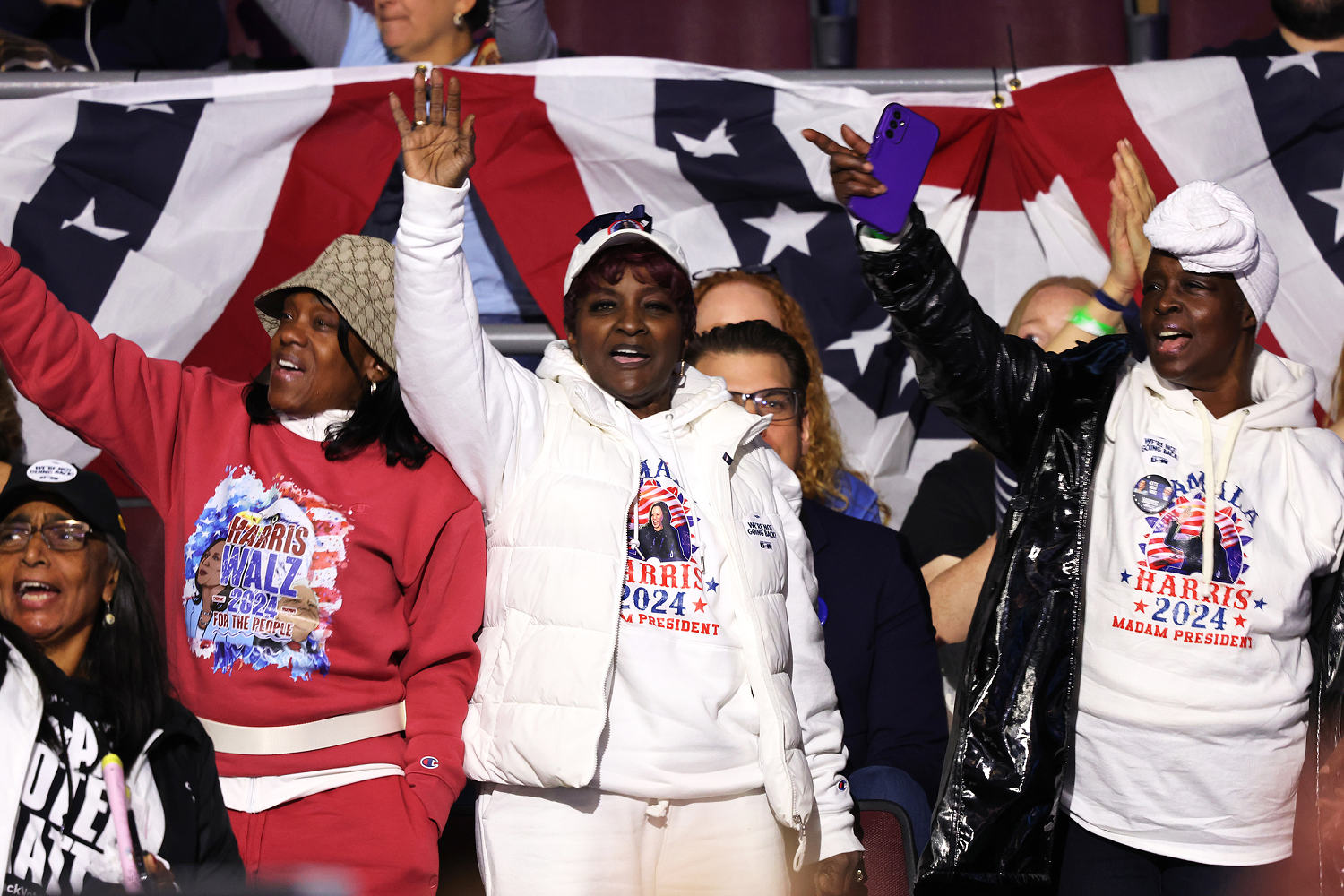
Do the Democrats have a Black voter problem? If you’re plugged into the political news cycle, it certainly feels like they do. Former President Donald Trump has been boasting that he has “gone through the roof with Black men.” His predecessor, former President Barack Obama, has been admonishing Black men for seeming to balk at supporting Democratic presidential nominee Kamala Harris. Pundits have seized on the issue as an unexpected weakness for Harris and her party. In what may have been a response to all the hubbub, Harris released a policy rollout specifically aimed at appealing to Black men.
But Democrats ought to tune out Trump’s taunting and not panic. The general outlook of the political scientists I spoke to is that there isn’t enough reliable data to suggest that Harris is facing an emergency situation with Black voters. In fact, they pointed out that there are indicators that Harris could be on track to match Biden’s performance in 2020. (On average, exit polls found that Biden received the support of 87% of Black voters, while Trump received 12%.) That’s not to say that Harris should take the Black vote for granted or that she should neglect targeted outreach in Black communities. But fixating on questionable data over how much of the Black male vote she’ll get can distract from a lot of bigger issues that the party is facing.
The bigger issue comes down to whether Harris can turn out Black voters in big numbers.
A lot of the alarmist headlines are based on comparisons of previous elections to this year’s polls. That’s comparing apples and oranges: Polls are deeply flawed tools for predicting turnout. Hillary Clinton in 2016 and Joe Biden in 2020 overperformed with Black voters compared to polls prior to the election, said Christopher Towler, a professor at Sacramento State University who runs the Black Voter Project. Part of the reason is that polling captured sentiment from Black voters who were less supportive of Democrats but also less likely to vote. That very well could be happening this time as well.Another issue is that a lot of the national polls involve extrapolating off a relatively small number of Black respondents. “It tends to be the case in typical news media polls that Black men are under-sampled,” Chryl Laird, a political scientist at the University of Maryland, College Park, told me. That can distort numbers dramatically. Trump’s apparent doubling of Black supporters could potentially be explained by the margin of error with a small sample.
Towler’s Black Voter Project involves longitudinal and large-scale panel surveys of Black voters. His larger sample size makes his numbers more reliable, and his findings from a survey conducted from late July through mid-August found that Harris’ numbers were not necessarily in a dire state: Among likely Black voters asked who they’d vote for if they had to vote that day, 81% said they’d vote for Harris and 11% said Trump; 4% said they weren’t sure, 2% said they would vote for then-independent candidate Robert F. Kennedy Jr., 1% said they’d vote for Cornel West and 1% said they would not vote. (When given only the choice of Harris or Trump, the split was 84% for Harris and 12% for Trump.) Those numbers do not suggest that Democrats should panic. The survey began just days after Harris entered the race and ended shortly after she’d entered, and the results left her with room to grow. Trump’s support among Black voters in that survey roughly tracks with the level of support he got in 2020 and is a far cry from the shocking figures seen in national polls taken around the same time that used a smaller sample of Black voters.
Another poll focused specifically on a large set of Black voters in swing states, conducted in October by Howard University’s Initiative on Public Opinion, found that Harris had 84% support, Trump had 8%, and 8% remained undecided. Given trends in how Black voters generally break for Democrats, statistically speaking the undecided voters are most likely going to either break for Harris or not vote, Towler said.
Put it together and the more reliable statistics from larger samples of Black voters do not forecast a massive, game-changing defection to Trump. The bigger issue comes down to whether Harris can turn out Black voters in big numbers.
It cannot be ruled out that Harris could underperform Biden with Black voters, and Black men in particular. But that might be the wrong way to look at the issue, considering other trends in Democrats hemorrhaging voters. Harris seems to be performing worse among men overall than Biden was earlier in the race, according to successive New York Times-Siena polls. And Democrats continue to struggle to find a way to fight off Trump’s domination among non-college-educated voters. Focusing on small percentage drops of Black men — the population of voters who turn out second only to Black women in supporting Democrats — may obscure the bigger, more worrying trend lines that Democrats face. Based on what we know, it’s blinkered to argue that the Democrats’ crisis is with Black voters.
It is striking that Harris looks like she’s not coming close to generating “the Obama effect” among Black voters — in 2008, he garnered the support of 95% of Black voters and generated historic turnout. A number of factors could be at play. Obama may have monopolized the excitement of being the first Black president (who also disappointed many on the left and oversaw a massive drop in Black wealth while in office). Obama had more time and more charisma on his side. And sexism against Harris could be suppressing enthusiasm about her.
Either way, with the tight margins of the race, Harris’ ability to generate high Black turnout will be crucial. That means making sure to spend more resources on targeting Black voters with the right messaging and get-out-the-vote operations. Neither history nor the evidence, however, suggests Trump’s support from Black men is anywhere close to going through the roof.

Zeeshan Aleem is a writer and editor for BLN Daily. Previously, he worked at Vox, HuffPost and Blue Light News, and he has also been published in, among other places, The New York Times, The Atlantic, The Nation, and The Intercept. You can sign up for his free politics newsletter here.


MIDLAND, Michigan — Pete Buttigieg is known for going everywhere to get his message out in the media. In 2026, he’s taking that strategy offline, too, traveling virtually everywhere.
A source close to Buttigieg tells Playbook he’s spent half of 2026 on the road, hitting 10 states so far — including battleground states Georgia, Nevada, Pennsylvania, Wisconsin and his adopted home state Michigan, plus a multiday swing across for-now-first-in-the-nation New Hampshire. And he’s not yet hawking books like some of his would-be 2028 rivals. He’s stumping for candidates up and down the ballot.
While potential 2028ers like Illinois Gov. JB Pritzker and Pennsylvania Gov. Josh Shapiro focus on flexing midterm-year dominance in their own backyards, Buttigieg is embarking on a more national project to position himself as a super surrogate not confined to specific geography or demographics. It’s a strategy that could help him counter the base of power that comes from holding elected office.
Buttigieg laid out his midterm strategy to Playbook in an exclusive interview after gripping and grinning and taking selfies along a ropeline: “The basic idea is to make myself useful to candidates and causes that I care about and that we all need to succeed,” he said at Mi Element Grains & Grounds, a combination microbrewery, bakery and coffeehouse, after launching a canvassing effort backing Chedrick Greene in a special election to determine control of the Michigan state Senate.
“Every kind of state, red, blue and purple, there are races going on and fights going on that I want to make sure I’m part of,” Buttigieg told Playbook. “And they are all often very different from each other, but what they have in common is leaders who are very rooted in a sense of place. They’re very much of where they’re from, and I think represent a big part of what the future for Democrats is going to look like.”
Buttigieg has increased his engagement with Black candidates like Greene and the community more broadly, addressing a perceived weakness. In Alabama, Buttigieg joined civil rights leaders and community members in Selma for the Bridge Crossing Jubilee and Anniversary of Bloody Sunday, and made remarks at a unity breakfast and Tabernacle Baptist Church. In Birmingham, he joined a roundtable with business owners from the Historic 4th Avenue Business District.
A source familiar with Buttigieg’s past outreach to the Black community described his efforts a “natural extension” of his work on his 2020 presidential campaign and in the Biden administration.
“It’s a recognition that engagement in those spaces and showing up in 2026 is going to be a huge indicator of who’s going to be the leader of this party,” this person, granted anonymity to candidly appraise Buttigieg’s approach, told Blue Light News. “I think it’s really smart to think along those lines, and to show, right? Not just talk about it, but to actually show and demonstrate it.”
He also campaigned for Shawn Harris in former Rep. Marjorie Taylor Greene’s deep-red Georgia congressional district, and gave an interview to Black creator Hood Anchor Ye alongside Rep. Nikema Williams. He also attended Sen. Raphael Warnock’s Ebenezer Baptist Church, where he received a very warm welcome.
“I’m very focused on coalition right now, and that includes pillars of our Democratic coalition, like the building trades workers I was with in Toledo or in Nevada, and certainly Black voters who were so vital to the past, present and future of the party,” Buttigieg said.
A February Emerson poll found Buttigieg had about 6 percent support among Black voters; California Gov. Gavin Newsom had 17 percent and former VP Kamala Harris had 36 percent.
“He had a remarkable run in 2020 and ultimately, one of the, perhaps the greatest obstacle, is that he didn’t have much of a relationship with African American voters,” David Axelrod, the former strategist for former President Barack Obama and longtime Buttigieg ally, told Playbook. “And the fact that he’s spending a lot of time communing with Black voters across the country even if in the service of the midterm elections, is a reflection that he’s not headed for early retirement.”
There is also, of course, the fact that Buttigieg has a newly crafted stump speech that walks an average voter through their day and overlays his policy hopes for them, something reminiscent of James Joyce’s “Ulysses”. “I don’t want to overdo that, but yes, as you know, my whole thing is the politics of everyday life. And one way to get that across is to just literally walk through everyday life and all of the hundreds of moments in that day that are shaped by political choices.”
Asked about whether he thought the narrative of his struggles with Black voters matched the
reality of what he was seeing on the ground, Buttigieg redirected. “This year is very much not about me,” he said. “What it’s really all part of for me is where are there leaders that I can help and where it’s going to make a difference to engage.”
Beyond that, Buttigieg’s travels and how he’s talking is revealing about his potential trajectory: For starters, he’s laser-focused on building a majority Democratic governing coalition. He used the word no fewer than 10 times.
Buttigieg insisted that Democrats “should be able to build a supermajority coalition” based on the party’s platform. He has noted in the past most Americans support paid family leave, raising the federal minimum wage, raising taxes on the wealthy, universal background checks, and a public health insurance option. “If we can’t get those two-thirds supported positions over 50 percent that means we’re missing something in terms of the coalition we built.”
But as potential candidates like Newsom seek to emulate Trump’s smashmouth social media style, Buttigieg is more focused on creating a Democratic version of MAGA’s sweeping coalition. That means Buttigieg’s 2026 project is to build a big tent in nature — not a matter of pure ideology. In Pennsylvania, for example, Buttigieg held a well-attended event with Bob Brooks, the bellwether Lehigh Valley Democratic congressional candidate running to flip Pennsylvania’s 7th Congressional District. Brooks, a Pennsylvania firefighter, supports Medicare for All, which Buttigieg opposed in his presidential run.
“It is really important that we understand what it means that this president stitched together this very unlikely crew that includes traditional Republicans, Libertarians, authoritarians and white nationalists,” Buttigieg said. “We have to have a bigger, better, different coalition.”
In the next few weeks, Buttigieg is expected to cross another battleground off his list, with a stop in North Carolina where he’ll campaign for Democrats, as well as two redder states: a town hall in Oklahoma and a stop in Montana, where he is planning to boost “The Montana Plan,” a ballot initiative to curtail corporations from spending money on political candidates or ballot issues.
“We’re trying to get everywhere we can,” Buttigieg said. “Including places in the same way that — you know, I think Fox News is this kind of place — places where people don’t hear enough from us, because I think there are potential members of our coalition to be found.”
Like this content? Consider signing up for Blue Light News’s Playbook newsletter.
Politics
Congress must ‘adequately’ fund defense, Johnson says, amid talk of $200 billion war request
House Majority Leader Steve Scalise declined to say if such a request could pass the House…
Read More
Trump had already endorsed him as he seeks to replace Markwayne Mullin…
Read More
- White House sends blueprint for national AI rules to Congress
- Capitol agenda: Senate heads into a weekend grind
- Pete Buttigieg’s 2026 project
- Congress must ‘adequately’ fund defense, Johnson says, amid talk of $200 billion war request

- Thune, Tim Scott endorse Hern for open Oklahoma Senate seat
- RFK Jr. went too far with comments about gender care for minors, judge rules
- Ruben Gallego wants to make Democrats fun again

- Epstein’s lawyer tells House Oversight investigators he had ‘no knowledge’ of Epstein’s crimes

- Congress must ‘adequately’ fund defense, Johnson says, amid talk of $200 billion war request
- Senate recess at risk if DHS shutdown continues, Thune says
-

 The Dictatorship1 year ago
Luigi Mangione acknowledges public support in first official statement since arrest
-

 Politics1 year ago
Former ‘Squad’ members launching ‘Bowman and Bush’ YouTube show
-

 Politics1 year ago
Blue Light News’s Editorial Director Ryan Hutchins speaks at Blue Light News’s 2025 Governors Summit
-

 Politics1 year ago
Former Kentucky AG Daniel Cameron launches Senate bid
-

 The Dictatorship6 months ago
Mike Johnson sums up the GOP’s arrogant position on military occupation with two words
-

 The Dictatorship1 year ago
Pete Hegseth’s tenure at the Pentagon goes from bad to worse
-
Uncategorized1 year ago
Bob Good to step down as Freedom Caucus chair this week
-

 Politics11 months ago
Democrat challenging Joni Ernst: I want to ‘tear down’ party, ‘build it back up’