
The Dictatorship
TENSIONS FLARE ON HILL

WASHINGTON (AP) — Tensions flared as questions mounted at the U.S. Capitol on Tuesday over the Trump administration’s shifting rationale for war with Iran as lawmakers demand answers over the strategy, exit plan and costs to Americans in lives and dollars for what is quickly becoming a widening Middle East conflict.
Trump officials made their case at the Capitol during a second day of closed-door briefings, this time with all members of the House and Senate ahead of a looming war powers resolution vote intended to restrict Trump’s ability to continue the joint U.S.-Israel campaign against Iran.
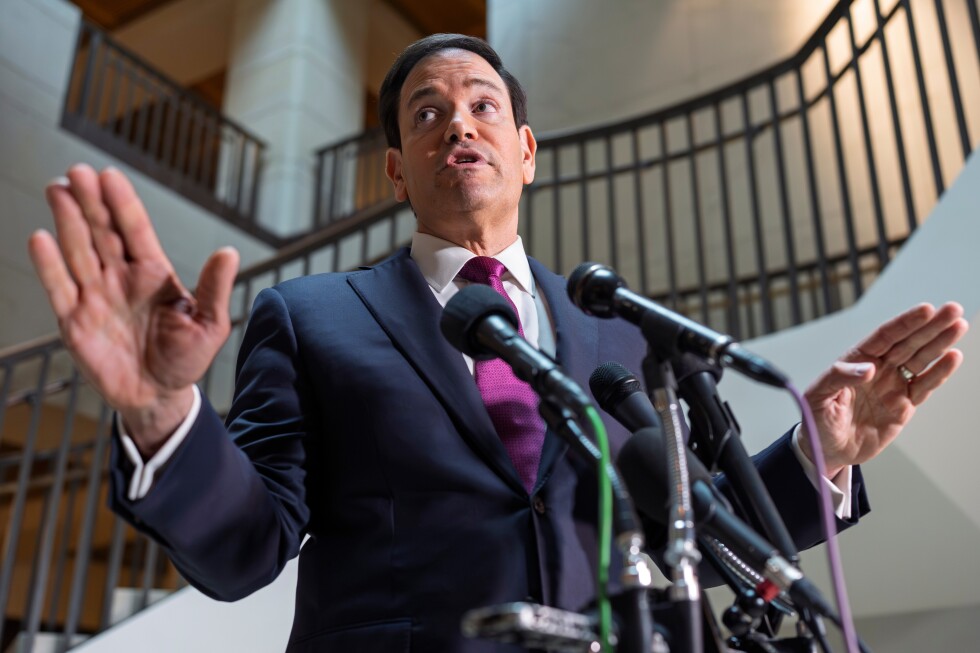
“The president determined we were not going to get hit first. It’s that simple,” Secretary of State Marco Rubio said in a testy exchange with reporters at the Capitol.
Rubio pushed back on his own suggestion a day earlier that Trump decided to strike Iran because Israel was ready to act first. Instead, he said Trump made the decision to attack this past weekend because it presented a unique opportunity with maximum chance for success.
“There is no way in the world that this terroristic regime was going to get nuclear weapons, not under Donald Trump’s watch,” he said.
The sudden pivot to a U.S. wartime footing has disrupted the political and policy agenda on Capitol Hill and raised uneasy questions about the risks ahead for a prolonged conflict and regime change after the killing of Iran’s Supreme Leader Ayatollah Ali Khamenei. At least six U.S. military service personnel have died so far.
The situation has intensified the push in Congress for the war powers resolution — among the most consequential votes a lawmaker can take, with the war well underway — as administration officials are telling lawmakers they will likely need supplemental funds to pay for the conflict. It comes at the start of a highly competitive midterm election season that will test Trump’s slim GOP control of Congress.
Senate Democratic Leader Chuck Schumer left the closed hearing, saying he was concerned about “mission creep” in a long war.
Defense Secretary Pete Hegseth arrives for a briefing for lawmakers on Iran at a secure room in the basement of the Capitol in Washington, Tuesday, March 3, 2026. (AP Photo/J. Scott Applewhite)
Defense Secretary Pete Hegseth arrives for a briefing for lawmakers on Iran at a secure room in the basement of the Capitol in Washington, Tuesday, March 3, 2026. (AP Photo/J. Scott Applewhite)
Senators demand answers, and some cheer Trump on
Senators spent the morning grilling Trump officials during an Armed Services Committee hearing over Rubio’s claim Monday that the president, believing that Israel was ready to act, decided it was better for the U.S. to launch a preemptive strike to prevent Iran’s potential retaliation on American military bases and interests abroad.
Sen. Angus King, the independent from Maine, said it’s “very disturbing” that Trump took the U.S. to war because Israel’s Prime Minister Benjamin Netanyahu wanted to bomb Iran. Past U.S. presidents, he said, “have consistently said, ‘No.’”
Defense official Elbridge Colby told senators the president directed the military campaign to destroy Iranian missiles and deny the country nuclear weapons.
Trump himself disputed the idea that Israel had forced his hand. In his own Oval Office remarks, he said, “I might might have forced their hand.”
Sen. Markwayne Mullin, a Trump ally from Oklahoma, said the president “did the world a favor.”
“How about we say, ‘Thank you, Mr. President, for finally getting rid of this nuisance,’” he said.
But Sen. Elizabeth Warren, D-Mass., demanded to know how this fits into Trump’s “America First” campaign promise not to commit U.S. troops to protracted military campaigns abroad.
Trump has suggested the war could drag on, and has not ruled out sending American troops into Iran.
“’America First’ and ‘peace through strength’ are served by rolling back — as the military campaign is designed to do — the threats posed,” Colby responded. “This is certainly not nation-building. This is not going to be endless.”
Senate Majority Leader John Thune, R-S.D., arrives for a briefing for Senators on Iran at a secure room in the basement of the Capitol in Washington, Tuesday, March 3, 2026. (AP Photo/J. Scott Applewhite)
Senate Intelligence Committee Sen. Mark Warner, D-Va., speaks to reporters following a House and Senate Intelligence Committees briefing about the war in Iran at the Capitol in Washington, Monday, March 2, 2026. (AP Photo/Manuel Balce Ceneta)
What’s next for the Iranian regime and its people
Questions are growing over who will lead Iran after the death of Khamenei, who has ruled the country for decades, and worries of a leadership vacuum that creates unrest.
Democrats warned against sending U.S. military troops into Iran after more than two decades of war in Iraq and Afghanistan in the aftermath of the Sept. 11, 2001, attacks.
“I am more fearful than ever we may be putting boots on the ground,” said Sen. Richard Blumenthal, D-Conn., after the closed briefing.
And while House Republicans applauded in support of the Trump administration’s operations, warning signs flared.
Rep. Chip Roy, R-Texas, said he supports the operation, for now. “My flag starts going up, the longer this goes, my flag starts going up, the more there’s boots on the ground,” he said.
Many lawmakers expressed concern over the number of Americans calling their offices seeking help evacuating from the region as the war spreads. “It’s getting worse, not better,” said Rep. Jason Crow, D-Colo., a former Army Ranger.
Trump, in calling for Iranians to seize this opportunity to take back their country, has acknowledged the uncertainty.
“Most of the people we had in mind are dead,” Trump said Tuesday. He also panned the idea of elevating Reza Pahlavi, the exiled crown prince of Iran’s last shah, to take over in Iran.
Republicans insist it’s not for the Americans to decide the future of Iran.
“That’s going to be largely up to the Iranian people,” said Senate Majority Leader John Thune, a Republican.
House Speaker Mike Johnson said flatly, “We have no ability to get into the nation-building business.”
President Donald Trump departs after a Medal of Honor ceremony in the East Room of the White House, Monday, March 2, 2026, in Washington. (AP Photo/Alex Brandon)
President Donald Trump departs after a Medal of Honor ceremony in the East Room of the White House, Monday, March 2, 2026, in Washington. (AP Photo/Alex Brandon)
War powers resolutions become a consequential vote
Both the House and Senate are preparing to vote on war powers resolutions that would restrain Trump’s ability to continue waging war on Iran without approval from Congress.
Under the U.S. Constitution, it’s up to Congress, not the president, to decide when the country goes to war. But lawmakers often shirk that duty, enabling the executive branch to amass more power to send the military into combat without congressional approval.
“Why are we spending billions of dollars to bomb Iran?” said House Democratic Leader Hakeem Jeffries, who said there would be strong support from Democrats for the resolution.
But Johnson has said it would be “frightening” and “dangerous” to tie the president’s hands at this time, when the U.S. is already engaged in combat.
Other lawmakers have suggested that if Congress does not vote to restrain Trump, it should next consider an Authorization of the Use of Military Force, which would require lawmakers to go on record with affirmative support for the Iran operation.
“The reason why there’s so much consternation on our side is because President Trump has not given us a clear reason why he is in Iran,” said Sen. Kirsten Gillibrand, D-N.Y. “If he wants to declare war on Iran, that is the job and responsibility of Congress under the Constitution.”
Former President George W. Bush sought, and received, authorization from Congress to launch the post-9/11 wars.
___
Associated Press writers Stephen Groves and Mary Clare Jalonick contributed to this report.



NEW YORK (AP) — United States President Donald Trump signed an executive order Thursday that could impose tariffs of up to 100% on some patented medicines from companies that do not reach agreements with his government in the coming months.
Companies that have signed a “most favored nation” pricing agreement and are actively building facilities in the United States to move production of patented drugs and their ingredients there will have a 0% tariff. For those that do not have a price agreement but are building projects of this type in the United States, a 20% tariff will apply, although it will increase to 100% in four years.
A senior government official told reporters on a conference call that companies still have months to negotiate before the 100% tariffs take effect: 120 days for the largest companies and 180 days for everyone else. The official, who spoke on condition of anonymity to preview the executive order before it was issued, did not identify any companies or drugs that were at risk of receiving the tariff increase, but noted that the government had already reached 17 pricing agreements with big pharma, 13 of which have already been signed.
In the order, Trump wrote that he considered these measures necessary “to address the potential deterioration of national security posed by imports of pharmaceutical products and pharmaceutical ingredients.” The order was announced on the first anniversary of Trump’s so-called “Liberation Day,” when the president unveiled new tariff rates on imports on nearly every country in the world, rocking the stock market. Those tariffs were among the levies that the Supreme Court struck down in February.
Some warned of the consequences of the tariffs announced Thursday. Stephen J. Ubl, chief executive of the pharmaceutical industry trade group PhRMA, said taxes “on cutting-edge drugs will increase costs and could put billions in U.S. investments at risk.” He noted the already extensive presence of the United States in biopharmaceutical production and noted that drugs obtained from other countries “the vast majority come from reliable allies of the United States.”
Trump has launched a barrage of new tariffs on America’s trading partners since the start of his second term, and has repeatedly promised sky-high levies on medicines made abroad. But the government has also used the threat of new tariffs to strike deals with big companies — such as Pfizer, Eli Lilly and Bristol Myers Squibb — over the past year, with promises of lower prices for new drugs.
Beyond company-specific rates, a handful of countries have reached trade frameworks with the United States to further limit tariffs on medicines. The United States will apply a 15% tariff on patented drugs to the European Union, Japan, South Korea and Switzerland, matching previously agreed rates for most goods, and will impose a 10% tariff rate on the United Kingdom, which, Thursday’s order noted, “will then be reduced to zero” under future trade agreements. The United Kingdom had previously said it had secured a 0% tariff rate on all medicines exported to the United States for at least three years.
Trump also presents an update on metal tariffs
Also on Thursday, Trump released an update on his 50% tariffs on steel, aluminum and copper. Starting Monday, tariff rates on those metals will be calculated based on the “full customs value” of what customers in the United States pay when purchasing foreign metal, according to the latest order, which government officials said will prevent importers from other countries from avoiding higher payments.
Products made entirely of steel, aluminum and copper will continue to be subject to a 50% tariff for most countries. But the government will also change the way it calculates tariffs for derived metals — or finished goods that contain some of these metals, but are not made entirely of them.
For a product whose metal makes up less than 15% of its total weight (such as the lid of a perfume bottle), only country-specific tariffs will now apply, officials told reporters Thursday. But for products with more metal, such as a mostly steel washing machine, they indicated that a tariff of 25% will be applied to the total value.
More sectoral taxes accumulate
Thursday’s orders are another example of Trump’s use of sectoral levies. The president used Section 232 of the Trade Expansion Act of 1962 to impose the tariffs, the same authority he cited to impose taxes on imports of automobiles, lumber and even kitchen cabinets. And many expect to see more product-specific tariffs later.
That’s because a Supreme Court ruling struck down blanket tariffs that Trump imposed using the International Emergency Economic Powers Act of 1977.
Although the February 20 court decision represented a significant blow to Trump’s economic agenda, the president still has many options to continue taxing imports aggressively. In addition to the sectoral levies, Trump also imposed a 10% tariff on all imports under another legal authority, just hours after the Supreme Court ruling, but that levy can only last 150 days. About two dozen states have already challenged the new tariffs.
Trump has maintained that his new taxes on imports are necessary to recover the wealth that was “stolen” from the United States. He claims they will reduce the decades-long U.S. trade deficit and bring manufacturing back to the country. But Trump has also resorted to tariffs over personal grudges or in response to political critics. And disrupting the global supply chain has proven costly for businesses and households already under pressure from rising prices.
___
This story was translated from English by an AP editor with the help of a generative artificial intelligence tool.

A federal judge on Friday denied the Trump administration’s bid to revive the defunct subpoenas targeting Federal Reserve Chair Jerome Powell, another blow to the Justice Department’s ability to execute President Donald Trump’s demands.
The subpoenas sought records from a $2.5 billion renovation project at the Fed’s headquarters in Washington. The investigation alleged Powell knowingly misled Congress about the project’s cost. The accusation became central to Trump’s public smear campaign against Powellwhom he appointed to the top Fed position in his first term.
Powell’s lawyers fought the subpoenas, and the Fed chief publicly argued the investigation was motivated by his refusal to succumb to Trump’s pressure campaign on the central bank to slash interest rates, which the president said will boost the U.S. economy.
In his orderChief Judge James E. Boasberg of U.S. District Court for the District of Columbia wrote, “The Government’s arguments do not come close to convincing the Court that a different outcome is warranted.” He rejected the DOJ’s motion to reconsider his March 13 decision to quash the investigation.
Boasberg wrote in his March 13 decision that “a mountain of evidence” suggested that “the Government served these subpoenas on the [Federal Reserve] Board to pressure its Chair into voting for lower interest rates or resigning.” The judge threw out the subpoenas, but the DOJ quickly filed a motion to reconsider.
On Friday, Boasberg ruled the DOJ’s motion “ignores the fact that its total lack of a good-faith basis to suspect a crime is relevant to the second, separate question of the subpoenas’ true purpose.”
The federal government can formally appeal Boasberg’s decision, which could complicate the confirmation process for Kevin WarshTrump’s pick to lead the central bank after Powell’s term as Fed chair ends next month.
Powell was joined by every living former Fed chair in denouncing the probe as an act of partisanship against the leader of an institution designed to be insulated from political pressure.
Two Republicans on the Senate Banking Committee, Sens. Thom Tillis of North Carolina and Kevin Cramer of North Dakota, expressed deep concern over the investigation. Sen. Lisa Murkowski, R-Ala., called the probe “an attempt at coercion,” in a post on X in January.
Tillis is a key vote on the banking committee, which handles confirmation hearings for Fed appointees and has a narrow 13-11 Republican majority. He has vowed not to support Trump’s pick for Fed chair as long as Powell is under criminal investigation.
Sydney Carruth is a breaking news reporter covering national politics and policy for MS NOW. You can send her tips from a non-work device on Signal at SydneyCarruth.46 or follow her work on X and Bluesky.
Fallon Gallagher is a legal affairs reporter for MS NOW.

Today’s edition of quick hits.
* Iran’s military assets still matter: “An American fighter jet carrying two crew members was shot down today by Iranian forces, a U.S. official told MS NOW. The military has rescued a pilot of the F-15E, and a search is underway for the second crew member, two officials said.”
* In related news: “A second U.S. military plane involved in the U.S. war with Iran crashed on Friday, a U.S. official with knowledge of the matter told MS NOW. The plane’s pilot was safely rescued by American forces after it went down near the Strait of Hormuz. The crash was first reported by The New York Times. It was not clear if the plane, an A-10 Warthog, was shot down or crashed due to mechanical failure, the U.S. official said.”
* Crisis conditions in Lebanon: “The U.S. Embassy in Lebanon issued an alert Friday to U.S. citizens to ‘Leave Lebanon NOW,’ urging them to depart ‘while commercial flight options remain available.’ The alert said if people choose not to leave, they should ‘prepare contingency plans’ in case ‘the situation deteriorate further.’”
* A probe worth watching: “An expansive inquiry by the Department of Homeland Security’s inspector general into the handling of contracts under the agency’s former secretary, Kristi Noem, is scrutinizing her senior adviser Corey Lewandowski’s interactions with companies seeking federal business, according to multiple people familiar with the investigation.”
* The obvious call: “A federal judge on Friday reaffirmed his decision to block subpoenas from the Justice Department to the Federal Reserve on the grounds that the probe appears to be driven by a political vendetta, setting the stage for an appeal by the Trump administration.”
* Hegseth ice”https://apnews.com/article/pentagon-policy-guns-military-bases-hegseth-09cdd079f8ac28aa72b2349859e2f54e”>full of ideas: “Defense Secretary Pete Hegseth said Thursday that he will allow service members to carry personal weapons onto military installations, citing the Second Amendment and recent shootings at bases across the country.”
* In light of the occasional rumors about his possible retirement, this seems notable: “Supreme Court Justice Samuel Alito became ill during an event in Philadelphia on the evening of March 20, a spokesperson for the high court said Friday. … Alito, 76, underwent an examination and received fluids for dehydration, the spokesperson said, adding he returned home that night, which was previously planned.”
Have a safe weekend.
Steve Benen is a producer for “The Rachel Maddow Show,” the editor of MaddowBlog and an MS NOW political contributor. He’s also the bestselling author of “Ministry of Truth: Democracy, Reality, and the Republicans’ War on the Recent Past.”
- Artemis II astronauts are more than halfway to the moon as they seek to break Apollo 13’s record
- ‘Paradigm shift:’ How Trump’s budget request will keep everyone guessing
- Trump announces 100% tariff on some patented drugs
- ‘Bad idea’: Party-line plan for ICE funding has some fearing a slippery slope
- Bondi isn’t off the hook yet for Epstein testimony

- What to know about US fighter jets hit in Iran war

- Susan Collins knocks funding cuts in White House budget proposal

- 2 US helicopters hit during recovery efforts in Iran

- What to know about Trump’s defense budget proposal

- GOP senator calls to end Iran operations without formal declaration of war

-

 Politics1 year ago
Former ‘Squad’ members launching ‘Bowman and Bush’ YouTube show
-

 The Dictatorship1 year ago
Luigi Mangione acknowledges public support in first official statement since arrest
-

 Politics1 year ago
Former Kentucky AG Daniel Cameron launches Senate bid
-

 Politics1 year ago
Blue Light News’s Editorial Director Ryan Hutchins speaks at Blue Light News’s 2025 Governors Summit
-

 The Dictatorship7 months ago
Mike Johnson sums up the GOP’s arrogant position on military occupation with two words
-

 The Dictatorship1 year ago
Pete Hegseth’s tenure at the Pentagon goes from bad to worse
-
Uncategorized1 year ago
Bob Good to step down as Freedom Caucus chair this week
-

 Politics12 months ago
Democrat challenging Joni Ernst: I want to ‘tear down’ party, ‘build it back up’