
Congress
Swing-district Republicans are questioning Mike Johnson’s budget

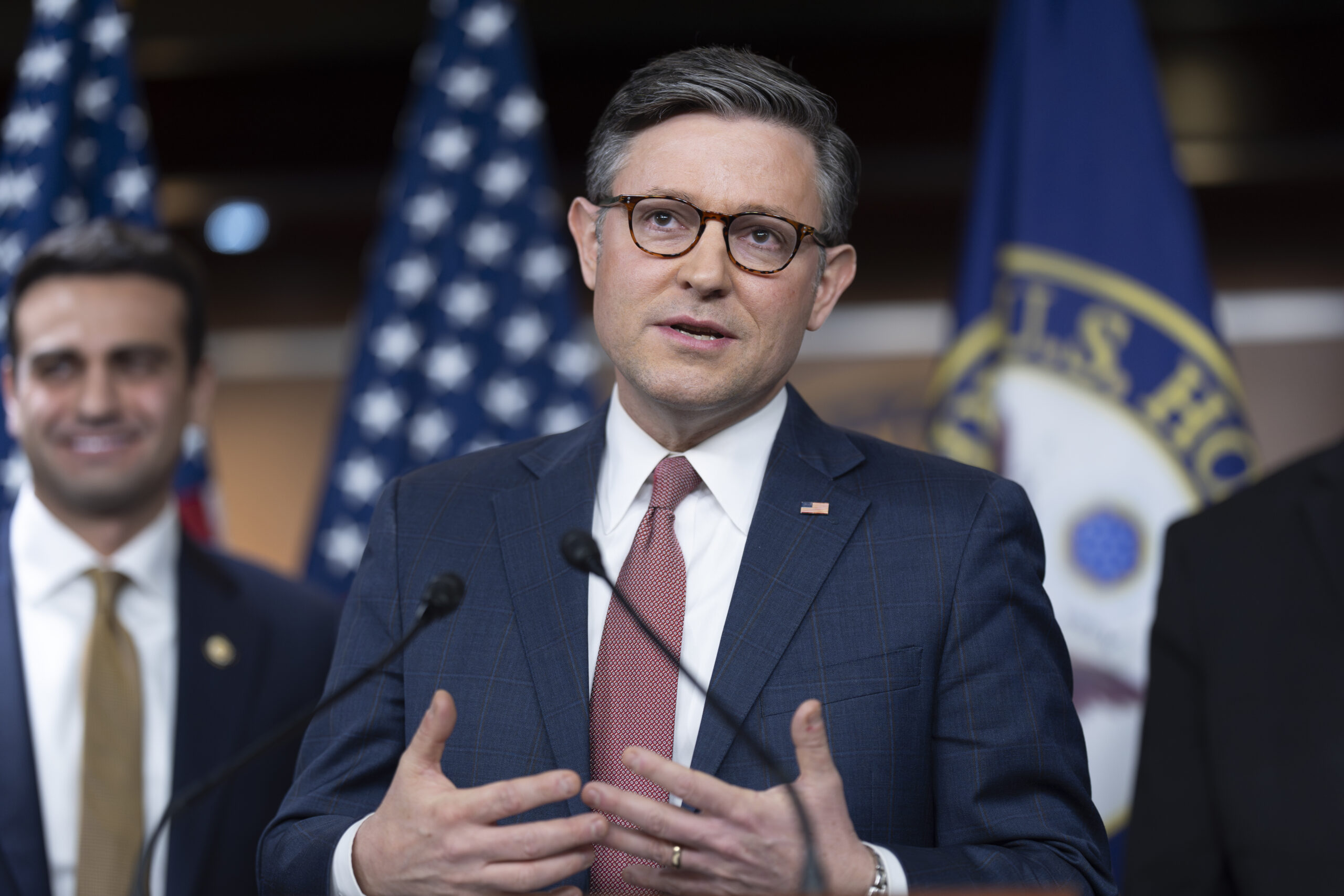
Speaker Mike Johnson has cleared a major hurdle toward unlocking the massive, party-line bill he’s pursuing to enact President Donald Trump’s vast domestic agenda. Now he’s got more jumping to do.
On Thursday, as Republican hard-liners celebrated a concession they won from party leaders to force deeper spending cuts as part of the GOP’s sweeping policy push, centrists expressed deep alarm about the trajectory of the massive legislation that will include border security, energy, defense and tax provisions.
The emerging fault lines are many: GOP members in high-tax blue states are concerned that the plan doesn’t leave enough room to expand the state and local tax deduction. And Senate Republicans and some House hard-liners aren’t ready to give up on a competing two-bill plan.
But Johnson’s most immediate problem comes from swing-district Republicans who believe that the steep spending cuts Johnson wants across Medicaid, food assistance and other safety-net programs for low-income Americans could cost them their seats — and Johnson his razor-thin GOP majority.
“I don’t know where they’re going to get the cuts,” said Rep. David Valadao, who represents a heavily Democratic district in central California, as he left the Capitol on Thursday.
The House Budget Committee cleared the fiscal blueprint for the massive policy bill on a party-line vote late Thursday night, and Johnson intends to bring it to the floor when the House returns from recess later this month.
But with a two-vote majority, Johnson has virtually no room for error. And opposition from members like Valadao could force him and committee chairs to go back to the drawing board.
Low-key and soft-spoken, Valadao is the stylistic and ideological opposite of the fire-breathing hard-liners on Johnson’s right flank. His district in California’s Central Valley is one of the six Hispanic-majority GOP seats where more than 20 percent of households receive food aid benefits from the Supplemental Nutrition Assistance Program, which is being targeted under the GOP budget for some $230 billion in spending cuts.
“Obviously Medicaid and SNAP are ones that I’m very much watching,” Valadao said.
He believes he is speaking for a larger group of House Republicans who are worried about what the cuts will mean for their districts. Johnson’s own Louisiana district has a high rate of households that rely on food assistance, and hospital systems across the country rely on Medicaid revenue to stay in the black.
“There’s a lot of us, even leadership themselves, I think a lot of their districts are in the same boat as mine or close to it,” Valadao said.
The California Republican is also among the Republicans from high-tax blue states who worried the latest budget plan doesn’t provide enough room to sufficiently expand the SALT deduction, with more than a dozen votes at stake.
It’s also far from certain how the House GOP plan will play in the Senate, which has a long history of heavily editing tax plans sent across the Rotunda. There’s roughly 40 provisions that expire at the end of this year, and Trump has a slew of tax cuts he wants on top of that, with lawmakers in both chambers prepared to do battle over their favorite perks.
The concerns about Medicare cuts go just as deep, including inside the White House. Valadao referenced private conversations Trump had with GOP centrists on that subject last month. The president himself has been reticent to approve anything that could be perceived as a cut to health care given the collapse of his prior efforts in that realm back in 2017.
Valadao, referring to the major Medicaid reforms that would be required under the House GOP budget plan, said, “I think that goes against what he’s said and has been saying to members, both privately and publicly.”
House Energy and Commerce Chair Brett Guthrie (R-Ky.), whose committee is tasked with shouldering more than half of the proposed spending cuts, has acknowledged that some changes to Medicaid might not be able to pass the House. That includes so-called per-capita caps, a major cost-saver that would convert the program from an open-ended entitlement to a population-based grant to states. But conservatives say the White House has been open to some Medicaid reforms, and House GOP leaders have been in close contact with administration officials.
Trump’s top economic adviser, Kevin Hassett, attended reconciliation meetings with GOP leaders and rank-and-file Republicans in the speaker’s office this week, according to two people familiar with the conversations. House Republicans view Hassett as supportive of Johnson’s one-bill approach, sharing their concerns that a separate tax package wouldn’t clear the chamber.
Nebraska Republican Don Bacon also expressed uneasiness about the potential level of Medicaid cuts that could hit his district, which Kamala Harris won in the 2024 presidential election.
“Most of us support work requirements for able-bodied adults with no children, and we should make sure it’s not going to people who don’t qualify,” Bacon said.
“Beyond that, President Trump said he was reluctant to see cuts in Medicaid that will impact the most needy,” he added. “His gut instinct is right here.”
If that wasn’t enough, some on the hard right are still suggesting they want further changes to the budget framework before they support it on the House floor.
Rep. Andy Ogles (R-Tenn.) on Thursday said he wanted to pursue alterations to the plan over recess, including securing guarantees about “where the cuts are coming from” in specific committees. Asked if he thought GOP leaders were open to additional changes, Ogles replied, “They don’t have the votes, so I think they’re compelled to work with us.” He added that things were trending in “the right direction.”
GOP leaders’ decision to include a $4 trillion debt ceiling hike in the budget blueprint is adding a further complication. Lifting the federal borrowing limit is deeply controversial among Republicans, and several GOP members, including Reps. Tim Burchett of Tennessee and Thomas Massie of Kentucky, have never voted to do so.
Other ultraconservative members are finding reasons to be skeptical. Rep. Keith Self (R-Texas), a member of the House Freedom Caucus, said he doubted a key economic assumption budget writers used to claim that their plan wouldn’t add to the national debt.
GOP leaders assert that enacting the tax cuts and other measures in the bill will result in 2.6 percent average annual GDP growth— well above the current 1.8 percent projection of the nonpartisan Congressional Budget Office.
“That in and of itself is extremely optimistic,” Self said. “I was very concerned when I started hearing people saying, ‘Well, we can just grow our way out of this.’”
“We cannot,” he added.
Brian Faler and Ben Leonard contributed to this report.


SYRACUSE, New York — President Donald Trump came to New York on Friday to help a Republican win an uphill race for governor. But his visit was also a reminder of the complicated role he plays in his party’s fight to keep control of Congress.
Trump rallied alongside GOP gubernatorial nominee Bruce Blakeman, calling on New Yorkers to fire Gov. Kathy Hochul and, referring to the state attorney general, “her totally corrupt sidekick, Letitia ‘Peekaboo’ James.”
“Your city and state are dirty, filthy places, and everybody wants to leave,” he told some 5,000 attendees at a convention center in downtown Syracuse — which, he noted, was “a short distance from the beautiful shores of Lake America.”
“You gotta get your act together, and I tell you what, Bruce Blakeman will get your act together,” Trump said.
For Republicans, the president’s appearance underscored a political dilemma that extends beyond New York: Even as Trump increasingly appears to be a drag on their ticket, they need his loyal supporters to energize their base. While voters have soured on the president’s handling of the economy and costs, he remains a potent force in turning out MAGA voters — even in an otherwise Democratic-dominated state.
“The targeting of where the president goes is not a random exercise,” Marist University pollster Lee Miringoff said. “They’re looking to stir the base without stirring the opposition. They’re picking and choosing, that’s not uncommon. For him to come to New York to help the turnout upstate is a positive for the Republicans and his base.”
Blakeman, the Nassau County executive, hasn’t distanced himself from the president — nor have most of the top officials in New York’s GOP. Nearly every Republican running a competitive congressional race in this half of the state came to Friday’s rally, eager to make their presence known.
“I’m always happy to be with the president,” said Anthony Constantino, who’s running in a nearby red district that’s inched into toss-up territory. “He’s the leader of the free world, and I’m excited to have a great relation with him.”
Some GOP operatives, however, have quietly grumbled that their candidates need to start creating some distance from the president. Republicans from other parts of the state like Rep. Mike Lawler decided that campaigning in their districts was more valuable than trekking to be seen with Trump — as did several down-ballot candidates in Central New York. Democrats, notably, have been just as eager to highlight the visit.
“This is supposed to be a swing district. And the feedback I get is that the president is very unpopular,” said Democratic Rep. John Mannion, who represents Syracuse and the surrounding Central New York area. “He still certainly will have his core base of supporters, but I do think he’s lost support here compared to what he had around the 2024 election.”
Blakeman, for his part, isn’t worried about Trump’s drop in popularity.
“Kathy Hochul should be worried about her drop in popularity,” he said before taking the stage in Syracuse. “She’s the most unpopular governor in the history of the state of New York.”
Trump’s visit came against the backdrop of a darkening political environment for New York Republicans.
Immigration and Customs Enforcement shot a man in Manhattan on Thursday afternoon, stirring fresh condemnation of Trump’s aggressive deportation policies. New York City Mayor Zohran Mamdani, a democratic socialist who has a surprisingly warm relationship with the president, called on him to cease all ICE activity in the five boroughs. Hochul stressed that the shooting took place with a five-year-old child present and demanded that federal authorities “provide answers.”
Immigration is one of several areas where Blakeman has hewed close to the Trump wing of the party throughout his campaign.
“I’m outraged with Kathy Hochul for taking sides with somebody who was a convicted felon, someone who was an alleged drug dealer, a gang member,” he said Friday about the shooting in Manhattan.
While Trump’s speech repeatedly careened back to the rhetoric one could expect from any of his rallies — boasts about the stock market, complaints about ‘Dumocrats’ — he did manage to seamlessly blend almost all of Blakeman’s oft-used talking points into his stump speech.
“Since Hochul took office, she’s raised your utility rates 48 times, and energy prices in New York have skyrocketed 100 percent,” Trump said. “If Bruce Blakeman gets in, he will cut your electric bills by 70, 80, 90 percent.”
The climate outside of deep blue New York City is also turning increasingly hostile to the GOP. Constantino, who’s running to succeed Rep. Elise Stefanik in upstate New York, trails his Democratic foe Blake Gendebien by 4 points, a Siena Research Institute survey released Friday morning found. A Blue Light News poll showed that nationally one in four Trump voters believe Republican candidates should break from the president in order to win in November.
The wisdom of appearing with Trump has been debated by Republicans throughout the country at a time when gas prices are high and a foreign war drags on. And New York Democrats aren’t viewing the presidential visit as a concern.
Much of Hochul’s messaging this year has focused on making sure New Yorkers know Blakeman and Trump are friends. Her most-aired TV commercial features a puppeteer saying one Republican would do the other’s bidding.
“Puppets are my life. You tell them what to say, they say it,” the narrator says. “But that’s not what you want in a governor.”
Earlier in the day during an MSNOW interview, Hochul dismissed the rally.
“It’s obviously a very political event,” she said. “It seems like a last-ditch effort to breathe some life into a campaign that’s on life support.”
Despite his low approval ratings with voters, Trump’s visit stands to light up a Republican base that Blakeman will need to turn out next month to help him defeat Hochul.
Polling has shown the governor leading the GOP nominee by as much as 18 points in this deep blue state. Yet some Trump supporters maintain the president can help generate much-needed enthusiasm for Blakeman, especially in areas of upstate New York where the Long Island native is not well known.
“We actually have the ability to win these elections, but I just don’t see the enthusiasm out there,” Conservative Party Chair Gerard Kassar said. “Hochul has won the day as far as being a terrible governor, but now we’ve got to get our people out to vote.”
Winning is still a tall order for Blakeman — especially in a tough national political environment where polls show GOP candidates in red states like Texas, Ohio and Kansas struggling against Democratic challengers.
Republicans have not won statewide in New York since George Pataki secured a third term in 2002. Since then, the GOP has lost all levers of statewide power, and Trump’s tariffs as well as his decision to launch a war in Iran have not helped him fulfill his campaign pledge of addressing voters’ cost concerns.
The president’s political woes aren’t going unnoticed.
Privately, Republican operatives grumbled that the president’s visit put swing seat candidates in an uncomfortable spot.
“There’s a lot of commiserating between folks within the party structure — why is this happening? Why is he doing this?” said one Republican operative who was granted anonymity to freely discuss the dynamic. “Then you’ve got the blind loyalists who say, ‘Yay Trump’s coming’ — people who are too politically dumb to understand the ramifications of it.”
Yet the head of the Republican party kept his message very much in line with Hochul’s.
“Please pretend I’m on the ballot,” Trump told Central New Yorkers.
Sen. Chris Murphy wants Democrats to go big for Angie Nixon in Florida’s Senate race — and he’s pushing to raise some “serious money” to help.
“I do believe that we’d make a big mistake if we slept on Florida,” the Connecticut Democrat told Blue Light News on Friday. “I know it feels like a longer shot, but I just think this year is looking exceptional.”
Murphy plans to hit the trail with Nixon as part of a campaign swing for Senate candidates over the next three weeks that will take him through North Carolina and Florida, as well as events with Abdul El-Sayed in Michigan, Peggy Flanagan in Minnesota and Chris Pappas in New Hampshire. Murphy will serve as a surrogate for El-Sayed in the spin room at his next debate, and said he’s “just a big believer” in the Michigan Senate nominee.
Murphy’s bullishness about a blue wave comes as Senate Democrats are pushing the boundaries of a midterm battle map that is shifting further into red territory. The Chuck Schumer-aligned Senate Majority PAC has dropped roughly $5 million apiece into Texas and Kansas over recent days, and the minority leader has included Kansas and Mississippi in his pitches to donors.
“If I were in charge, I would definitely put some resources in Florida,” Murphy said. “When you have an exciting candidate like this, it’s a good long-term investment” in growing Democrats’ activist base.
Still, Murphy stressed he’s “not making any formal recommendations” on where Schumer or top Democratic campaign groups should move their money.
“They’ve got so many mouths to feed,” Murphy said. “That’s why I’m going to try to step up and do some work on my own.”
Murphy, who is considered a potential 2028 presidential contender, has spread roughly $2.5 million across candidates, campaign arms and other organizations this cycle. That includes transferring more than $500,000 to Democrats’ three top campaign arms and 25 state parties.
Prominent Democrats have been ramping up their attention on Florida. Sen. Bernie Sanders (I-Vt.) has funneled $250,000 toward Nixon’s campaign, along with other resources. Sen. Ruben Gallego (D-Ariz.) also told Blue Light News he hopes to campaign with Nixon.
But Democrats across suddenly competitive red states are clamoring for more cash and Florida is an expensive state, complicating the chances of a significant investment from national groups.
Nixon also faces an uphill battle against GOP Sen. Ashley Moody in the Sunshine State. A progressive state lawmaker, Nixon aligned herself with the Democratic Socialists of America over the summer in a state where many voters, especially those with ties to Cuba, reject such an ideology. Also, Republicans in Florida have a 1.5 million voter registration advantage over Democrats.
Senate Democrats’ top super PAC is pushing into Kansas.
The Chuck Schumer-aligned Senate Majority PAC is launching a $5 million statewide television ad blitz starting Saturday through Election Day — the latest sign that Democrats believe the Senate map is shifting onto red turf.
SMP had signaled in recent days it could get involved in the race, telling Blue Light News late last month it was “actively thinking” about whether to wade into the state where Democrats haven’t won a Senate seat in nearly a century but where Adam Hamilton narrowly leads GOP Sen. Roger Marshall in recent polls. Internal SMP polling that found an increasingly competitive race factored into the group’s decision to spend. It will also run digital ads.
“The gap is closing in Kansas,” SMP spokesperson Lauren French said in a statement. “We are committed to ensuring families understand Marshall’s real record of making health care and basic goods more expensive for working Kansans.”
Republicans are scrambling to shore up Marshall. Senate Leadership Fund, a top GOP super PAC aligned with Republican leadership, has booked over $10 million in ads through Election Day in the state, per ad tracking firm AdImpact.
SMP’s first ad attacks Marshall for joining Senate Republicans in voting to table a Democratic-led amendment last year to release the Jeffrey Epstein files. The Senate later approved legislation to release the files by unanimous consent. It’s the latest in a slate of ads from Democrats hitting their Republican rivals over the late, disgraced financier and convicted sex offender. Marshall’s campaign did not immediately respond to a request for comment.
Senate Democrats’ plunge into the state comes as the midterm battle map is undergoing a major realignment. Georgia and North Carolina — primed to be two of the cycle’s premiere battlegrounds — are tilting left to the point where national Republicans are retracting spending in both states and Democrats are starting to follow suit, freeing funds on both sides to shift elsewhere.
Republicans are racing to reinforce incumbents across what was once safer red turf. SLF has also pledged $5 million to bolster Sen. Darline Graham in South Carolina.
Democrats, meanwhile, are starting to spend more in red states. SMP has dropped over $2 million on digital ads in Texas. Schumer, the Senate minority leader, has included Kansas and Mississippi in his pitches to donors.
-

 Politics2 years ago
Former ‘Squad’ members launching ‘Bowman and Bush’ YouTube show
-
Uncategorized2 years ago
Bob Good to step down as Freedom Caucus chair this week
-

 The Josh Fourrier Show2 years ago
DOOMSDAY: Trump won, now what?
-

 The Dictatorship2 years ago
Pete Hegseth’s tenure at the Pentagon goes from bad to worse
-

 Politics2 years ago
Former Kentucky AG Daniel Cameron launches Senate bid
-

 The Dictatorship2 years ago
Luigi Mangione acknowledges public support in first official statement since arrest
-

 Politics2 years ago
Blue Light News’s Editorial Director Ryan Hutchins speaks at Blue Light News’s 2025 Governors Summit
-

 The Dictatorship1 year ago
Mike Johnson sums up the GOP’s arrogant position on military occupation with two words