
Congress
Stefanik accuses Johnson of lying, ‘blocking’ her defense bill provision

Rep. Elise Stefanik is taking aim directly at Speaker Mike Johnson over signals a provision she has championed won’t be included in the annual defense policy bill the House wants to pass next week — marking a notable and unusual split inside the House GOP leadership team.
Stefanik, a New York Republican who serves as a member of Johnson’s leadership team, said in a social media post Tuesday morning she would help tank the National Defense Authorization Act if it doesn’t incorporate her provision that would require the FBI to notify Congress when it opens investigations into candidates running for federal office.
“This is an easy one,” the New York Republican posted on social media Tuesday morning. “This bill is DOA unless this provision gets added in as it was passed out of committee.”
Stefanik also blamed Johnson for the expected omission.
“[T]he Speaker is blocking my provision to root out the illegal weaponization that led to Crossfire Hurricane, Arctic Frost, and more,” she wrote on X. “He is siding with Jamie Raskin against Trump Republicans to block this provision to protect the deep state.”
Stefanik’s proposal, which would require the public disclosure of all “FBI counterintelligence investigations into presidential and federal candidates seeking office,” is designed to combat what many Republicans consider politically motivated investigations related to Russian interference in the 2016 election and former special counsel Jack Smith’s probe into President Donald Trump’s efforts to subvert the election in 2020.
Asked about whether he thwarted the provision’s inclusion in the NDAA, Johnson said Stefanik’s retelling of events is “false.” He said he supported the provision and that there could still be a path for its passage in some other legislative vehicle.
“I don’t exactly know why Elise just won’t call me,” he said, recalling that he told his colleague over text, “What are you talking about? This hasn’t even made it to my level.”
Johnson explained the bipartisan leaders of the House and Senate Judiciary Committees, who he suspected have jurisdiction over this issue, had not agreed to include the language, leading to the provision being dropped from the defense bill. A spokesperson for Rep. Jamie Raskin of Maryland, the top Democrat on the House Judiciary panel, deferred to Johnson’s explanation.
Stefanik quickly responded in another post on X, “Just more lies from the Speaker,” while insisting the Intelligence Committee, on which Stefanik sits, has jurisdiction over her provision.
Leaders of the House and Senate Armed Services Committees have been negotiating the NDAA for weeks and could roll out a compromise package as soon as Thursday; Stefanik said in her social media post that she got early details of that package in an Intelligence Committee briefing.
The narrow GOP majority in the House means that Johnson can barely afford to lose any Republican support if Democrats reject the legislation en masse, but it’s far from guaranteed Stefanik’s opposition will doom the NDAA on its own.
While most Democrats opposed the hard-right version of the Pentagon bill the House passed in September, more Democrats might come on board to support a compromise measure and make up for a shortfall of votes on the Republican side of the aisle. The NDAA is typically a broadly bipartisan package.
Connor O’Brien contributed to this report.


Rep. Chuck Edwards, who dropped his plans for reelection following a scathing House Ethics report earlier this month, lobbied his colleagues this week to oppose an expected censure resolution that would condemn him over claims of inappropriate conduct towards two female staffers.
The North Carolina Republican argued in a six-page letter obtained by POLITICO that his conduct did not amount to sexual harassment, arguing that the Ethics Committee selected specific pieces of evidence to fit a narrative. He also told fellow House members that while he did not expect them to approve of every action detailed in the report, “context matters” when it comes to the consequences.
“I am asking you to distinguish between the conduct that someone, examining isolated excerpts after the fact, might consider unconventional and conduct that actually establishes sexual harassment,” Edwards wrote. “That distinction is critical because of what the Committee did not find.”
The House Ethics Committee report released Aug. 3 recommended censuring Edwards for engaging in “persistent unprofessional and inappropriate conduct towards two young female staffers.” Edwards dropped his reelection bid two days later amid pressure from House Republican leaders.
Edwards’ letter, to which he appended a fact sheet and a 14-page response memo provided to the committee by his lawyers, is being circulated ahead of the censure vote, which could happen as soon as next week. NOTUS first reported on Edwards’ letter.
A spokesperson for Edwards did not immediately respond to a request for comment.
Edwards said in the letter that his interactions with the two female employees were similar to how he treated the rest of his staff, outlining examples of similar gifts he’d given and trips he’d taken with other staffers.
The Ethics Committee’s determination that his actions “could be interpreted as romantic,” he argued, did not mean he made unwanted sexual advances.
“An affectionate friendship is not a sexual proposition. A gift is not sexual misconduct. A compliment is not sexual misconduct. Poetry is not sexual misconduct. Socializing with a colleague is not sexual misconduct. Caring deeply about someone with whom you have worked and come to know for years is not sexual misconduct,” Edwards wrote.
Edwards also said investigators failed to take into account preexisting relationships with some of the staffers from before he was in Congress.
“That history matters. Gift-giving, travel, time together outside the office, and familiarity with my home did not suddenly emerge after I became a Member of Congress,” Edwards said. “They were established features of longstanding relationships. Yet despite knowing this history, the Committee completely omitted it from its report while assigning a different meaning to similar conduct in Washington.”
Edwards’ claims seek to undermine the committee’s investigative report, which found that the two women “were uncomfortable with his behavior (which they attempted to communicate) but were put in an untenable position by virtue of his status as their boss and a Member of Congress.”
At one point, a senior staffer confronted Edwards over his dealings with the young women — which included frequent public comments about their dress and appearance as well as a series of lavish gifts.
That staffer testified that “Edwards ‘got very angry’ and said she ‘didn’t understand the unique relationship’ he had with them,” according to the report.
The panel said its findings were based on a “thorough” record that “includes not only significant testimony from multiple witnesses, but also contemporaneous text messages.”
Edwards claimed in his letter that investigators cast those messages and testimonials in a false light, writing that “conduct does not become sexual harassment merely because someone looking backward through thousands of pages can construct a theory under which it ‘could be interpreted as romantic.’”

A sudden cut to Social Security checks — long seen as a far-off doomsday — is now an imminent problem for the next president and whomever voters send to Congress in the coming years.
The trust fund that bankrolls monthly checks to retirees is set to be drained of reserves in late 2032. That means tens of millions of Americans age 62 and older, as well as children and widowed spouses who get survivor benefits following the death of a family member, would see their monthly payments shrink by more than 20 percent — or an average of about $500 a month — unless Congress and the president act.
Capitol Hill saw a noticeable surge this summer in the sense of urgency to enact a fix, and alliances have started forming between prominent Republicans and Democrats rallying for a solution. But President Donald Trump and congressional leaders have yet to join the calls to action or back any of the numerous bipartisan bills aimed at preventing benefit cuts.
“This train wreck is going to happen,” Rep. Steve Womack (R-Ark.) said in an interview. “So as early as six years from now, we’re going to have to have a plan. And of course, I’m a big believer that we need to deal with it now, or we need to start the process of dealing with it now.”
Trump has yet to signal interest in a specific fix for the federal government’s single largest safety-net program, sticking instead to broad promises to safeguard benefits.
House Appropriations Chair Tom Cole (R-Okla.) recalled discussing the issue with Trump during his first term as president.
“He said, ‘Tom, I’ll be for this the first day of my second term,’” Cole told reporters this summer about trying to get Trump to push for a fix. “Well, we’re here.”
White House spokesperson Liz Huston said in a statement that Trump “will always protect and strengthen Social Security” and noted that the Republican megabill enacted last summer created a temporary tax deduction for people 65 and older that can be used to reduce taxes owed on Social Security benefits.
“Under his leadership, there will be zero reductions to Social Security payments,” she said, without specifying how Trump proposes to address the 2032 cliff.

Trump isn’t the only Washington power player uninterested in risking their political legacy by diving into a policy thicket where proposals include hiking payroll taxes, raising the age for benefit eligibility or letting some taxpayer cash ride the waves of the stock market.
Senate Majority Leader John Thune and Speaker Mike Johnson rarely discuss the approaching benefit cliff, nor have they called to advance any of the bills lawmakers have proposed to prevent it — prompting criticism this summer from top Democrats demanding the two GOP leaders “put forward their plan” to protect Social Security.
Meanwhile, some lawmakers have been telling voters the whole notion of a cliff is a hoax.
“Your Social Security is safe. You can write that down and take it home to mama,” Sen. John Kennedy (R-La.) said at an event this summer. “All we got to do is go take the money out of the general fund, which we always do.”
But backfilling a depleted trust fund with Treasury dollars, as Kennedy suggests, would not be automatic. Congress would need to pass a bill to do so, and winning support to siphon that cash could be difficult considering the U.S. public debt zoomed past $40 trillion this month after exceeding the nation’s annual economic output earlier this year.
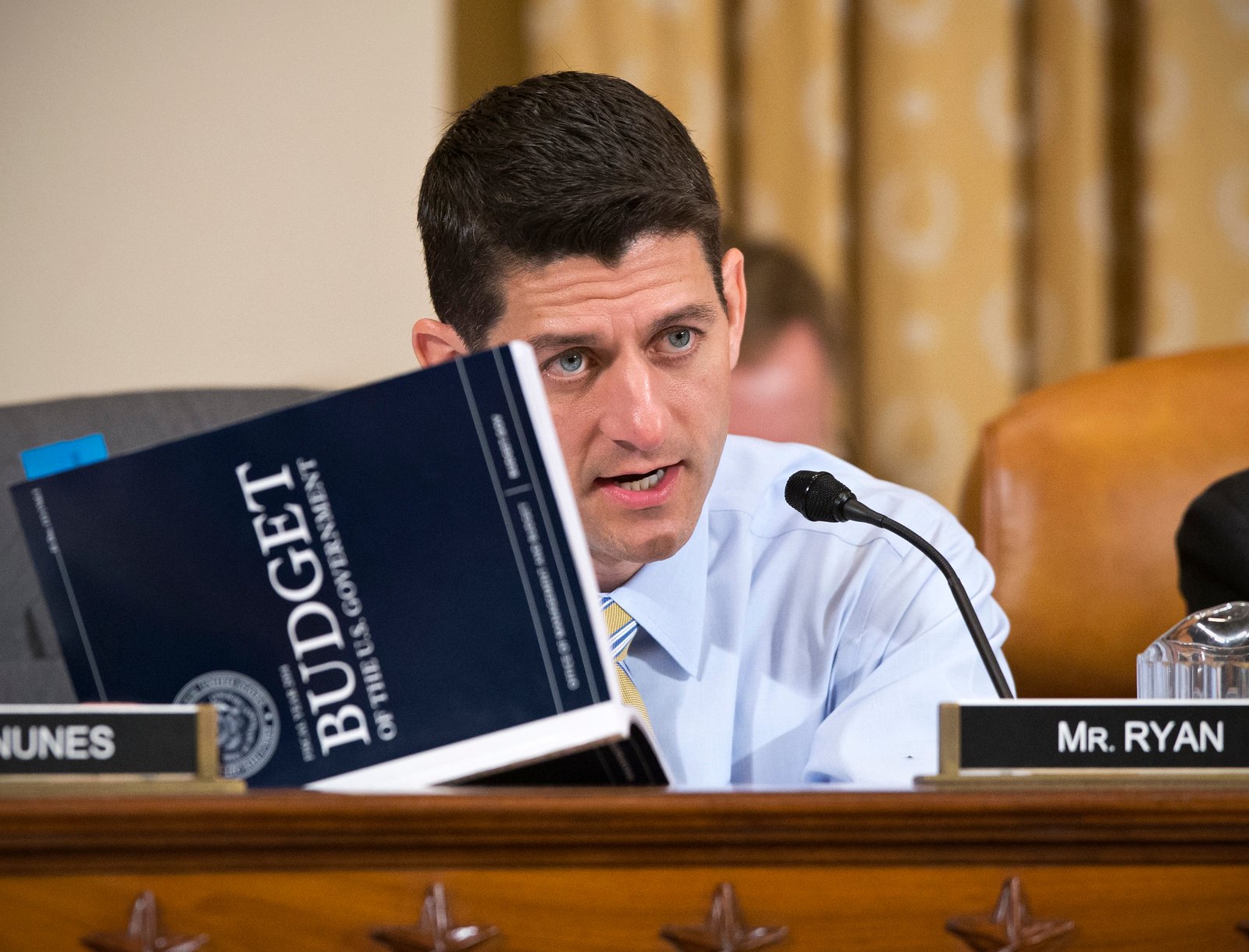
“Those are the politics that are bringing us a debt crisis,” former Speaker Paul Ryan said in an interview, knocking the “populist” approach lawmakers like Kennedy are taking in assuring voters that Social Security benefits would be covered by growing the deficit.
During the presidencies of George W. Bush and Barack Obama, Ryan pushed controversial plans to invest some Social Security contributions into private savings accounts and make changes like raising the retirement age.
“Regrettably, if we had reformed it back when we were trying to in the Bush administration, we would not be at this place,” Ryan said. “But the politics got the better of us in those days.”
Ryan was a member of the bipartisan 2010 fiscal commission led by Democrat Erskine Bowles and Republican Alan Simpson but ultimately voted against the group’s final proposal, which included plans to increase the age for receiving full Social Security payments, changing the formula for benefits and taxing more wages.
Obama backed away from a deal in 2011 with then-Speaker John Boehner to enact changes to Social Security as part of a broader fiscal “grand bargain.”
Today, not only is the Social Security cliff much closer, but the nation’s overall fiscal trajectory has worsened. In recent weeks, market watchers have blamed endless deficits for helping spike long-term Treasury bond yields — increasing borrowing costs and raising fears of a “debt spiral.”
Fixing the Social Security benefit cliff is not the same as solving the country’s larger fiscal issues. But it could be a test case for Washington’s ability to make difficult tradeoffs that will be necessary to bring deficits under control.
“My sense is that there’s pretty wide recognition of the fiscal situation — that the fiscal trajectory is unsustainable,” Congressional Budget Office director Phillip Swagel said in an interview. “And the interest in Social Security seems like the first kind of translation … into sort of realistic policy alternatives.”
The last time Social Security was headed toward insolvency, in the early 1980s, Congress didn’t enact a solution until a few months before benefits were set to be cut. A commission appointed by then-President Ronald Reagan developed proposals for overhauling the safety-net program, and lawmakers then passed a 1983 overhaul that gradually increased the age for receiving full benefits to 67 and raised taxes on those benefits, among other tweaks.
In a nod to Reagan’s approach, Cole and Rep. Tom Suozzi (D-N.Y.) released a bill this summer to create a bipartisan commission that would recommend a plan for staving off benefit cuts and then fast-track that proposal through Congress on an up-or-down vote. Several Republicans and Democrats are signed on to a similar bill across the Capitol led by Sens. Bill Cassidy (R-La.) and Dick Durbin (D-Ill.), both of whom are leaving office at the end of the year.
“The senators elected this November will be here when we have to solve this. The next president who’s elected will be here when we have to solve this,” Sen. Tim Kaine (D-Va.), a sponsor of that Senate bill, said in an interview. “So rather than wait till 2032, let’s go ahead and get this started now.”
Those bipartisan plans have critics on Capitol Hill, however. Sen. Bernie Sanders (I-Vt.) publicly warned Democrats this month not to allow Republicans “to slash or privatize Social Security through an unelected commission.” And backlash has emerged to other proposals that have delved into controversial policy specifics.
For instance, anti-tax advocate Grover Norquist has slammed a bill from the odd-bedfellows duo of progressive Sen. Elizabeth Warren (D-Mass.) and MAGA Sen. Bernie Moreno (R-Ohio) that would make the nation’s highest earners pay Social Security payroll taxes on 100 percent of their earnings.
Rep. Brendan Boyle (D-Pa.), who has pushed a similar plan for years, said in an interview that because Trump “has absolutely no interest whatsoever in solving this problem,” the issue needs to be at the center of the presidential primary debates for Trump’s successor.
“Like it or not,” Boyle said, “this will be on the plate of the next president.”
Pressure is growing on House GOP leaders to allow a floor vote before the midterms on legislation designed to shield their constituents from the costs associated with data centers, with an increasing number of Republicans worried that mounting opposition to the energy-sucking facilities could hurt them at the polls.
Reeling from voter complaints over the five-week summer recess about rising power prices linked to the nationwide data center boom — necessary to power the growing artificial intelligence demand — some Republicans are now pressing for action around a bill called the Ratepayer Protection Act.
The bipartisan measure, which advanced unanimously out of the House Energy and Commerce Committee in July, would require states to consider adopting a federal standard that would ensure data centers cover the costs of the grid upgrades needed to serve them.
“I’m encouraged by the momentum behind the Ratepayer Protection Act, and I’m hopeful we’ll see it come to the floor when Congress returns in September,” Rep. Gabe Evans (R-Colo.), an original sponsor of the bill alongside Rep. Kathy Castor (D-Fla.), said in a statement Wednesday. “This legislation earned unanimous bipartisan support in committee, and we continue to see more members sign on every week.”
But GOP leaders are so far undecided on whether to bring the measure up before the November elections — driving anxiety among Republicans who fear they’re politically vulnerable on an increasingly polarizing issue.
“We’ve reached out to Majority Leader [Steve] Scalise to let him know that we’d like to see the Ratepayer Protection Act on the floor as soon as the House comes back from August recess,” said an aide for a Republican member of the Energy and Commerce Committee, granted anonymity to describe internal party dynamics. “Our constituents are demanding substantive action on data centers.”
Another House GOP aide, also granted anonymity to speak candidly, was even more blunt about the political urgency at play: “There’s not really a point in passing this bill after the election.”
When members return to Washington Monday after the August recess, the House is only scheduled to be in session for 15 days before breaking again until after the November elections. A spokesperson for Speaker Mike Johnson declined to comment on the floor agenda for the latter half of September.
A spokesperson for Scalise, meanwhile, said Wednesday night that “no decisions have been made as leadership has heard concerns from members about the bill.”
The spokesperson didn’t elaborate on those concerns, but Scalise, in earlier comments provided to Blue Light News, said the data center dilemma is ultimately “a local issue” — underscoring an aversion to strict federal regulations shared by many conservatives.
“If you want a data center in your community, it’s your choice,” he continued. “I’m from a state where we have several major data centers, and we are seeing tremendous benefits from them.”
In fact, Scalise said, increased tax revenue from Meta’s $50 billion data center has led to every teacher in Louisiana’s rural Richland Parish getting a $50,000 bonus. And in Loudoun County, Virginia, he noted that increased revenue from data centers has led to a 30 percent decrease in property taxes.
“There are tremendous benefits for communities who embrace data centers … They’re good customers, they’re good neighbors and studies prove that they don’t add to the cost of the grid,” Scalise said. “They’re paying their own way.”
Johnson, from Louisiana like Scalise, has similarly highlighted the economic potential of data centers while stressing the importance of maintaining local control. He told CBS Colorado in a recent interview that “my constituents are delighted to have [data centers]” and that they have “welcomed them with open arms.
In February, Amazon announced a $12 billion data center project in Shreveport, the most populous city in Johnson’s district. The company announced another $6 billion expansion there in August.
But there are signs some of Johnson’s constituents are more wary of data center projects: At a recent town hall dubbed “The Truth About Data Centers,” residents voiced concerns about the facilities and their potential impacts on their community.
The political winds across key swing states and districts also appear to be quickly shifting against data centers. Backlash has prompted Michigan Senate candidate Mike Rogers to announce last week that he would support a one-year data center moratorium in his state as he battles Democratic contender Abdul El-Sayed.
Sen. Jon Husted (R-Ohio), who is in a competitive race against former Democratic Sen. Sherrod Brown, has pledged he’ll work to make sure the Senate passes the version of the Ratepayer Protection Act he has sponsored in his chamber.
In the House, the Ratepayer Protection Act could end up being an easy way for Johnson and Scalise to demonstrate that Republicans are responding to voters’ calls to take the issue seriously.
The measure wouldn’t go so far as to impose a pause on data center construction but would still infuse a level of accountability on operators. It also would codify the principle behind the Trump administration’s voluntary agreement with data center developers that they should shoulder energy costs.
“Throughout August, members have heard directly from constituents that data center development and affordability are among their top concerns,” Evans said in his Wednesday statement. “This bill tackles both by ensuring hardworking families and small businesses aren’t forced to foot the bill for the massive energy demands of data centers.”
Regardless of whether the bill eventually becomes law, Francesca Hsie — deputy director for electricity at center-left think tank Third Way — said the Ratepayer Protection Act could have the effect of “signaling to states” the need to take up regulation.
Whether imagined or real, she said, public perception is that data center expansion is “inextricably linked” to rising energy costs, “and because of that, I think the public is really wanting politicians to show some sort of engagement or regulation of how buildout is happening.”
Owen Dahlkamp contributed to this report.
- Chuck Edwards defends himself ahead of censure vote: ‘Context matters’
- Will Kevin Warsh Squander a Huge Opportunity?
- The Social Security benefit cliff is here. Washington is struggling to wake up.

- The primaries testing Democratic 2028ers

- House GOP leaders under pressure to act on data centers before the midterms
- Lawmakers press Treasury to target Chinese banks over Iran
- House GOP leaders eye quick vote on Senate-passed stopgap
- Senate Democrats urge Netanyahu to stop surge of violence in West Bank
- Pentagon claims to have found ‘hidden’ files on final days of the Afghanistan war
- Iowa’s last Democrat on how he can win in Trump country

-

 The Josh Fourrier Show2 years ago
DOOMSDAY: Trump won, now what?
-

 Politics2 years ago
Former ‘Squad’ members launching ‘Bowman and Bush’ YouTube show
-

 The Dictatorship2 years ago
Luigi Mangione acknowledges public support in first official statement since arrest
-
Uncategorized2 years ago
Bob Good to step down as Freedom Caucus chair this week
-

 Politics2 years ago
Former Kentucky AG Daniel Cameron launches Senate bid
-

 Politics2 years ago
Blue Light News’s Editorial Director Ryan Hutchins speaks at Blue Light News’s 2025 Governors Summit
-

 The Dictatorship2 years ago
Pete Hegseth’s tenure at the Pentagon goes from bad to worse
-

 The Dictatorship12 months ago
Mike Johnson sums up the GOP’s arrogant position on military occupation with two words