
Congress
Senate Democratic moderates say they want to work with GOP on tax cuts

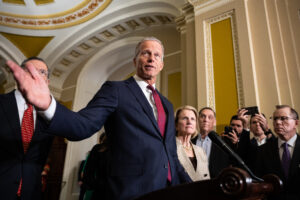
A group of eleven moderate Senate Democrats say they want to work with Republicans on addressing the GOP’s expiring tax cuts and raising the debt ceiling.
In a new letter to Republicanleaders, they say they are willing to cut spending, protect family-oriented tax policies, have “competitive” rates on businesses — and that they can provide enough votes to allow Republicans to overcome a filibuster in the Senate without having to resort to so-called reconciliation.
The lawmakers say they’re otherwise worried Republicans will tack the $4 trillion cost of extending their tax cuts onto the deficit, which will increase interest rates for everyone, something nonpartisan budget forecasters have recently warned about.
“We understand that the Senate Republican conference is likely to use the budget reconciliation process to address these expirations,” said the letter, put together by Sens. Catherine Cortez Masto (Nev.) and Mark Warner (Va.), both of whom sit on the tax committee. “While we respect the majority’s right to do so under Senate rules, we believe a better outcome can be achieved by working in a bipartisan manner to reform the tax code and address our growing national debt through responsible spending reforms.”
“We believe a fully deficit-financed, partisan effort could risk raising costs for families, driving up interest rates for Americans looking to purchase a home, and increasing borrowing costs for American businesses and consumers.”
Republicans appear unlikely to take them up on the offer, though it presents a potential answer to many of the jams they now face.
The GOP is deeply divided over the cost of renewing their tax cuts, not to mention scads of individual provisions like the $10,000 limit on state and local tax deductions, and are sure to have a difficult time raising the debt limit. Some have never voted to increase the legal cap on government borrowing.
Republicans have struggled to even agree on scheduling, with weeks of debate over whether they should take up immigration first or combine it with their tax plans.
Tax debates are typically highly contentious, but there was a surprising outbreak of bipartisanship last year when House Ways and Means Committee Chair Jason Smith (R-Mo.) and then-Senate Finance Committee Chair Ron Wyden (D-Ore.) agreed on a plan to expand breaks for parents and businesses. It was overwhelmingly approved by the House before later dying in the Senate.
No Democrats voted for Republicans’ original 2017 tax cuts, much of which are now due to expire at the end of this year. Rolling them over is projected to cost some $400 billion per year, and the price tag has become a major issue given the government is already running $2 trillion deficits.
The prospect of a bipartisan tax plan would raise a whole different set of challenges though, with the two sides likely to clash over issues like how much to charge businesses and high earners. The moderates signing the letter would also likely take heat from fellow Democrats who are opposed to the tax cuts and would be happy to see them expire.
The lawmakers said they can work with Republicans on business-related provisions.
“Good faith negotiations can ensure the permanence of a competitive tax code for American businesses with reasonable effective tax rates and competitive treatment of capital and R&D expenses, as well as a rational international tax regime,” they wrote.
“While there will certainly be challenges to finding bipartisan agreement on certain issues, we believe addressing the growing deficit and reducing unnecessary spending can serve as a basis for good faith bipartisan negotiation.”
The letter was also signed by Sens. Raphael Warnock (Ga.), Tim Kaine (Va.), John Hickenlooper (Colo.), Mark Kelly (Ariz.), Gary Peters (Mich.), Jacky Rosen (Nev.), Ruben Gallego (Ariz.), Elissa Slotkin (Mich.) and Jon Ossoff (Ga.).


Lawmakers rejected legislation Wednesday to compel the United States to maintain a balanced budget, a perennial pursuit of fiscal conservatives that stood little chance of becoming the law of the land.
The House voted 211-207 against the resolution that would have launched an effort to amend the U.S. Constitution to bar the federal government from running a deficit. It needed to clear each chamber of Congress by a two-thirds vote, then be ratified by three-fourths of all the states.
But the measure’s consideration had major symbolic meaning for budget hawks like its sponsor, Rep. Andy Biggs (R-Ariz.).
“Many of us have been agitating for years to do a balanced budget amendment and out of the blue, they said, ‘we’re ready to do it,’” Biggs said in an interview Tuesday, referring to House GOP leaders.
“They didn’t ask me to do anything, didn’t offer anything,” he said of whether leaders scheduled the vote in an effort to court Biggs, who has in the past threatened to tank spending bills for where he hasn’t liked the price tag. “Just out of the blue, I got a call.”
A spokesperson for Speaker Mike Johnson did not immediately respond to a request for comment about the timing of the measure’s consideration.
Various balanced budget amendment proposals have been offered more than a hundred times since 1999, but peaked in the 1970s and 1980s. The Pew Research Center found that balancing the budget is the single most popular subject of constitutional amendment proposals since 1999, according to analysis of legislative data from the Library of Congress.
Biggs’ latest resolution stated that “total expenditures for a year shall not exceed the average annual receipts collected in the three prior years,” adjusted for inflation and changes in the population.
It would have made an exception for war, where “specific expenditures in excess of the limit” can be approved by Congress “for any year in which a declaration of war is in effect.” Modern wars after World War II have largely been funded by debt; none of them, including the decades-long Global War on Terror, were never backed up by an official declaration of war.
The Biggs measure also would have instituted a two-thirds majority vote threshold in both chambers as necessary to approve any new tax or increase the tax rate. The GOP megabill passed last summer, which included significant tax cuts, passed the Senate in a simple majority vote through the filibuster-skirting budget reconciliation process.
Rep. Kevin Kiley, the former Republican who recently registered as an Independent, said in an interview Wednesday he plans to caucus with the House GOP and will seek to regain his committee assignments.
The California lawmaker was formally removed from his panels Wednesday after giving official notice he was switching parties to serve as an Independent and run in a new district after his state redrew congressional maps.
The House GOP Steering Committee will need to approve Kiley’s effort to take back his seats on Education and the Workforce, Transportation and Infrastructure and Judiciary. Kiley told reporters this was “completely expected” and that he looked “forward to being reappointed as an Independent.”
Mia McCarthy contributed to this report.
Sen. Tim Scott (R-S.C.) will run for reelection in 2028, his campaign told Blue Light News on Wednesday, reversing a promise to serve just two full terms in the chamber.
Appointed by then-Gov. Nikki Haley to serve out the last two years of outgoing Sen. Jim DeMint’s Senate term in 2012, Scott had long said that 2022 would mark his final bid for the Senate.
He easily won reelection that year, besting Democratic state lawmaker Krystle Matthews by more than 25 percentage points. Scott then ran for president but abandoned his short-lived bid for the White House before the Iowa caucuses.
He was briefly considered to serve as now-President Donald Trump’s running mate and has since emerged as a key White House ally in the Senate.
“And I’ll say without any question that as I think about my own reelection in 2028, I think about all the lessons I’ve learned on the campaign trail for all these other candidates, and frankly, even in South Carolina,” Scott told the Charleston, South Carolina-based Post and Courier, which was first to report his reelection plans.
- Stephanie Ruhle rips Trump official for downplaying war’s economic impact

- The Tea, Spilled by Morning Joe: ‘The SAVE Act is horrible legislation’

- House rejects effort to force a balanced budget in the US
- Inside the White House plan to sell the Iran war online
- Estonia ‘ready to talk’ on Strait of Hormuz backup
- Kiley switches parties, loses committees
- Top counterterrorism official Kent resigns over Trump’s Iran war, says Iran posed no imminent threat

- White House applying pressure to media…

- Quick vote on Mullin’s DHS nomination hangs on classified briefing

- Markwayne Mullin’s DHS nomination not at risk from Rand Paul, Thune says
-

 The Dictatorship1 year ago
Luigi Mangione acknowledges public support in first official statement since arrest
-

 Politics1 year ago
Former ‘Squad’ members launching ‘Bowman and Bush’ YouTube show
-

 Politics1 year ago
Blue Light News’s Editorial Director Ryan Hutchins speaks at Blue Light News’s 2025 Governors Summit
-

 Politics1 year ago
Former Kentucky AG Daniel Cameron launches Senate bid
-

 The Dictatorship6 months ago
Mike Johnson sums up the GOP’s arrogant position on military occupation with two words
-

 The Dictatorship1 year ago
Pete Hegseth’s tenure at the Pentagon goes from bad to worse
-

 Politics11 months ago
Democrat challenging Joni Ernst: I want to ‘tear down’ party, ‘build it back up’
-
Uncategorized1 year ago
Bob Good to step down as Freedom Caucus chair this week