
Politics
Republicans push mail-in voting for the midterms in defiance of Trump

Republicans are making mail-in voting a core part of their midterm battle plans — a sharp contrast with President Donald Trump’s efforts to abolish the practice as they scramble to turn out his base.
In Wisconsin, the state party is preparing a full-court press of mailers, emails, phone banks, door knocks and digital ads to get voters to sign up for mail ballots.
In Michigan, the Monroe County GOP ran a social media campaign ahead of the fall election urging voters to utilize permanent absentee ballots and is planning an even bigger push next year.
In Pennsylvania, where Republicans poured $16 million into boosting the number of GOP voters using mail ballots in 2024, the state party chair called it “a priority” for 2026. The nonprofit Citizens Alliance, which aided efforts to get Republicans to return their mail ballots in Pennsylvania last year, is planning to knock 750,000 doors ahead of the midterms to encourage infrequent voters to embrace the practice.
And the Republican National Committee intends to build on the aggressive early mail and in-person voting campaign it ran successfully in 2024, after shying away from the practice in 2020, while also supporting election security efforts including stopping ballots from being counted after Election Day, according to a person granted anonymity to describe the committee’s plans.
“Democrats have built a pretty massive structural advantage in early voting for a long, long time. And we just can’t keep going into election night 100,000 votes down and expect to make it up in 12 hours,” Wisconsin GOP Chair Brian Schimming said in an interview. “Treating early voting as optional, or something Democrats do, is a losing gamble.”
Trump has long falsely decried mail voting as rife with fraud. Over the summer, he vowed that Republicans “are going to do everything possible [to] get rid of mail-in ballots.” In November, and again this week, he called on Senate Republicans to eliminate the filibuster and pass a law to ban mail-in voting.
But, as has been the case for several years, he and his party are out of sync.
Rattled by electoral losses across the country this year and fearing a turnout slump in 2026 when control of Congress is on the line, Republican party chairs and operatives in battleground states Trump flipped by razor-thin margins in 2024 are turning to mail-in voting to keep lower-propensity voters engaged when he’s not on the ballot. They’re redoubling the 2024 efforts they ran successfully despite Trump alternating between promoting and railing against the practice — a turnabout after his vilification of mail ballots contributed to GOP losses in 2020.
Now, back in office, Trump is escalating his war against mail ballots. He signed an executive order in March that attempted to bar states from counting ballots that arrive after Election Day, along with other election-system overhauls. Judges have blocked most of the order, and the Supreme Court is set to decide whether federal law prohibits states from counting late-arriving ballots postmarked by Election Day.
Despite pledging to “lead a movement” to eliminate “corrupt” voting by mail ahead of the midterms, Trump has yet to issue another executive order on it. State courts have upheld vote-by-mail programs expanded during the pandemic. And presidents have little authority over state-run elections, whose rules are guided by federal and state law rather than presidential decree.
State and local Republicans, seeing few paths to overturning mail voting programs, are forging ahead — swallowing their own misgivings about ballot security in an effort to cut into a Democratic advantage as early voting options turn Election Day into election season.
Pressed about their mission appearing antithetical to Trump’s rhetoric, Republican operatives uniformly insisted they’re simply trying to play by the rules they’ve been given and that they support the president trying to change them — even if they’re unsure he’ll succeed.
“In Michigan, that’s the law of the land unless we can find a U.S. constitutional override, which I doubt that’s going to happen,” said Jim Runestad, a state senator who chairs the Michigan Republican Party. So, he said, “we’ll be fully engaged in early and absentee voting — we have to be.”
Still, the renewed dispute between Trump and his party over mail-in voting is the latest evidence of cracks forming in the ordinarily unified Republican Party. GOP lawmakers throughout the country, from New Hampshire to Indiana, have been rebuffing the president’s push for an aggressive redistricting effort to shore up his party’s chances of keeping its slim House advantage next year. Democrats need to net just three seats in order to seize control over the lower chamber. And several members of Trump’s base, namely departing Rep. Marjorie Taylor Greene of Georgia, bucked him on the yet-to-be-released Jeffrey Epstein files.
The White House did not respond to a request for comment for this story.
Republicans have already shown some success in convincing their voters to embrace mail voting. In Pennsylvania — where now-Sen. Dave McCormick’s campaign, party committees and outside groups spent millions promoting the practice — GOP voters cast 32.4 percent of mail ballots in 2024, up from 23.7 percent four years earlier, helping Trump narrowly flip the state. Roughly one in five Republican voters who cast ballots in the state that year had not participated in any elections since 2020, suggesting the method worked for some low-propensity voters who the party has to work harder to turn out.
Nationally, roughly three in 10 ballots in the 2024 general election were cast by mail, according to a U.S. Election Assistance Commission report from June. That was down from 43 percent in 2020, at the pandemic’s peak, but higher than pre-Covid, according to the report.
“We have to encourage people to embrace mail-in voting and early voting,” Pennsylvania GOP Chair Greg Rothman said in an interview. “That has to be a priority for us in 2026.”
Rothman won’t be alone in that fight. Citizens Alliance, the nonprofit founded by Pennsylvania-based conservative activist Cliff Maloney that hired over 100 people to chase ballots across roughly 500,000 doors in 2024, is gearing up to knock 750,000 in 2026. The Republican State Leadership Committee, which helped fund mail-ballot programs in Pennsylvania last year, put more than $2 million behind turnout efforts in New Jersey and Virginia this year and said it’s “doubling down” on the program in 2026.
“Without Trump on the ballot, the low-propensity problem is an epidemic” and “Republicans have to adapt or die,” Maloney said. “The blessing here is that there’s a solution — and the solution is to actually put dollars, cents, time and energy into the same tactics that the left uses to target low-propensity voters.”
State and county parties in Wisconsin and Michigan are planning similarly aggressive efforts, though they, like other Republican officials interviewed for this story, declined to share details or put price tags on strategies still taking shape. In Michigan, where voters can sign up for a permanent mail ballot list, Monroe County GOP Chair Todd Gillman sees it as a way to get more people engaged in more under-the-radar local elections.
But even as they try to make inroads with mail voting, Republicans in other states are attempting to follow Trump in restricting the practice. Ohio’s GOP-controlled Legislature last month passed a bill that would invalidate nearly all ballots received after Election Day that were postmarked prior to the deadline. The state’s Republican governor, Mike DeWine, is now weighing whether to sign it. Utah GOP Gov. Spencer Cox signed a similar bill earlier this year. Republican-led Kansas Legislature overrode Democratic Gov. Laura Kelly’s veto of another bill eliminating the grace period, which is being challenged in court.
And Republicans pushing mail-in voting remain somewhat hamstrung by their standard bearer’s scaremongering, which has sown a deep distrust among GOP voters that party officials and activists say they’re still working to reverse.
Trump made baseless claims of mail-voting fraud the basis for his constellation of stolen-election conspiracy theories in 2020. He piled on in 2024, suggesting scores of Pennsylvania ballots were fraudulent and accusing postal workers of “purposefully” losing some mail ballots — even as his campaign, the RNC and GOP-aligned groups prioritized early voting initiatives. Last month, as Californians voted to approve mid-decade redistricting in response to a GOP-led redraw in Texas, Trump threatened legal action that never materialized over ballots cast by mail in a state that sends one to every voter.
GOP operatives have a script for that, insisting to wary Republicans that they’ve made voting by mail more secure and informing them of the various options they have to ensure their ballots reach election offices, including hand delivery.
“We don’t necessarily like early voting or absentee ballots,” Gillman said. “But those are the rules we have to play by.”
Jessica Piper contributed to this report.


Republicans attempting to oust Kentucky Rep. Thomas Massie in a bitter primary are deploying his opposition to the war in Iran.
The Republican Jewish Coalition Victory Fund on Thursday planned to release an supporting Ed Gallrein, the candidate endorsed by President Donald Trump, that focuses on Massie’s opposition to the war.
“America is at war with a fanatical regime that seeks nuclear weapons. American hero Ed Gallrein stands with President Trump, our country and our military,” a narrator says in the 30-second spot, shared with Blue Light News ahead of its release.
“Thomas Massie, he stands with Iran and radical leftists in Congress,” the narrator says, “opposing Trump just like he did on the border and taxes.”
The campaign ad appears to be among the first attempts to use the Iran war to support a candidate, a risky choice since polls show the high-risk operation is not popular with voters. Massie, who faces Gallrein in a May primary, is a top Trump target for a number of perceived sins — most notably because the outspoken Kentucky lawmaker successfully pushed with Democratic Rep. Ro Khanna of California for the release of the Epstein files.
The ad from the RJC Victory Fund was scheduled to drop hours after the House rejected an effort led by Massie and Khanna to force the president to halt the attack.
Massie claimed a win, though, by saying “we put everyone on record” about a military operation that “could last months.”
Massie has been outspoken in his opposition to the conflict in Iran, accusing Trump of forsaking his “America First” doctrine and challenging members of his own party to rein in the president’s ability to wage war without the approval of Congress.
As the RJC Victory Fund funneled millions of dollars into attacking him, Massie cast his race as “about whether the Global Military Industrial Complex and Israel’s government controls the United States” and began fundraising off his opposition.
Andrew Howard contributed to this report.
Democrats celebrated Kristi Noem’s firing as the Homeland Security secretary on Thursday, while calling for more heads to roll among President Donald Trump’s more controversial aides and advisers.
“Kristi Noem will go down as the most shamelessly incompetent and cruel Homeland Security Secretary in U.S. history,” California Gov. Gavin Newsom wrote on X. “Firing her is not enough. NOEM, GREG BOVINO, and STEPHEN MILLER all must be held accountable for terrorizing and endangering the American people.”
Several other potential 2028 presidential candidates were quick to join the chorus applauding the move, seizing on the opportunity to push for further personnel changes at the highest levels of the Trump administration.
Illinois Gov. JB Pritzker also warned in a video posted to social media that Noem would still “be held accountable.”
“Hey, Kristi Noem, don’t let the door hit you on the way out,” he said. “Here’s your legacy: corruption and chaos, parents and children were teargassed. Moms and nurses, U.S. citizens, getting shot in the face. Now that you’re gone, don’t think you get to just walk away.”
Noem’s impending departure — Trump wrote Thursday on Truth Social that she’ll soon become the inaugural “Special Envoy for The Shield of the Americas” — brings to a close a tumultuous yearlong stint at the agency. Trump also announced that he intends to tap Sen. Markwayne Mullin (R-Okla.) to replace Noem atop the department.
Noem is the most senior administration official to depart thus far in Trump’s second term.
But Democrats were quick to signal they were not satisfied with her exit, swiftly calling for Trump to axe other Cabinet-level officials. Both House Minority Leader Hakeem Jeffries and Rep. Pete Aguilar (D-Calif.) urged Trump to fire embattled Attorney General Pam Bondi.
Sen. Raphael Warnock (D-Ga.), meanwhile, said Trump should cut loose Defense Secretary Pete Hegseth and Health Secretary Robert F. Kennedy Jr. next. Maryland Gov. Wes Moore also celebrated Noem’s ouster.
Noem came under bipartisan fire for her alleged relationship with Trump ally Corey Lewandowski, which she denies, and for labeling two Minnesota protesters killed by federal law enforcement in January “domestic terrorists.”
The former South Dakota governor also faced questions about a $220 million DHS ad campaign, testifying during a Tuesday congressional hearing that Trump approved the spending — a claim he later denied in an interview with Reuters.
“Time and time again, Secretary Noem failed the American people and her duty to the Constitution,” Sen. Elissa Slotkin (D-Mich.) wrote on X. “This was particularly true in how she oversaw ICE. Her departure demonstrates that if you don’t uphold the most basic American values, the American public wants you gone.”
Several Democratic lawmakers also indicated that Noem’s departure does not change their demands surrounding funding for DHS and for reforms at Immigration and Customs Enforcement amid an ongoing partial government shutdown.
Senate Minority Leader Chuck Schumer said Thursday that ICE faces deeper problems that cannot be addressed with a single personnel change.
“The problems at ICE transcend any one individual. … It goes beyond any one person,” he said Thursday. “You need to straighten out the whole agency. The rot there is deep.”
Republicans, meanwhile, largely fell in lockstep behind Mullin — who said Thursday he was “excited about the opportunity” — and he will likely face a smooth confirmation process. Some Republican lawmakers acknowledged that a leadership shakeup at DHS was overdue.
“It was time for a change,” Sen. Lindsey Graham (R-S.C.) wrote in a social media post, while Sen. Thom Tillis (R-N.C.) said the decision was “good for the president and his legacy on border and deportation.”
Cheyanne M. Daniels contributed to this report.
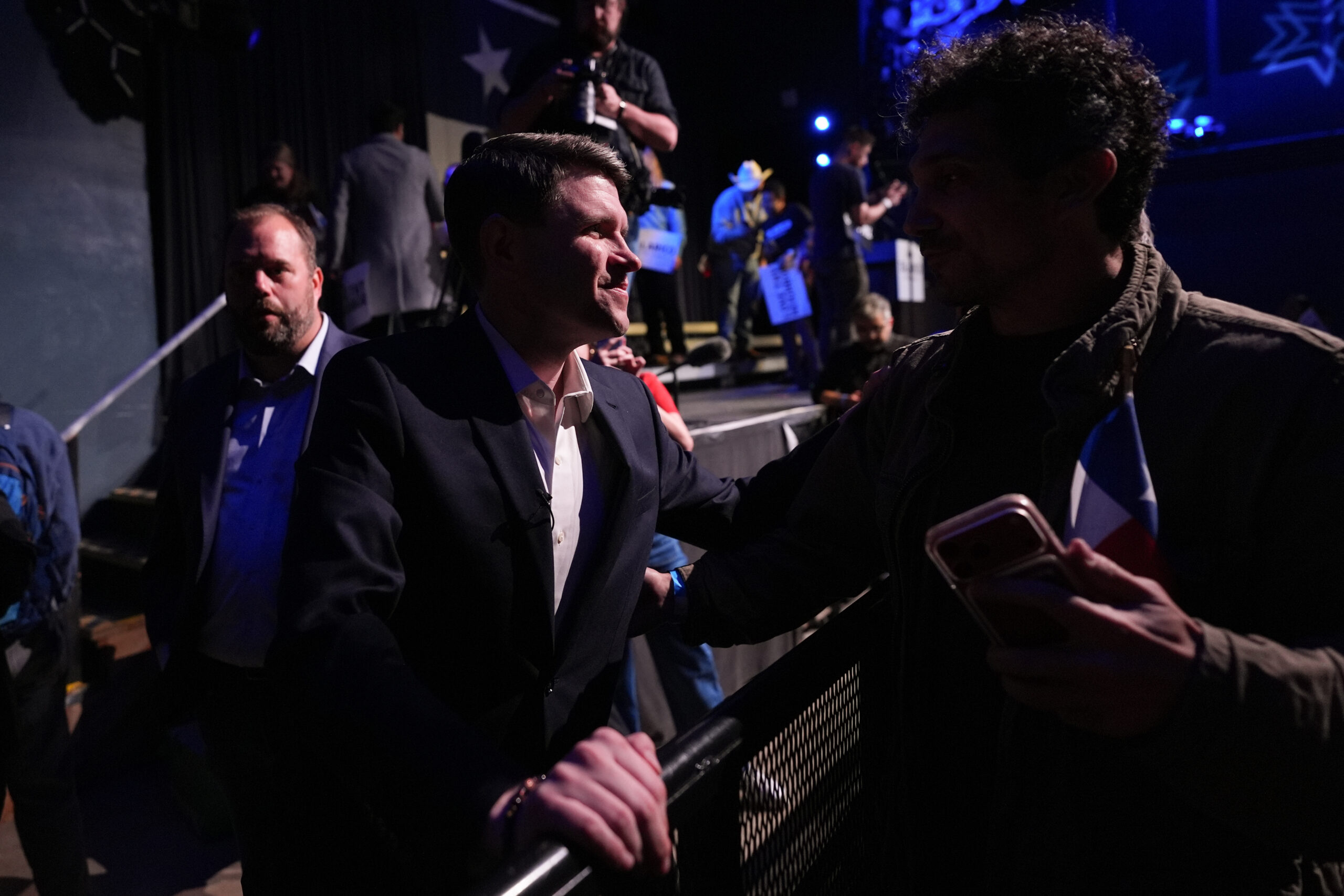
Black Democratic strategists, lawmakers and activists are frustrated that Texas Democrats rejected Jasmine Crockett as their Senate nominee Tuesday night — but they also saw it coming.
Following Crockett’s single-digit loss, they recounted a laundry list of why she fell to state Rep. James Talarico: Her campaign was unfocused; she had an insufficient campaign infrastructure to challenge Talarico, even though she earned the backing of former Vice President Kamala Harris. They also said her media strategy relied too heavily on social media rather than television ad buys — typically seen as critical in a sprawling state like Texas and its nearly two dozen media markets.
“People who don’t understand politics will be upset because Jasmine was their hero,” said Texas state Rep. Jolanda Jones, a Democrat. “But for people who understand politics, [Crockett] literally had no ground game.”
She added: “This L is on her.”
Taken together, Crockett’s campaign shortcomings doomed the upstart Senate bid of the two-term congressmember who entered the contest with broad name recognition and hopes of showcasing her firebrand personality and penchant for viral moments to help Texas Democrats end their nearly 40-year winless streak in Senate races.
Still, Black strategists and activists warn Crockett’s loss will have ripple effects.
They say the party rejected an established star in favor of an untested, white state lawmaker over style — the two candidates did not substantively disagree on policy — raising concerns that Black voters, especially women, will not turn out when the party needs them the most.
“A lot of Black women who work in the Democratic Party, vote for Democrats, organize for Democrats, have always had a sense of this,” said Houston-based political strategist and social media influencer Tayhlor Coleman. “It is a lot more apparent now: A lot of people in the Democratic Party want our labor, they do not want our leadership.”
A spokesperson for Crockett’s campaign pushed back on the criticism of her campaign, saying it came from “Monday morning quarterbacks.”
“This was the most expensive Democratic primary ever in Texas with the overwhelming majority of those dollars being spent on attacks against the Congresswoman,” former deputy campaign manager Karrol Rimal said in a text message Wednesday afternoon. “Despite being outspent, she held our own and excited an untapped base of support for Democrats with record numbers of first time primary voters. There was also the intentional voter suppression of voters in Dallas and Williamson counties. That can not be ignored.”
After Crockett conceded, she tweeted her support for Talarico, saying, “Democrats must rally around our nominees and win.”
Democrats for years have praised Black women as the “backbone of the party.” And Crockett, a former civil rights and criminal defense lawyer, rose to prominence in part by viral moments from House hearings. Just last month, she garnered praise from party insiders for her sharp criticism of Attorney General Pam Bondi during a House Judiciary hearing over the Justice Department’s handling of Jeffrey Epstein documents.
Heading into Tuesday’s primary election — the first of the 2026 midterm cycle — there was optimism Crockett could harness her star power to beat Talarico, a seminary student and former teacher who drew national attention when Texas Democrats fled the state to try to block a major redistricting effort.
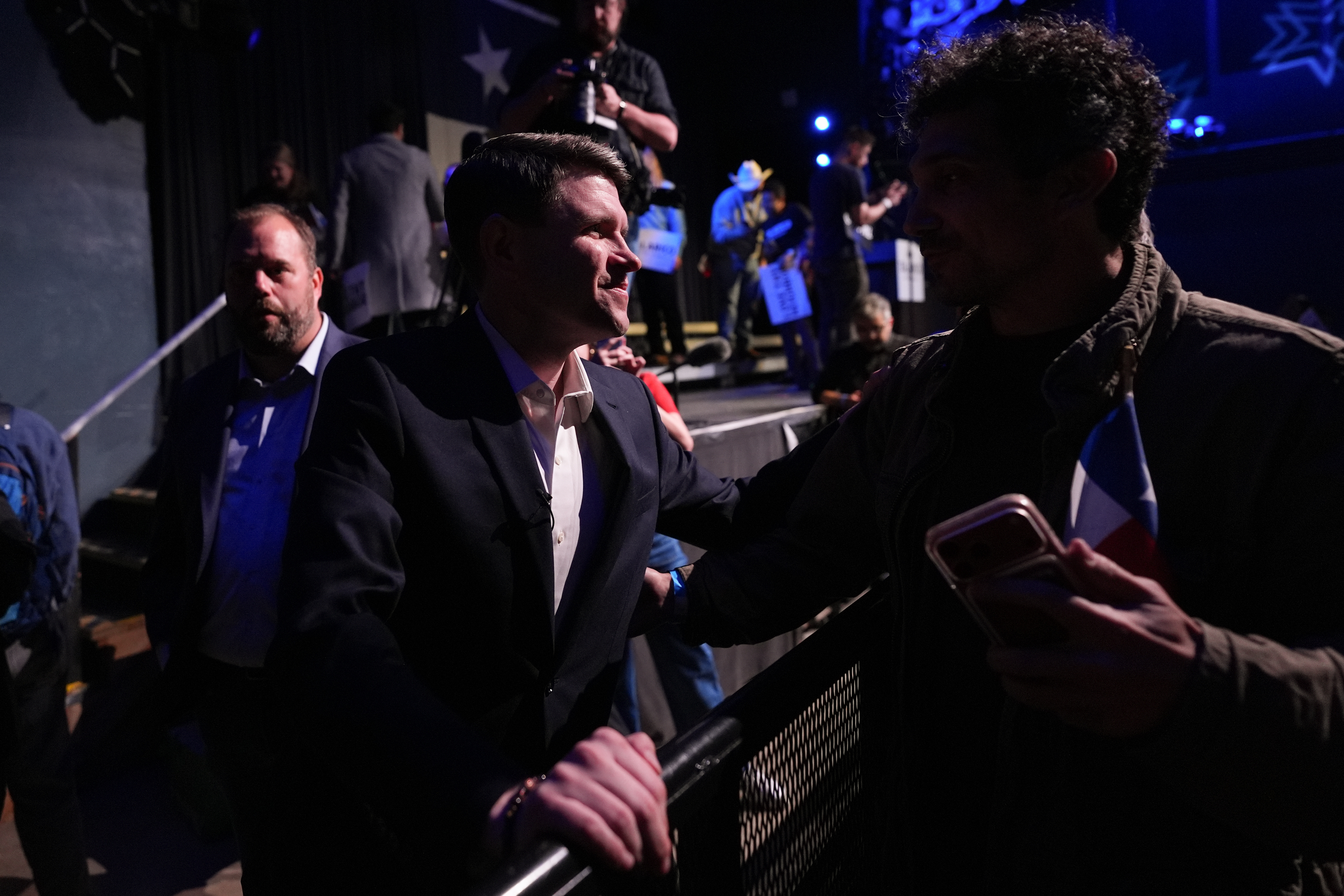
Talarico also built his national name with a sitdown on the nation’s top podcast, “The Joe Rogan Experience” where the show’s host urged him to run for president — weeks before he officially launched his Senate bid, and later turned an online interview with the late night host Stephen Colbert into a fundraising boon.
Throughout the primary, Crockett faced constant questions about her viability and campaign decisions, including whether she hired enough staff. She also faced criticism that the get-out-the-vote efforts were virtually nonexistent.
“She ran a fucking terrible campaign that many will question if she’s running a campaign at all,” said one Black national Democratic operative granted anonymity to give a candid assessment of Crockett’s campaign.
Crockett staked much of her political campaign on her ability to connect with young voters and rebuked her party for trying to win Republicans instead of wooing hard-to-reach Democrats that have grown frustrated with the party. By contrast, Talarico was praised by many Democrats for the way he leaned into his seminarian background as a way to appeal to progressives, independents and disillusioned Republicans.
“In many ways, she has been and has felt like a woman on an island,” said Stefanie Brown James, co-founder of the Collective PAC, which works to elect Black candidates to local, state and federal offices.
“Even though she has substance, not everybody likes her style,” she added. “And I think that sometimes her style is one that is not appealing, especially to the old guard Democrats, whose fighting style is antiquated and outdated.”
State and national Democrats acknowledged Talarico built a strong campaign that shored up grassroots support and built a statewide infrastructure long before Crockett entered the primary in December, just months before voters began casting their ballots. He was able to raise money quickly, establish a field and digital plan and craft a message that cast him as a fighter and someone who would bring down high costs.
Some Democrats anticipate Talarico’s victory is going to ignite a fresh round of uncomfortable conversations among insiders about the importance race, gender and identity politics will play in Democratic political circles moving forward.
“The way that we have seen people rally around new, more untested white male candidates” is troubling, said Maya Rupert, a Democratic strategist who served as the campaign manager of Julian Castro’s 2020 presidential campaign.
While she is excited about Talarico’s nomination against what she called “a very weak Republican field,” Rupert said Crockett’s loss will continue to “sting” for months to come, especially with few opportunities beyond Texas for Black women candidates to win in statewide contests.
“There are a lot of people who see this and see a very qualified, very popular Black woman — that, once again — feels like people fail to appreciate the strength of,” Rupert adds. “And that is a very dangerous position for the party to be in.”
-

 The Dictatorship1 year ago
Luigi Mangione acknowledges public support in first official statement since arrest
-

 Politics1 year ago
Former ‘Squad’ members launching ‘Bowman and Bush’ YouTube show
-

 Politics1 year ago
Blue Light News’s Editorial Director Ryan Hutchins speaks at Blue Light News’s 2025 Governors Summit
-

 The Dictatorship6 months ago
Mike Johnson sums up the GOP’s arrogant position on military occupation with two words
-

 Politics1 year ago
Former Kentucky AG Daniel Cameron launches Senate bid
-

 The Dictatorship1 year ago
Pete Hegseth’s tenure at the Pentagon goes from bad to worse
-
Uncategorized1 year ago
Bob Good to step down as Freedom Caucus chair this week
-

 Politics11 months ago
Democrat challenging Joni Ernst: I want to ‘tear down’ party, ‘build it back up’