
Congress
Republicans not ruling out a subpoena for Lutnick in Epstein investigation

House Oversight Chair James Comer is not ruling out slapping Commerce Secretary Howard Lutnick with a subpoena to testify as part of the panel’s investigation into the convicted sex offender Jeffrey Epstein.
“That’s very possible,” the Kentucky Republican told reporters Thursday morning as members of the committee headed inside a performing arts center in Chappaqua, New York, for daylong grilling of Hillary Clinton.
The former secretary of State is testifying about interactions she may have had with Epstein or his associate Ghislaine Maxwell, who is now serving 20-years in prison for her part in the late financier’s sex trafficking scheme.
“I think it’s a good possibility that his name will arise in some questioning today,” Comer added.
Rep. Nancy Mace (R-S.C.) said she also intended to ask Hillary Clinton about Lutnick.
Lutnick had maintained that his relationship with Epstein ended in 2005, but newly-released materials from the Justice Department revealed they continued to have ties following Epstein’s conviction on soliciting a minor for prosecution in 2008. The files also show that Lutnick and his family had lunch on Epstein’s private island in 2012.
The Commerce secretary has not, however, been accused of wrongdoing in connection with Epstein’s crimes. The Commerce Department did not immediately return a request for comment.
Comer also said Thursday morning his panel was “looking into”reporting from NPR that the Justice Department has sought to obscure information that could be damaging to Trump, including that he sexually assaulted a minor, as part of its release of the Epstein files in compliance with the law Congress passed in November.
“We don’t know the answer to that,” Comer said when asked about the missing DOJ records around the allegation against Trump. “We know what the administration says. We’re still looking to get a definitive answer on that.”
Trump has not been charged with any crimes in connection with Epstein and has maintained that the two had a falling out years before his 2019 arrest.
Reached for comment Thursday, the White House referred questions to the Justice Department about the implementation of the Epstein Files Transparency Act, the law which compelled the administration to release materials in the Epstein case.
The White House also pointed to an earlier DOJ press release around the rollout of the Epstein materials, which stated that the production “may include fake or falsely submitted images, documents or videos, as everything that was sent to the FBI by the public was included in the production that is responsive to the Act.
“Some of the documents contain untrue and sensationalist claims against President Trump that were submitted to the FBI right before the 2020 election,” the statement continued. “To be clear, the claims are unfounded and false, and if they have a shred of credibility, they certainly would have been weaponized against President Trump already.”
A DOJ spokesperson also pointed to earlier statements insisting the department was reviewing materials flagged by the public and that no files had been deleted.
“Should any document be found to have been improperly tagged in the review process and is responsive to the Act, the Department will of course publish it, consistent with the law,” read one of the statements.
The Justice Department has accused Democrats of playing politics with the investigation, after Rep. Robert Garcia of California, the top Democrat on the Oversight panel, announced his team had been looking into missing materials related to an allegation against Trump.


Former Speaker Nancy Pelosi headlined a growing list of Democratic lawmakers who called Friday on Rep. Eric Swalwell to withdraw his campaign for California governor amid allegations of sexual misconduct.
“This extremely sensitive matter must be appropriately investigated with full transparency and accountability,” Pelosi said in a statement. “As I discussed with Congressman Swalwell, it is clear that is best done outside of a gubernatorial campaign.
The San Francisco Chronicle reported Friday that a former congressional aide accused the congressman of two sexual encounters without her consent, beginning in 2019. BLN later reported that four women allege that Swalwell has committed sexual misconduct, including one former staffer who accuses Swalwell of rape.
Swalwell denied the allegations in a statement.
“These allegations are false and come on the eve of an election against the frontrunner for governor,” he said. “I will defend myself with the facts and where necessary bring legal action.”
Key backers of Swalwell’s governor bid swiftly revoked their support after the Chronicle’s story was published, including Reps. Jimmy Gomez (D-Calif.) and Adam Gray (D-Calif.), who served as campaign co-chairs.
“Today’s reports about Eric Swalwell’s conduct while in office are deeply disturbing,” Gray said in a statement. “Harassment, abuse, and violence of any sort are unacceptable. Given these serious allegations, I am withdrawing my support and Eric Swalwell should end his campaign immediately.”
But nothing underscored the peril for Swalwell’s nearly two-decade political career as vividly as Pelosi’s statement. The former speaker included Swalwell in her inner circle of favored Democratic members for years, tapping him for junior leadership roles and to serve as a manager in Donald Trump’s second impeachment trial in 2021.
The situation also presents a predicament for the sitting House Democratic leaders, who have insisted on letting a full Ethics Committee investigation play out before supporting formal discipline against another House Democrat accused of misconduct, Rep. Sheila Cherfilus-McCormick (D-Fla.).
A spokesperson for Minority Leader Hakeem Jeffries called the allegations “serious” and said they require “a serious and thorough investigation.”
“These brave women must be heard and respected,” the spokesperson, Christie Stephenson, said in a statement. “It is imperative that the inquiry follow the facts, apply the law and take place immediately.”
House Republicans already began discussing Friday evening the likely scenario that one of their own members will bring a censure effort against Swalwell, according to three people granted anonymity to describe private conversations.
Rep. Anna Paulina Luna (R-Fla.) said in an interview that she was weighing a censure and other action against Swalwell based on the reports of sexual assault allegations against him.
Luna said she would act “if there is evidence brought forward.”
The internal consequences could start playing out as soon as the House returns to session Tuesday, but a wave of top California Democrats immediately dropped their endorsements of Swalwell, including Rep. Ted Lieu, the No. 4 Democrat in House leadership.
Rep. Ro Khanna (D-Calif.) likened the situation to his push for transparency around disgraced financier Jeffrey Epstein and called for “appropriate” House and law enforcement investigations.
“No one in a position of power should be allowed to act above the law or with impunity,” he said in a statement. “It doesn’t matter what office you hold, how wealthy you are, or which political party you align with. The same rules must apply to Eric Swalwell.”
Meredith Lee Hill and Hailey Fuchs contributed to this report.
President Donald Trump gave his blessing Friday afternoon for a party-line package focused narrowly on immigration enforcement — in a boost to Senate GOP leaders amid the Department of Homeland Security funding stalemate.
Trump’s comments came after he met Friday with Senate Budget Chair Lindsey Graham of South Carolina and Senate Majority Whip John Barrasso of Wyoming. The two lawmakers went to the White House to pitch Senate GOP leadership’s plan to restrict the party’s filibuster-skirting effort to only funding for Immigration and Customs Enforcement and parts of Customs and Border Protection.
“Reconciliation is ON TRACK, and we are moving FAST and FOCUSED in keeping our Border SECURE, and getting funding to the Department of Homeland Security and the Justice Department to continue our incredible SUCCESS at MAKING AMERICA SAFE AGAIN!” Trump wrote on Truth Social.
Trump had previously backed using reconciliation to pass funding for immigration enforcement after it became clear Democrats would not agree to reopen those shuttered operations within DHS without a deal for more guardrails on ICE and CBP. But the president’s post Friday, which hammered home the preference for focusing the bill on this issue, is a significant boost to GOP leaders as they face calls from some of their members to broaden the scope of any reconciliation measure.
Some Republicans have called for funding all of DHS through reconciliation. The Senate previously passed a bipartisan deal that would reopen the department except for ICE and Border Patrol, but it has stalled in the House as hard-liners demand the Senate first pass the immigration enforcement funding.
Graham, whom Trump also re-endorsed Friday, is responsible for crafting the budget resolution that will allow the party to begin the reconciliation process — its second time using this maneuver in addition to last year’s tax and spending megabill. He is expected to tap the Judiciary Committee and the Homeland Security and Governmental Affairs panel to draft the immigration enforcement measure.
Senate Republicansare expected to not include pay-fors for the funding, arguing that it would have gone through the appropriations process were it not for opposition from Democrats. They’ll need sign-off from their own conservatives and the right-flank in the House for such a plan.
Trump also reiterated Friday that he wants the bill on his desk by June 1, adding that Republicans won’t need Democrats’ votes “as long as Republicans UNIFY, and stick together.”
The White House did not immediately respond to a request for comment.
Myah Ward contributed to this report.
Republican infighting is leaving Congress in legislative limbo.
While there are plenty of partisan disputes that have frustrated Capitol Hill — such as the nearly two-month shutdown of the Department of Homeland Security — divisions between House and Senate Republicans have been the more significant obstacle for a laundry list of stalled legislation that could otherwise sail to President Donald Trump’s desk.
Trump could intervene to settle many of these disputes, but he has kept his distance in most cases. That has left each chamber pushing ahead with their own proposals — and against their counterparts in the other chamber.
In the one instance where the president appears truly invested, in passage of a sweeping GOP elections bill, his fixation has only made the intraparty divisions worse.
Lawmakers will return to Washington next week with the pre-midterm legislative calendar dwindling and leaders eyeing action on at least one party-line budget reconciliation bill — a time-consuming process that could make it even tougher to find consensus on these pending items:
Housing affordability
With cost-of-living concerns dominating the pre-midterm political landscape, a bipartisan effort to address housing prices should be a no-brainer, but disputes over niche policy provisions are holding up dueling House and Senate housing packages.
The Senate passed a bill last month that includes a temporary ban on central bank digital currency as well as a provision restricting large investors from owning more than 350 homes. Both provisions face serious opposition from House Republicans, who joined with Democrats in their chamber to pass their own bill in February.
While the Senate wants the House to accept its version, House Financial Services Chair French Hill (R-Ark.) and others in the GOP are pushing for the two chambers to go to conference — potentially adding months to the process.
Aviation safety
Legislation aiming to respond to the deadly crash near Ronald Reagan Washington National Airport last year is stuck in a battle of wills among GOP committee chairs. A bill backed by Senate Commerce Chair Ted Cruz (R-Texas) appeared set for Trump’s desk earlier this year until the heads of two key House committees, Armed Services Chair Mike Rogers (R-Ala.) and Transportation and Infrastructure Chair Sam Graves (R-Mo.), came out against it, causing the measure to fail on the House floor.
The Senate bill’s requirement for advanced aircraft location-alerting technology has been one of the biggest points of contention among Republicans, with the House version of the bill opting for more open-ended language. The House bill focuses on a different technology, which major aviation labor groups argue wouldn’t have prevented the Washington disaster.
Cruz has called the House rejection of his ROTOR Act a “temporary delay,” but the House chairs are pushing forward with their own ALERT Act, with a floor vote expected Tuesday. How the policy disputes will be settled from there remains uncertain.
College sports
Trump has taken a keen interest in college athletics, issuing a flurry of executive orders on this topic. But Congress has struggled to act on legislation tackling the controversial “name, image and likeness” regime for compensating student athletes
House Republicans last year made a push for the SCORE Act, which would create new standards for how college athletes are paid and give antitrust exemptions, before opposition from hard-liners and many Democrats put it on ice.
While there has been new chatter about putting it on the floor this month, the bill is dead on arrival in the Senate, where Cruz and Sen. Maria Cantwell (D-Wash.), the top Commerce Committee senators, have warned the measure doesn’t have enough support. The two are discussing ways to address NIL concerns but have yet to produce a bill.
Tech regulation
The House and Senate have failed to reach consensus on a number of tech-industry flashpoints, including artificial intelligence and children’s online safety.
The House GOP largely wants to codify a Trump executive order creating a national AI rulebook, but some Senate Republicans appear concerned that the president’s plan could limit state-level regulations the White House wants to override.
There’s a similar standoff over online safety bills. The Senate cleared a privacy bill by unanimous consent, but the House hasn’t taken it up and instead is pushing ahead with a package that doesn’t include key Senate-passed provisions.
One of the key differences is on state preemption — included in the House version but not the Senate version. Another dispute is over “duty of care” language in the Senate bill that requires tech companies to design their platforms with an eye toward preventing harm to children. Senate Majority Leader John Thune floated pairing AI legislation with kids online safety legislation in an interview earlier this year.
And then there’s cryptocurrency: A closely watched “market structure” bill is stuck for now in the Senate after it was excluded from a landmark crypto bill signed into law last year despite a push in the House.
The Trump administration is increasing pressure, with Treasury Secretary Scott Bessent saying Thursday that “Senate time is precious, and now is the time to act.”
Elections oversight
Conservative lawmakers and Trump have joined forces behind the SAVE America Act — a GOP bill aimed at fully eliminating noncitizen voting — as a top-level, must-pass agenda item even as many Senate Republicans doubt it can ever skirt their chamber’s 60-vote filibuster threshold.
Trump views the bill as his “No. 1 priority,” and House hard-liners are pushing for a filibuster workaround. Sen. Mike Lee (R-Utah) has pushed to force Democrats into a “talking filibuster” where they would have to hold the floor to block the bill, and the Senate will resume debate early next week with no indication of when GOP leaders will choose to hold a likely doomed vote and move on.
Some Republicans, including Senate Budget Chair Lindsey Graham of South Carolina, want to try to pass parts of the bill through the reconciliation process later this fall. But hard-liners view that as a nonstarter because most of the bill likely violates the strict Senate rules governing the party-line reconciliation process.
DHS funding
There’s no bigger dispute for House and Senate Republicans to settle than DHS funding, which has already been subject to nearly a month of back-and-forth.
A Senate-passed bill delivering funding for all of the department save for immigration enforcement agencies is currently held up in the House. Republicans there aren’t enthused about a plan that would instead fund ICE and other agencies through the reconciliation process — an idea Speaker Mike Johnson called “garbage” before flipping in support.
Now, many House Republicans want their Senate counterparts to pass immigration enforcement funding before the House passes the balance of DHS spending. The hard-line Freedom Caucus has gone further, demanding GOP leaders fund all of DHS through reconciliation.
As party leaders make plans to pass a narrowly targeted reconciliation bill ahead of a Trump-imposed June 1 deadline, most Senate Republicans want the House to fund most of DHS now — or risk prolonging the infighting that even one GOP senator called a “circular firing squad.”
Katherine Hapgood, Gabby Miller, Alfred Ng, Nick Niedzwiadek and Sam Ogozalek contributed to this report.
- Trump administration admits error in New York health care fraud probe

- Trump’s budget hawk is still trying to slash medical research. Congress is saying no.
- RFK Jr. has turned corporate America’s name to mud, Blue Light News Poll finds
- 2028 Democrats say anyone can win. Voters aren’t so sure.
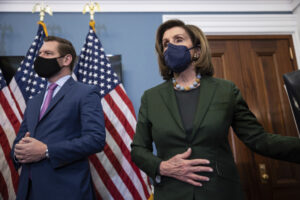
- Jeffries, Pelosi and other Democrats call on Eric Swalwell to end governor campaign
- Trump endorses ‘focused’ immigration enforcement funding bill

- These Republican-on-Republican disputes are keeping Congress frozen

- Trump’s proposed cuts to NASA are an insult to astronauts like the Artemis crew
- Artemis II mission splashes down, returning to Earth

- Former staffer accuses Rep. Eric Swalwell of sexual assault, reports say

-

 Politics1 year ago
Former ‘Squad’ members launching ‘Bowman and Bush’ YouTube show
-

 The Dictatorship1 year ago
Luigi Mangione acknowledges public support in first official statement since arrest
-

 Politics1 year ago
Former Kentucky AG Daniel Cameron launches Senate bid
-

 The Dictatorship1 year ago
Pete Hegseth’s tenure at the Pentagon goes from bad to worse
-

 The Dictatorship7 months ago
Mike Johnson sums up the GOP’s arrogant position on military occupation with two words
-

 Politics1 year ago
Blue Light News’s Editorial Director Ryan Hutchins speaks at Blue Light News’s 2025 Governors Summit
-
Uncategorized1 year ago
Bob Good to step down as Freedom Caucus chair this week
-

 Politics12 months ago
Democrat challenging Joni Ernst: I want to ‘tear down’ party, ‘build it back up’