
The Dictatorship
Pope Francis schooling JD Vance brings ‘harsh words’ from border czar Tom Homan

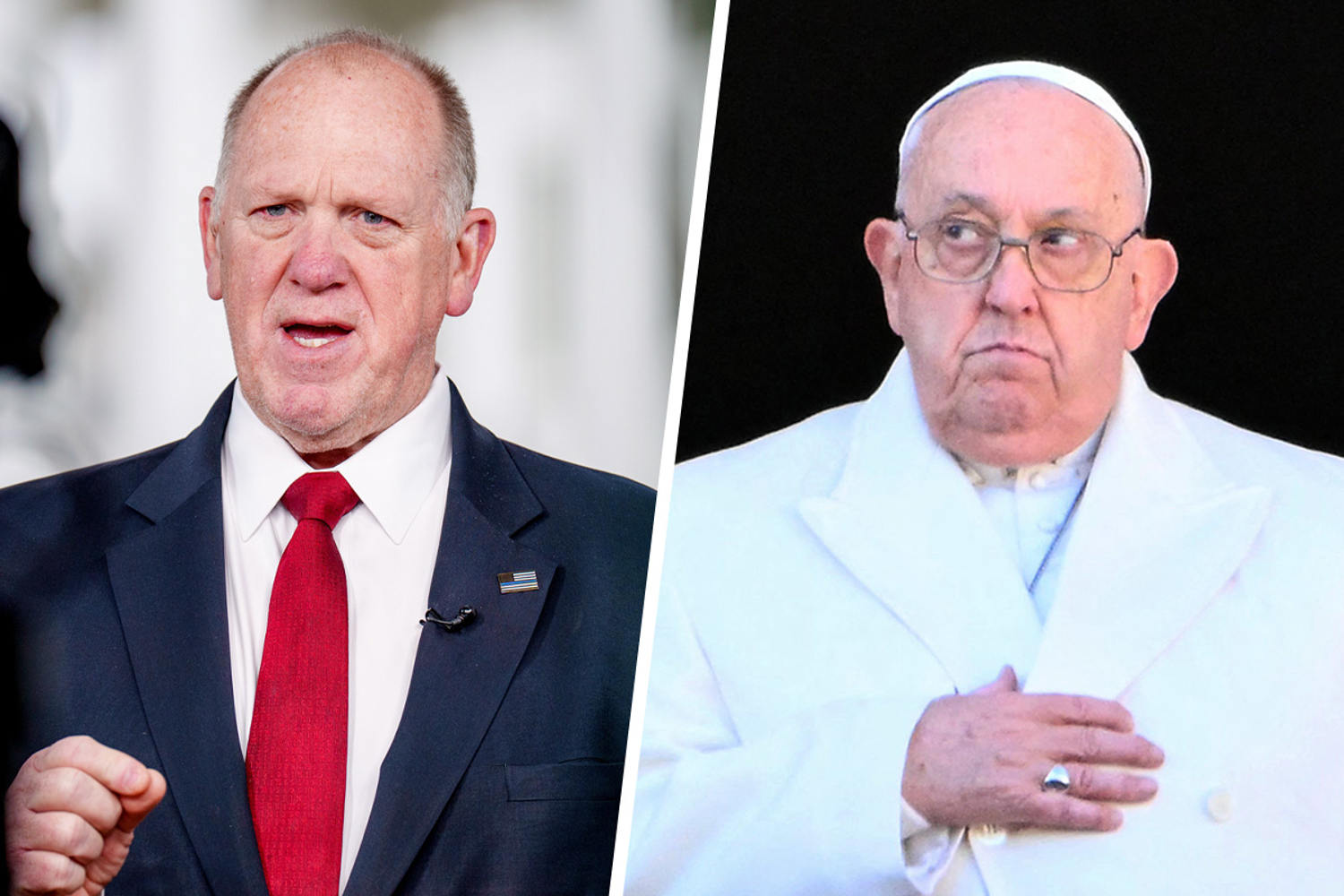
Pope Francis is rattling the Trump administration this week with a letter to the U.S. bishops regarding the president’s mass deportation policies. Calling them a “violation of the dignity of many men and women and entire families,” the letter upset President Donald Trump’s “border czar,” Tom Homanwho, when asked by a reporter about the pope’s “harsh words,” Banized out“I got harsh words for the pope. The pope ought to fix the Catholic Church.”
Really?
Homan should know better than to critique the pope over clear Catholic teaching.
As a Catholic, Homan should know better than to critique the pope over clear Catholic teaching. So should Vice President JD Vance, a relatively recent Catholic convert who got a pointed correction to his faulty Catholic theology in Francis’ letter. Homan, a cradle Catholic, and Vance, a convert, each needs to go back and take some remedial Confraternity of Christian Doctrine (CCD) courses to understand the teachings of the Catholic Church on human dignity. After all, as Francis reminds Vance in his letter, Jesus was an immigrant.
The Trump administration, which describes itself as “faith based,” is in fact setting itself up for an epic religious and social battle with religious groups over deportation. Francis’ letter is notable because he took the time to write specifically to the bishops of the United States about the way deportations have been categorized by the Trump administration. The letter is clear about thisstating, “The rightly formed conscience cannot fail to make a critical judgment and express its disagreement with any measure that tacitly or explicitly identifies the illegal status of some migrants with criminality.”
In other words, labeling all deportees as criminals flies in the face of human dignity, and is directly opposite to Christian teachings about loving and caring for one’s neighbors.
Vance proclaimed himself to be “ Heartbroken” about the Catholic bishops’ criticism of the Trump administration’s immigration policy, and, in a tone similar to Homan’s, said the bishops needed to “look in the mirror” because “when they receive over $100 million to help resettle illegal immigrants, are they worried about humanitarian concerns? Or are they actually worried about their bottom line?”
Francis’ letter was also a pointed critique of Vance’s erroneous exposition on medieval theology. “Just google ‘ordo amoris,’” Vance posted on the social media platform X on Jan. 30 as people were criticizing him for a Fox News interview in which he said, “There is a Christian concept that you love your family, and then you love your neighborand then you love your community, and then you love your fellow citizens in your own country. And then after that, you can focus and prioritize the rest of the world.” He said the “far left” got the order backward.
Francis’ letter was also a pointed critique of Vice President JD Vance’s erroneous exposition on medieval theology.
And in the X post, he called his view “basic common sense.”
To the contrary, the ordo amoris is about the order of love and charity that should be held for all humans, and to care for all in need. To quote from the pope’s letter, “The true ordo amoris that must be promoted is that which we discover by meditating constantly on the parable of the ‘Good Samaritan’ (cf. Lk 10:25-37), that is, by meditating on the love that builds a fraternity open to all, without exception. But worrying about personal, community or national identity, apart from these considerations, easily introduces an ideological criterion that distorts social life and imposes the will of the strongest as the criterion of truth.”
The pope devoting a whole paragraph to correcting Vance should be seen as embarrassing, not only for the vice president but also for the Trump administration as a whole.
In the battle between the Catholic Church and the Trump administration over deportations, Francis has been putting his chess pieces on the board. He just appointed another pro-migrant bishop, Bishop Weisenburger,to serve as archbishop in Detroit. And as I’ve previously written, Cardinal Robert McElroywhom the pope decided to make the archbishop of Washington, D.C., after Trump won, has decried mass deportations. Given those voices and a statement defending migrants from Bishop Mark J. Seitz of El Paso, the Trump administration should expect there to be more than the usual criticism of its decidedly non-Christian policies on immigration and deportation.
Even New York’s archbishop, Cardinal Timothy Dolan, who led a prayer at Trump’s inauguration last month, said Vance’s comments on the bishops and immigration were “very scurrilous and very nasty.”
Other religious groups are joining in to denounce Trump’s draconian deportation policies. A lawsuit filedby 27 religious groups is suing the Trump administration to protect houses of worship from immigration raids. Add to that the condemnation over the closure of U.S. Agency for International Development offices around the world, which many U.S. religious organizations participated in, and you have the makings of a new war pitting religious groups against Trump’s immigration and foreign aid policies.
Even Cardinal Timothy Dolan, who led a prayer at Trump’s inauguration, said Vance’s comments were ‘very scurrilous and very nasty.’
Francis clearly wants this fight. He called Trump’s focus on deportations a major crisis in his letter to the bishops. Then he directly addressed the Trump administration in his letter by saying “what is built on the basis of force, and not on the truth about the equal dignity of every human being, begins badly and will end badly.”
I think members of the Trump administration believed they could brush aside the concerns of Christians with MAGA-style rhetoric and bad theological takes and did not anticipate an immediate fight — and certainly not a scolding letter from the pope. Unlike the sycophantic evangelical followers and prosperity gospel folks like Paula Whitethe new head of Trump’s faith office, the administration is now encountering Christians who understand and seek to carry out the message of the Gospels.


The Dictatorship
Newly created Polymarket accounts bet big on US-Iran ceasefire in hours before Trump’s announcement
NEW YORK (AP) — A group of new accounts on the prediction market Polymarket made highly specific, well-timed bets on whether the U.S. and Iran would reach a ceasefire on April 7, resulting in hundreds of thousands of dollars in profits for these new customers.
These bets were made even though, in the hours before a two-week ceasefire was announced on Tuesday, President Donald Trump’s rhetoric had escalated sharply and there were few signals that a ceasefire deal was imminent. Early in the day Trump had issued a warning on social media that “a whole civilization will die tonight” if Iran did not meet his demand to open the Strait of Hormuz by his 8 p.m. ET deadline.
An analysis of publicly available blockchain data from Polymarket, using the crypto analytics platform Dune, shows that at least 50 accounts, or wallets, placed substantial “Yes” bets Tuesday before Trump announced the ceasefire in a Truth Social post at around 6:30 pm ET. These were the first bets made by these particular wallets.
One of these wallets, created Tuesday around 10 am ET, placed roughly $72,000 in bets at an average price of 8.8 cents. The buy-in for each betting event ranges from $0 to $1 each, reflecting a 0% to 100% chance of what users think could happen. This Polymarket user then cashed out for a profit of $200,000.
Another, which joined the platform on April 6 and traded on this exact event, shows a win of $125,500.
Another wallet, created 12 minutes before Trump’s post, made $31,908 of “Yes” bets at 33.7 cents, and is estimated to have earned a profit of $48,500. The higher price for “Yes” at that time may have reflected the efforts late Tuesday by the government of Pakistan to get Trump to extend his deadline by two weeks.
There is also the possibility that these individual Polymarket users placed their bets expecting Trump to back down, given his habit during his second term to make bold threats only to retreat — a phenomenon his critics have derided as “Trump Always Chickens Out,” or TACO.
While some users took handsome profits, others must wait for payouts because Polymarket has labeled the April 7 Iran-U.S. ceasefire contract as “disputed,” given that Iran was still placing restrictions on ships passing through the Strait of Hormuz and missile attacks in the region continued. That dispute could take 48 hours to resolve.
Public blockchain data cannot identify who controls the new wallets. Polymarket uses proxy smart contract wallets, meaning a single user can create multiple accounts. Only Polymarket has the internal data needed to determine whether these were new users or existing users opening additional accounts.
Polymarket did not respond to a request for comment.
Rep. Blake Moore, R-Utah, who has introduced legislation to regulate prediction markets, released a statement Wednesday saying: “It’s highly unlikely that these are good-faith trades; it’s much more likely that these are insiders with access to information ahead of the public. Without some kind of restrictions, there is nothing stopping government or military officials from profiting from their positions.”
The trading pattern of newly created Polymarket accounts placing strategic, well-timed bets mirrors earlier episodes on the platform. Newly created accounts placed large wagers hours before the January capture of Venezuelan President Nicolás Maduro, and made hundreds of thousands of dollars in profit. Similar clusters of accounts have also repeatedly profited from well-timed bets on military actions involving Iran.
Such bets have repeatedly raised questions from the public as well as members of Congress about whether some traders are using inside information to profit in these prediction markets. Bipartisan groups of senators as well as representatives have introduced legislation that would broaden the definition of insider trading to include prediction markets.
Even the two biggest platforms in the industry, Kalshi and Polymarket, have said they see a need to broaden the definition of insider trading on their platforms.
“This is why these markets need regulation,” said Todd Philips, a professor at Georgia State University who has written on prediction markets and the industry’s regulations. “We can’t have people trading with inside information and expect other traders are going to be OK being in these markets.”
_____
Keller reported from Albuquerque, N.M.

The Trump administration’s fragile white ego is in focus yet again thanks to newly proposed changes for an exhibit in Philadelphia centered on George Washington and slavery.
The administration is being sued by the city over its efforts to whitewash Washington’s history of slave ownership from the President’s House Site, the nation’s first official presidential residence. The push has been put on hold by a judge who compared it to the censorship depicted in George Orwell’s book “1984.”
The attempted alteration of the exhibit came after a Trump executive order demanded a review of national parks and museums to bar any displays that “inappropriately disparage Americans past or living.” Last year, Trump also lobbed a puerile complaint that Smithsonian musuems focus too much on “how bad” slavery was.
And all that kvetching provides context for the changes that Trump’s administration is seeking to impose at the President’s House Site — alterations that The Philadelphia Inquirer said places the first president’s slave ownership “in a more sympathetic light.”
The Inquirer flagged government renderings showing plans for new historical panels to be installed at the site, and it seems clear that the administration’s goal is to make Washington out to be a loving patriot or conscientious objector to slavery, rather than a racist slave driver.
First, note what the Inquirer said has been removed:
The panels taken down by the Park Service in January included displays titled ‘The Dirty Business of Slavery’ and ‘Life Under Slavery,’ as well as illustrations about the Fugitive Slave Act and Ona Judge, who was enslaved by Washington and later escaped.
So the administration wants to omit detailed references to Washington’s slavery history — which Black activists fought for years to include — while also promoting a whitewashed narrative that he was a fundamentally moral man despite the whole “claiming dominion over other human beings” thing. Per the Inquirer:
For instance, on one panel titled ‘Presidents Washington and Adams on Slavery,’ the Trump administration writes that ‘Caught between his private doubts about slavery and his public responsibilities as president, George Washington navigated a nation deeply divided over slavery.’
‘Privately, George Washington often expressed discomfort with the institution and a desire to see it abolished,’ the panel continued. ‘Yet as a Virginia plantation owner, his wealth and livelihood were deeply tied to it.’
And another example:
And later in the same panel: ‘Slaves living in the President’s House experienced a greater modicum of autonomy than elsewhere in the South such as to explore the city and sometimes even attend the theater, with Washington buying the tickets.’
When a censorship regime like Trump’s sees fit to tout a slave owner’s generosity — and the “greater modicum of autonomy” he purportedly granted to those he subjected to brutal bondage and forced labor — it leaves little doubt that the fundamental goal is to sanitize history, rather than teach it thoroughly.
A White House spokesperson told the Inquirer that the administration wants to acknowledge “the full breadth of our nation’s history” and that “no piece of history should be washed away.”
But “whitewashing” truly is the most apt descriptor for a plan that includes touting George Washington as some kind of selfless, principled gift-giver while brushing past, or deliberately omitting, details about his well-documented — and extremely lucrative — history of enslaving human beings.
Ja’han Jones is an MS NOW opinion blogger. He previously wrote The ReidOut Blog.

Today’s edition of quick hits.
* Crisis conditions in Lebanon: “Prime Minister Benjamin Netanyahu of Israel vowed on Thursday to continue striking Hezbollah in Lebanon, hours after he appeared to make a concession by saying his country would start talks with the Lebanese government about trying to disarm the Iran-backed paramilitary group.”
* In related news: “More than 80 countries — which did not include the U.S. — condemned Israel’s lethal strikes on Lebanon. … Several international leaders have condemned Israel’s intensified strikes on Lebanon, which killed more than 300 people yesterday alone, according to The Associated Press, citing the country’s health ministry.”
* This wasn’t a problem before the war: “Ayatollah Mojtaba Khamenei vowed today to tighten control over the Strait of Hormuz and claimed victory in the ongoing war between his country and Israel and the U.S. ‘We will definitely take the management of the Strait of Hormuz to a new phase,’ Khamenei said in a series of posts on X.”
* Inflation news: “Core inflation held above the Federal Reserve’s target before the recent surge in energy prices, according to a key gauge released Thursday that offers the central bank a snapshot of conditions leading into the Iran war. The core personal consumption expenditures price index, which excludes food and energy, rose a seasonally adjusted 3% in February, the Commerce Department reported. The all-items headline inflation measure increased 2.8%.”
* The good news is, the vaccine saves lives; the bad news is, the Trump administration doesn’t want us to know that: “The acting director of the Centers for Disease Control and Prevention has delayed publication of a CDC report showing the covid-19 vaccine cut the likelihood of emergency department visits and hospitalizations for healthy adults last winter by about half, according to two scientists familiar with the decision.”
* Even for this White House, her remarks were weird: “First lady Melania Trump denied any ties to convicted sex offenders Jeffrey Epstein and Ghislaine Maxwell on Thursday. … ‘The lies linking me with the disgraceful Jeffrey Epstein need to end today,’ the first lady began in remarks delivered from the White House. … It was not clear who or which statements or reporting she was referring to.”
* On a related note, Donald Trump told MS NOW that he didn’t know about his wife’s press statement.
* Trump’s animosity toward the NFL has reached a new stage: “The Justice Department has opened an investigation into whether the National Football League has engaged in anticompetitive tactics that harm consumers, according to people familiar with the situation.”
See you tomorrow.
Steve Benen is a producer for “The Rachel Maddow Show,” the editor of MaddowBlog and an MS NOW political contributor. He’s also the bestselling author of “Ministry of Truth: Democracy, Reality, and the Republicans’ War on the Recent Past.”
- Harris gives her clearest signal she is mounting a 2028 presidential bid
- Newly created Polymarket accounts bet big on US-Iran ceasefire in hours before Trump’s announcement

- These Republican-on-Republican disputes are keeping Congress frozen
- Why Trump’s endorsement hasn’t been a ‘close out move’ for Louisiana Senate
- Candidate security costs up in era of political violence: Research

- CDC delays COVID vaccine benefits report
- EPA proposes flexibilities for toxic coal waste

- Pentagon denies threatening Vatican during January meeting with Holy See’s diplomat

- Trump says Iran is not living up to ceasefire agreement in Strait of Hormuz
- This is Rand Paul’s next potential clash with Donald Trump
-

 Politics1 year ago
Former ‘Squad’ members launching ‘Bowman and Bush’ YouTube show
-

 The Dictatorship1 year ago
Luigi Mangione acknowledges public support in first official statement since arrest
-

 Politics1 year ago
Former Kentucky AG Daniel Cameron launches Senate bid
-

 The Dictatorship1 year ago
Pete Hegseth’s tenure at the Pentagon goes from bad to worse
-

 The Dictatorship7 months ago
Mike Johnson sums up the GOP’s arrogant position on military occupation with two words
-

 Politics1 year ago
Blue Light News’s Editorial Director Ryan Hutchins speaks at Blue Light News’s 2025 Governors Summit
-
Uncategorized1 year ago
Bob Good to step down as Freedom Caucus chair this week
-
 Politics12 months ago
Democrat challenging Joni Ernst: I want to ‘tear down’ party, ‘build it back up’