
Congress
Pelosi is out. Expect heavy campaigning in CA — and cues for senior Dems in DC to follow suit.

SAN FRANCISCO — Nancy Pelosi, the first female speaker of the House and one of the most powerful women in modern American politics, will retire from Congress next year.
The San Francisco Democrat, who announced her decision Thursday, had come under increasing pressure to step aside amid her party’s widening generational divide. Now 85, she defied political observers in 2023 when she ran for a 20th congressional term despite Democrats losing the House and her speakership the year before. But next year, she faced a tougher-than-expected group of primary challengers.
“I will not be seeking reelection to Congress. With a grateful heart, I look forward to my final year of service as your proud representative,” Pelosi said in a lengthy and emotional video posted on social media and addressed to San Franciscans.
One of the most formidable political tacticians of her generation, Pelosi had deflected speculation for months about her plans. Her announcement came two days after California voters overwhelmingly approved a measure to redraw the state’s congressional map to favor Democrats in next year’s midterm elections.
The question of Pelosi’s retirement timeline has for years been the subject of feverish speculation in San Francisco, a deep-blue and politics-obsessed city that has produced a stream of national Democratic leaders, including Gov. Gavin Newsom and former Vice President Kamala Harris. But Pelosi had hinted that she would make a major announcement after Tuesday’s election.
Now, the departure of one of the nation’s most recognizable Democrats, who was first elected to Congress in a 1987 special election, marks the end of an era. It also sets off a cascade of campaign maneuvering here as Democrats seize on the once-in-a-generation opportunity of an open House seat in this center of Democratic politics. And in Washington, Pelosi’s coming departure will prompt questions about the political futures of her senior-ranking congressional allies.
Pelosi already faced two serious Democratic challengers: Saikat Chakrabarti, a wealthy former tech executive and progressive organizer, and Scott Wiener, a prominent state lawmaker who has been angling to succeed Pelosi for years.
Another potential contender for the seat is San Francisco Supervisor Connie Chan, a progressive force inside City Hall who, much like Pelosi, is closely aligned with the city’s powerful labor movement. Pelosi has recently heaped attention on Chan, who’s been featured alongside the former speaker at several recent campaign events.
Pelosi’s departure will deprive Republicans of a chief antagonist they have used as a visceral foil since long before the Trump era — part of a decades-long effort by the GOP to cast Pelosi as a caricature of coastal elite liberalism.
Pelosi, while fading from center stage after stepping aside from her leadership post, continued to wield clout in party politics. She campaigned across the state this fall in support of Democrats’ redistricting measure and was central to the effort to resist President Donald Trump’s cuts to Medicaid and federal safety-net programs. Last year, Pelosi moved behind the scenes to help convince former President Joe Biden not to run for another term. And she’s continued to be a sounding board for Hill Democrats, including her successor, Hakeem Jeffries.
Some Pelosi allies said in recent days that they hoped she would run again, predicting she could help boost Democrats in the midterms.
“She’s back in her five-inch heels. This is not someone who gets lost in the hallways,” said Oakland Rep. Lateefah Simon, a first-term member who counts Pelosi as a mentor and described her as a force at the Capitol even after leaving leadership and recovering from an injury last year. “She has been one of the most consequential legislators in American history. That loss is going to be deeply felt.”
Pelosi has often said she meant to retire years ago but stayed on Capitol Hill to defend the Affordable Care Act — one of her crowning achievements as speaker — amid threats from Republicans. Then, she found herself embroiled in her party’s yearslong power struggle with Trump, who she, like many Democrats, cast as a threat to democracy.
Her farewell video, posted on social media, recalls highlights of Pelosi’s career, including leading efforts to rebuild in San Francisco after the 1989 Loma Prieta earthquake, responding to the HIV/AIDS epidemic, helping to create the city’s Presidio national park site and her trailblazing status as the first female speaker.
“I have truly loved serving as your voice in Congress, and I’ve always honored the song of Saint Francis, ‘Lord make me an instrument of thy peace,’ the anthem of our city,” Pelosi said. “That is why I want you, my fellow San Franciscans, to be the first to know.”
Pelosi also faced personal struggles in recent years that fueled speculation about her political future. Just before the 2022 midterms, David DePape broke into the Pelosis’ San Francisco mansion and attacked Paul Pelosi with a hammer. He was sentenced to life in prison on a slew of state and federal charges. And last year, she underwent hip replacement surgery after suffering an injury while traveling.
Pelosi, in a 2022 documentary by her daughter, filmmaker Alexandra Pelosi, reflected on the accomplishments and travails of her speakership — offering a sobering yet unapologetic take.
“Being speaker makes you a target — a target of misinformation, a target of mockery and sometimes a target of violence,” Pelosi said, before quoting from a prayer she once saw in Africa: “When one day I meet my maker … he will say to me: ‘Show me your wounds.’ … I’m proud of my wounds.”


It’s crunch time for talks to reopen the Department of Homeland Security — and President Donald Trump is making things messier.
The House and Senate are scheduled to leave in a few days for a two-week recess. If they go home with no deal, the DHS funding lapse could end up lasting at least two months and break a new record for the longest shutdown of a federal agency. Now Trump is saying he doesn’t even want a deal if the Senate doesn’t pass the SAVE America Act.
Despite Trump’s warning, the threat of a two-month shutdown is spurring an uptick in what had been completely stalled negotiations. Starting Monday, the Trump administration plans to detail ICE agents to airports to do jobs like guarding exits so TSA agents can focus on screening passengers and baggage.
A bipartisan group of senators is aiming to meet Monday with border czar Tom Homan to continue talks, after the White House laid out an expanded offer Friday that included changes to DHS immigration enforcement tactics.
“We’ll see if they can land something,” Senate Majority Leader John Thune said in an interview Sunday.
But Trump made a deal somewhat more complicated Sunday night.
When asked by NewsNation about whether Congress should just fund TSA while negotiating the rest of DHS, he said “I don’t think any deal should be made on this until they approve SAVE America.” He then said on Truth Social, “I don’t think we should make any deal with the Crazy, Country Destroying, Radical Left Democrats unless, and until, they Vote with Republicans to pass ‘THE SAVE AMERICA ACT.’”
What does it mean? Trump’s missive reflects where some Republicans already believed he was privately — in no mood to accept a DHS deal unless the elections bill is also passed. But negotiators and members of leadership are still hoping there can be a deal.
Trump is also opposed to breaking up DHS funding, including a plan proposed by Sens. Ted Cruz (R-Texas), John Kennedy (R-La.) and other conservatives to fund most of DHS now through a bipartisan deal and then let Republicans separately fund ICE and CBP through budget reconciliation, two people granted anonymity to disclose private discussions told Blue Light News. Thune on Sunday didn’t close the door to the idea and noted it was one of several under discussion, though he’s urging Democrats to fund all of DHS.
Despite the movement in negotiations, it’s still looking likely that the DHS shutdown will be record-breaking. While the Senate is considering staying in session if the shutdown isn’t resolved, House GOP leaders do not plan to cut their break short, according to three people granted anonymity to discuss private planning. The House will likely vote again on DHS funding on Thursday.
Also for your radar: Senate Democrats will force at least one Iran war powers vote this week and House Democrats are hoping to do the same. Sen. Lisa Murkowski (R-Alaska) told reporters this weekend that it’s time for Congress to consider a formal authorization for use of military force and that she’s been working with Republicans on what an AUMF might look like.
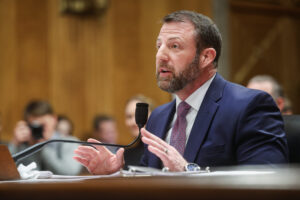
What else we’re watching: The Senate returns at 3 p.m. to finish debate on Sen. Markwayne Mullin’s (R-Okla.) nomination to be DHS secretary. Mullin is expected to be confirmed as soon as Monday night after Democratic Sens. John Fetterman of Pennsylvania and Martin Heinrich of New Mexico joined most Republicans Sunday to advance him.
Jennifer Scholtes, Jordain Carney, Katherine Tully-McManus and Meredith Lee Hill contributed to this report.
The shutdown of the Department of Homeland Security is at risk of shattering the record for the longest-ever funding lapse for any federal agency if President Donald Trump and congressional Democrats can’t strike a deal this week.
Lawmakers are scheduled to take a two-week recess for Passover and Easter starting Friday. While the Senate is considering staying in session if the shutdown is not resolved, House GOP leaders do not plan to cut their break short in hopes of reaching an accord, according to three people granted anonymity to discuss private planning.
“It’s going to be very, very hard to explain if we leave town this next week without having funded” DHS, Senate Majority Leader John Thune told reporters over the weekend.
Trump threw a curveball into the rekindled talks Sunday night when he declared on Truth Social he would not back any deal unless it includes the GOP’s partisan elections bill, the SAVE America Act. Senators, Trump said, should “lump everything together as one, and VOTE!!!”
“Kill the Filibuster, and stay in D.C. for Easter, if necessary,” he wrote.
The House and Senate are not scheduled to return to business until the week of April 13, when the DHS shutdown would hit Day 60 — significantly exceeding the 43-day record set last fall for the longest federal funding lapse in U.S. history.
The threat of a two-month shutdown — and evidence of lengthening TSA lines at U.S. airports as security officers refuse to work without pay — has spurred an uptick in what had been completely stalled negotiations.
A bipartisan group of lawmakers met twice in the Capitol late last week with Trump’s border czar, Tom Homan. Negotiators continued to talk over the weekend, after the White House laid out an expanded offer Friday that included changes to DHS immigration enforcement tactics — the crux of the shutdown fight.
“We’ll see if they can land something,” Thune said in an interview Sunday before Trump delivered his ultimatum. “The clock’s ticking. If we’re going to get this done, we’ve got to get moving pretty quickly here.”
With the urgency to clinch a bipartisan agreement increasing, the White House has sought to engage some of the Democrats who helped negotiate a solution to the broader government funding lapse that ended in November. That includes New Hampshire Sens. Maggie Hassan and Jeanne Shaheen, along with Sens. Catherine Cortez Masto of Nevada and Angus King of Maine, an independent who caucuses with Democrats.
Those senators were among the bipartisan group of lawmakers who met in person with Homan last week, along with Sen. Patty Murray of Washington, the Senate’s top Democratic appropriator.
“I can tell you that Democrats are really united, and we are talking to the White House and telling them what our demands are,” Murray told reporters Sunday afternoon. “I don’t know how you define progress. That is really up to the White House, whether they’re willing to move forward on this or not.”
Republican negotiators voiced frustration over the weekend that Democrats hadn’t responded to the updated offer the Trump administration delivered Friday night.
“I would have hoped we could continue to build on the momentum, positive momentum, that I felt like we had at the meeting Friday,” Sen. Katie Britt (R-Ala.), chair of the DHS funding panel, said in an interview Sunday. “I’m clearly disappointed.”
Britt noted that the meetings with Homan last week marked the first in-person DHS negotiations between Democratic lawmakers, their Republican counterparts and a delegate from the White House since the talks began almost two months ago.
“The American people need us to get in the room,” Britt said. “And we have to be expeditious about this.”
Democrats on both sides of the Capitol have pressed Republicans multiple times to take up their bills that would fund all of DHS except Immigration and Customs Enforcement, Customs and Border Protection and the secretary’s office.
Minority Leader Chuck Schumer said Saturday on the Senate floor that negotiators are having “productive conversations,” but Congress should fund TSA in the meantime
“Let’s keep negotiating the outstanding issues with ICE while sending paychecks to TSA workers now,” he added.
But Republicans continue to object to votes on those proposals, saying the entire department needs to be funded. The House has twice passed DHS funding legislation, but Senate Democrats have repeatedly voted against advancing an all-DHS funding bill — most recently on Friday.
Increasingly, Republicans are highlighting the irony that the funding lapse barely affects the agencies Democrats are trying to reign in, since ICE and CBP received about $140 billion from the tax and spending law Republicans enacted along party lines last summer.
“They’re trying to please their base,” Nebraska Sen. Deb Fischer, a Republican appropriator, said about Democrats in an interview. “But I would hope their base is smart enough to know that ICE and Border Patrol are already funded.”
Instead, the shutdown is causing the most disruption at agencies like TSA, where more than 300 airport security screeners have quit since funding lapsed more than five weeks ago. As the workforce goes without pay, TSA callouts also tipped over 10 percent multiple days last week, leading to long lines and travel disruptions at airports across the country.
Starting Monday, the Trump administration plans to detail ICE agents to U.S. airports to do jobs like guarding exits, allowing TSA agents to focus on screening passengers and baggage.
“We ought to fund TSA now,” said Sen. Raphael Warnock (D-Ga.), who requested a vote last week on legislation to fund all of DHS except the immigration enforcement agencies. “But I don’t know why the Republicans insist on holding federal workers hostage, holding TSA workers hostage, so that they can have an unaccountable paramilitary force on our streets.”
Senate Republican leaders are still waiting to make the call on whether to delay or cancel the chamber’s two-week recess. They’re typically reluctant to send lawmakers home during a crisis that requires legislative action.
In contrast, under Speaker Mike Johnson, House Republican leaders have repeatedly resisted pressure to reconvene the House to consider critical legislation while lawmakers are back home during a congressional recess. They argue it’s up to Senate Democrats to cut a DHS deal with the White House.
“We’ll see,” Thune told reporters on Sunday about canceling recess. “We’ll kind of see how the rest of the week plays out.”
Meredith Lee Hill contributed to this report.
President Donald Trump on Saturday threatened to send federal immigration agents to airports across the country on Monday if Democrats don’t agree to end the Department of Homeland Security shutdown, now approaching five weeks.
“If the Radical Left Democrats don’t immediately sign an agreement to let our Country, in particular, our Airports, be FREE and SAFE again, I will move our brilliant and patriotic ICE Agents to the Airports where they will do Security like no one has ever seen before, including the immediate arrest of all Illegal Immigrants who have come into our Country,” he wrote.
“Illegal Immigrants who have come into our Country, with heavy emphasis on those from Somalia” would be targeted with an especially firm hand, the president wrote on Truth Social.
Shortly thereafter, Trump followed up to say he plans to send ICE to airports in just days.
“I look forward to moving ICE in on Monday, and have already told them to, ‘GET READY.’ NO MORE WAITING, NO MORE GAMES!” he wrote in a separate Truth Social post on Saturday.
It’s his latest bid to push Democrats, who have refused to greenlight DHS funding without changes to how it carries out immigration enforcement, pointing to deadly incidents as Immigration and Customs Enforcement agents descended en masse on major American cities. Increased callouts among TSA agents and airport staffers are expected to roil airports in the coming weeks, with major interruptions to airport procedure likely to follow.
Both sides have seemingly made progress in recent days toward ending the shutdown. The White House made several concessions on immigration enforcement policies in a proposal shared with Senate Democrats on Friday. But the ICE agent masking ban Democrats are seeking in exchange for their support on a funding package remains a bridge too far, Republicans argue.
Trump’s latest threat isn’t likely to make the prospects of a truce any more viable, especially given his focus on Minnesota, where tensions flared after federal immigration agents killed two protesters during a major surge of personnel in January.
In a post on X following Trump’s threat, Rep. Lauren Boebert said, “The airport in Minnesota is about to be a ghost town.”
The president’s threat Saturday lands squarely in the middle of a confirmation fight over his pick to run DHS, Sen. Markwayne Mullin (R-Okla.), a process that has quickly become a proxy battle over the future of ICE itself.
At his hearing this week, Mullin tried to strike a more measured tone than in some of his past remarks, pledging to rein in some enforcement tactics and lower the agency’s public profile. But he repeatedly defended ICE agents amid mounting scrutiny, including backing officers involved in high-profile civilian deaths and arguing Democrats are tying the agency’s hands.
Republicans — including Mullin — have instead pushed to expand ICE’s resources and authority, framing the standoff as a fight over public safety.
The backdrop is the messy ouster of Kristi Noem, whose tenure was defined by aggressive deportation policies, costly PR campaigns and a series of controversies that ultimately led Trump to push her out after a bruising round of congressional hearings.
The enforcement-heavy approach Trump threatened Saturday sets up a preview for what Mullin will perhaps be asked to defend — and potentially formalize — as the next head of DHS.
ICE and the Transportation Security Administration did not immediately respond to requests for comment from Blue Light News.
- Capitol agenda: Trump muddies DHS talks
- Why Texas isn’t cheering oil price spike
- Capitol agenda: Markwayne Mullin’s rockier-than-expected road
- Democrats say Bondi won’t commit to testifying in House Epstein investigation

- ‘Warrants or bust’: House hard-liners deliver ultimatum ahead of spy powers vote

- Capitol agenda: Markwayne Mullin’s rockier-than-expected road
- ‘When will it end?’ The ‘elevator pitch’ oil executives and diplomats are making to the White House in Houston
- Pressure builds on Congress as DHS shutdown threatens to drag into April
- Bernie Sanders to force disapproval votes over U.S. arms sales to Israel

- Capitol agenda: Markwayne Mullin’s rockier-than-expected road
-

 The Dictatorship1 year ago
Luigi Mangione acknowledges public support in first official statement since arrest
-

 Politics1 year ago
Former ‘Squad’ members launching ‘Bowman and Bush’ YouTube show
-

 Politics1 year ago
Blue Light News’s Editorial Director Ryan Hutchins speaks at Blue Light News’s 2025 Governors Summit
-

 Politics1 year ago
Former Kentucky AG Daniel Cameron launches Senate bid
-

 The Dictatorship6 months ago
Mike Johnson sums up the GOP’s arrogant position on military occupation with two words
-

 The Dictatorship1 year ago
Pete Hegseth’s tenure at the Pentagon goes from bad to worse
-
Uncategorized1 year ago
Bob Good to step down as Freedom Caucus chair this week
-

 Politics11 months ago
Democrat challenging Joni Ernst: I want to ‘tear down’ party, ‘build it back up’