
Politics
New Hampshire’s GOP Gov. Kelly Ayotte draws her first major challenger

Cinde Warmington launched a repeat bid for governor of New Hampshire on Wednesday, giving Democrats their first major challenger to GOP Gov. Kelly Ayotte in the purple state.
Warmington, a former state executive councilor, ran unsuccessfully for governor in 2024, losing the Democratic nomination to former Manchester Mayor Joyce Craig who then went on to lose to Ayotte. She now enters a relatively open Democratic field, with just one other declared candidate.
In a launch video posted to her campaign website, Warmington attacked Ayotte for “making your life more expensive.” She also accused the Republican of not standing up to President Donald Trump’s attempts to open an ICE detention facility in the state.
“I’ll stand up to Trump when he jacks up health care costs and tariffs. I’ll say ‘no’ to ICE’s warehouse. I’ll work for our small businesses and I’ll make sure we don’t have a sales or income tax,” Warmington said in the video. WMUR first reported her launch.
Ayotte, for her part, has clashed with Trump. She has criticized the lack of transparency around the ICE warehouse and forced the resignation of a state official who had been communicating with the Trump administration without alerting the governor. Her refusal to redistrict last year led the White House to weigh putting up a primary challenger against her.
Ayotte spokesperson John Corbett blasted Warmington in a statement, saying the former health care lobbyist “chose to make money off big pharmaceutical companies who hurt Granite Staters, and she is absolutely disqualified from serving as our Governor.”
Democrats are bullish they can block Ayotte from a second term, emboldened by their party’s wins in the off-year elections. But they face an uphill battle in a blue-leaning battleground state that routinely elects Republican governors while sending all-Democratic delegations to Congress.
Recent history is not on Democrats’ side: The party thrice failed to unseat Ayotte’s predecessor, Republican Gov. Chris Sununu. And prognosticators rate the seat as “likely Republican” this year.
Democrats may also face another messy primary just two years after Warmington and Craig waged a bruising battle to be their party’s nominee. For now, just Warmington and Democrat Jon Kiper, who finished a distant third in the 2024 race, have declared their candidacies. But Democratic Portsmouth Mayor Deaglan McEachern has been publicly weighing a bid for governor as recently as this month.
A University of New Hampshire survey from January showed Ayotte leading both men in hypothetical general-election matchups; it did not test her against Warmington. Ayotte notched a 50-percent approval rating in the poll, though 44 percent of likely voters said she did not deserve to be reelected compared to 42 percent who did.


The United States once prided itself on being the final destination of people around the world seeking refuge from war and strife. The State Department reports that America has welcomed a total of more than 3.1 million refugees to its shores since the U.S. refugee program was established in 1980. But President Donald Trump has decimated the number of applicants who were granted refugee status — and those who made it through are overwhelmingly the beneficiaries of an insidious shift in policy to favor white South Africans.
Of the 4,999 refugees admitted, 4,496 were from South Africa; the remaining three newcomers were from Afghanistan.
Last November, the Trump administration announced it would be putting the lowest cap on the number of refugees that would be admitted in the refugee program’s decadeslong history. Only 7,500 applicants will be provided refugee status in fiscal 2026. That’s a 94% drop from the 125,000 cap the Biden administration had in place for each of the two fiscal years before Trump’s second term began.
The latest numbers from the State Department’s Bureau of Population, Refugees, and Migration only add insult to injury. As of March 31, there have been 4,499 refugees admitted to the U.S., more than half the annual cap. Of those, 4,496 were from South Africa; the remaining three newcomers were from Afghanistan.
“The largest share of South African refugees — over 500 — have arrived in Texas, followed by Florida and California,” The Christian Science Monitor reported last week. The bureau’s data doesn’t include race or ethnicity. But the memo in the Federal Register establishing the 7,500-person cap also required that those slots “primarily be allocated among Afrikaners from South Africa … and other victims of illegal or unjust discrimination in their respective homelands.” It’s no great leap then to presume the South African arrivals this year are all white.
While Trump’s war on undocumented immigrants has hogged the spotlight since January 2025, the administration’s campaign against legal immigration has been no less pernicious. The White House’s chief anti-immigration hard-linerdeputy chief of staff Stephen Millerhas been busy both removing protections for those who have already made it to the U.S. and discouraging those who are hoping to gain entry.

The Guardian reported last fall that Miller, who is also the White House homeland security adviser, has made significant inroads into influencing operations at Foggy Bottom. A top anti-immigration ally, Christopher Landau, is second-in-command at the State Department. Much like his past calls haranguing Department of Homeland Security staffers about deportations and arrests, Miller has also reportedly instated daily calls “to drill the diplomats on visa and immigration issues.”
White South Africans have been one major loophole to Miller’s immigration gatekeeping. Trump has been yelling about the supposed plight of the country’s minority for years now, buying fully into far-right claims that a “genocide” is being carried out against Afrikaner farmers. The truth is that white farmers control about 75% of the country’s farmland and still make up the vast majority of senior positions in South African corporations. As the Rev. Nontombi Naomi Tutu wrote for MS NOW last year“If white South Africans are experiencing genocide, then it is truly an enviable genocide.”
Concerned for white South Africans’ imagined hardship, in the face of a new law that replaced an apartheid-era ruleTrump issued an executive order in February 2025 cutting off foreign aid to South Africa. He also directed his government to “prioritize humanitarian relief, including admission and resettlement through the United States Refugee Admissions Program, for Afrikaners in South Africa who are victims of unjust racial discrimination.” Three months later, even while busy stripping parolees awaiting asylum claims of their legal status, the first several dozen white South Africans landed in the U.S.
The cruelty of this racist policy is only exacerbated when you consider the compounded effect of the other actions Trump has taken.
The cruelty of this racist policy is only exacerbated when you consider the compounded effect of the other actions Trump has taken. The administration slashed the foreign aid budget to ribbons, leading to a projected spike in deaths worldwide. Thousands of applicants from the Global South who were told to wait in line have been shunted to the back in favor of an unoppressed minority whose skin just happens to be the right color for this administration.
None of this is meant to directly shame the white South African immigrants who have taken advantage of this policy. The opportunity to emigrate to the U.S. is a dream shared by millions across the world, so it is hard to fault them for taking an opportunity when presented to them. Their new communities should welcome them with open arms, as all newly arrived immigrants should be. It’s hard not to hope, however, that there is a twinge of introspection in the back of their minds when they tell the story of how they came to be so fortunate as to find themselves in America.
Hayes Brown is a writer and editor for MS NOW. He focuses on politics and policymaking at the federal level, including Congress and the White House.
NEW YORK — A fear of losing again is already shaping how Democrats think about 2028.
Chants of “run again!” reverberated through the packed room as Kamala Harris spoke Friday at the National Action Network convention, a gathering of Black voters, lawmakers and power brokers that saw drop-ins from a steady stream of potential presidential candidates. But several Black attendees openly questioned whether anyone other than a straight, white man can win the White House.
“The Democratic Party, they’re going to have to consider … who can win? Who can win, Black, white, who can win?” the Rev. Kim Williams, 63, a New Yorker and registered independent said in an interview.
“I don’t think [the country is] ready for another different type of person,” said Annette Wilcox, a 69-year old New Yorker.
It’s an open question the party is grappling with in the wake of Harris’ decisive 2024 loss to President Donald Trump. Conversations with a dozen people on the sidelines of the Rev. Al Sharpton’s gathering found some lingering concerns that America remains too bigoted — and that as a result, the desire to diversify the highest reaches of government is in tension with the desire to win.
In interviews, several of the prospective 2028 Democrats themselves argued that anyone can win. They poured into the midtown Manhattan ballroom over the week to build their relationships with Black voters for what became a barely-hidden shadow primary.
Sen. Ruben Gallego, a first-term Democrat who won statewide in Arizona despite Harris losing the state, told Blue Light News on the sidelines of the convention that the party shouldn’t let fear narrow who ultimately runs.
“If you got stuck into this idea of what an ideal character is … you could potentially miss some really great talent,” said Gallego, who leaned intohis identity as a Latino veteran in his 2024 campaign.
Maryland Gov. Wes Moore, another possible 2028 candidate, said that he doesn’t “know many people back in 2022 who thought that an African American who had never held political office in his life was gonna be the next governor of Maryland.”
“People want to know, does your message meet a moment,” he added.
On stage with Sharpton on Friday, Harris seemed to agree. She made her most explicit overture at running again for the presidency, telling the audience she was “thinking about it” — to loud cheers and applause. Her appearance at the convention energized an otherwise largely staid event.
But even Harris, the first Black and South Asian woman to become vice president, has tacitly acknowledged the limitations of the country.
In her latest book, she divulged that former Transportation Secretary Pete Buttigieg — another 2028 contender who also made a pit-stop at NAN — was her top vice presidential pick in 2024. But she didn’t select him because she didn’t believe the country was ready for both a woman of color and a gay man in the White House.
A spokesperson for Harris declined to comment.
Some women, from former first lady Michelle Obama to various convention attendees disappointed by Harris’ 2024 loss, have said the U.S. isn’t ready for a female president.
“I believe the current climate of this country is not ready for a Black woman as president,” Aaliyah Payton, 30, a middle school teacher in the Bronx, said while waiting to see Harris speak on the third day of the convention in a line that spanned far outside the convention room.
“If Kamala Harris is running as a Democrat, and there is another white man also running as a Democrat, she would have a tough time winning,” said 60-year-old Donna Carr, who lives in New Jersey. “It’s a man’s world.”
“I’m not going to lie, it may be too soon,” said 27-year-old New Yorker Justina Peña when asked if Harris should run again.
The same handwringing roiled the 2020 Democratic presidential primary, and voters ultimately selected Joe Biden — a more moderate straight white man — to block Trump from winning a second consecutive term.
The debate within the Democratic Party over what kind of candidate is electable played out again most recently in Texas, where the Democratic Senate primary was defined by tensions over race and concerns over which candidate could unify enough Democrats, independents and disillusioned Republicans to flip the red state. Voters chose seminarian James Talarico, a white man, over political firebrand Jasmine Crockett, a Black woman, in the end.
“We saw it with the race with Crockett, and I saw a woman say she wanted to vote for Crockett, but she knew she could not win against [a] white male Republican,” said Williams, the 63-year-old reverend.
Now, those conversations are already emerging for 2028 before a single Democrat has officially announced a bid for the White House. The question over 2028 ambitions hovered over Moore, Gallego, Harris, Buttigieg, Illinois Gov. JB Pritzker, Pennsylvania Gov. Josh Shapiro and California Rep. Ro Khanna this week — and while nobody said they officially are, nobody ruled it out. Kentucky Gov. Andy Beshear and Arizona Sen. Mark Kelly are slated to speak on Saturday.
Buttigieg has dismissed concerns over his viability, including in a direct response to Harris’ revelation of why she didn’t choose him as a running mate in 2024.
“My experience in politics has been that the way that you earn trust with voters is based mostly on what they think you’re going to do for their lives, not on categories,” Buttigieg told POLITICO in a September interview.“Politics is about the results we can get for people and not about these other things.”
Some of the Black voters at the conference similarly expressed frustration with the idea that candidates’ identities should be a consideration in the looming 2028 primary.
“My concern — biggest concern — is when we get into a crisis like this in this country, people want to go to the ‘center,’ which usually is right of center in my view. A lot of people get kind of left out,” said Wilcox, the 69-year-old New York voter.
“In my experience, or history I’ve had with the Democratic Party, I feel like when that happens, Black people get tossed to the side.”
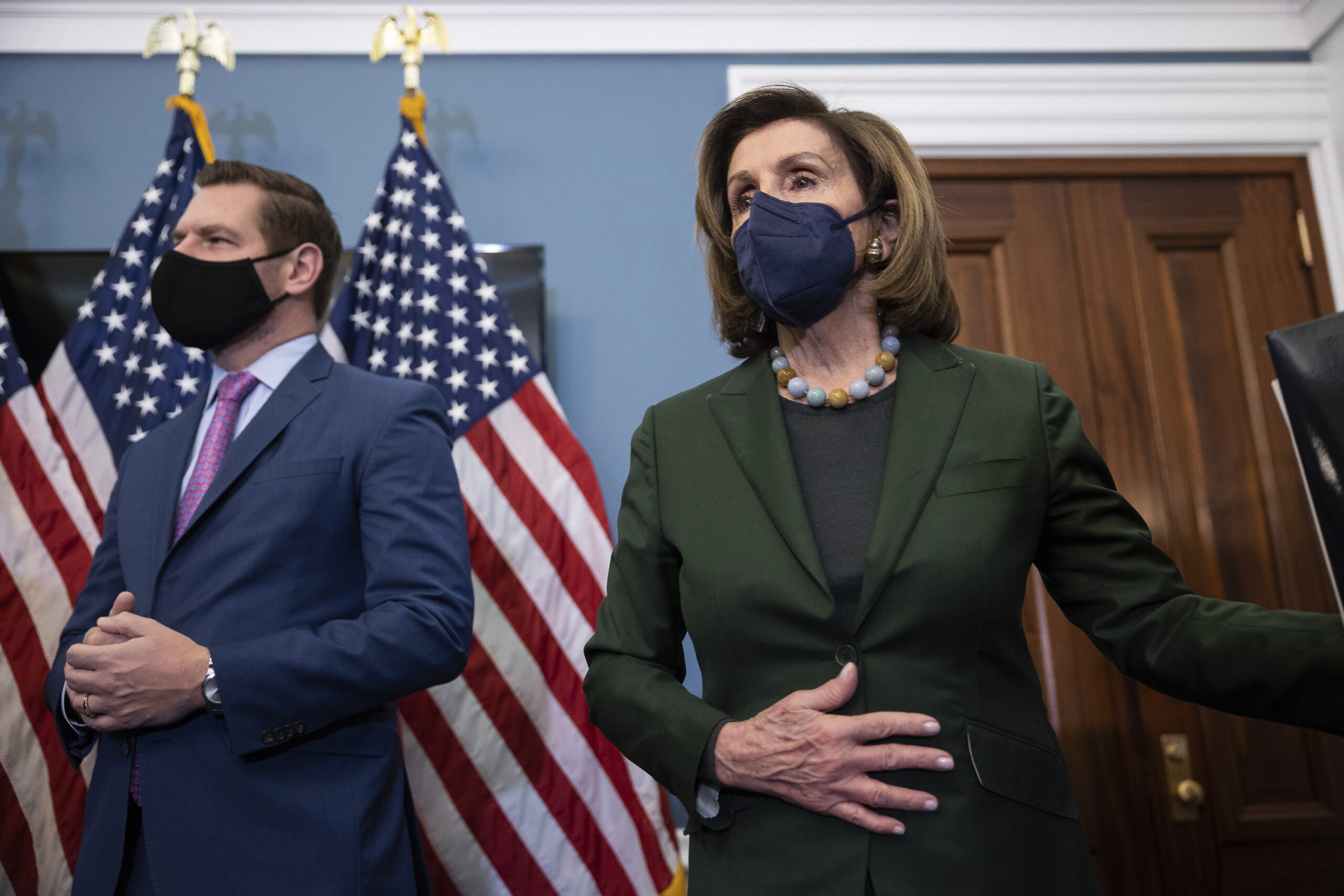
The former speaker said the sexual assault allegations “must be appropriately investigated with full transparency and accountability.”…
Read More
- Peace talks fail after U.S. warships launch risky Strait of Hormuz action
- U.S. Vice President JD Vance says talks with Iran ended after 21 hours without reaching agreement

- The Trump family’s conflicts of interest are of no interest to Fox News
- Trump’s white supremacy refugee policy is in full effect
- Trump administration admits error in New York health care fraud probe

- Trump’s budget hawk is still trying to slash medical research. Congress is saying no.
- RFK Jr. has turned corporate America’s name to mud, Blue Light News Poll finds
- 2028 Democrats say anyone can win. Voters aren’t so sure.
- Jeffries, Pelosi and other Democrats call on Eric Swalwell to end governor campaign
- Trump endorses ‘focused’ immigration enforcement funding bill

-

 Politics1 year ago
Former ‘Squad’ members launching ‘Bowman and Bush’ YouTube show
-

 The Dictatorship1 year ago
Luigi Mangione acknowledges public support in first official statement since arrest
-

 Politics1 year ago
Former Kentucky AG Daniel Cameron launches Senate bid
-

 The Dictatorship1 year ago
Pete Hegseth’s tenure at the Pentagon goes from bad to worse
-

 The Dictatorship7 months ago
Mike Johnson sums up the GOP’s arrogant position on military occupation with two words
-

 Politics1 year ago
Blue Light News’s Editorial Director Ryan Hutchins speaks at Blue Light News’s 2025 Governors Summit
-
Uncategorized1 year ago
Bob Good to step down as Freedom Caucus chair this week
-

 Politics12 months ago
Democrat challenging Joni Ernst: I want to ‘tear down’ party, ‘build it back up’