
Congress
Mike Johnson: Republicans ‘have nothing to negotiate’ on shutdown

Speaker Mike Johnson moved to shut down any attempts to negotiate a way out of the shutdown Thursday as some senators look for off-ramps.
Johnson said in a news conference outside his Capitol office that Democrats should stop pressing Republicans to come to any agreement to reopen the government, saying Senate Democrats instead need to pass the seven-week stopgap bill that had already cleared the House.
“I quite literally have nothing to negotiate,” Johnson said, before again warning that the shutdown will “inflict pain” on Americans as it drags on.
Still, Johnson is balancing concerns from some Republicans wary of President Donald Trump’s plans to slash federal workers and certain program funding amid the shutdown. Two House Republicans raised concerns directly with Vought on a private call Wednesday afternoon.
Before Johnson spoke, Trump said would meet Thursday with White House budget director Russ Vought to determine which “Democrat Agencies” they would cut.
Other House Republicans, meanwhile, are livid any GOP senators would be willing to talk about off-ramps to the shutdown, including promises of health care negotiations. Rep. Rick Allen of Georgia railed against attempts to extend the expiring Affordable Care Act insurance subsidies that are at the center of the Democratic shutdown demands during the House GOP call Wednesday. He pressed Republicans to not just allow the subsidies to expire but to rekindle their attempts to repeal and replace the ACA altogether.
Johnson backed Trump in saying the president has the authority to slash federal workers and funding during the shutdown. He added Trump takes “no pleasure” in it.
“He doesn’t want to do it,” Johnson said.
The speaker also referenced a flurry of inflammatory AI-generated deepfake videos, including several that Trump posted after his Monday White House sitdown with congressional leaders depicting House Minority Leader Hakeem Jeffries in a sombrero and mustache. One has fabricated audio of Senate Majority Leader Chuck Schumer saying Democrats need to court undocumented immigrants because voters have turned on their “trans bullshit.”
Johnson said he’d advise Jeffries to “just ignore it.”
The speaker also criticized Senate leaders for entertaining a plan to leave Washington for the weekend after voting a fourth time on the House-passed stopgap Friday. “Of course” the Senate should stay through the weekend and keep voting, Johnson said.
“The House is coming back next week, hoping they will be sending us something to work on, that we can get back to the work of the people,” he said. “They’re anxious to come back.”


House Financial Services Chair French Hill said he has “no concerns” about winning back his Arkansas seat in the upcoming midterm elections, but the six-term House member acknowledged the political headwinds for his party.
“I consider the atmosphere a very tough political environment right now because of President [Donald] Trump’s lack of favorability at the top, and you know people are concerned about, as I say, what it’s like to live under an inflated economy the last four years,” Hill said in an interview.
Hill is in a solidly red district, according to the nonpartisan Cook Political Report, and said he is up against a “weaker candidate this time than I’ve had in past races.” Polling in the district, however, has shown a tighter race. The two polls done this year placed Democratic challenger Chris Jones ahead of Hill by a few percentage points. Any perceived polling victory for Jones is still well within the margin of error, and one of the polls had a Democratic sponsor.
Stephannie Lane Baker, a spokesperson for Jones, said that “of all the Republicans in Congress, the chairman of the Financial Services Committee doesn’t get to dodge responsibility for this economy. He’s in trouble, and he knows it.”
Additionally, Illinois Gov. JB Pritzker’s PAC, Ready for the Fight, committed more than $1 million in television ads through the next five weeks for Jones’ race in Arkansas’s 2nd District, Jordan Abudayyeh, a spokesperson for the PAC confirmed. Overall Democratic spending on advertising for the race was just over $1 million, primarily made up by contributions from the Ready for the Fight PAC, with Republicans spending almost $2.7 million on ad buys, according to AdImpact, an advertising tracking service.
Hill said he has addressed affordability concerns “head on” this Congress.
“My work on housing, my work on the Price Stability Act, my work to try to reduce waste, fraud, and abuse, and drop the federal budget deficit as a percentage of GDP,” Hill said. “All these things can contribute to a more affordable environment for people. So I’ve tried to make that a forefront of my campaign this year.”
Hill was a key architect of the 21st Century ROAD to Housing Act, a bipartisan housing affordability bill that became law in July. The Price Stability Act, which is unlikely to become law this year, would narrow the Federal Reserve’s current dual mandate of pursuing maximum employment and price stability to focus exclusively on containing inflation.
Rep. Alexandria Ocasio-Cortez (D-N.Y.) and Sens. Bernie Sanders (I-Vt.) and Jeff Merkley (D-Ore.) on Friday released text of legislation intended to ban the use of Flock surveillance cameras and other license plate readers.
Flock has faced severe public backlash against the surveillance technology following reports that police officers misused the technology to track women, and it has the largest network of license plate readers across the U.S. Sens. Josh Hawley (R-Mo.) and Dick Durbin (D-Ill.) hosted a hearing last month probing its potential misuses, although the company’s CEO Garrett Langley did not appear.
The latest bill, unveiled Friday and named the Ban Flock Act, would bar federal agencies from using automated license plate readers or accessing data from the technology and prevent federal grants from funding states and local governments that use automated license plate readers.
“At a time of growing concern about the unchecked power of artificial intelligence, Flock is eviscerating the very notion of privacy by installing tens of thousands of cameras in communities across America without their consent,” Sanders, who has positioned himself as a leading progressive voice on AI technology, said in a statement. “We cannot allow America to become a surveillance state where a handful of AI oligarchs profit by giving the government the power to track our every movement.”
Ocasio-Cortez similarly condemned the surveillance capabilities of the technology and said the bill would “enforce our constitutional right to privacy and protect Americans from both corporate and government surveillance.”
“No one should have this unchecked surveillance power at their fingertips,” Merkley added.
Republicans have introduced similar efforts to regulate license plate readers, such as Hawley’s Stop Flock Abuse Act, which would require audits and limits on unauthorized searches.
Flock did not immediately respond to a request for comment.
Democrats watching Speaker Mike Johnson deal with a chaotically slim majority have seen enough — and they’re trying to avoid the same fate.
The party is investing in deep-red districts that could pad a future majority and strengthen the hand of Hakeem Jeffries, who’s widely favored as speaker if Democrats win the chamber in November.
“Another five-or-so-seat buffer would be a game-changer,” said one senior House Democrat, who like others in this report was granted anonymity to discuss internal party dynamics. That lawmaker added it would help Jeffries “rise above some of the incoming bullshit he’s going to have to deal with.”
Every extra seat would help Jeffries secure the speaker’s gavel without having to make concessions to the two clashing blocs within his party: progressives and moderates.
Recent spending reflects these ambitions. Since the start of August, Democratic-aligned groups and candidates have spent or committed more than $73 million in ad dollars to GOP-held districts that President Donald Trump won by at least 10 points in 2024, according to a Blue Light News review of data from AdImpact. The NewDem Action Fund, the political arm of the centrist New Democrat Coalition, is spending in some even redder districts.
“Every single endorsed candidate supports Hakeem Jeffries for speaker of the House,” said the fund’s chair, Rep. Greg Stanton. “We will be a strong governing partner with Hakeem Jeffries to make sure that his speakership is as successful as possible.”
Tight majorities are misery-makers for speakers. Before Johnson, former Speaker Kevin McCarthy gave numerous concessions to his party’s right flank to assume the role — only to later be ousted by those same lawmakers. And former Speaker Nancy Pelosi had to cut a deal with moderates to secure her post in 2018 by promising to limit her leadership term.
Even with the gavel secured, a speaker has more flexibility to manage the floor if he or she can let some party colleagues peel off on tough votes.
Progressive challengers ousted a handful of Democratic incumbents in primaries this year, and they could adopt tactics from the ultraconservative House Freedom Caucus if Democrats win just a narrow majority.
Meanwhile, newly elected moderates, particularly from rural districts that swung heavily for Trump in 2024, could end up as a bigger problem for Jeffries — as they were for Pelosi when she was speaker.
What else we’re watching:
— HAWLEY’S POPULIST AI REBELLION: Sen. Josh Hawley’s push against artificial intelligence is placing an unmistakable marker for anti-tech rhetoric in the 2028 campaign among ambitious Republicans. Hawley’s call for AI safety legislation this week — including imposing corporate liability when AI causes harm — contrasts with Trump’s favoring of voluntary standards and exposes the growing rift between Republicans on how to respond to the technology. But Hawley’s influence is poised to expand as more Republicans start to echo his tone.
— GOP ADS SPUR CORPORATE HEARTBURN: A series of TV campaign ads this midterms season has highlighted a growing reality: On the right it’s become increasingly in vogue to bash big business. The ascendancy of Trump has ushered in a new era of skepticism toward multinational corporations in a party traditionally known as corporation-friendly. That puts big financial services firms, health insurance companies and tech titans — the subjects of the hottest rhetoric — at risk for becoming high-profile political punching bags for Republican 2028 presidential hopefuls.
Andrew Howard, Meredith Lee Hill, Riley Rogerson, Jessica Piper, John Hendel, Jasper Goodman and Victoria Guida contributed to this report.
- Hill: Trump’s ‘lack of favorability’ creating challenging politics
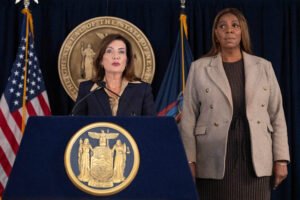
- Hochul eyes changes to state’s rape law amid Cornell crisis
- Kansas becomes a surprise Senate battleground
- Musk-led war commission triggers alarms in Pentagon
- ‘Blackmail’: Europe fumes against White House demand for more diesel
- Top GOP groups scale back North Carolina spending
- October
- Sanders, AOC, Merkley propose bill to ban Flock cameras
- Capitol agenda: Dems spend big to help Hakeem’s dream
- The low-profile Democrat helping shape her party’s AI agenda
-

 Politics2 years ago
Former ‘Squad’ members launching ‘Bowman and Bush’ YouTube show
-
Uncategorized2 years ago
Bob Good to step down as Freedom Caucus chair this week
-

 The Josh Fourrier Show2 years ago
DOOMSDAY: Trump won, now what?
-

 Politics2 years ago
Former Kentucky AG Daniel Cameron launches Senate bid
-

 The Dictatorship2 years ago
Pete Hegseth’s tenure at the Pentagon goes from bad to worse
-

 The Dictatorship2 years ago
Luigi Mangione acknowledges public support in first official statement since arrest
-

 Politics2 years ago
Blue Light News’s Editorial Director Ryan Hutchins speaks at Blue Light News’s 2025 Governors Summit
-

 The Dictatorship1 year ago
Mike Johnson sums up the GOP’s arrogant position on military occupation with two words