
Politics
Melania Trump and Usha Vance are exactly who they seem to be

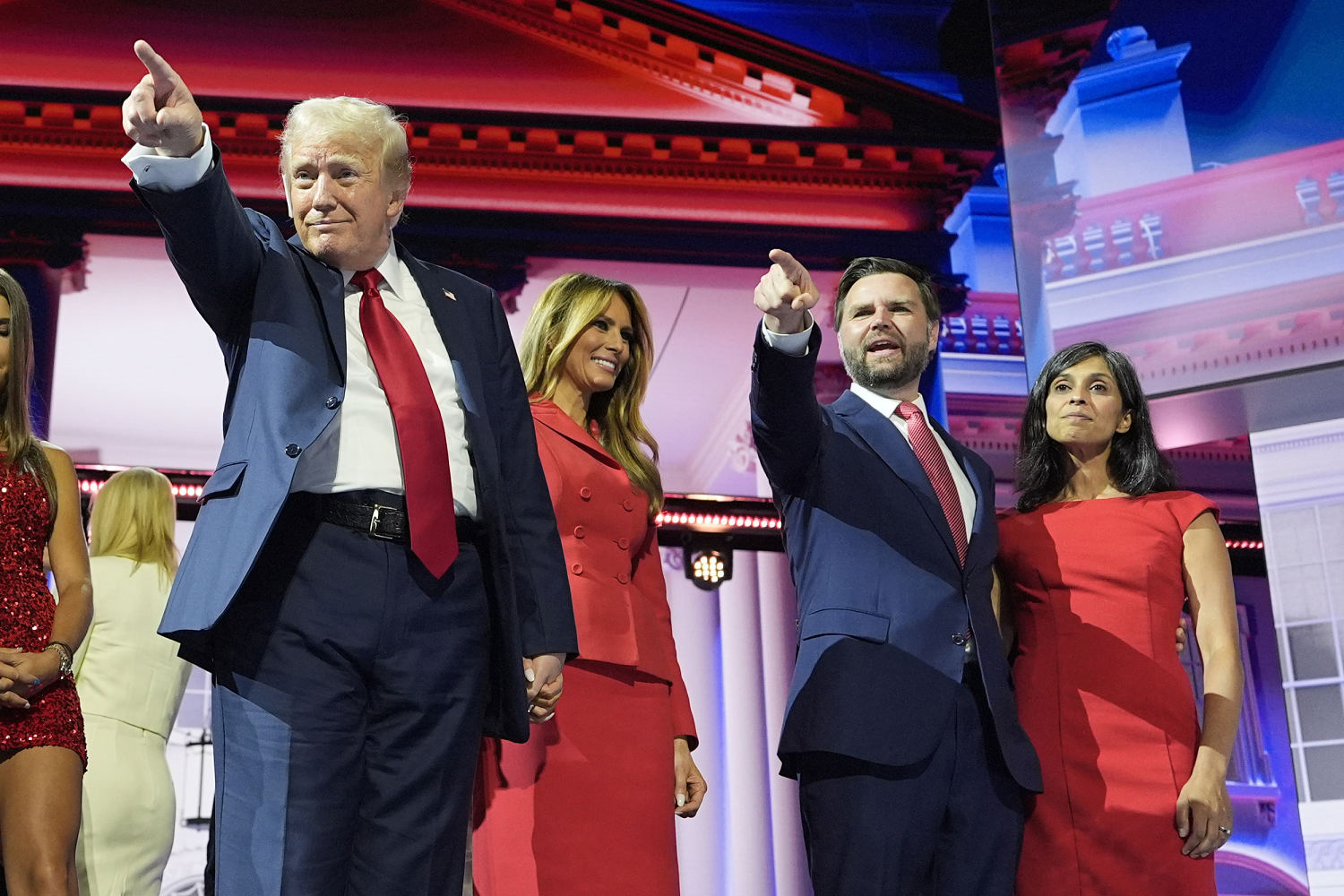
Who, exactly, is Melania Trump? Since the sphinx-eyed former model came onto the political scene alongside her husband, former President Donald Trump, she’s been something of an enigma: often seemingly apolitical and largely silent, with opaque motivations. She clearly doesn’t believe Trump’s politics were a deal-breaker — after all, she remains married to the guy. But she didn’t exactly seem enthusiastic about being in the political crosshairs, either.
The former first lady’s very short memoir, with an all-black cover interrupted only by “MELANIA” printed in neat white block letters, promised to offer some insight “into the life of a remarkable woman who has navigated challenges with grace and determination.”
In fact, no such insight is offered. It is a difficult book to remark on, because it contains nothing remarkable. This is a book you can judge by its cover. “Melania” isn’t just boring; it’s a void.
This is a book you can judge by its cover. “Melania” isn’t just boring; it’s a void.
Perhaps Melania is, too. Journalists have tried to profile her, interviewing friends and family members and even people she grew up with, trying to find anyone who can help them decode this cipher. But Melania may be more stick figure than hieroglyphic; there seems to be no complex code to crack.
Melania is exactly who she seems to be: a beautiful woman who has spent a long time trying to be beautiful, who found a rich man to take care of her. She loves her son, Barron, and her parents (her mother recently passed away). She likes expensive clothes and other luxuries. She may not be an aggressively cruel person like her husband, but she doesn’t seem to be an ardently compassionate one, either.
And that would be all fine and good had she stayed on the Upper East Side of Manhattan with her wealthy if boorish and allegedly philandering husband. But Trump’s foray in politics has dragged her in, too, and her decision to stand by his side (even if she didn’t go to the trial stemming from his alleged dalliance with porn star Stormy Daniels during their marriage) is at the very least a symbol of her acceptance of his vulgarities and goals.
She did get some headlines — good and bad — for using her memoir to voice public support for abortion rights just weeks before an election in which abortion is one of her husband’s weaker issues. But this, too, seems less a statement of true independence and more one of cynical political game-playing — her husband needs to rope in more female voters, and many women are angry that he appointed Supreme Court justices who overturned Roe v. Wade.
In this sense, perhaps Melania and Donald aren’t so different. Neither are politically sophisticated or particularly attentive to policy. Neither evince much in the way of compassion or even interest in other people. Trump is angry and vitriolic, while Melania is purse-lipped and stoic; he is emotionally incontinent, while she often appears to be in emotional rigor mortis; he is behaviorally uninhibited and says whatever he wants, while she is studiously reserved, perhaps because she has very little to say. But with both Trumps, what you see is what you get: There’s just not all that much there.
The Vances — JD, who is running for vice president, and Usha, who would be the second lady — are far more fascinating. But they, too, may be more transparent than the public would hope.
Journalist Irin Carmon has a compelling profile of Usha Vance in The Cut, and it sketches out a woman who on her face seems ill-suited for the role of political spouse to a MAGA maniac.
Usha is the high-achieving daughter of highly educated immigrant parents, who married a man whom she academically outperformed and who was attracted to her intelligence; JD even reportedly considered taking her last name and being the primary caregiver for their kids. Now, he’s a different kind of guy, one who rails against childless cat ladies and, as Carmon writes, “refer[s] to his children as belonging to Usha” (“She’s got three kids,” he recently said on a New York Times podcast).
Vance, Carmon writes, “often describes Usha as a ‘working mother’ without implying that he himself has anything to juggle. He has come a long way from the would-be stay-at-home dad who put his wife’s career first.”
Usha Vance has clerked for conservative judges, including federal appeals Judge Brett Kavanaugh, now a Supreme Court justice, and Chief Justice John Roberts, but she doesn’t seem particularly conservative (or political) herself. JD Vance once compared Trump to Hitler and voiced his respect for ambitious women; now he’s Trump’s highest-level lackey and mocks professional women who delay or — for whatever reason — don’t end up giving birth.
JD Vance once compared Trump to Hitler and voiced his respect for ambitious women; now he’s Trump’s highest-level lackey.
After he graduated from law school, Vance did a little bit of time in the world of corporate law before moving into bigger-money venture capital. While there, he published a finger-wagging memoir about his working-class Appalachian roots, writing about rural America in a way that appealed to moneyed coastal conservatives who wanted to believe that the poor and miserable immiserated themselves. (While the book garnered plenty of bipartisan praise, leftists, it’s worth pointing out, were some of the harshest critics of “Hillbilly Elegy.”) When he decided to run for the Senate in Ohio, he was barely living in the state and had to quickly rebrand as a real working-class man — and one sympathetic to the MAGA movement.
Usha hasn’t adopted many of the aesthetics of the MAGA female, but she has quit her job, joined her husband on the campaign and stood by her man even as he demeans the sort of smart, well-educated, ambitious female archetype she very recently embodied.
The public wants the people in high office — and most people in the public eye, whether they are in politics or are celebrities of another kind — to have depth. We want them to be decipherable, but we want to believe they are special. When they seem insubstantial or fueled by some silly and transparent motivation, we may assume there’s something they’re obscuring. If they’re at the top of their game, then there must be something there, right?
Maybe with these four — the Trumps and the Vances — that’s simply assuming too much. Perhaps they are exactly who they appear to be: The Trumps are superficial, intellectually shallow and money-obsessed; the Vances have principles that seemingly bend to their grand ambitions. All four of these people have had enough time to show the public who they are. I suspect that what we see is exactly what we get.
Jill Filipovic is a journalist and the author of “OK Boomer, Let’s Talk: How My Generation Got Left Behind” and “The H-Spot: The Feminist Pursuit of Happiness.”




Iowa’s last Democrat on how he can win in Trump country
lead image
Alaska GOP Sen. Dan S. Sullivan can’t shake his same-name challenger.
Retired teacher Dan J. Sullivan punched a ticket out of the state’s top-four, all-party primary early Wednesday morning. He could now play spoiler in a high-stakes Senate clash between the Republican senator and former Democratic Rep. Mary Peltola that could help swing control of the upper chamber.
Republicans fought and failed to keep Dan J. Sullivan off the primary ballot, arguing he was a Democratic plant designed to boost Peltola. Both Dan J. Sullivan and Peltola’s campaign have denied any coordination.
The senator’s allies have already taken steps to mitigate the second Sullivan’s potential vote siphoning, in some cases running ads using the senator’s middle initial to help differentiate between the same-named candidates.
Supporters of the state’s ranked-choice voting system, which kicks in for the general election, argue the process helps curtail the spoiler effect. But the presence of other candidates could still skew the results of the battleground race. Outside groups flooded the primary with more than $2 million to boost myriad fringe candidates — and could do so again ahead of November.
It’s not smooth sailing for Peltola, either, as she wages an uphill battle to flip a red seat in a state President Donald Trump won by 13 percentage points in 2024. She recently replaced her campaign manager in a staffing shakeup ahead of the primary, among other internal moves.
President Donald Trump notched a major win on Tuesday night. Republicans in battlegrounds wonder if it was the best use of his time and money.
Sen. Darline Graham defeated Rep. Ralph Norman in South Carolina’s snap Senate GOP runoff, handing Trump a revitalizing win after several of his endorsed candidates fell in recent primaries.
It was a victory that Graham, a complete political unknown six weeks ago, could not have pulled off without Trump’s steadfast support, underscoring just how much his influence still matters among the Republican electorate in the deeply conservative state.
But South Carolina’s Senate seat will not dictate the balance of power in Washington, and GOP strategists working on critical swing state campaigns are eager for Trump to finally direct his attention to them.
“The message coming out of this is that obviously the president’s support is still super powerful. The president’s operation still has the ability to move the needle in a lot of these states,” said a Republican strategist working on several battleground races, including in Georgia, who was granted anonymity to speak candidly about Trump’s involvement. “Hopefully, this is a sign of things to come that the president is willing to get involved and really start to move the needle in some other places that obviously matter a little bit more than South Carolina.”
Trump’s persistent backing of Graham defined the race: He championed her appointment to her late brother Sen. Lindsey Graham’s seat, he coaxed her into the race with an early endorsement, stood by her as she stumbled on the debate stage, and flew down to Myrtle Beach for a rare political rally that few of his chosen candidates have enjoyed this cycle. MAGA Inc., Trump’s behemoth super PAC, even spent a slice of highly sought after cash from its $400 million stockpile in the closing days of the race.
And yet, the president hasn’t taken a meaningful step into the states that will matter in a few short months — even as battleground Republicans have been clamoring for him to spend his MAGA Inc. money.
“It’s now or never. It’s put up or shut up time, and it’s really time to start to see if he’s going to get serious,” the GOP strategist said. “You’ve got September and October to really move the needle here, and it just doesn’t seem like there’s any sense of urgency, or like we understand that we are down big in some of these states.”
During her victory speech in Columbia, Graham acknowledged Trump’s heavy hand: “Our victory would not have been possible without you, and we are truly grateful,” Graham said of the president. “South Carolina is truly Trump country.”
Norman’s take on the president’s participation was not as rosy: “The president got involved. He has that right. That’s his prerogative,” Norman said in his concession speech Tuesday, prompting jeers from the crowd at his election night watch party. “Y’all,” he continued, “his policies are good. I never understood why he got in this race. It is what it is, and I’ll accept it.”
Norman’s bewilderment reflected several national and South Carolina Republicans’ confusion as to why the president would expend energy for the safe Republican seat when his MAGA allies like Mike Collins in Georgia, scandal-plagued Ken Paxton in Texas and Michael Whatley in North Carolina are facing tough Senate battles against Democratic opponents.
“There’s the principle,” said a North Carolina-based GOP strategist who was granted anonymity to speak candidly about the battleground picture. “If you’re not Trump and you have these people shoved down your throat, you’re like, ‘Okay, are you gonna help?’”
The White House did not immediately respond to a request for comment.
Some Republicans are worried that though Trump helped power Graham’s win, the president’s overall unpopularity may be more of a curse than a boon in any highly competitive battleground state. A series of Trump-backed candidates lost gubernatorial and congressional primaries in recent weeks, including in Georgia and Iowa.
Republicans overall are facing a tough election environment given the ongoing and unpopular war in Iran, backlash to the administration’s highly-visible deportation agenda and voters’ persistent cost of living concerns.
“You have a president and maybe even a vice president that are just so underwater politically in the polls, that they might be a help by not intervening,” said Matthew Bartlett, a GOP strategist and former State Department official in the first Trump administration.
Still, Trump swept the battlegrounds in 2024, and his ability to boost Graham despite her foreign policy debate gaffe and questions about her political inexperience serves as a reminder of his electoral prowess to campaign officials.
The question remains when — or if — he’ll throw them a presidential life raft.
“I wouldn’t count on the money if I were in these states,” said the North Carolina-based Republican strategist. “He still could. I’m just saying, I wouldn’t count on it. We’re not dealing with somebody that’s, you know, super calculated in the way they plan.”
For months, Republicans across the country have watched on as the president has continued to amass a remarkable pile of cash — and many have implored him to empty his pockets in their races. The president told reporters last week that he’ll spend “a lot of that money” to boost “Republican candidates that I think are good,” without being specific.
However, what some saw as a distraction from the greater Republican cause this year, others read as the first few drops of Trump’s cash flood.
“If they’re going to spend 800 grand in South Carolina, they’re going to spend in the midterms,” said Matt Mackowiak, a Republican strategist based in Texas who worked on Sen. John Cornyn’s failed reelection campaign and is now backing the GOP ticket. “It signals they’re going to make a substantial investment in the midterms because you don’t make an 800-grand investment in South Carolina and say, ‘Yeah, we’re going to let everybody do their own thing.’ This was in some ways a test case.”
Trump’s targeted support for Graham — the kind that some Republicans are banking on to shift the dial later this fall — paid off for her in dividends on election night. Horry County, the site of the president’s marquee rally with the candidate late last week, resoundingly broke for Graham.
Trump’s backing also helped open the door to endorsements from key South Carolina Republican figures, including fellow GOP Sen. Tim Scott, who helped Graham shore up support in his Charleston-area home base, Gov. Henry McMaster, and two members of the state’s congressional delegation, Reps. Russell Fry and William Timmons.
Outside spending also proved crucial to Graham’s success. Her campaign and its allies outspent Norman by more than $5 million in the runoff alone, according to AdImpact.
Trump’s allies took a victory lap after Graham’s victory was confirmed Tuesday evening.
“The power of the Trump endorsement is alive and well in South Carolina,” said Mike Hahn, a GOP strategist involved in the midterms. “A good opening salvo for the team at MAGA Inc. and the president ahead of the midterms.”
- Pentagon claims to have found ‘hidden’ files on final days of the Afghanistan war
- Iowa’s last Democrat on how he can win in Trump country

- Trump’s trade moves add to GOP’s midterm anxieties
- The other Dan Sullivan makes November ballot against Sen. Dan Sullivan
- ‘It’s put up or shut up time’: Battleground Republicans want the Darline treatment
- Trump-backed candidate wins primary for Oklahoma governor
- Political newcomer Darline Graham wins South Carolina’s GOP Senate runoff
- 2 unvaccinated people die of measles in Pennsylvania
- Ossoff presses GOP opponent Mike Collins on House Ethics probe
- The Iran war is already on November ballots
-

 The Josh Fourrier Show2 years ago
DOOMSDAY: Trump won, now what?
-

 Politics2 years ago
Former ‘Squad’ members launching ‘Bowman and Bush’ YouTube show
-

 The Dictatorship2 years ago
Luigi Mangione acknowledges public support in first official statement since arrest
-
Uncategorized2 years ago
Bob Good to step down as Freedom Caucus chair this week
-

 Politics2 years ago
Former Kentucky AG Daniel Cameron launches Senate bid
-

 Politics2 years ago
Blue Light News’s Editorial Director Ryan Hutchins speaks at Blue Light News’s 2025 Governors Summit
-

 The Dictatorship2 years ago
Pete Hegseth’s tenure at the Pentagon goes from bad to worse
-

 The Dictatorship12 months ago
Mike Johnson sums up the GOP’s arrogant position on military occupation with two words