
Politics
‘Massive crack in the MAGA coalition’: The Trump-Musk feud threatens the GOP’s future

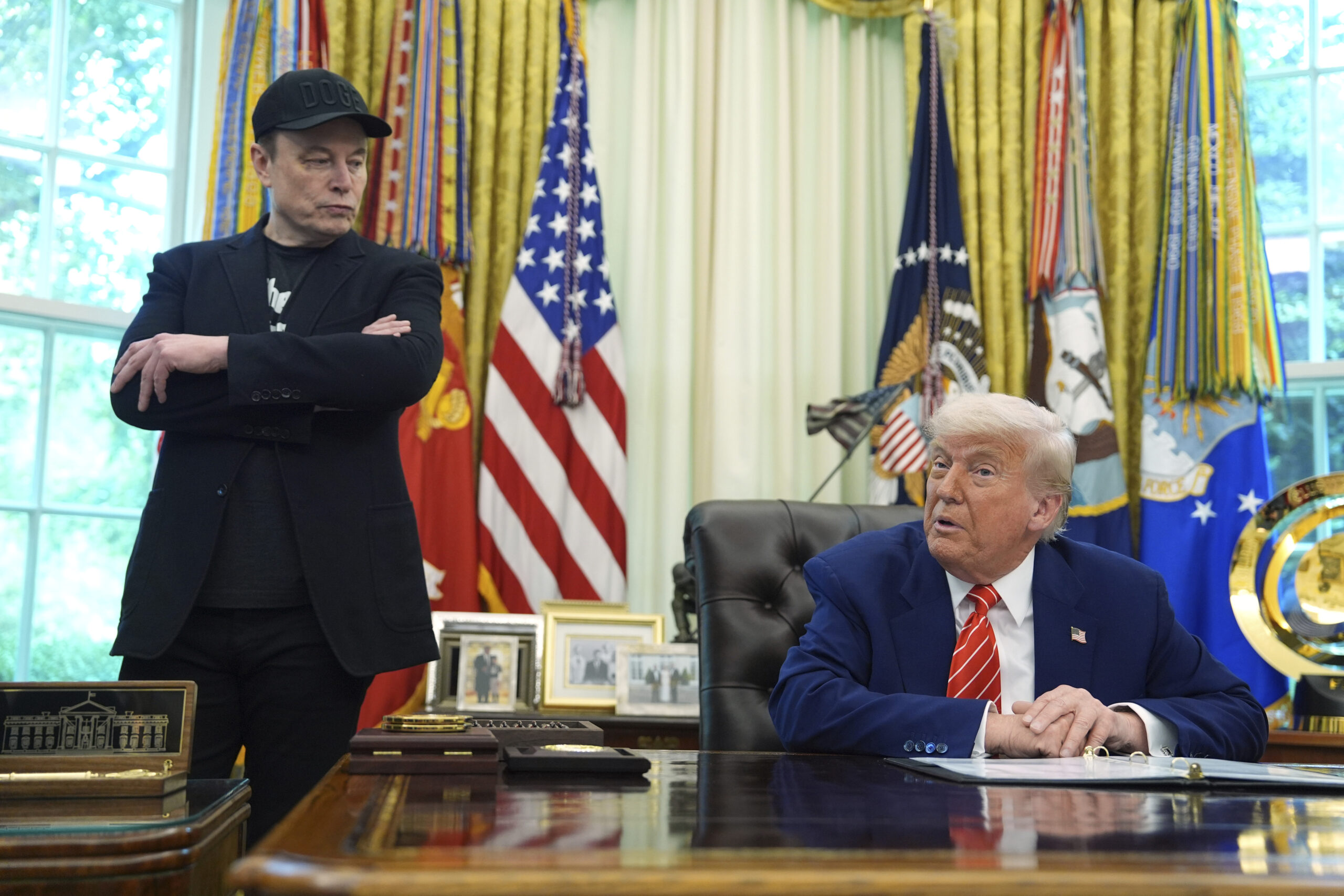
Elon Musk just launched a war against the GOP. Now the party’s hopes of holding onto power are at stake.
Musk has gone from helping Republicans take total control of Washington — spending nearly $300 million to become the single biggest known donor last year — to attacking the highest-ranking leaders of the party and daring the rank and file to cross him.
“Trump has 3.5 years left as President, but I will be around for 40+ years,” Musk said on X.
The post was an unambiguous warning from the world’s richest man, who has the power to single-handedly reshape elections with his wealth. It was not long ago that Republicans hoped Musk could pour cash into their efforts to help maintain control of Washington. Instead, he’s becoming their public adversary.
Musk spent Thursday online attacking President Donald Trump over Republicans’ massive tax-and-spending bill, which Musk says does not cut enough government spending.
He’d already threatened to challenge Republicans who support the megabill; on Thursday, he blasted House Speaker Mike Johnson and Senate Majority Leader John Thune, took credit for Republicans winning trifecta control in November, and floated the idea of launching a third party.
“This is a massive crack in the MAGA coalition,” said Matthew Bartlett, a Republican strategist and a former Trump administration appointee. “This town is historically built on Republican versus Democrat, and this seems to be crazy versus crazy. It is asymmetric and it seems, for the first time, President Trump seems to be out-crazied.”
Just a few weeks ago, Republicans were still praising Musk for his financial backing in the 2024 election as they hoped he’d make a graceful return to the private sector after overseeing the administration’s program to slash federal spending. Less than one week ago, Musk was in the Oval Office with Trump commemorating his time in administration as a special government employee.
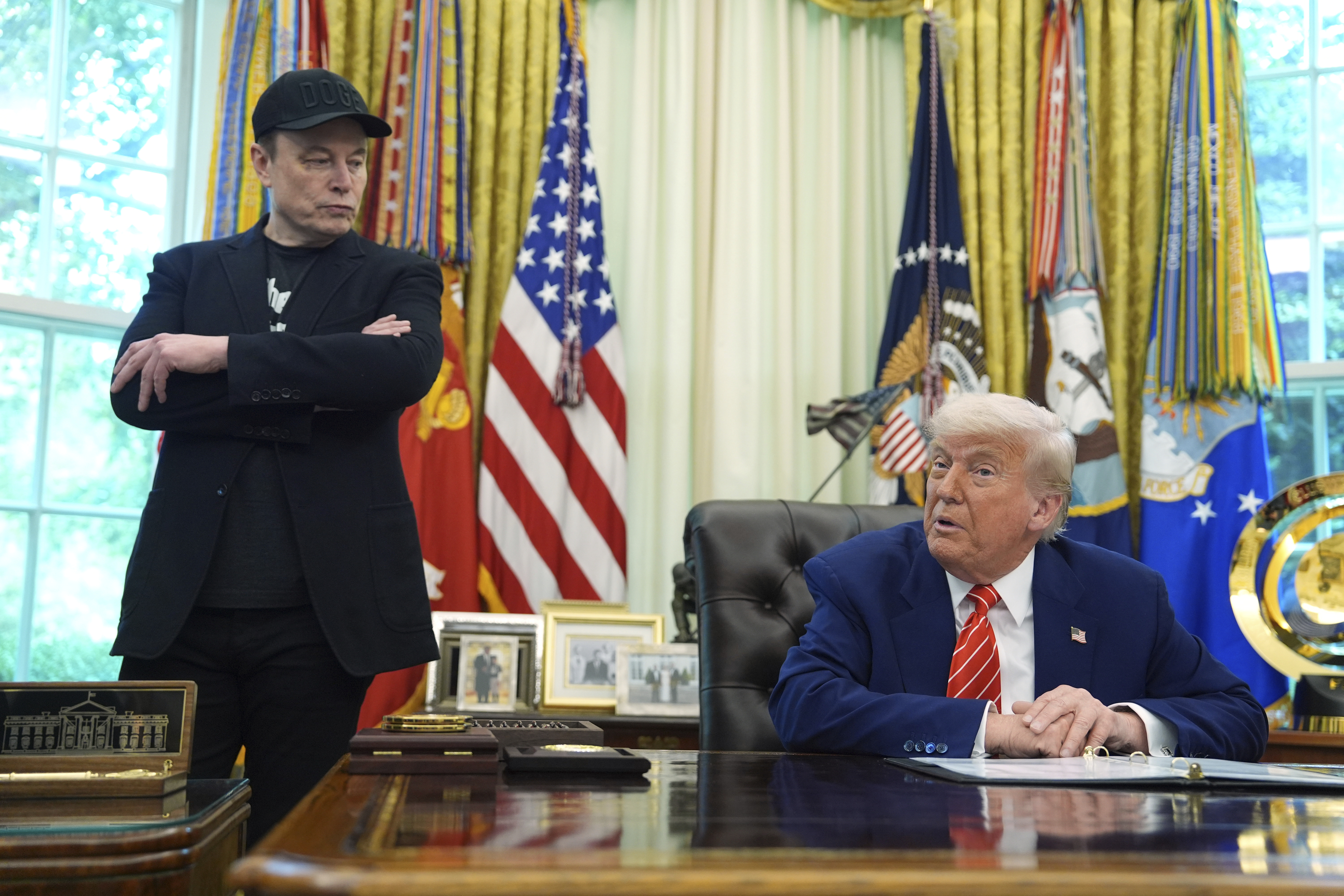
But that polite departure, it quickly became evident, was not going to happen.
“Elon was ‘wearing thin,’ I asked him to leave,” Trump wrote on Truth Social, blaming Musk’s anger on the megabill’s removal of electric vehicle tax credits. “He just went CRAZY!”
As Musk’s drama engulfed the party Thursday, Republicans in Congress mostly tried to avoid getting caught in the crossfire. Key GOP lawmakers in both chambers worked to downplay the potential effects on both the party’s domestic policy package and on the GOP’s midterms posture.
Rep. Richard Hudson (R-N.C.), who leads the House GOP campaign arm, told reporters Thursday that he hopes the spat will “blow over.” Before the breakup went nuclear, Hudson had said in a brief interview Wednesday evening that Musk has “been a friend and he’s just wrong about this bill.”
Even fiscal hard-liners who have embraced some of Musk’s talking points about the bill tried to avoid getting drawn into the fracas. Rep. Chip Roy (R-Texas), who at one point threatened to tank the megabill for not being fiscally conservative enough, said, “Elon crossed the line today … we’ll let those guys go play it out.”
“I don’t disagree with him about our need to find more spending cuts,” Roy added, but Musk needs to “keep it in the lines.”
Another hard-liner, Rep. Tim Burchett (R-Tenn.), said he believes Musk is losing sway within MAGA. Musk is “just another shiny object,” he said, “and we’ll deal with it.”

But Musk appeared intent on turning his opposition to the legislation into a civil war for the party. He amplified two Kentucky Republicans, Rep. Thomas Massie and Sen. Rand Paul, who have been thorns in the side of Trump and GOP leaders trying to pass the bill.
Even though Musk brought massive financial backing, he has also at times been an electoral problem for Republicans. His popularity has fallen below Trump’s, and his biggest political effort this year — the Wisconsin Supreme Court race — ended with the conservative candidate losing by almost 10 points.
“Elon couldn’t buy a Wisconsin Supreme Court seat. You really think that people are gonna be afraid of this money?” said a person close to the White House, granted anonymity to discuss the dynamics.
As Musk’s popularity faded, Republicans wondered how long his relationship with Trump could endure. On Thursday, Musk severed ties.
He took shot after shot at Trump, accusing him of lying, replying “yes” to a post suggesting he should be impeached, and accusing him of having a cozy relationship with the deceased Jeffrey Epstein, who had been accused of sex trafficking.
“What a predictable shitshow,” said a person who has been in the room with both Musk and Trump. “Trump is a liar, and it was obvious Elon would not be able to go along with his incessant lying forever.”
A nervous Republican Party is now scrambling to figure out what the electoral fallout will look like, starting with next year’s midterms.
Already, two of Trump’s top campaign operatives, Chris LaCivita and Tony Fabrizio had signed up to work with Musk’s Building America’s Future PAC. But Musk’s scorched-earth strategy could create dueling allegiances.
Privately, some Republicans are arguing they had already been preparing for next year’s elections without Musk’s money, and complained that America PAC — the tech billionaire’s super PAC — didn’t spend its money effectively in House races last year.
America PAC spent $19.2 million backing GOP candidates across 18 battleground House races last year, according to data from the Federal Election Commission. Republicans won 10 of those elections. But those were among the highest-profile and most expensive races in the country, and Musk’s group accounted for only 12 percent of Republican outside spending in them. It wasn’t even the biggest GOP spender — that was still the Congressional Leadership Fund, the primary super PAC affiliated with House Republicans.
“What Elon has is money, and if he’s not going to put $100 million in the [midterms], that’s a hole that has to be filled,” said Chris Mottola, a GOP media consultant. “On the other hand, there was a question about how effective the money was that he spent, because he spent it the way he wanted to.”
Over the last few months, Musk has floated the idea of getting involved in the midterms, but he’s also claimed he would step back from political spending. If Musk is going to go all-in against the party, he’s going to need more than money.
“Are there enough good Republican operatives out there to go achieve this mission for Elon Musk when it means going up against the president?” said a former RNC official, granted anonymity to discuss the situation candidly. “Everybody’s got a price, but I don’t think they are rushing to go help Elon further divide the Republican Party ahead of the midterms.”
Lisa Kashinsky, Jessica Piper, Holly Otterbein, Dasha Burns, Nicholas Wu, Sophia Cai, Jordain Carney and Meredith Lee Hill contributed to this report.


Former President Barack Obama will campaign in Detroit with Michigan Democrats later this month, giving the party a high-profile boost ahead of the start of the state’s early voting period.
Obama is set to join Democratic Senate nominee Abdul El-Sayed, gubernatorial nominee Jocelyn Benson and other candidates on Oct. 24, the state party announced Monday.
“It is my honor and privilege to announce that President @BarackObama is joining us on the trail in Detroit on Saturday, October 24,” El-Sayed wrote on social media. “Get. Ready.”
The event comes 10 days before Election Day, with Democrats defending an open Senate seat and the governor’s office.
El-Sayed faces Republican former Rep. Mike Rogers in the race to succeed retiring Democratic Sen. Gary Peters. Benson, Michigan’s secretary of state, faces Republican Rep. John James in the open governor’s race.
Since leaving the White House, Obama has remained one of the party’s most popular figures, both nationally and among the party grassroots. He has campaigned in past cycles, but he’s made few public stops on the trail this year.
He previously campaigned in Texas with Democratic Senate nominee James Talarico and gubernatorial nominee Gina Hinojosa, and appeared in a campaign ad with Iowa Senate nominee Josh Turek.
The former president is also set to headline a Washington-area fundraiser Wednesday for the Democratic Senatorial Campaign Committee, his first with the party’s Senate campaign arm this election cycle.
Ken Paxton is less than a month out from the conclusion of a D.C.-outsider campaign for a Texas U.S. Senate seat that he privately admitted is being run by Washington.
“I’ve never been in a race where I felt less control over the campaign and, like, what issues are going to matter because it’s all coming — you know — from D.C.,” Paxton said during a small fundraising event last month, according to an audio recording obtained by Blue Light News from a person in the room who does not support Paxton, and verified by another attendee.
“I don’t control message or what we’re doing.”
The lunch, hosted Sept. 24 in Washington by Chris Brinson and Susan Hirschmann of the D.C.-based lobbying firm Williams & Jensen, was attended by about a dozen people including Scott Kopple, VP of government relations at defense contractor BWXT.
“Texas is a big state, and some of these issues obviously resonate with real — I’ll call real people — you know, like back home,” Kopple, who did not respond to a request for comment, said to some chuckles in the room. “I know you need money to get the message out and stuff, but how does this stuff translate?”
Paxton replied saying: “I miss the days when I could go to, get around with all the people. But we have 32 million people, so let’s just say for the next 40 days I’m in front of 1,000 people a day — which I’m not — and that’s 40,000 people. Ten to 10.4 million people are gonna vote.”
“But then it comes down to your messaging,” he continued, “which in a federal race comes from other people a lot of times, which you don’t control.”
One attendee granted anonymity to discuss the private meeting said that Paxton never explicitly said he was referring to Trump’s team controlling his campaign, but “everybody knew what he was talking about.” The person said Paxton’s comments came amid a broader discussion about the national political environment.
“I don’t have ability to change anything,” Paxton went on. “So I have to live with whatever I’ve got. So it is a challenge.”
Paxton campaign adviser Nick Maddux said, “Campaigns don’t coordinate with super PACS and that’s obviously what AG Paxton was referring to,” in a statement to Blue Light News. “AG Paxton is thankful for the support and knows how important Texas is to keeping the majority which is why he’s on the ground every day talking to Texas, raising money, and taking his message directly to the people including with his statewide television buy that started over this past weekend.”
Neither Hirschmann nor Brinson responded to a request for comment.
In an audio recording of the same meeting obtained by The New York Times, Paxton told attendees the midterm convention hosted by Trump in Texas last month “dropped our numbers. Everybody’s numbers dropped. Right now, yeah, not good.” Maddux described the article as “manipulated nonsense.” Playbook hasn’t heard the contents of the rest of the hourlong meeting.
The most recent New York Times/Siena poll has Paxton running 6 points behind Democratic challenger James Talarico.
The private comments follow a bitter primary campaign waged against Republican incumbent John Cornyn, whom Paxton framed as a “Washington insider” and “RINO” while publicly aligning himself with Trump.
“His money is coming from the D.C. establishment,” Paxton said of Cornyn while campaigning in Texas before the primary, the AP reported. “That’s how they always try to convince us from Washington with their money that we should select their person. Well, I’m not their person and I’m never going to be their person.”
Paxton maintains a cash advantage heading into November and announced a $20 million ad buy last month. The Senate Leadership Fund, a top GOP super political action committee closely aligned with Senate Majority Leader John Thune, pledged millions to back Paxton earlier in September.
Like this content? Consider signing up for Blue Light News’s Playbook newsletter.
President Donald Trump made major gains among Latino voters in 2024. Now, those same voters might cost Republicans control of Congress.
Fifty-nine percent of Latino registered voters prefer a Democratic-controlled Congress, compared with 35% who favor Republican control, according to a new NBC News/Telemundo poll released Sunday. That 24-point gap for Democrats is twice the party’s lead compared to the September 2024 version of the poll.
A separate CBS News/YouGov poll released Sunday also found Democrats ahead among Hispanic likely voters, with 60% backing a Democratic House candidate and 39% supporting a Republican.
The findings threaten gains the GOP made in 2024, when Trump narrowed Democrats’ long-standing advantage among Latino voters. A POLITICO analysis of that year’s election results found that Trump improved his vote share by an average of more than 6 percentage points in majority-Hispanic counties, compared with 2020.
With the midterms approaching, Republicans have made those gains central to their push to maintain control of the House. When Texas Republicans revealed their redistricting proposal last year, four of the five potential GOP pickup opportunities were in majority-Hispanic districts.
Meanwhile, Trump’s overall approval rating among Latino registered voters stands at just 27% in the NBC/Telemundo poll, while 69% disapprove. On the economy specifically, 74% of Latino voters disapprove of Trump’s handling, while 78% disapprove of how he’s dealt with cost-of-living concerns.
Nearly two-thirds, 65%, say Trump’s policies have hurt economic conditions. Inflation and cost of living rank as the most important issues facing the country for 33% of respondents, followed by government corruption at 22%. Another 10% named jobs and the economy.
Economic frustration helped drive Latino voters toward Trump in 2024, with Democrats across the country suggesting in the aftermath of his victory that he was better able to connect with the voting bloc on financial issues.
But now, Latino voters seem to favor Democrats over Republicans on the economy, 48% to 27%, and the cost of living, 45% compared to 26%.
The war with Iran, now in its seventh month, is also weighing on voters’ perceptions of energy costs. In September, the average price of diesel hit a record $6.53, according to AAA.
In the CBS survey, 91% of Hispanic registered voters attributed rising U.S. oil and gas prices to the conflict.
Trump’s immigration crackdown is also putting vulnerable Republicans on the defensive. Rep. María Elvira Salazar (R-Fla.) released an ad in English and Spanish criticizing the administration for going “too far” on immigration and saying Hispanics who backed Trump in 2024 feel “betrayed.”
In the days immediately following her ad, Trump told reporters that he still supported Salazar. “I’m very strong on the borders — and she isn’t,” Trump said. But the president later reposted a flurry of social media messages criticizing Salazar on Truth Social, including one calling for the Florida Republican’s replacement ahead of the midterms.
In the NBC/Telemundo poll, 67% of Latino voters say Trump’s immigration enforcement has gone too far, compared with 22% who say he has taken the right approach.
The White House did not immediately respond to a request for comment.
Dissatisfaction with Trump and Republicans has not translated into broadly positive views of Democrats. According to the NBC poll, Latino voters remain nearly evenly divided on the Democratic Party, with 41% viewing it positively and 42% negatively. Negative views of the GOP, meanwhile, have climbed to 62%, up from 46% in September 2024.
The NBC/Telemundo survey of 800 Latino registered voters was conducted Sept. 21-28 and has a margin of error of ±3.46%. The CBS/YouGov survey of 2,166 adults was conducted Sept. 30-Oct. 2, with a margin of error of ±2.5 points.
-

 Politics2 years ago
Former ‘Squad’ members launching ‘Bowman and Bush’ YouTube show
-
Uncategorized2 years ago
Bob Good to step down as Freedom Caucus chair this week
-

 The Josh Fourrier Show2 years ago
DOOMSDAY: Trump won, now what?
-

 The Dictatorship2 years ago
Pete Hegseth’s tenure at the Pentagon goes from bad to worse
-

 Politics2 years ago
Former Kentucky AG Daniel Cameron launches Senate bid
-

 The Dictatorship2 years ago
Luigi Mangione acknowledges public support in first official statement since arrest
-

 Politics2 years ago
Blue Light News’s Editorial Director Ryan Hutchins speaks at Blue Light News’s 2025 Governors Summit
-

 The Dictatorship1 year ago
Mike Johnson sums up the GOP’s arrogant position on military occupation with two words