
Politics
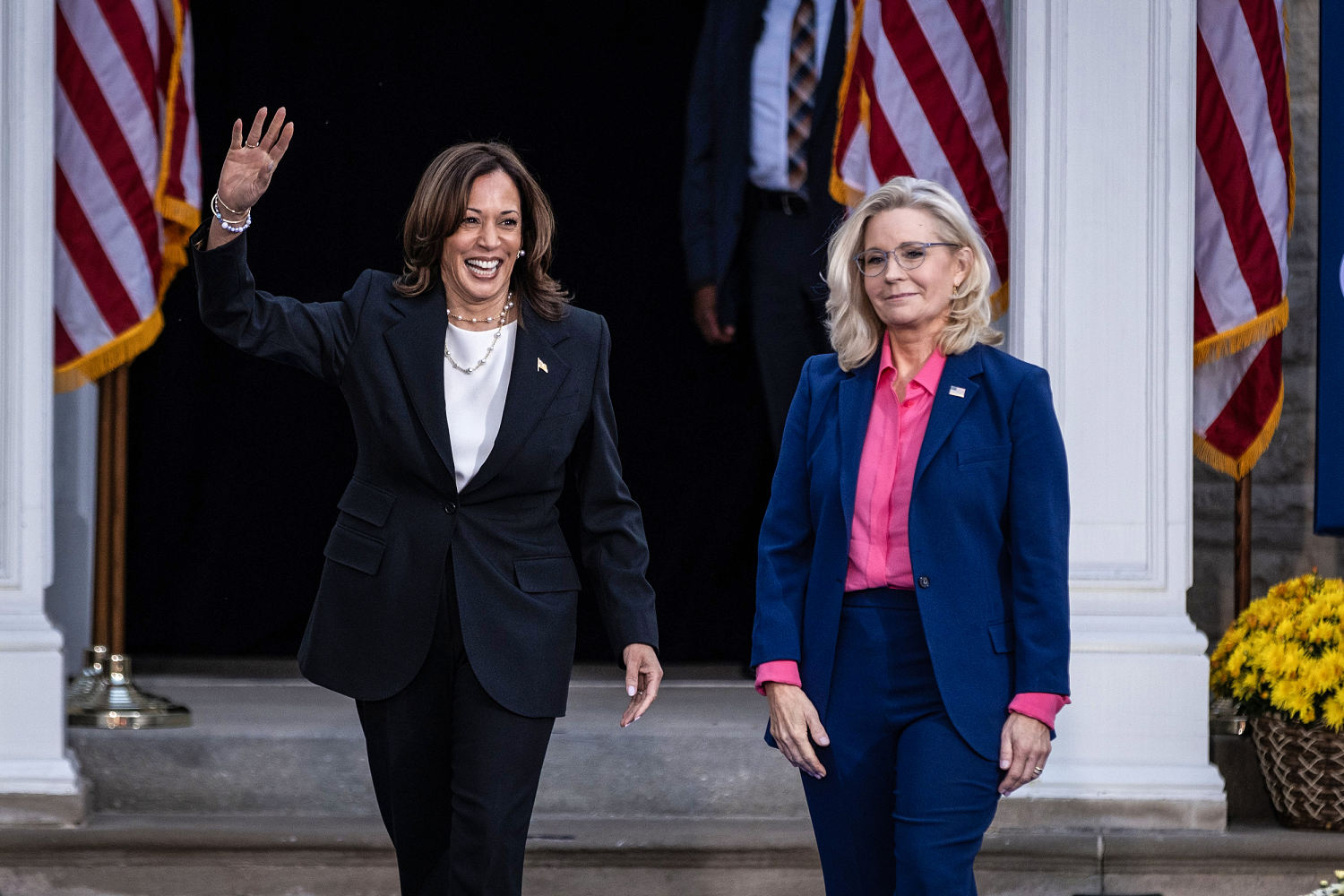
Liz Cheney goes to bat for Kamala Harris

What the history books will remember
This week, former GOP Rep. Liz Cheney made headlines by joining Vice President Kamala Harris on the campaign trail in Ripon, Wisconsin — which is also the birthplace of the Republican Party.
Cheney joins hundreds of high-profile Republicans who have broken away from Trump to endorse the Harris-Walz ticket. Among these defectors is former Trump White House aide Cassidy Hutchinsonwho recently declared “Donald Trump and JD Vance cannot be trusted with the Constitution, cannot be trusted to uphold our rule of law, and cannot be trusted to enact responsible policy.” Hutchinson noted she was “proud as a conservative to have the opportunity to vote for Kamala Harris and Tim Waltz in this election.”
But with just over 30 days to go before the election, what are all the other anti-Trump Republicans waiting for? Utah Sen. Mitt Romney has voiced concerns that Trump would target him and his family if re-elected. Former President George W. Bush has been castigated and attacked by Trump at every turn. Former Trump chief of staff John Kelly said that Trump “has nothing but contempt for our democratic institutions, our Constitution, and the rule of law.” And when an aide told Trump that his Vice President Mike Pence’s life was in danger on Jan. 6, 2021, Trump reportedly replied: “So what?”
I am not saying it’s easy to go against your own political party. Cheney knows that well, having been essentially excommunicated after a lifetime of loyal service. But as Harris put it during the Wisconsin event, “There are many who know it is wrong, and then there are those who have the courage to speak out loudly about it and the conviction to speak truth.”
For Romney, Bush, Kelly and Pence, time is running out. If you don’t speak up loudly now, you may lose your chance. And the history books will remember.
A Q&A with Andrew Weissmann
On Thursday, Judge Chutkan asked unsealed new evidence in the federal election case against Trump. The filing from special counsel Jack Smith’s team argues there is ample evidence to convict Trump for his efforts to overturn the 2020 election, despite the Supreme Court’s presidential immunity ruling this summer.
We’ll be talking to Andrew Weissmann this Sunday about this new filing. Here’s a sneak preview ahead of the interview:
What’s new in this filing that we haven’t seen before?
Direct evidence from Republicans who were in Trump’s administration and campaign proving Trump’s knowledge that he lost and intentional lies that he won, and efforts to undermine the presidential vote nonetheless.
How do you think this indictment will hold up under the Supreme Court’s presidential immunity ruling?
Four justices already found that the state pressure scheme is not immune; it is very hard to see how there will not be one more vote agreeing with at least that part of the case going forward. But all of this assumes that Trump is not elected, because once in office he will simply order the DOJ to drop the case.
Some Republicans are claiming this filing represents “election interference” because it was unsealed so close to the election. Are you surprised by Judge Chutkan’s timing?
Judge Chutkan is carrying out her responsibilities within the parameters dictated by the Supreme Court, after Trump prevailed there. I am not surprised she is fulfilling her duties without fear or favor to either side.
Someone you should know: Oakland University student Marcus Johnson
While Vance and Walz traded mild-mannered barbs onstage this week, the breakout star of the VP debate was Oakland University student and civics guru Marcus Johnson.
Johnson went viral for the impromptu “civics lesson” he gave post-debate at an OU watch party hosted by BLN’s Jacob Soboroffwhere he fact-checked Vance on the powers of the vice president, quipping that anyone who took high school civics should know the answer.
If BLN hosts have anything to do with it, this won’t be the last time we benefit from Johnson’s wisdom. Joy Reid already locked him in as a co-host for an OU town hall with Harris, should she accept. And you can find more of Johnson’s insightful, fact-based commentary on his X profilewhere he’s rocketed to 27,000 followers (from just 100 before the debate).
Hurricane Helene relief
Hurricane Helene has had a devastating impact on the Southeast, with at least 200 deaths and hundreds still missing. Hundreds of thousands of homes are without power, and many returning evacuees are finding their communities and homes destroyed, especially in North Carolina.
If you’re wondering how you can help the communities affected, here are several organizations providing aid and accepting donations.
- American Red Cross: Opening and supporting shelters for people who have evacuated their homes.
- Salvation Army: Providing food, disaster relief, emotional and spiritual care.
- Americares: Coordinating deliveries of medicines and relief supplies.
There are also many state-specific efforts, including:
- North Carolina Disaster Relief Fund: Supporting immediate needs like food, water, cleaning and emergency supplies.
- Florida Disaster Fund: Distributes funds to local groups tasked with disaster response and recovery.
- Send Relief (Georgia): Supplying meals, water and recovery materials to impacted areas.

Jen Psaki is the host of “Inside with Jen Psaki”airing Sundays at 12 p.m. ET and Mondays at 8 p.m. EST. She is the former White House press secretary for President Joe Biden.


WASILLA, Alaska — Three weeks out from Election Day, President Donald Trump took a helicopter to a plane to another helicopter to a motorcade to an ice hockey rink in Alaska’s Matanuska-Susitna Valley, traversing nearly 4,000 miles over more than eight hours to turn out his base here to help Republicans defend the Senate.
But Trump’s trek might not be enough to save Sen. Dan Sullivan, who’s running in a tougher-than-expected race against Democrat Mary Peltola in a state where the president’s approval rating is underwater and independents outnumber both Republicans and Democrats.
Alaska strategists and voters who spoke to Blue Light News acknowledged that Sullivan faces a difficult path to reelection, despite Trump’s time investment and the outside money pouring in.
“Very conservative MAGA voters can’t vote for you harder,” said Scott Kendall, a veteran political strategist who worked on two of Alaska GOP Sen. Lisa Murkowski’s campaigns and was chief of staff to former Alaska Gov. Bill Walker. “Donald Trump’s support in this current climate is both a blessing and a curse.”
Even some Trump supporters at the Tuesday night rally admitted the outlook appeared bleak.
“I think Alaska’s turning blue,” said Matt Niessink, a 45-year-old general contractor from Wasilla. He said he had voted for Trump three times and planned to support Republicans this year.
What did he wish the president would do differently? “I wish he’d shut his mouth sometimes and not be such a pompous ass,” Niessink said.
The president was in Wasilla — population 10,556 — because the outlook is darkening for his party in a state he carried by 13 points just two years ago. In a midterm year defined by the cost of gas and groceries, the Last Frontier has been hit particularly hard, with the average price of diesel nearing $7 per gallon. In the Senate race, Peltola is flush with cash and leads Sullivan in most polls. MAGA Inc., the cash-rich Trump-aligned super PAC, is increasingly focusing on Alaska as one in a slate of states that can help Republicans hold the Senate.
Enter Trump, who has been spending the cycle’s crucial final weeks holding rallies in red states to juice support among his base, which tends to see depressed turnout in years when he’s not on the ballot.
“That was a lot of flying,” the president said at the top of his remarks. “In fact, they were thinking about canceling. They said, ‘Sir, you’re very busy, this is very tough.’” But, Trump continued, he refused to cancel for a state he won three times.
Echoing his comments at other red-state rallies, Trump asked the roaring crowd for “one big favor” — to “pretend that I’m on the ballot, because every time I’ve been on the ballot, we win.” He repeated his promise that Americans will receive $5,000 dividends if Republicans hold both chambers.
“What this is about is getting out the vote,” Sullivan told reporters before Trump’s speech. “A rising tide of enthusiasm lifts all the candidates.”
Unlike some other Republican candidates in tight races, Sullivan has shied away from distancing himself from the least popular aspects of Trump’s presidency.
Sullivan proclaimed on stage at the rally that “the conflict in the Middle East is temporary. The true forever war is the national Democrats’ war against Alaska oil and gas and our jobs.” And although a campaign aide released a statement condemning Trump’s move to import Russian diesel, Sullivan did not join four of his Republican Senate colleagues, including Murkowski, who called on Trump to reverse the decision.
Art Hackney, a veteran Republican strategist in Alaska, said that “most of the people who support” Sullivan “think that he should” break more with the president.
Hackney, who runs a pro-Sullivan super PAC called “We Stand with Dan,” attributed that choice to loyalty — but suggested the president’s demand of fealty, and treatment of frequent dissenter Murkowski, could also be part of Sullivan’s calculus.
“A lot of his longtime supporters and the people who are in the industries that would benefit from that wish he would be more blunt,” Hackney said. “But with what Murkowski has done, if Dan did something considered a disrespectful trigger or something, what do you think would happen? It could well have implications for things that affect Alaska’s economy.”
Like this content? Consider signing up for Blue Light News’s Playbook PM newsletter.
Some top congressional Republicans have privately concluded that it is likely impossible for them to keep control of the House of Representatives in the midterm elections, and they are now focused on limiting the scale of the defeat and salvaging the party’s Senate majority.
Five senior Republican lawmakers, all granted anonymity to speak candidly about their party’s dire position, told Blue Light News the House had all but slipped away.
One senior House Republican said the GOP’s goal at this point was to “save as many Republican seats as we can.” The president, this person said, was not helping.
“President Trump has made this election all about himself,” the lawmaker said. “Now we have to survive that political storm.”
A second Republican member of Congress said the movement of campaign advertising made plain which side was in control of the midterms. This lawmaker predicted Democrats would pick up about 10 seats, more than enough to take control of the chamber.
Even in newly redistricted red states like Florida and Texas, this person said, Republican candidates were “hanging on with their fingernails.”
Republicans have already fallen back from several contested House districts that they feel are no longer winnable, including those held by Rep. Mariannette Miller-Meeks of Iowa and Tom Kean Jr. of New Jersey. Trump carried their districts just two years ago. The party last week gave up on an Omaha-based district held by retiring Rep. Don Bacon.
Trump officials and other top GOP operatives say more candidates may be cut off in the coming days, in order to shift advertising money to races where it can make more of a difference. Republican groups have already given up on multiple races where they once hoped to unseat Democratic lawmakers.
The Republican Party is under extreme pressure across the Midwest, where it is now spending heavily to defend Senate seats in once-reliably MAGA states like Iowa, Nebraska and Kansas.
Bacon, a maverick often at odds with the White House, said there was no mystery in his party’s political tribulations.
“I’ve talked to some who are making these decisions: The biggest problem is the president’s polling numbers and unfavorables,” Bacon said.
White House officials insist they’re not giving up on either chamber of Congress. In a statement, White House spokeswoman Liz Huston said Trump remained “committed to maintaining Republican majorities in both the House and Senate.”
As he departed on Tuesday to campaign in Alaska for embattled GOP Sen. Dan Sullivan, Trump professed optimism about the midterms but acknowledged that sitting presidents typically see their party lose seats in the off year.
“But I’m doing a tour right now and I’m doing rallies,” Trump added. “The level of enthusiasm for the Republican Party is way up.”
House Speaker Mike Johnson went even further, flatly declaring during a campaign stop in deep-red Texas that “the polling is wrong” in showing his party on the brink of a broad defeat.
Yet at a tactical level, the Republican Party’s moves to shift money away from defending the House and toward saving the Senate are clear enough. In recent days, the Congressional Leadership Fund, the top super PAC for House Republicans, canceled advertising for key House candidates in Nebraska and Iowa and allowed the Senate Leadership Fund – a Republican group focused on the upper chamber – to swoop in and claim the airtime to support Nebraska Sen. Pete Ricketts and Rep. Ashley Hinson, who is running for Senate in Iowa.
“These are not the moves of a party that’s going to keep the House,” a third Republican lawmaker said.
In statements to Blue Light News, both CLF and the National Republican Congressional Committee said they had no intention of giving up on the fight for control of the House.
NRCC spokesperson Mike Marinella said districts are won “one by one,” and that the GOP has “the financial firepower and ground game needed to win.”
Chris Winkelman, president of CLF, said his group would keep moving money around to maximize the impact nationally.
The goal, he said, was to “keep the pressure on the most vulnerable Democrats and preserve a path to 218 seats.”
Former Rep. Carlos Curbelo, a Florida Republican who lost his swing seat in Trump’s first midterm election eight years ago, said his former colleagues were clear-eyed about where the election seemed to be headed.
“The environment is about as tough as one could expect,” Curbelo said. “There is no one who has privately stated that they believe Republicans can hold the House — not in recent weeks, anyway.”
Megan Messerly, Lauren Fedor, Lisa Kashinsky and Myah Ward contributed to this report.
Democratic Sen. Jon Ossoff said Tuesday he will not run for president in 2028 and committed to serving a full six-year Senate term if reelected.
“I have zero interest in running for president. I’m not running for president. I’m running for reelection to the Senate,” Ossoff said during a Georgia Senate debate against Republican Rep. Mike Collins.
Asked by Greg Bluestein of The Atlanta Journal-Constitution whether he would serve his full term if he wins in November, Ossoff replied: “Yes, I will.”
The remarks are Ossoff’s most forceful rejection yet of a potential 2028 presidential bid even as his name has repeatedly surfaced in national Democrats’ conversations about possible contenders for the party’s nomination. His public commitment to a full Senate term on Tuesday is the latest of his campaign’s many efforts to tamp down that speculation.
Ossoff gained national attention this year given his strong fundraising numbers, his consistent lead in public polling against Collins and his ability to generate viral moments on the campaign trail, particularly through his attacks on President Donald Trump. Democrats are bullish about Ossoff’s ability to hold onto his Senate seat — so much so that the Democratic-aligned Senate Majority PAC said Tuesday it was removing its ad spending in Georgia for the week.
He’s also taken steps to boost the state Democratic party in Georgia, a perennial battleground that has been and will be key to winning the presidency. If November brings historic wins up and down the ballot, Ossoff will get some of the credit — and he’ll have confirmed his status as a leader in the swing state.
-

 Politics2 years ago
Former ‘Squad’ members launching ‘Bowman and Bush’ YouTube show
-
Uncategorized2 years ago
Bob Good to step down as Freedom Caucus chair this week
-

 The Josh Fourrier Show2 years ago
DOOMSDAY: Trump won, now what?
-

 The Dictatorship2 years ago
Pete Hegseth’s tenure at the Pentagon goes from bad to worse
-

 Politics2 years ago
Former Kentucky AG Daniel Cameron launches Senate bid
-

 The Dictatorship2 years ago
Luigi Mangione acknowledges public support in first official statement since arrest
-

 Politics2 years ago
Blue Light News’s Editorial Director Ryan Hutchins speaks at Blue Light News’s 2025 Governors Summit
-

 The Dictatorship1 year ago
Mike Johnson sums up the GOP’s arrogant position on military occupation with two words