
Congress
Key senators meet over dinner to discuss permitting deal

Key Senate negotiators held a bipartisan meeting Monday night to discuss closing a long-sought deal on overhauling the federal permitting process for energy projects — a sign that talks are progressing despite the difficult odds in a midterm election year.
Sen. John Hickenlooper (D-Colo.), a moderate Energy and Natural Resources Committee member active on permitting issues, organized the dinner meeting with committee leaders to “provide a forum to keep conversations moving,” according to a person granted anonymity to describe the private gathering.
Environment Public Works Chair Shelley Moore Capito (R-W.Va.) and Energy and Natural Resources Chair Mike Lee (R-Utah) also attended the gathering, along with the ranking members of each of these panels — Democratic Sens. Sheldon Whitehouse of Rhode Island and Martin Heinrich of New Mexico, respectively.
Lee, in an interview Tuesday, called it a “good bipartisan meeting” and stressed “we’re making good progress” on an overhaul of federal permitting rules for energy projects of all kinds — from solar and wind farms to long-distance power lines to pipelines and gas export plants — in a bid to respond to spiking electricity and gasoline prices.
“It’s always good to get together with colleagues and talk,” Whitehouse said Tuesday, confirming his attendance, while cautioning that “the real work is being done in actual negotiations.”
Capito also claimed “good progress” and regular “engagement” with Whitehouse, Lee, Heinrich and Trump administration officials.
“I wouldn’t say we smoothed out the rough edges, but we all know what we want here, so that’s good,” she added, while also expressing hope they could reach a deal before lawmakers leave town for the monthlong the August recess.


Former Speaker Kevin McCarthy predicted Republicans will lose the House in two weeks, citing historical midterm trends while also criticizing the sitting GOP leadership for how they’ve managed the chamber.
“In the last 100 years, all off-year elections, whoever is the party in power has the White House, has lost seats, and it’s only a few seats for the majority,” McCarthy said in an interview with Bloomberg TV Thursday.
Democrats, he added, will “get a majority” in the House: “I’m not quite sure how big it is, but they will probably win the majority.”
The former speaker, who ushered in the current GOP House majority in 2022 but only led the conference for less than a year before being booted from the speakership, went on to fault his own party for giving the election away.
“It’s not that the Democrats are going to win this election,” he said. “Republicans are going to lose it.”
He pointed to the skimpy House legislative calendar as a factor. Speaker Mike Johnson and his deputies have routinely canceled scheduled session days amid member revolts that have undermined his grip on the razor-thin majority.
“You’re only given 24 months in a majority to manage it. They were in the fewest amount of days. They let the Democrats dictate,” McCarthy said. “You have to give a reason why to win. What are the three things Republicans will do if they win the majority? I can’t tell you what that is.”
Still, McCarthy cautioned that if Democrats win the House, it won’t be because they have laid out their own agenda and warned that he believes that Democrats will face their own hurdles.
“Democrats are not popular. They haven’t laid out an agenda on what they’ll do,” McCarthy said. “So they’ll have a really hard time governing in the next Congress.”
North Dakota Sen. Kevin Cramer said Thursday that he had concerns about Elon Musk’s influence over national security matters after Ukraine was blindsided by a disruption of a satellite communications service developed by Musk’s SpaceX.
“We’re putting too many eggs in one company’s basket when it comes to our space assets,” the Republican member of the Armed Services Committee said. He added about Musk that he was concerned about the power of “one individual and one company over America’s ability to protect the domain of space, which is a war-fighting domain.”
Cramer received a briefing Thursday from Air Force Secretary Troy Meink that he said focused on getting an update on Starshield — a military product based on SpaceX’s Starlink technology. Cramer told reporters before the briefing that he wanted Congress and the Pentagon to “pour a lot of resources … into making sure there’s lots of competition both for satellite production and satellite launch.” “I’m uncomfortable with the potential vendor lock in space, and I think the events of the last couple of weeks have demonstrated greater concern, even than just simply cost,” Cramer said.
Musk has been under days of scrutiny — including fresh pledges by Democrats to investigate him next year — after the Wall Street Journal reported that he ordered the recent slowdown in Starshield capabilities over the Russia-Ukraine war theater.
Cramer, asked about the Journal reporting after the closed-door briefing, said that he wasn’t sure if Musk ordered the slowdown and that the “culpability of multiple people … was left somewhat loose.”
“By that I mean, discussions with the president before, discussions with the president after. … Obviously I don’t think it could have possibly happened without Elon Musk’s knowledge, whether or not you know how supportive he was one way or the other,” Cramer said.
Cramer added that he believed there could have been a broad misunderstanding within the U.S. government and within SpaceX about how reliant Ukraine was on the satellite technology. But he said it was incumbent that the operation of satellite technology like Starshield must “be exclusively with the authority of the United States government.”
“There are certain things the government has to do that can’t be so dependent on others,” Cramer said. “And fighting wars is one of those things.”
The top Democrat on the Senate Finance Committee wants to revive a clean energy tax credit program he argues was a booming success — and says he has the receipts to prove it.
Sen. Ron Wyden of Oregon is releasing a new report of IRS data, shared first with Blue Light News, showing that, in the first two years of the Democrats’ 2022 climate law, nearly $2.5 billion in direct payments went directly to schools and other tax-exempt entities to cover electric school buses, rooftop solar, electric vehicles and more.
Wyden said in a press release the numbers prove there is “massive demand” for “any and all” programs that lower energy costs and rebuild aging infrastructure, after Republicans gutted many of these wind and solar tax credits in their tax and spending megalaw last summer.
“When Democrats have a trifecta of power, reinstating the wind and solar tax credits and bolstering the Direct Pay Program will be a top priority to help bring an end to Trump’s energy crisis,” said Wyden, who is poised to take back the Finance gavel if control of the Senate flips in the midterms.
The report, prepared by Democratic staff for the committee, argues the current “energy crisis,” where Americans’ utility bills are rising, was manufactured by Republicans and the direct result of the Trump administration’s clean energy incentive rollbacks.
Wyden said he would revive the solar and wind tax credits if given the chance to chair the Finance Committee again, plus boost what’s known as the Direct Pay Program, which schools and tax exempt entities can use on rooftop solar, electric vehicle purchases, heat pumps and more.
“If we’re back in the majority — and I think we will — I will be introducing that bill [to restore] the clean energy tax credits that had billions of dollars in the market in the first couple of years,” Wyden said in an interview last month regarding his plans. “I’ll be introducing that right away.”
Wyden, who has led his party on the Finance Committee since 2015, wrote the bulk of the 2022 Inflation Reduction Act’s climate and clean energy provisions.
- Kevin McCarthy predicts GOP will lose House majority
- Trump plans to fast-track arch despite legal challenge
- GOP senator questions Elon Musk’s influence over military assets
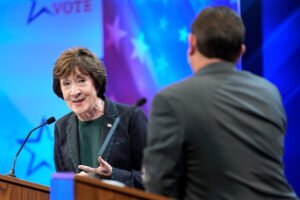
- The good, the bad and the unruly from over two dozen candidate debates
- How a fake pollster may have moved some 2026 elections
- Top Senate Finance Democrat maps out clean energy plan
- Australian treasurer says opponents want higher inflation for political gain
- Rising bond yields will add billions to budget pressure: Australian treasurer
- Capitol agenda: Some Republicans get bipartisan curious
- America’s Heartland sows doubt in the GOP

-

 Politics2 years ago
Former ‘Squad’ members launching ‘Bowman and Bush’ YouTube show
-
Uncategorized2 years ago
Bob Good to step down as Freedom Caucus chair this week
-

 The Josh Fourrier Show2 years ago
DOOMSDAY: Trump won, now what?
-

 The Dictatorship2 years ago
Pete Hegseth’s tenure at the Pentagon goes from bad to worse
-

 Politics2 years ago
Former Kentucky AG Daniel Cameron launches Senate bid
-

 The Dictatorship2 years ago
Luigi Mangione acknowledges public support in first official statement since arrest
-

 Politics2 years ago
Blue Light News’s Editorial Director Ryan Hutchins speaks at Blue Light News’s 2025 Governors Summit
-

 Politics1 year ago
John Legend advises Trump to drop the ‘dictator s‑‑‑’ if he wants Nobel Peace Prize