
Politics
Kamala Harris just did what Donald Trump never could

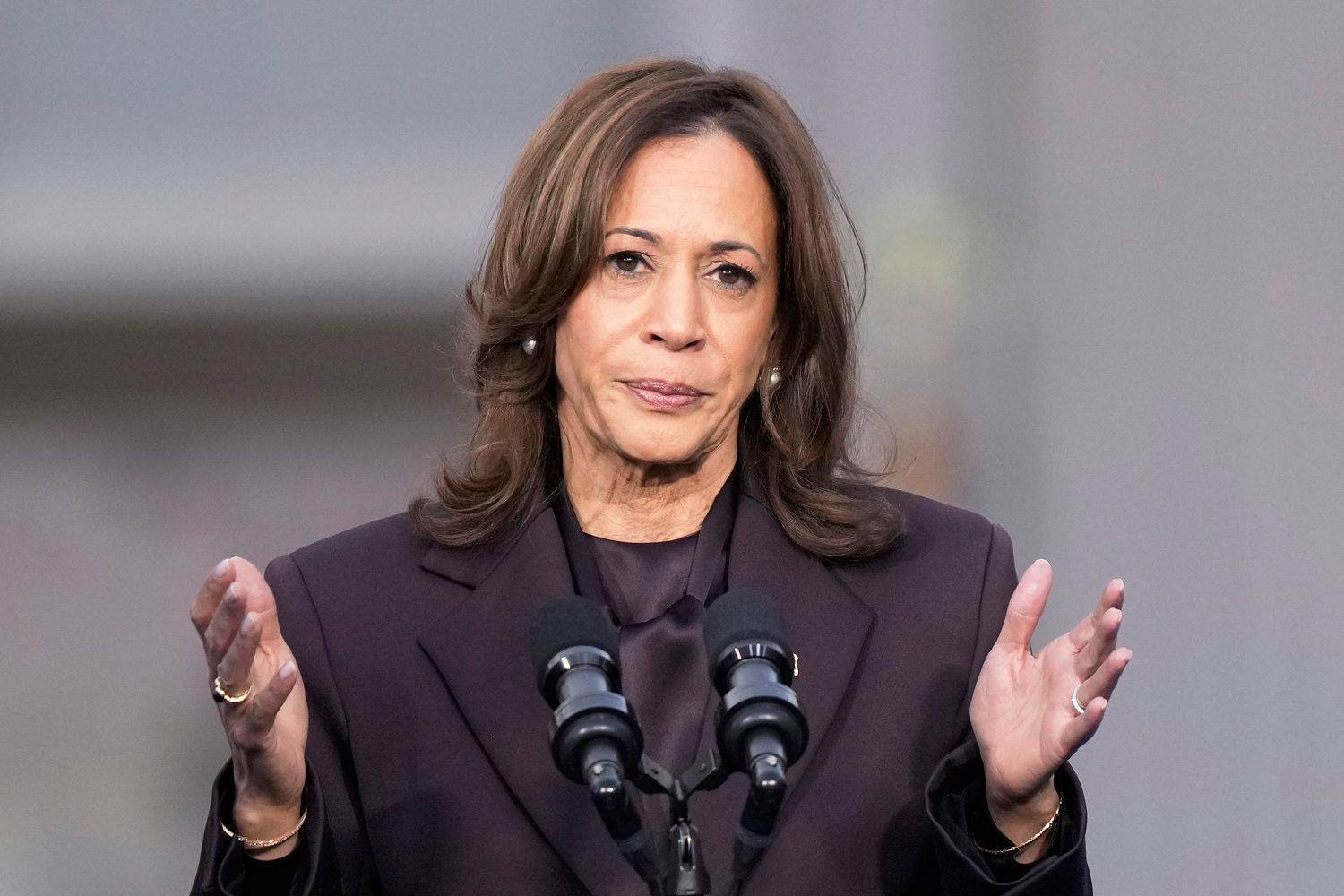
The peaceful transfer of power is back, America.
During her concession speech at Howard University Wednesday afternoon, Vice President Kamala Harris brought back from the dead one of America’s most storied traditions: presidential candidates accepting the results of an electoral defeat, urging their supporters to do the same and promising to cooperate with the incoming administration.
However one feels about a second Trump presidency, Harris’ words are crucially important for the health of American democracy.
“Now, I know folks are feeling and experiencing a range of emotions right now,” Harris said. “I get it, but we must accept the results of this election. Earlier today, I spoke with President-elect Trump and congratulated him on his victory. I also told him that we will help him and his team with their transition, and that we will engage in a peaceful transfer of power.”
The mention of “President-elect Trump” generated a brief smattering of boos, which the vice president ignored. But the words “peaceful transfer of power” triggered cheers from her crestfallen supporters. That matters a lot.
However one feels about a second Trump presidency, Harris’ words are crucially important for the health of American democracy. To various degrees, 2024 will be the first generally accepted presidential election since George H.W. Bush decisively defeated Michael Dukakis in 1988.
A loud and prominent subset of Republicans never accepted the legitimacy of either of Bill Clinton’s elections because he never won an outright majority in the popular vote, mainly because third-party candidate Ross Perot took roughly 18.9% and 8.4% of the popular vote in 1992 and 1996.
Then came 2000, when George W. Bush lost the popular vote but won the Electoral College after the Supreme Court halted Florida’s recount with Bush ahead by 537 votes. Many Democrats never accepted Bush’s legitimacy after that, even when he won re-election in 2004, as a small group of Democrats insisted some vote-counting hanky panky in Ohio unfairly swung the Buckeye State to Bush.
Barack Obama was elected in a popular and electoral landslide in 2008, then handily re-elected in 2012. But a fake conspiracy theory alleging Obama’s foreign birth — a racist lie most prominently amplified by Trump — led millions of Americans to insist Obama’s two decisive victories were actually unconstitutional.
Then there was 2016, when Hillary Clinton lost a seemingly unlosable election to the political novice Trump amid evidence of Russian election interference. Many overwrought Democrats refused to accept the glaring failures of their nominee’s campaign and instead overhyped Trump and Vladimir Putin’s very real and nefarious connections into a fantasy of Trump as a “Manchurian candidate” puppet.
But in all of those elections, the vanquished opponent conceded. And, with the exception of Al Gore in 2000, they conceded quickly. (However, Gore’s eventual concession after the Supreme Court decision gracefully accepted the legitimacy of Bush’s presidency and called for unity among Americans.)
It was only in 2020, when Trump lost a close election — but decisively — that the 220-year-old tradition of peaceful transfer of power was broken. And it was broken for no good reason.
Trump spread lies made up of whole cloth about election fraud that were so baseless that they were rejected by GOP state officials, his own attorney general, his daughter Ivanka and by a Supreme Court with a 6-3 conservative majority (including three Trump appointees). He will now very likely escape prosecution for his attempts to overturn the 2020 election and inciting the Jan. 6, 2021, assault on the U.S. Capitol (and for illegally hoarding national security documents).
Someone had to make a gesture that the rhetorical war that is an election is now over.
In Harris’ case, after running a campaign that correctly made an issue out of the uniquely destructive force Trump has been to the American body politic — including testimonials from his own former Cabinet members that he’s an unhinged fascist — the vice president accepted the will of the people. Much as a defeated Sen. John McCain did in 2008 when he told his supporters that the failing was his and not theirs and called Obama “my president,” Harris made it clear that Trump will be her president — just as he will be for over 300 million Americans.
The fact that the words “peaceful transfer of power” generated applause among Harris’ supporters at Howard says something important about the state of America right now. A defeated Trump would never say those words; we know this because he didn’t when he was defeated. And his supporters would never applaud such a line because Trump convinced them of the big lie that “they” stole the 2020 election.
Someone had to make a gesture that the rhetorical war that is an election is now over. The loser has conceded, for the good of the country, even though the winner never would.

Anthony L. Fisher is a senior editor and writer for BLN Daily. He was previously the senior opinion editor for The Daily Beast and a politics columnist for Business Insider.




Iowa’s last Democrat on how he can win in Trump country
lead image
Alaska GOP Sen. Dan S. Sullivan can’t shake his same-name challenger.
Retired teacher Dan J. Sullivan punched a ticket out of the state’s top-four, all-party primary early Wednesday morning. He could now play spoiler in a high-stakes Senate clash between the Republican senator and former Democratic Rep. Mary Peltola that could help swing control of the upper chamber.
Republicans fought and failed to keep Dan J. Sullivan off the primary ballot, arguing he was a Democratic plant designed to boost Peltola. Both Dan J. Sullivan and Peltola’s campaign have denied any coordination.
The senator’s allies have already taken steps to mitigate the second Sullivan’s potential vote siphoning, in some cases running ads using the senator’s middle initial to help differentiate between the same-named candidates.
Supporters of the state’s ranked-choice voting system, which kicks in for the general election, argue the process helps curtail the spoiler effect. But the presence of other candidates could still skew the results of the battleground race. Outside groups flooded the primary with more than $2 million to boost myriad fringe candidates — and could do so again ahead of November.
It’s not smooth sailing for Peltola, either, as she wages an uphill battle to flip a red seat in a state President Donald Trump won by 13 percentage points in 2024. She recently replaced her campaign manager in a staffing shakeup ahead of the primary, among other internal moves.
President Donald Trump notched a major win on Tuesday night. Republicans in battlegrounds wonder if it was the best use of his time and money.
Sen. Darline Graham defeated Rep. Ralph Norman in South Carolina’s snap Senate GOP runoff, handing Trump a revitalizing win after several of his endorsed candidates fell in recent primaries.
It was a victory that Graham, a complete political unknown six weeks ago, could not have pulled off without Trump’s steadfast support, underscoring just how much his influence still matters among the Republican electorate in the deeply conservative state.
But South Carolina’s Senate seat will not dictate the balance of power in Washington, and GOP strategists working on critical swing state campaigns are eager for Trump to finally direct his attention to them.
“The message coming out of this is that obviously the president’s support is still super powerful. The president’s operation still has the ability to move the needle in a lot of these states,” said a Republican strategist working on several battleground races, including in Georgia, who was granted anonymity to speak candidly about Trump’s involvement. “Hopefully, this is a sign of things to come that the president is willing to get involved and really start to move the needle in some other places that obviously matter a little bit more than South Carolina.”
Trump’s persistent backing of Graham defined the race: He championed her appointment to her late brother Sen. Lindsey Graham’s seat, he coaxed her into the race with an early endorsement, stood by her as she stumbled on the debate stage, and flew down to Myrtle Beach for a rare political rally that few of his chosen candidates have enjoyed this cycle. MAGA Inc., Trump’s behemoth super PAC, even spent a slice of highly sought after cash from its $400 million stockpile in the closing days of the race.
And yet, the president hasn’t taken a meaningful step into the states that will matter in a few short months — even as battleground Republicans have been clamoring for him to spend his MAGA Inc. money.
“It’s now or never. It’s put up or shut up time, and it’s really time to start to see if he’s going to get serious,” the GOP strategist said. “You’ve got September and October to really move the needle here, and it just doesn’t seem like there’s any sense of urgency, or like we understand that we are down big in some of these states.”
During her victory speech in Columbia, Graham acknowledged Trump’s heavy hand: “Our victory would not have been possible without you, and we are truly grateful,” Graham said of the president. “South Carolina is truly Trump country.”
Norman’s take on the president’s participation was not as rosy: “The president got involved. He has that right. That’s his prerogative,” Norman said in his concession speech Tuesday, prompting jeers from the crowd at his election night watch party. “Y’all,” he continued, “his policies are good. I never understood why he got in this race. It is what it is, and I’ll accept it.”
Norman’s bewilderment reflected several national and South Carolina Republicans’ confusion as to why the president would expend energy for the safe Republican seat when his MAGA allies like Mike Collins in Georgia, scandal-plagued Ken Paxton in Texas and Michael Whatley in North Carolina are facing tough Senate battles against Democratic opponents.
“There’s the principle,” said a North Carolina-based GOP strategist who was granted anonymity to speak candidly about the battleground picture. “If you’re not Trump and you have these people shoved down your throat, you’re like, ‘Okay, are you gonna help?’”
The White House did not immediately respond to a request for comment.
Some Republicans are worried that though Trump helped power Graham’s win, the president’s overall unpopularity may be more of a curse than a boon in any highly competitive battleground state. A series of Trump-backed candidates lost gubernatorial and congressional primaries in recent weeks, including in Georgia and Iowa.
Republicans overall are facing a tough election environment given the ongoing and unpopular war in Iran, backlash to the administration’s highly-visible deportation agenda and voters’ persistent cost of living concerns.
“You have a president and maybe even a vice president that are just so underwater politically in the polls, that they might be a help by not intervening,” said Matthew Bartlett, a GOP strategist and former State Department official in the first Trump administration.
Still, Trump swept the battlegrounds in 2024, and his ability to boost Graham despite her foreign policy debate gaffe and questions about her political inexperience serves as a reminder of his electoral prowess to campaign officials.
The question remains when — or if — he’ll throw them a presidential life raft.
“I wouldn’t count on the money if I were in these states,” said the North Carolina-based Republican strategist. “He still could. I’m just saying, I wouldn’t count on it. We’re not dealing with somebody that’s, you know, super calculated in the way they plan.”
For months, Republicans across the country have watched on as the president has continued to amass a remarkable pile of cash — and many have implored him to empty his pockets in their races. The president told reporters last week that he’ll spend “a lot of that money” to boost “Republican candidates that I think are good,” without being specific.
However, what some saw as a distraction from the greater Republican cause this year, others read as the first few drops of Trump’s cash flood.
“If they’re going to spend 800 grand in South Carolina, they’re going to spend in the midterms,” said Matt Mackowiak, a Republican strategist based in Texas who worked on Sen. John Cornyn’s failed reelection campaign and is now backing the GOP ticket. “It signals they’re going to make a substantial investment in the midterms because you don’t make an 800-grand investment in South Carolina and say, ‘Yeah, we’re going to let everybody do their own thing.’ This was in some ways a test case.”
Trump’s targeted support for Graham — the kind that some Republicans are banking on to shift the dial later this fall — paid off for her in dividends on election night. Horry County, the site of the president’s marquee rally with the candidate late last week, resoundingly broke for Graham.
Trump’s backing also helped open the door to endorsements from key South Carolina Republican figures, including fellow GOP Sen. Tim Scott, who helped Graham shore up support in his Charleston-area home base, Gov. Henry McMaster, and two members of the state’s congressional delegation, Reps. Russell Fry and William Timmons.
Outside spending also proved crucial to Graham’s success. Her campaign and its allies outspent Norman by more than $5 million in the runoff alone, according to AdImpact.
Trump’s allies took a victory lap after Graham’s victory was confirmed Tuesday evening.
“The power of the Trump endorsement is alive and well in South Carolina,” said Mike Hahn, a GOP strategist involved in the midterms. “A good opening salvo for the team at MAGA Inc. and the president ahead of the midterms.”
- Pentagon claims to have found ‘hidden’ files on final days of the Afghanistan war
- Iowa’s last Democrat on how he can win in Trump country

- Trump’s trade moves add to GOP’s midterm anxieties
- The other Dan Sullivan makes November ballot against Sen. Dan Sullivan
- ‘It’s put up or shut up time’: Battleground Republicans want the Darline treatment
- Trump-backed candidate wins primary for Oklahoma governor
- Political newcomer Darline Graham wins South Carolina’s GOP Senate runoff
- 2 unvaccinated people die of measles in Pennsylvania
- Ossoff presses GOP opponent Mike Collins on House Ethics probe
- The Iran war is already on November ballots
-

 The Josh Fourrier Show2 years ago
DOOMSDAY: Trump won, now what?
-

 Politics2 years ago
Former ‘Squad’ members launching ‘Bowman and Bush’ YouTube show
-

 The Dictatorship2 years ago
Luigi Mangione acknowledges public support in first official statement since arrest
-
Uncategorized2 years ago
Bob Good to step down as Freedom Caucus chair this week
-

 Politics2 years ago
Former Kentucky AG Daniel Cameron launches Senate bid
-

 Politics2 years ago
Blue Light News’s Editorial Director Ryan Hutchins speaks at Blue Light News’s 2025 Governors Summit
-

 The Dictatorship2 years ago
Pete Hegseth’s tenure at the Pentagon goes from bad to worse
-

 The Dictatorship12 months ago
Mike Johnson sums up the GOP’s arrogant position on military occupation with two words