
The Dictatorship
Judge orders ICE chief to appear in court or risk contempt over denial of due process

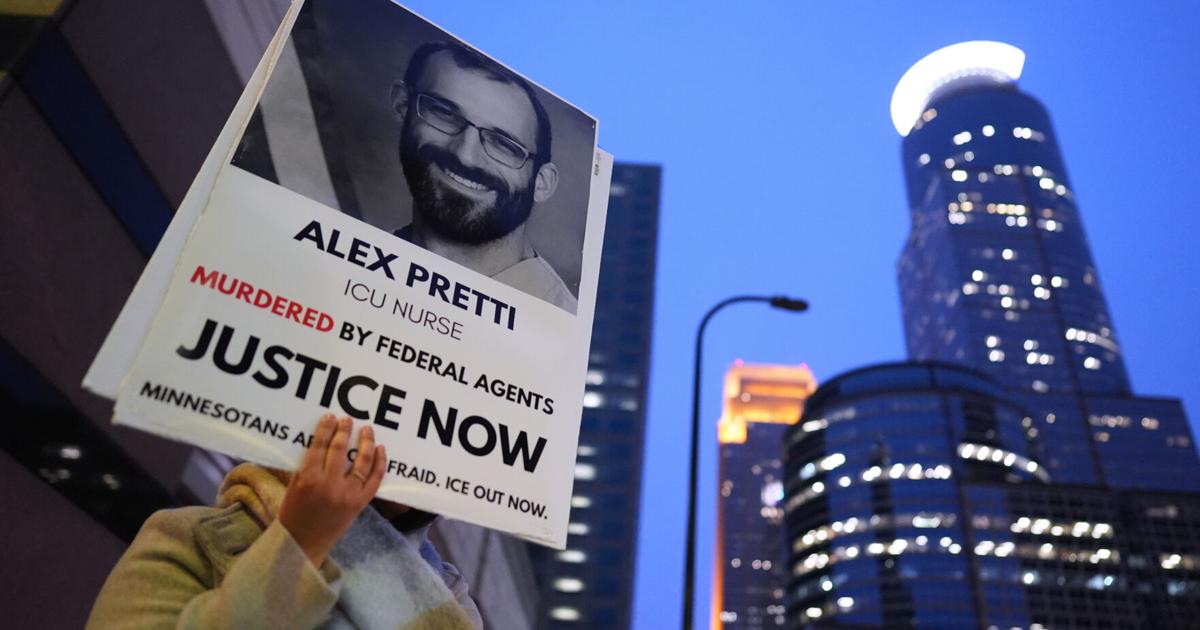
WASHINGTON (AP) — Two federal officers fired shots during the encounter that killed ICU nurse Alex Pretti over the weekend in Minneapolis, a Customs and Border Protection official told Congress in a notice sent Tuesday, while Ecuador’s minister of foreign affairs filed an objection saying immigration agents tried to enter the country’s consulate in the city without permission.
Officers tried to take Pretti into custody and he resisted, leading to a struggle, according to a notification to Congress obtained by The Associated Press. During the struggle, a Border Patrol agent yelled, “He’s got a gun!” multiple times, the official said.
A framed photograph of Alex Pretti, along with candles and an American flag, sits at a memorial outside the Minneapolis VA hospital on Tuesday, Jan. 27, 2026, in Minneapolis. (Kerem Yücel/Minnesota Public Radio via AP)
A framed photograph of Alex Pretti, along with candles and an American flag, sits at a memorial outside the Minneapolis VA hospital on Tuesday, Jan. 27, 2026, in Minneapolis. (Kerem Yücel/Minnesota Public Radio via AP)
A Border Patrol officer and a CBP officer each fired Glock pistols, the notice said.
Investigators from CBP’s Office of Professional Responsibility conducted the analysis based on a review of body-worn camera footage and agency documentation, the notice said. The law requires the agency to inform relevant congressional committees about deaths in CBP custody within 72 hours.
Separately, a man was arrested after he sprayed an unknown liquid at U.S. Rep. Ilhan Omar while she was speaking at a town hall meeting in Minneapolis. The Democrat had just called for the abolishment of Immigration and Customs Enforcement and for Homeland Security Secretary Kristi Noem to resign when she was sprayed.
Trump says ‘we’re going to de-escalate a little bit’
The developments came a day after President Donald Trump ordered border czar Tom Homan to take over his administration’s immigration crackdown in Minnesota in the wake of Pretti’s death, which was the second fatal shooting this month of a person at the hands of immigration law enforcement.
By sending Homan to Minnesota, “we’re going to de-escalate a little bit,” Trump said during an interview on Fox News’ “Will Cain Show.” That’s significant since White House press secretary Karoline Leavitt, when questioned repeatedly Monday about Homan’s being dispatched to Minnesota, refused to say that doing so was an effort to calm the situation.
White House border czar Tom Homan poses for a photo after an interview by Stuart Varney, on the Fox Business Network, in New York, Jan. 13, 2026. (AP Photo/Richard Drew, File)
White House border czar Tom Homan poses for a photo after an interview by Stuart Varney, on the Fox Business Network, in New York, Jan. 13, 2026. (AP Photo/Richard Drew, File)
The president added of Homan, “Tom, as tough as he is, gets along” with governors and mayors, even in Democratic areas.
As he left the White House on Tuesday, the president was asked whether Pretti’s killing was justified. He responded by saying that a “big investigation” was underway. In the hours after Pretti’s death, some administration officials sought to blame the shooting on the 37-year-old intensive care nurse.
Stephen Miller, Trump’s deputy chief of staff who had initially called Pretti “an assassin,” issued a statement suggesting CBP officers in Minneapolis “may not have been following” protocol. He said the Homeland Security Department’s initial statements about what transpired on Saturday was “based on reports from CBP on the ground.”
Ecuador files a protest with the US Embassy
A video of the Ecuadorian consulate entry attempt posted on social media shows a staffer running to the door to turn the Immigration and Customs Enforcement agents away, telling them, “This is the Ecuadorian consulate. You’re not allowed to enter.” One ICE officer can be heard responding by threatening to “grab” the staffer if he touched the agent before agreeing to leave.
International law generally prohibits law enforcement authorities from entering foreign consulates or embassies without permission, though sometimes permission may be assumed granted for life-threatening emergencies, like fires.
“Consulate officials immediately prevented the ICE officer from entering the consular building, thus ensuring the protection of the Ecuadorians who were present at the time and activating the emergency protocols issued by the Ministry of Foreign Affairs and Human Mobility,” the ministry wrote on X.
A “note of protest” was filed with the U.S. Embassy in Ecuador so that similar attempts aren’t made at other consulates, the ministry said. The State Department, Homeland Security and Immigration and Customs Enforcement did not immediately respond to requests for comment.
Trump says of sending Bovino to Minneapolis: ‘Maybe it wasn’t good here’
Immigration enforcement activity witnessed by journalists in Minneapolis and surrounding suburbs on Tuesday appeared comparable with recent weeks. As before, most didn’t result in major confrontations with agents. Activists say they continue to monitor enforcement operations through social media and chats on messaging apps.
The White House had tried to blame Democratic leaders for the protests of immigration raids. But after Pretti’s killing and videos suggesting he was not an active threat, the administration tapped Homan to take charge of the Minnesota operation from Border Patrol commander Gregory Bovino.
Trump said Bovino, the go-to architect for the president’s large-scale city-by-city immigration crackdowns, was “very good” but added “he’s a pretty out-there kind of a guy” and “maybe it wasn’t good here.”
Minnesota Gov. Tim Walz and Minneapolis Mayor Jacob Frey, along with the city’s police chief, met with Homan on Tuesday and agreed to keep talking. Homan posted on social media that the discussions “were a productive starting point.”
Courts weigh in on detained immigrants
In Texas, a federal judge issued a temporary order prohibiting the removal of a 5-year-old Ecuadorian boy and his father who were detained last week in Minnesota in an incident that further inflamed divisions on immigration. U.S. Judge Fred Biery ruled Monday that any removal or transfer of 5-year-old Liam Conejo Ramos and his father, Adrian Alexander Conejo Arias, is on hold while a court case proceeds.
Also in Texas, federal immigration authorities released an Ecuadorian man whose detention led the chief federal judge in Minnesota to order the head of ICE to appear in his courtroom, the man’s attorney said.
Attorney Graham Ojala-Barbour said the man was released in Texas. The lawyer said in an email to The Associated Press that he was notified in an email from the U.S. attorneys office in Minneapolis that his client had been freed.
In an order dated Monday, Chief Judge Patrick J. Schiltz expressed frustration with the Trump administration’s handling of immigration cases. He took the extraordinary step of ordering Todd Lyons, the acting director of ICEto personally appear in his courtroom Friday.
Schiltz had said in his order that he would cancel Lyons’ appearance if the man was released from custody.
“This Court has been extremely patient with respondents, even though respondents decided to send thousands of agents to Minnesota to detain aliens without making any provision for dealing with the hundreds of habeas petitions and other lawsuits that were sure to result,” he wrote.
Schiltz’s order followed a federal court hearing Monday on a request by the state and the mayors of Minneapolis and St. Paul for a judge to halt the immigration enforcement surge. The judge in that case said she would prioritize the ruling but did not give a timeline for a decision.
Schiltz wrote that he recognizes ordering the head of a federal agency to appear personally is extraordinary. “But the extent of ICE’s violation of court orders is likewise extraordinary, and lesser measures have been tried and failed,” he said.
The Associated Press left messages Tuesday with ICE and a DHS spokesperson seeking a response.
___
Catalini reported from Trenton, New Jersey and Karnowski from Minneapolis. Associated Press writers Tim Sullivan in Minneapolis, Rebecca Boone in Boise, Idaho, and Michelle Price in Washington contributed to this report.



Rep. Eric Swalwell dropped out of the Democratic primary for California governor on Sunday night after detailed accusations of sexual assault and misconduct doomed his once successful campaign — and led his closest allies and aides to demand he bow out.
“I am suspending my campaign for Governor,” Swalwell said in a statement posted on social media.“To my family, staff, friends, and supporters, I am deeply sorry for mistakes in judgment I’ve made in my past. I will fight the serious, false allegations that have been made — but that’s my fight, not a campaign’s.”
The damning allegations brought by a former aide against the congressman sparked a criminal investigation in New York City and threatened the one-time presidential candidate’s political future.
By Sunday, several Democratic lawmakers — including fellow members of the California congressional delegation — had called on Swalwell to not just end his campaign for governor, but resign from Congress.
There must be accountability with both House Ethics and law enforcement about the sexual assault, and Eric Swalwell should resign.”
Rep. Ro Khanna, D-Calif.
“There must be accountability with both House Ethics and law enforcement about the sexual assault, and Eric Swalwell should resign,” Rep. Ro Khanna, D-Calif., said Sunday.
Several Democrats suggested they would support an expulsion effort if Republicans would take down one of their own: Rep. Tony Gonzalez of Texas, who is under a House ethics investigation for alleged sexual misconduct with an aide who died by suicide.
Rep. Anna Paulina Luna, a Florida Republican, announced her effort to push an expulsion resolution against Swalwell, saying, “I am not going to serve with these sexual deviants, that is not what Congress is about.”
Swalwell vehemently denied the accusationsfirst reported by the San Francisco Chronicle Friday, and disregarded calls from prominent California Democrats, including his two campaign co-chairs, Reps. Jimmy Gomez and Adam Gray, to drop out of the race.
“These allegations of sexual assault are flat false. They are absolutely false. They did not happen. They have never happened,” Swalwell said in a video address posted to social media after the reports were made public. “And I will fight them with everything that I have.”
House Minority Leader Hakeem Jeffries and former House Speaker Nancy Pelosi, whose district spans much of San Francisco, called for Swalwell to relinquish the race while key backers withdrew their endorsements and his campaign effectively suspended its operations.
It was unclear which of the candidates in the crowded Democratic primary to succeed California Gov. Gavin Newsom, a term-limited Democrat who is seen as a 2028 presidential contender, would gain the backing of the Democratic establishment.
MS NOW spoke with the woman at the center of the allegations, a former Swalwell staff member, who confirmed that she made the sexual assault allegations first reported by the Chronicle and later by CNN, which citedthree other women alleging various kinds of sexual misconduct by Swalwell.
The main accuser, who has not been publicly identified and worked for Swalwell for nearly two years, said she had sexual encounters while he was her boss. She said he sexually assaulted her on two occasions when she was too intoxicated to consent, the Chronicle reported. The former aide confirmed to MS NOW that she made the sexual assault allegations.
Her former colleagues supported her and condemned Swalwell.
“We stand with our former colleague, and the other women who have come forward. We believe you should stand with them, too,” the California lawmaker’s gubernatorial and congressional staff wrote in a joint letter issued over the weekend. “The behavior detailed in these reports is abhorrent, beneath the dignity of those serving in public office and betrays the trust of all Californians.”
Sydney Carruth is a breaking news reporter covering national politics and policy for MS NOW. You can send her tips from a non-work device on Signal at SydneyCarruth.46 or follow her work on X and Bluesky.
The Dictatorship
Hungarian Prime Minister Viktor Orbán concedes defeat after ‘painful’ election result
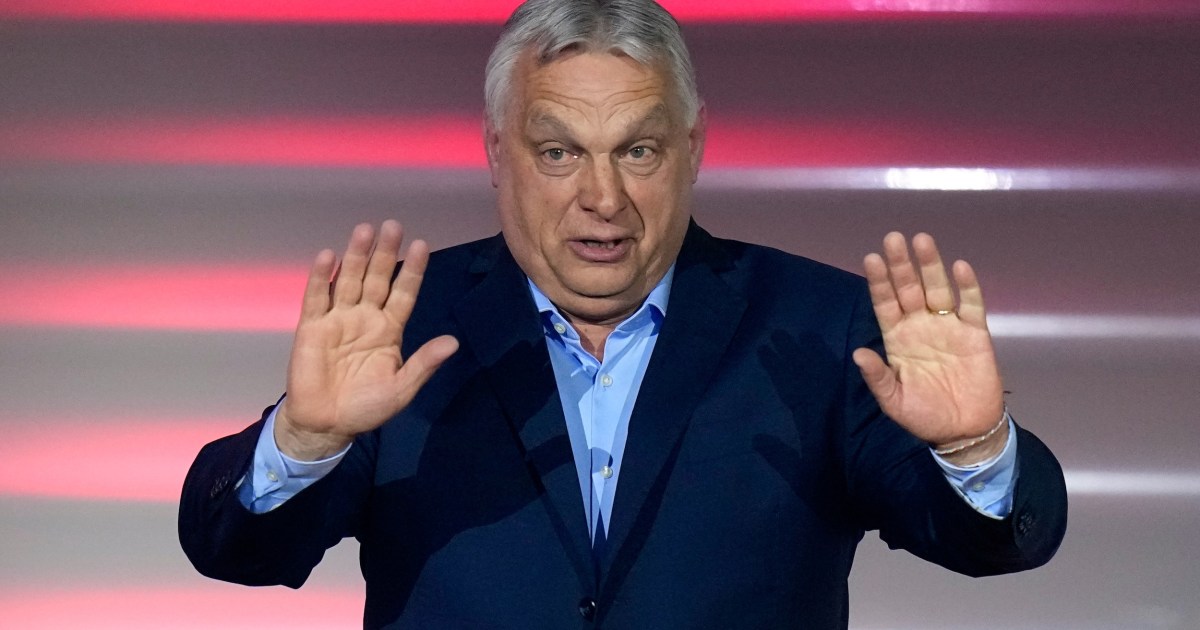
BUDAPEST, Hungary (AP) — Hungarian Prime Minister Viktor Orbánconceded defeat on Sunday after what he called a ″painful″ election resultending 16 years in power for a powerful figure in the far-right movement allied with U.S. President Donald Trump and Russian President Vladimir Putin.
Partial official results show opposition leader Peter Magyar’s party dominating the vote, in a bombshell election result with repercussions around Europe and beyond. ‘’Thank you, Hungary!” Magyar posted on X, as thousands of his supporters thronged the banks of the Danube in Budapest.
Across town, Orban told his followers that “I congratulated the victorious party.”
“We are going to serve the Hungarian nation and our homeland from opposition as well,” he said.
With 60% of the vote counted, Magyar’s Tisza party had more than 52% support to 38% for Orbán’s governing Fidesz party. That proportion will change as more votes are counted.
It’s a major blow for Orbán, the European Union’s longest-serving leader and one of its biggest antagonists, who has traveled a long road from his early days as a liberal, anti-Soviet firebrand to the Russia-friendly nationalist admired todayby the global far-right.
The parties of both Orbán and Magyar said they had received reports of electoral violations, suggesting some results could be disputed by both sides.
Voters showed up in droves
Turnout by 6:30 p.m. was over 77%, according to the National Election Office, a record number in any election in Hungary’s post-Communist history.
“I’m asking our supporters and all Hungarians: Let’s stay peaceful, cheerful, and if the results confirm our expectations, let’s throw a big, Hungarian carnival,” Magyar said.
Orbán’s chief of staff, Gergely Gulyás, said the record high turnout showed that “Hungarian democracy is extremely strong.”
‘Choice between East or West’
Orbán has repeatedly frustrated EU efforts to support Ukraine in its war against Russia’s full-scale invasion, while cultivating close ties to President Vladimir Putin and refusing to end Hungary’s dependence on Russian fossil fuel imports.
Recent revelations have shown a top member of his government frequently shared the contents of EU discussions with Moscow, raising accusations that Hungary was acting on Russia’s behalf within the bloc.
The election was closely watched in countries around Europeand beyond, which is a testament to the outsize role Orbán occupies in far-right populist politics worldwide.
Members of Trump’s “Make America Great Again” movement are among those who see Orbán’s government and his Fidesz political party as shining examplesof conservative, anti-globalist politics in action, while he is reviled by advocates of liberal democracyand the rule of law.
After casting his vote, Magyar told reporters that the election was “a choice between East or West, propaganda or honest public discourse, corruption or clean public life.”
Casting his ballot in Budapest, Marcell Mehringer, 21, said he was voting “primarily so that Hungary will finally be a so-called European country, and so that young people, and really everyone, will do their fundamental civic duty to unite this nation a bit and to break down these boundaries borne of hatred.”
Strained relationship with the EU
During his 16 years as prime minister, Orbán has launched harsh crackdowns on minority rightsand media freedomssubverted many of Hungary’s institutions and been accused of siphoning large sums of money into the coffers of his allied business elite, an allegation he denies.
He also has heavily strained Hungary’s relationship with the EU. Although Hungary is one of the smaller EU countries, with a population of 9.5 million, Orbán has repeatedly used his veto to block decisions that require unanimity.
Most recently, he blocked a 90-billion euro ($104 billion) EU loanto Ukraine, prompting his partners to accuse him of hijacking the critical aid.
Serious challenger on the rise
Magyar rapidly rose to become Orbán’s most serious challenger. The 45-year-old leader of the center-right Tisza party, which led in independent polls, campaigned on issues affecting ordinary voters including Hungary’s faltering public health care and transportation sectors and what he describes as rampant government corruption.
A former insider within Orbán’s Fidesz, Magyar broke with the party in 2024 and quickly formed Tisza. Since then, he has toured Hungary relentlessly, holding rallies in settlements big and smallin a campaign blitz that recently had him visiting up to six towns daily.
In an interview with The Associated Pressearlier this month, Magyar said the election will be a “referendum” on whether Hungary continues on its drift toward Russia under Orbán, or can retake its place among the democratic societies of Europe.
Tisza won 30% of the vote in European Parliament elections in 2024, and Magyar took a seat as an EU lawmaker. Tisza is a member of the European People’s Party, the mainstream, center-right political family with leaders governing 12 of the EU’s 27 nations.
Uphill election battle
Magyar and Tisza face a tough fight. Orbán’s control of Hungary’s public media, which he has transformed into a mouthpiece for his party, and vast swaths of the private media market give him an advantage in spreading his message.
The unilateral transformation of Hungary’s electoral system and gerrymandering of its 106 voting districts by Fidesz also will require Tisza to gain an estimated 5% more votes than Orbán’s party to achieve a simple majority.
Additionally, hundreds of thousands of ethnic Hungarians in neighboring countries had the right to vote in Hungarian elections and traditionally have voted overwhelmingly for Orbán’s party.
Fidesz and Tisza both have launched platforms for reporting irregularities, accusing their opponents of planning to commit election abuses.
Russian secret services have plotted to interfere and tip the election in Orbán’s favor, according to numerous media reports including by The Washington Post. The prime minister, however, has accused neighboring Ukraineas well as Hungary’s allies in the EU, of seeking to interfere in the vote to install a “pro-Ukraine” government.
Such accusations are part of why many in the EU see Orbán as a danger to the bloc’s future.
But across the Atlantic, Trump and his MAGA movement are all-in for another Orbán term. Trump has repeatedly endorsed the Hungarian leader and U.S. Vice President JD Vance made a two-day visit to Hungarylast week meant to help push Orbán over the finish line.
The walls are closing in around Rep. Eric Swalwell, D-Calif., who faces a criminal investigation into sexual assault allegations and mounting pressure — not just to abandon his campaign for California governor — but to resign from Congress.
Rep. Pramila Jayapal of Washington state, who has long advocated for survivors of Jeffrey Epstein, was one such Democrat on Sunday saying Swalwell should resign or be expelled.
When asked on NBC’s “Meet the Press” Sunday if she thinks Swalwell should abandon the race for governor, Jayapal said, “I absolutely do.”
She also said Swalwell should resign, along with Republican Rep. Tony Gonzalez of Texas, who is under a House ethics probe for a sexual relationship he admitted to having with an aide who later killed herself. “I do think that both of them need to step down from Congress,” Jayapal said.
“What we are seeing now is an emergence of women across the country who have been dismissed, told to shut up, told to move on —who have been abused by men in powerful positions. This is not a partisan issue,” Jayapal said.
Rep. Ro Khanna said Swalwell, a fellow California Democrat, should step down.
“There must be accountability with both House Ethics and law enforcement about the sexual assault, and Eric Swalwell should resign,” Khanna, a leader in Democratic efforts to investigate the Justice Department’s Epstein files, said in a statement on X Sunday after appearing on Fox News.

Rep. James Walkinshaw, D-Va., said he agreed. “His campaign for governor is over whether he realizes it or not,” he said during an appearance on MS NOW’s “Alex Witt Reports” Sunday.
Rep. Anna Paulina Luna, a Florida Republican, announced this weekend that she will push an expulsion resolution this week against Swalwell, saying, “I am not going to serve with these sexual deviants, that is not what Congress is about.”
Swalwell, who was the frontrunner in the California governor’s race to replace current term-limited Gov. Gavin Newsom, has vehemently denied any wrongdoing. Newsom, seen as a 2028 Democratic presidential contender, has not weighed in on whether Swalwell should resign or at least end his campaign for governor. His office did not immediately respond to MS NOW’s request for comment on Sunday.
But he said in a statement issued Friday, “These allegations from multiple sources are deeply troubling and must be taken seriously.”
Rep. Byron Donalds, a Republican from Florida, said he, too, would support expulsion resolutions for both Gonzalez and Swalwell. “If separate motions to expel the two congressmen come before the House, I will be voting yes on both measures,” Donalds said on “Meet the Press” Sunday.
The Manhattan District Attorney’s Office said on Saturday it launched an investigation into allegations of sexual assault against Swalwell, a one-time presidential candidate.
The main accuser, a former aide to Swalwell who spoke with MS NOW, first told the San Francisco Chronicle that the congressman sexually assaulted her on two separate occasions when she was too intoxicated to consent.
California House Democrats have turned on their colleague. Rep. Ted Lieu announced Friday he was withdrawing his endorsement of Swalwell for governor and Rep. Robert Garcia — another prominent advocate for Epstein survivors — called on Swalwell to quit the race.
Sen. Adam Schiff, D-Calif. withdrew his endorsement of Swalwell as campaign staffers abandoned him in droves. Rep. Jared Huffman, D-Ca., said Saturday that both Swalwell and Gonzalez should resign or face expulsion.
“Swalwell must halt his campaign, resign from office, and face the consequences of a full investigation,” California Rep. Sam Liccardo said Friday.
Senior staff working in Swalwell’s congressional office and on his gubernatorial campaign issued a joint letter over the weekend, saying they are “horrified” by the news reports detailing the sexual assault allegations against their boss and that any decision to remain on payroll “should not be viewed as support for Eric Swalwell.”
“We stand with our former colleague, and the other women who have come forward. We believe you should stand with them, too,” the letter said. “The behavior detailed in these reports is abhorrent, beneath the dignity of those serving in public office and betrays the trust of all Californians.”
Mychael Schnell and Jillian Frankel contributed to this report.
Erum Salam is a breaking news reporter for MS NOW, with a focus on how global events and foreign policy shape U.S. politics. She previously was a breaking news reporter for The Guardian.
- Eric Swalwell ends bid for California governor amid sexual misconduct allegations

- Hungarian Prime Minister Viktor Orbán concedes defeat after ‘painful’ election result

- Calls grow for Eric Swalwell to exit politics over sexual assault allegations
- Trump orders Strait of Hormuz blockade after peace talks fail
- What’s troubling about Delcy Rodriguez’s transition from pariah to Trump’s partner
- IMF managing director: ‘Everybody feels the pinch of prices going up’
- ‘It would be catastrophic’: A Supreme Court decision could upend Alaska’s crucial Senate race
- Vance says no headway in ceasefire talks: ‘I think that’s bad news for Iran’
- China preparing delivery of new air defense systems to Iran, report says

- White House ballroom construction can continue, federal appeals court says

-

 Politics1 year ago
Former ‘Squad’ members launching ‘Bowman and Bush’ YouTube show
-

 The Dictatorship1 year ago
Luigi Mangione acknowledges public support in first official statement since arrest
-

 Politics1 year ago
Former Kentucky AG Daniel Cameron launches Senate bid
-

 The Dictatorship1 year ago
Pete Hegseth’s tenure at the Pentagon goes from bad to worse
-

 Politics1 year ago
Blue Light News’s Editorial Director Ryan Hutchins speaks at Blue Light News’s 2025 Governors Summit
-

 The Dictatorship7 months ago
Mike Johnson sums up the GOP’s arrogant position on military occupation with two words
-
Uncategorized1 year ago
Bob Good to step down as Freedom Caucus chair this week
-

 Politics12 months ago
Democrat challenging Joni Ernst: I want to ‘tear down’ party, ‘build it back up’