Congress
Inside the shadow campaign to lead a diminished House GOP

MYRTLE BEACH, South Carolina — Donald Trump is facing his worst-ever approval ratings as president, GOP candidates in deep-red districts are scrambling for political cover, and Jim Jordan would like his fellow House Republicans to know he’s here to help.
“We are helping anybody, everybody,” the veteran Ohio lawmaker said in an interview on the sidelines of a get-out-the-vote rally in South Carolina, a typically red state that is suddenly a midterm battleground.
The differences between Republicans “are pretty darn small compared to the differences in Republicans and the radicals who control the other party,” Jordan added, “so let’s stick together.”
To the outside ear, that might sound like generic campaign-trail hokum. But to Jordan’s colleagues, his comments essentially renouncing the factional warfare that made him a proto-MAGA star is emblematic of the shadow election battle that is now quietly underway — to lead what is expected to be a diminished House Republican Conference.
Interviews with three dozen GOP lawmakers and senior Republican aides revealed the widespread expectation that their House majority is coming to an end and that many are skeptical Speaker Mike Johnson would run for minority leader in that scenario.
They are keeping a close eye on two potential alternatives — Jordan, who has run twice before to lead House Republicans, and Majority Leader Steve Scalise, who has spent more than a decade climbing the GOP leadership ladder.
While most expect the contest to explode into plain view after Tuesday’s election, neither man is acknowledging any jockeying — or even the possibility that the GOP could lose the majority.
“I’m supporting Hakeem Jeffries for minority leader,” Scalise scoffed in an interview, referring to the top House Democrat, and said that “anybody who’s measuring the drapes of the minority leader’s office is not focused on the right things.”
But their colleagues are closely following their respective pre-midterm maneuvers — including trips like Jordan’s — and quietly handicapping who might have the advantage if their expectations for an underwhelming Election Day come to pass.
Scalise has spent nearly eight years as the No. 2 leader, raising scads of money and building back-slapping relationships with a broad cross-section of members. He’s traveled this cycle with 203 candidates and incumbents and sent nearly $24 million to fellow Republicans. Jordan, meanwhile, has made himself into a conservative icon through his battles with top GOP leaders and his combative performances at Oversight and Judiciary committee hearings, only to take a more conciliatory turn in recent years.
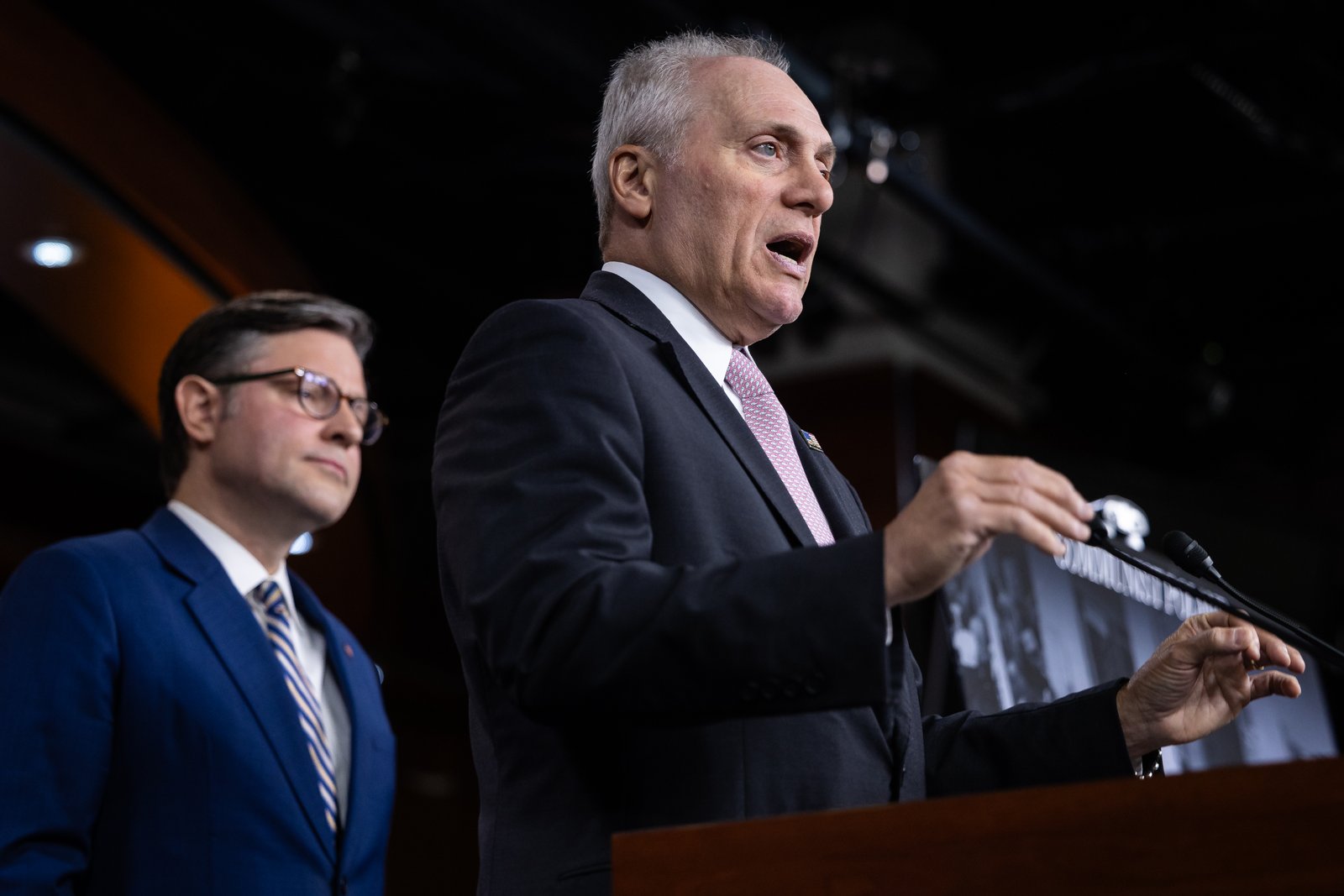

Many, though not all, predict that a Republican wipeout Tuesday would leave members reluctant to elevate a member of the existing leadership structure and would instead choose a known face of the conservative insurgency.
“It’s Jordan’s race to lose,” said a House Republican, who like others in this story was granted anonymity to speak candidly about the as-yet-unofficial race. “I think it’s his time.”
“People want fresh blood,” another GOP member said — referring to the 62-year-old Jordan, not the 60-year-old Scalise.
Aside from the election results, the big unknown surrounds Johnson, who just celebrated his three-year anniversary as speaker. He recently suggested in a CBS News interview that he believed his “colleagues would ask me to continue leading this conference” even in the minority — something no former speaker has done since Nancy Pelosi’s Democrats lost the 2010 midterms.
A close election result could make that tenable, but most Republicans believe he will step aside. Retiring Rep. Mark Amodei (R-Nev.) said in an interview he’s told Johnson he “sincerely” wants him to stay on as speaker next Congress but acknowledged the current national landscape is not “warm” for Republicans.
“When … everything’s good, the quarterback’s the hero,” Amodei said. “When you lose, I’m sure there’ll be plenty of blame to go around — that’s what transpires.”
Asked if he would back Johnson for the top spot regardless of Tuesday’s results, Scalise said, “I support Mike for speaker, and I want to see us, again, work and leave everything out on the field.”
A Johnson spokesperson said the speaker is “solely focused on holding the majority” and plans to campaign in 21 districts across 13 states before Election Day. If he succeeds in staving off Democrats, most Republicans believe those in the existing leadership slate would continue in their posts. The speaker raised $526 million this cycle for House Republican campaigns and the major House GOP super PAC.
If Democrats win the majority, Scalise is facing a squeeze: Rep. Tom Emmer of Minnesota, the current No. 3, has said regardless of the election outcome he will run for party whip — which is the No. 2 spot in the minority. If Johnson were to try to stay on in that scenario, Scalise would be forced into a contested race to either move up or keep his rung on the GOP power ladder.
The initial hours after a GOP loss could see a flurry of announcements as potential leaders make their intentions known and scramble to win verbal commitments from their colleagues. Candidates have only until Nov. 6 to declare, with the leadership election scheduled for the Tuesday after the midterms.
While Jordan and Scalise are being most closely watched, some believe Emmer could emerge as a candidate if others fail, as could Texas Rep. August Pfluger, the outgoing chair of the Republican Study Committee.
Many will also be keeping eyes on President Donald Trump, who has yet to weigh in on the post-election GOP leadership picture. He endorsed Johnson for reelection Monday without mentioning him continuing as top leader.
White House spokesperson Allison Schuster said Trump is “laser-focused on maintaining Republican majorities in Congress” and is “certainly not weighing in on Hakeem’s race and possible Democrat challengers for Minority Leader.”
Were he to mount a minority leader run, Jordan would have to overcome a pair of previous failed bids for the No. 1 post — where, in both cases, colleagues saw him as too combative and ideological to lead the party.
His 2018 run for minority leader, in the aftermath of the last Democratic House takeover, fell well short to Kevin McCarthy. He went on to ally himself with McCarthy, however, and mounted a bid to take over as speaker in 2023 after McCarthy was ousted from the post.
So did Scalise, who beat him in an initial conference tally, but neither man could gather the required 218 votes — ultimately leading to Johnson’s election as speaker. What many Republicans remember most about the process was a scorched-earth campaign conducted by Jordan’s allies outside of Congress, with some members recalling floods of phone calls during the election drama — including some death threats.
Asked about those incidents, Jordan said, “There’s no place for that.”
“As a guy who gets death threats all the time, I don’t want that to happen to anybody — Republican, Democrat, any American,” he said.
The math for a potential minority leader bid is different: Jordan needed near-unanimity to win the speaker race, which is contested among both parties on the House floor. Election as minority leader involves Republicans voting only among themselves, and Jordan has made conspicuous moves in the past three years to build support with more centrist members of the party.
He’s made campaign appearances for endangered members like Rep. Jen Kiggans of Virginia, lending the star power of a Fox News regular to their campaign stops. As Judiciary chair, Jordan sent signals to farm-state Republicans that he could be willing to back off his hard-line immigration stances and agree to new guest-worker measures aimed at the agricultural industry, according to three people involved in those conversations.
Jordan has also retained his backing from the more MAGA-friendly corners of the conference, including members who have clashed with McCarthy, Johnson and Scalise. He rallied Saturday in Clearwater, Florida, with one of them — Rep. Anna Paulina Luna.
In an interview, Luna credited Jordan with helping her get elected in 2022 and faulted the House’s existing leaders for standing in the way of her efforts to ban stock trading and allow new parents in the House to vote by proxy.
Asked about her potential support for a Jordan leadership run, Luna said he “definitely has a really good shot at it.”
“I am fair game for anyone who thinks that they have a shot at that position,” she added. “I want to hear what the platform is. But I will tell you that Jim Jordan helped get me elected, and I have an immense amount of respect for him because I remember who was there for me when no one else was.”
Kimberly Leonard contributed to this report.