
Congress
Inside John Thune’s strategy for ending the shutdown

Senate Majority Leader John Thune laid out a path to end the government shutdown in an exclusive interview Wednesday, saying he is willing to discuss the shape of future health care negotiations if a “critical mass” of Democrats say they are willing to support a House-passed funding bill in return.
The comments, made in his Capitol office less than 18 hours into the first shutdown since 2019, are in keeping with the South Dakota Republican’s current strategy — which is to let pressure build on Democrats to back the GOP-led House stopgap as the only solution.
But Thune acknowledged that he has had back-channel conversations with Democrats and said he’s willing to discuss how to structure a negotiation on Obamacare insurance subsidies that are set to lapse at the end of the year.
“I keep telling them: When they have eight or 10 — preferably 10, or more — when they have a critical mass, let me know if there’s a conversation they want to have,” Thune said.
He insisted he would not negotiate on the substance of an extension while the government is closed. But pressed on whether he was open to discussions with Democrats about how the health care negotiations might work post-shutdown or how to advance full-year appropriations bills, Thune said, “We are.”
“Some of those conversations are happening,” he added. “With our members and their members there’s a lot of back-and-forth going on right now about some of the things they would like to see happen.”
Those bipartisan conversations spilled into public view Wednesday when a large group of senators talked on the Senate floor about how the government might be reopened. The talks, according to several lawmakers involved, are in their early phases. But they are a sign that, less than 24 hours into the shutdown, lawmakers are already looking for the way out of it.
Republicans involved in the bipartisan talks say that a framework for negotiations on the health insurance subsidies has come up, as well as a timeline for wrapping them up. Some Democrats want a deal by Nov. 1, when open enrollment starts for plans offered on Affordable Care Act exchanges. Linking it to the passage of a larger appropriations package after the shutdown fight has also been discussed.
But GOP senators said they are largely offering reassurances to Democrats that dozens of their members, and Thune, are willing to have a negotiation on the subsidies once the government is reopened under the House-passed continuing resolution.
Thune backed up that message Wednesday, reiterating in the interview that the GOP funding patch through Nov. 21 remains the only viable option: “Everybody wants a solution, wants a way out. But I don’t know how you do that absent opening up the government.”
Senate Minority Leader Chuck Schumer continued Wednesday to push for a substantive negotiation on health care as 44 of the 47 members of the Democratic caucus remained behind him in a third vote against the House CR. Another five would have to break ranks to pass the bill.
Thune said in the interview that he believed Schumer is in a “tough spot” but that he hoped he would give rank-and-file Democrats “latitude” in their current discussions with Republicans.
Schumer, for his part, offered public support for the bipartisan Senate talks Wednesday, noting that he and other Democrats have been saying for weeks that Republicans need to talk to them.
While some Democratic lawmakers have warned they won’t vote for the stopgap bill unless a deal on extending the insurance subsidies is written into it, others have left the door open to an off-ramp that would fall short of that red line.
“One of the reasons probably why there are some of us in this camp is that there are Republicans telling us, ‘We agree with you. For our own interest, we have to fix this,’” Sen. Tim Kaine (D-Va.), who is involved in the talks, said Wednesday.
Thune, however, said he could not guarantee that a deal on extending the premium tax credits would be ready to be passed by Nov. 21, when the House stopgap would expire.
“I don’t know we can have a deal that could pass by then but I think there are … definitely discussions around things that could lead” to one, he said.
What to do about the soon-to-expire subsidies badly divides Republicans. Conservatives want to let them lapse at the end of the year. But a swath of House and Senate Republicans are open to extending them later this year with changes, such as new income limits, language aimed at preventing potential fraud and new minimum out-of-pocket premiums.
“What I can’t guarantee, of course, is an outcome and, in particular, one that would clear in the House, too,” Thune added. “The White House is another factor here. But I think everybody realizes we want solutions.”


The six-week-old Department of Homeland Security shutdown is hinging not only on what lawmakers do in the Capitol, but on how they get there.
Members of Congress are some of America’s most frequent fliers, giving them an up-close look at the shutdown’s most dramatic impacts on Americans — the long airport security lines caused by TSA staffing shortages.
The juxtaposition of the elected jet-setters, who can take advantage of some unusual perks as they travel, with growing disruptions for everyday travelers has emerged as the most potent point of pressure as the standoff wears on.
“Generally, when elected officials have to suffer the consequences of their own inaction, it tends to provide a motive for action,” Rep. Kevin Kiley, a California independent, said Thursday.
President Donald Trump announced Thursday evening he would sign an executive order to pay TSA agents, but as prospects for a shutdown-ending deal ebbed and flowed in recent weeks, airports became politically fraught spaces for members.
Many have made clear they are waiting in lines alongside everyone else, some have proposed legislation to enshrine that principle and at least one partisan confrontation has taken place on airport property.
In a viral blow-up last week outside the airport in Austin, Texas, Democratic Rep. Greg Casar crashed an event where GOP Sen. John Cornyn was handing out hamburgers to TSA agents missing paychecks amid the funding lapse. Casar blasted Cornyn for opposing legislation that would fund TSA without providing funding for Immigration and Customs Enforcement.
“My experience at the airport speaking with TSA agents is that several that I’ve spoken with just want to see us pass a TSA-only bill and have our debate about ICE separately,” Casar said in an interview.
Cornyn then introduced legislation to end “special treatment” for members of Congress at airports by requiring that lawmakers use the same screening procedures as other travelers and banning federal funds from being used to give members expedited security screenings. The legislation passed the Senate unanimously but has not been taken up in the House.
“As many Americans probably don’t know … airports around the country allow Members of Congress to bypass the usual TSA security screening process at airports,” Cornyn said in a statement. “This should end today.”
The special security arrangements are just some of the air-travel privileges that lawmakers can enjoy. Lawmakers have been known to skip to the front of screening lines, and many take advantage of special security escorts as they move through airports.
Major airlines offer special reservation booking privileges to members of Congress and their staff, giving them direct lines with dedicated personnel devoted to handling the needs of 535 congressional offices. Some allow members to book multiple flights on the same day without penalty, giving them options in case a vote runs late or another delay arises.
Delta, the largest U.S. carrier, said Tuesday it was suspending airport escorts for lawmakers and assistance from special “red coat” agents in light of the ongoing shutdown. The airline’s dedicated “Capital Desk” reservations line remains open.
Even before the shutdown, airports have been political hazards for members of Congress. Most infamously, former Sen. Larry Craig (R-Idaho) was arrested in a 2007 bathroom sex sting inside the Minneapolis airport, effectively ending his career. Former Rep. Madison Cawthorn (R-N.C.) and Rep. Victoria Spartz (R-Ind.) were both cited after trying to bring firearms through security checkpoints.
More recently, Rep. Nancy Mace (R-S.C.) sparked a political firestorm after she was alleged to have verbally abused Charleston, South Carolina, airport workers in October after a mix-up involving her security escort. The widely publicized incident was seen as harming her campaign for governor.
The notion of lawmakers getting special air travel perks has gone viral in several instances in recent days as airport security lines have grown.
Proclaiming her support for Cornyn’s measure Thursday, Rep. Ashley Hinson of Iowa reposted a video showing old, pre-shutdown videos of Mace and Rep. Debbie Wasserman Schultz (D-Fla.) being escorted through airports.
“Neither Republicans or Democrats should be skipping the line while constituents are facing 4+ hour waits across the country,” she said.
Virtually all of the more than 20 lawmakers Blue Light News interviewed Thursday about the airport chaos expressed sympathy for the unpaid agents, and many took pains to emphasize they had been inconvenienced alongside everyone else.
“My staff has been crushed. I got crushed a couple times. I got caught in the mess,” said Rep. Rich McCormick (R-Ga.), who frequently flies out of Atlanta, America’s busiest airport. “First time I walked in, I’m like, ‘Oh my gosh, pandemonium.’”
Utah Republican Rep. Burgess Owens, who flies out of Salt Lake City, another Delta hub, said in an interview he does not use any special airline offerings for lawmakers and said he was glad those services are paused.
“Across the board, we should be living the same experience and pain that we give to other people,” he said.
“I don’t think we deserve any special perks,” added Rep. Nikki Budzinski (D-Ill.), who said the priority should be “making sure our constituents … can get through the line.”
There is, however, another point of bipartisan consensus — that the airport chaos is the other party’s fault.
“Democrats have proposed that we fund [TSA] fully,” Rep. Ro Khanna (D-Calif.) said, referring to bills that would provide standalone funding for the agency. “Trump just refuses to take the deal.”
Speaker Mike Johnson made the opposite case in a Fox News interview Thursday afternoon.
“If you’re waiting in line at the airport, it’s because Democrats are refusing to fund the government,” he said.
Oriana Pawlyk contributed to this report.
A large contingent of House Republicans — encompassing hard-liners, Budget Committee members, panel chairs and party leaders — piled into Speaker Mike Johnson’s office Thursday afternoon to discuss a second party-line package, according to four people granted anonymity to share details of the private meeting.
Among the lawmakers attending were Budget Chair Jodey Arrington of Texas and Republican Study Committee Chair August Pfluger, also of Texas.
Reps. Chip Roy of Texas, Byron Donalds of Florida, Tom McClintock of California and Josh Brecheen of Oklahoma were also on hand, alongside Pennsylvania Reps. Lloyd Smucker and Scott Perry.
“We’re definitely preparing to move forward,” Johnson said in an interview as he left the meeting, regarding the House GOP Conference’s plans to pursue another bill through the filibuster-skirting budget reconciliation process. “We’re talking about more details. Lots of work going on.”
One of the biggest issues members are trying to work through at the moment is how to close the wide gap between Republicans in the House and Senate. Most House Republicans want a more expansive bill with myriad conservative policy priorities to ride alongside war and defense funding, while the Senate GOP is largely pushing for a more narrowly-focused measure, according to the four people.
Senate Democrats rejected a GOP photo ID amendment Thursday, an issue that Republicans are eager to use as a cudgel in the midterms.
Senators voted 53-47 on the amendment from Ohio Sen. Jon Husted, which needed 60 votes to advance. Republicans wanted to add the language to their election bill, known as the SAVE America Act.
Senate Minority Leader Chuck Schumer said the amendment “would impose the single strictest voter ID law in America.”
“Stricter than Texas. Stricter than Florida. Stricter than any state in the country,” he said.
- Brian Fitzpatrick delivers a warning on GOP reconciliation redo
- John Thune says he’s aiming to land DHS deal Thursday
- Collins meets the Problem Solvers
- Brian Fitzpatrick delivers a warning on GOP reconciliation redo
- Rubio touts progress in Iran talks, ‘but that’s an ongoing and fluid process’
- Maduro defense, prosecutors argue over blocked funds to pay for legal team

- Live updates: White House expected to intervene in TSA turmoil amid DHS shutdown
- Iran war ‘pouring’ money into Russia’s war coffers: Swedish defense chief

- Watch live: Trump gives remarks at Greek Independence Day celebration
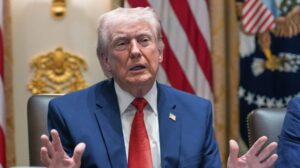
- Airports become political battlegrounds as DHS shutdown drags on
-

 The Dictatorship1 year ago
Luigi Mangione acknowledges public support in first official statement since arrest
-

 Politics1 year ago
Former ‘Squad’ members launching ‘Bowman and Bush’ YouTube show
-

 Politics1 year ago
Former Kentucky AG Daniel Cameron launches Senate bid
-

 Politics1 year ago
Blue Light News’s Editorial Director Ryan Hutchins speaks at Blue Light News’s 2025 Governors Summit
-

 The Dictatorship7 months ago
Mike Johnson sums up the GOP’s arrogant position on military occupation with two words
-

 The Dictatorship1 year ago
Pete Hegseth’s tenure at the Pentagon goes from bad to worse
-
Uncategorized1 year ago
Bob Good to step down as Freedom Caucus chair this week
-

 Politics11 months ago
Democrat challenging Joni Ernst: I want to ‘tear down’ party, ‘build it back up’