
The Dictatorship
Hundreds march in Boston to support democracy and protest policies of Trump, Musk

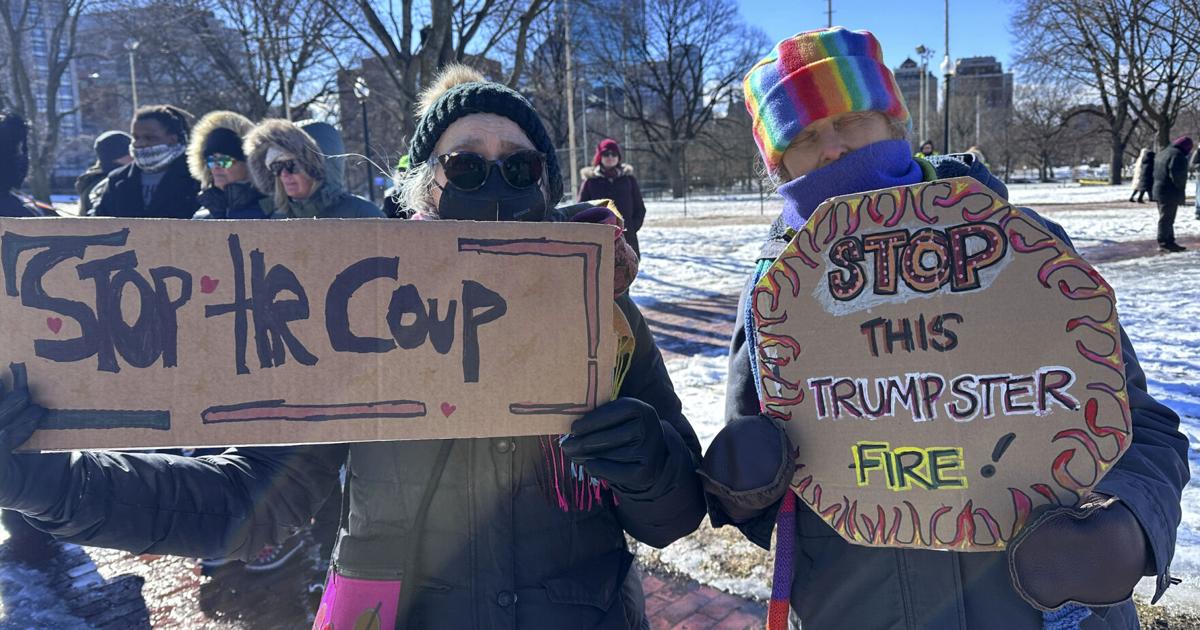

BOSTON (AP) — Chanting “Stop the coup” and carrying signs including “I Love Democracy” and “Resist,” hundreds of people rallied Friday in Boston against the policies of President Donald Trump and his billionaire adviser Elon Musk.
The peaceful rally in freezing conditions was supported by 100 civil rights, environmental and progressive groups from Massachusetts. Speaker after speaker decried administration policies targeting marginalized communities and urged the crowd to oppose what they called an attack on democracy.
“I’m here because I’m extremely concerned about my grandchildren, especially my granddaughter who’s not going to have the same rights that I have had in terms of controlling my body and all the rights that we’ve experienced and I’ve grown up with,” said Diane Bleier, a 76-year-old from Lexington, at the rally in Boston Common.
“They’re going to be taken away if this evildoer continues to run rampant over the government and destroy our rights and destroy our democracy,” she continued.
Others criticized what they see as a dismantling of the federal government.
“It’s important to stand up and protest and not just stay home and do nothing,” said Ellen Epstein, a Medford resident holding a sign that read “Stop the Trumpster Fire.” “I feel compelled to stand up for what’s right. What is happening now is very wrong.”
Others stressed the need to support and protect immigrant and LGBTQ+ communities, which have been the target of Trump administration policies in the early days of the administration.
“Our government is trying to erase our people, the people that make up our beautiful country including queer people, trans people, immigrants, Black and Indigenous people of color,” Logan Rubio, a 27-year-old Boston resident holding a sign that said “Queerness is Healing.” “It’s vile and disgusting.”
Rally organizers said they hoped to pressure political leaders to show moral courage and resist Trump’s agenda.
The rally came the same day that layoffs were implemented across federal agencies as part of an effort to reduce the government workforce and a day after vaccine skeptic Robert F. Kennedy Jr. was sworn in as health secretary.


The Dictatorship
Company backed by Trump sons looks to sell drone interceptors to Gulf states being attacked by Iran
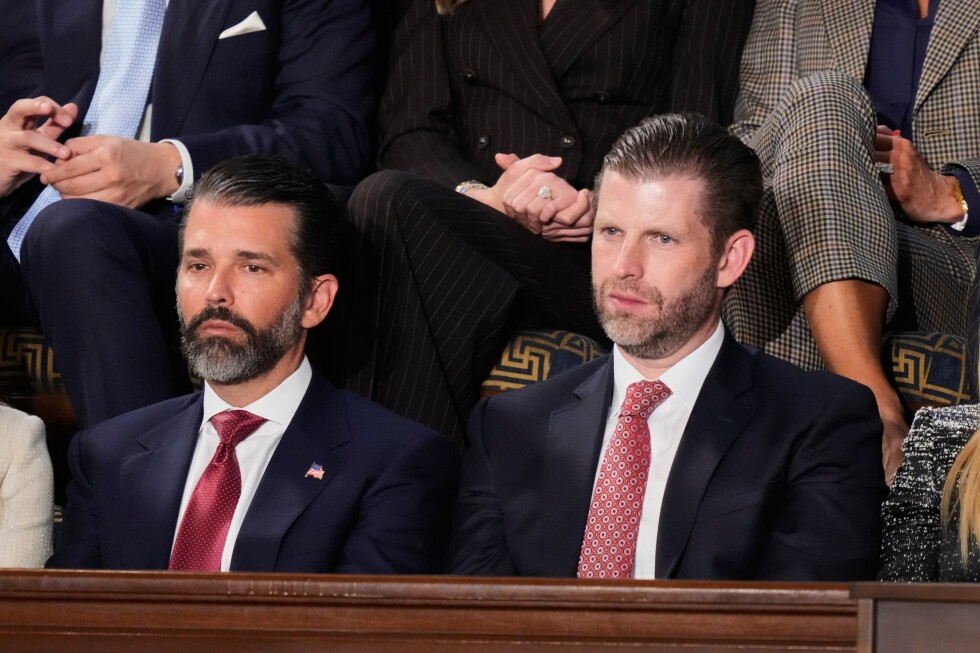

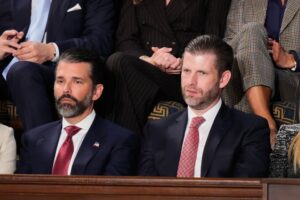
NEW YORK (AP) — A drone maker backed by President Donald Trump’s two oldest sons is trying to sell to Gulf countries while they are under attack by Iran and dependent on the U.S. military led by their father.
The sales drive by Florida-based Powerus – which announced a deal last month to bring aboard Eric Trump and Donald Trump Jr. – positions the company to potentially benefit from a war that their father began.
“These countries are under enormous pressure to buy from the sons of the president so he will do what they want,” said Richard Painter, a former chief White House ethics lawyer under President George W. Bush. “This is going to be the first family of a president to make a lot of money off war — a war he didn’t get the consent of Congress for.”
Powerus co-founder Brett Velicovich told The Associated Press that the company is making sales pitches that include drone demonstrations in several Gulf countries to show how its defensive drone interceptors could help them ward off Iranian attacks.
“Our team is doing many demos across the Middle East right now for our interceptors,” Velicovich said in an text exchange. “We have very incredible tech that can save lives.”
He declined to name the countries or give more details.
The Trump brothers’ deal with Powerus could give them sizable equity stakes. Their father, as commander in chief, launched the strikes with Israel against Iran over a month ago that began the war, the impetus for why these Gulf countries now need protection.
Powerus denied there were any conflicts when the Trump brothers’ stake was first announced. Velicovich emphasized its determination to help the U.S. catch up with Chinese and Russian drone makers and beat them.
“We are at war, my friend, we are in an arms race and America will lose if we don’t build fast,” said Velicovich, an Army veteran who had come under fire from the same Russian drones now being used by Iran. He added, “We should be thankful anyone is trying to invest in American manufacturing now. That idea transcends politics.”
The president’s oldest sons have expanded their business interests beyond hotels and golf courses since their father took office again. The companies they’ve invested in or been named advisers for — with equity stakes — run the gamut from cryptocurrency ventures to prediction markets to federal contractors making rocket parts and rare earth magnets.
This latest Trump venture has its sights on $1.1 billion set aside by the Pentagon to build up a U.S. manufacturing base for armed drones to fill a hole left when the Trump administration banned such imports from China.
The Trump Organization, where the two sons are executives, didn’t respond to a request for comment, but has dismissed claims of conflicts of interest in the past. The sons have said they didn’t get credit for their restraint in expanding their businesses in their father’s first term so have decided not to hold back much this time.
Asked about potential Powerus conflicts of interest specifically, Eric Trump sent AP a statement last month saying, “I am incredibly proud to invest in companies I believe in. Drones are clearly the wave of the future.”
Founded by U.S. Army Special Operations veterans about a year ago, Powerus makes drones for commercial uses, from spreading fertilizer to putting out forest fires. But it is bulking up fast to supply drones for military uses.
The company recently raised $60 million from investors and hopes to tap additional financing by doing a “reverse merger” with a Trump company listed on the Nasdaq stock exchange that owns a few golf courses in Florida. Such a merger allows a private business to quickly go public by taking over a company that already has publicly traded shares, shortening the process of filing paperwork and meeting various requirements of regular initial public offering.
The Dictatorship
Iran fires on Israel and Gulf neighbors as Trump claims threat from Tehran nearly eliminated
DUBAI, United Arab Emirates (AP) — There was little sign Friday of the war in the Mideast winding down as Israel said it faced incoming fire from Iran, Kuwait and Bahrain reported being under attack, and Iran said eight people were killed while celebrating the close of Persian new year near a major bridge hit by a U.S. strike.
Tehran continued to demonstrate its ability to strike its neighbors even as U.S. President Donald Trump claimed the threat from the country was nearly eliminated and cheered the collapse of the bridge on Thursday, reportedly the tallest in the Middle East.
Iran decried the strike on the bridge, which also injured 95 people celebrating Nature Day, when Iranians gather for picnics and other celebrations outdoors on the last day of Nowruz, the Persian new year.
“Striking civilian infrastructure only conveys the defeat and moral collapse of an enemy in disarray,” Iran’s Foreign Minister Abbas Araghchi wrote Thursday in a post on X.
Iran’s attacks on Gulf states along with its chokehold on the Strait of Hormuz have disrupted the world’s energy supplies with effects far beyond the Middle East. That has proved to be Iran’s greatest strategic advantage in the war. Britain held a call with nearly three dozen countries about how to reopen the strait once the fighting is over.
Trump has insisted the strait can be taken by force — but said it is not up to the U.S. to do that. In an address to the American people Wednesday night, he encouraged countries that depend on oil from Hormuz to “build some delayed courage” and go “take it.”
Before the U.S. and Israel started the war on Feb. 28 with strikes on Iran, the waterway was open to traffic and 20% of all traded oil passed through it.
Iran continues to strike Israel and Gulf countries
Iran responded defiantly to Trump’s speechin which the American president claimed U.S. military action had been so decisive that “one of the most powerful countries” is “really no longer a threat.”
A spokesman for Iran’s military, Lt. Col. Ebrahim Zolfaghari, insisted Thursday that Tehran maintains hidden stockpiles of arms, munitions and production facilities. He said facilities targeted so far by U.S. strikes are “insignificant.”
Trump, in his address, said U.S. “core strategic objectives are nearing completion.”
Iran state media reported the attack on the B1 bridge, which was still under construction, citing authorities in Alborz province.
Trump posted footage on social media showing what he said was the collapse of Iran’s biggest bridge and threatening, “Much more to follow.” It was not immediately clear if the footage Trump shared was the B1 bridge.
In Lebanon — where Israel has launched a ground invasion against Iran-backed Hezbollah militants — Israeli strikes killed 27 people over 24 hours, the Health Ministry said.
More than 1,900 people have been killed in Iran during the war, while 19 have been reported dead in Israel. More than two dozen people have died in Gulf states and the occupied West Bank, while 13 U.S. service members have been killed.
More than 1,300 people have been killed and more than 1 million displaced in Lebanon. Ten Israeli soldiers have also died there.
Nearly three dozen nations talk about securing the Strait of Hormuz
Iranian attacks on about two dozen commercial ships, and the threat of more, have halted nearly all traffic in the waterway that connects the Persian Gulf to the open ocean.
Since March 1, traffic through the strait has dropped 94% over the same period last year, according to the Lloyds List Intelligence shipping data firm. Two ships are confirmed to have paid a fee, the firm said, while others were allowed through based on agreements with their home governments.
Saudi Arabia piped about 1 billion barrels of oil away from the Strait of Hormuz in March, according to maritime data firm Kpler, while Iraq said Thursday that it had started to truck oil across Syria to avoid the strait.
The 35 countries that spoke Thursdayincluding all G7 industrialized democracies except the U.S., as well as the United Arab Emirates and Bahrain, signed a declaration last month demanding Iran stop blocking the strait.
Thursday’s talks were focused on political and diplomatic measures, but British Foreign Secretary Yvette Cooper said military planners from an unspecified number of countries will also plot ways to ensure security once fighting ends, including potential mine-clearing work and “reassurance” for commercial shipping.
No country appears willing to try to open the strait by force while the war is raging. French President Emmanuel Macron, while on a visit to South Korea, called a military operation to secure the waterway “unrealistic.”
But there is a concern that Iran might limit traffic through the waterway even after U.S. and Israeli attacks cease.
Oil prices rise again even as Trump suggests the war could end soon
The conflict is driving up prices for oil and natural gasroiling stock markets, pushing up the cost of gasoline and threatening to make a range of goods, including food, more expensive.
Oil prices remained elevatedhowever, at $111.54 for a barrel of U.S. crude, having soared following Trump’s address. That’s up about 50% from Feb. 28.
Though the oil and gas that typically transits the strait is primarily sold to Asian nations, Japan and South Korea were the only two countries from the region joining Thursday’s call about the strait. The supply of jet fuel has also been interruptedwith consequences for travel worldwide.
___
Rising from Bangkok and Corder reported from The Hague, Netherlands. Associated Press writers Will Weissert in Washington and David McHugh in Frankfurt, Germany, and Toqa Ezzidin in Cairo contributed to this story.
The Dictatorship
Trump uses Iran war address to urge an increasingly skeptical electorate to give him a bit more time
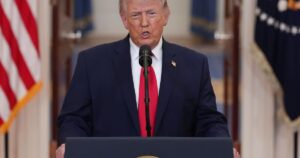
WASHINGTON (AP) — President Donald Trump used his first major address since launching his war in Iran to assure Americans that all of his military objectives will be completed “shortly” and urge an increasingly skeptical electorate to give him a little bit more time.
Trump in his Wednesday evening speech dialed back the bluster that’s dominated his rhetoric in recent days as world markets convulse and a badly battered Iran is still landing some effective blows on Gulf neighbors’ infrastructure and U.S. bases.
But the Republican president’s promise to “finish the job” hardly built confidence with a jittery market as oil prices surged and Asian stocks fell as he vowed that the U.S. will continue to hit Iran very hard.
He offered no detail about the state of negotiations with Iran that could bring about a promised endgame that he insists could come in a matter of weeks. There was also no overt lashing out at NATO allies for failing to fall in line and help him reopen the critical Strait of Hormuz waterway — something White House officials had said would be a prominent part of his roughly 20-minute address.
The U.S. will continue to hit Iran hard for the next two or three weeks, he said, without saying how much longer the war would last. But he offered a plea to Americans to show a little patience.
“We are in this military operation, so powerful, so brilliant, against one of the most powerful countries for 32 days, and the country has been eviscerated and essentially is really no longer a threat,” Trump said. “This is a true investment in your children and your grandchildren’s future. The whole world is watching, and they can’t believe the power, strength and brilliance.”
Trump finds himself not only negotiating with an enemy that refuses to throw in the towel but also dealing with an American tolerance for a conflict that’s being stretched.
Most Americans believe recent U.S. military action against Iran has gone too far, and many are worried about affording gasoline, according to an AP-NORC poll conducted in mid-March, a couple of weeks after the war started. While Trump is deploying more warships and troops to the Middle East, about 59% of Americans say U.S. military action in Iran has been excessive.
Meanwhile, 45% are “extremely” or “very” concerned about being able to afford gas in the next few months, up from 30% in an AP-NORC poll conducted shortly after Trump won reelection with promises that he would improve the economy and lower the cost of living.
Americans, Trump noted, have certainly shown patience during times of war.
“American involvement in World War I,” he said, “lasted one year, seven months and five days. World War II lasted for three years, eight months and 25 days. The Korean War lasted for three years, one month and two days. The Vietnam War lasted for 19 years, five months and 29 days. Iraq went on for eight years, eight months and 28 days.”
Hours before his address, Trump seemed to reflect on the domestic pressure he’s feeling to wrap up the war.
Speaking at a private lunch at the White House to mark Easter, Trump argued that the U.S. could “very easily” use this moment to take Iran’s oil. It is “unfortunate,” he lamented, that there did not seem to be patience among the American people for such an effort.
“They want to see it end,” he said. He added, “People in the country sort of say, ‘Just win. You’re winning so big. Just win. Come home.’ And I’m OK with that, too.”
Democrats lash at Trump for failing to offer a coherent argument for conflict
Sen. Chris Murphy, D-Conn., said Trump’s speech was “grounded in a reality that only exists in Donald Trump’s mind.”
The president, Democrats fumed, offered no plan for how he would go about reopening Hormuz, the critical waterway for oil tankers that a battered Iran has effectively choked off even though Trump claims it’s been defeated.
For allies worried about a global economy that’s been rattled by rising oil prices, Trump suggested they “buy oil from the United States of America” and “build up some delayed courage” and help the U.S. secure the strait. Trump made no attempt to answer his European critics who say he entered his war of choice against Iran without consulting global allies but is now expecting the world to help him fix the unintended damage that it has caused.
“We are losing this war,” Murphy added. “We cannot destroy all their missiles or drones, nor their nuclear program. Iran projects more power in the region than they did before the war, especially if they now permanently control the Strait of Hormuz. We are spending billions we don’t have and losing American lives in a war that is destabilizing the world and making us look feckless.”
President steers clear of suggesting ground troops deployment could be coming
Trump offered cautious optimism that those now in power in Iran after more than a month of U.S. and Israeli strikes are “less radical and much more reasonable” with much of the pre-war Islamic Republic’s hierarchy taken out. He didn’t explicitly mention a Monday deadline he has set for Iran to open the strait or face attacks from U.S. forces on its energy infrastructure, though he made clear that he remains open to targeting the heartbeat of Tehran’s economy.
“If there is no deal, we are going to hit each and every one of their electric generating plants very hard and probably simultaneously,” Trump said. “We have not hit their oil, even though that’s the easiest target of all, because it would not give them even a small chance of survival or rebuilding. But we could hit it, and it would be gone.”
Trump also notably did not signal that he’s making any preparation for a ground invasion by American troops.
He seemed to steer away from the possibility of sending ground troops to secure Iran’s nearly 1,000 pounds (450 kilograms) of highly enriched uraniumsaying it “would take months” for Iran to get to it as it’s buried under the rubble created by last year’s American bombing campaign of Iran’s nuclear sites.
Trump has offered shifting reasons for launching the war, but he has been consistent in articulating that a primary objective in joining Israel in the military action is ensuring that Iran will “never have a nuclear weapon.”
But over the course of the conflict, he has been more circumspect about how far he’s willing to go to follow through on his pledge to destroy Iran’s weapons program once and for all, including seizing or destroying the near-bomb-grade nuclear material that Iran possesses.
“We have it under intense satellite surveillance and control,” Trump said in his prime-time speech. “If we see them make a move, even a move for it, we’ll hit them with missiles very hard again. We have all the cards. They have none.”
___
Associated Press writers Collin Binkley, Michelle L. Price and Konstantin Toropin contributed to this report.
- The White House has a war-funding sales pitch the GOP might not buy
- ‘Bad idea’: Party-line plan for ICE funding has some fearing a slippery slope
- Company backed by Trump sons looks to sell drone interceptors to Gulf states being attacked by Iran
- Iran fires on Israel and Gulf neighbors as Trump claims threat from Tehran nearly eliminated
- April
- Is Hochul the unlikely hero of Adams’ world indictments?

- Trump admin moves Title X family planning program away from contraception, towards conception
- NATO’s Rutte to meet with Trump at White House amid attacks on alliance
- US military launches rescue mission for pilots who crashed in Iran
- Trump wants the world to buy more US oil. He might regret it.
-

 Politics1 year ago
Former ‘Squad’ members launching ‘Bowman and Bush’ YouTube show
-

 The Dictatorship1 year ago
Luigi Mangione acknowledges public support in first official statement since arrest
-

 Politics1 year ago
Former Kentucky AG Daniel Cameron launches Senate bid
-

 Politics1 year ago
Blue Light News’s Editorial Director Ryan Hutchins speaks at Blue Light News’s 2025 Governors Summit
-

 The Dictatorship7 months ago
Mike Johnson sums up the GOP’s arrogant position on military occupation with two words
-

 The Dictatorship1 year ago
Pete Hegseth’s tenure at the Pentagon goes from bad to worse
-
Uncategorized1 year ago
Bob Good to step down as Freedom Caucus chair this week
-

 Politics12 months ago
Democrat challenging Joni Ernst: I want to ‘tear down’ party, ‘build it back up’