
Congress
How John Thune is trying to manage Trump’s summer squeeze

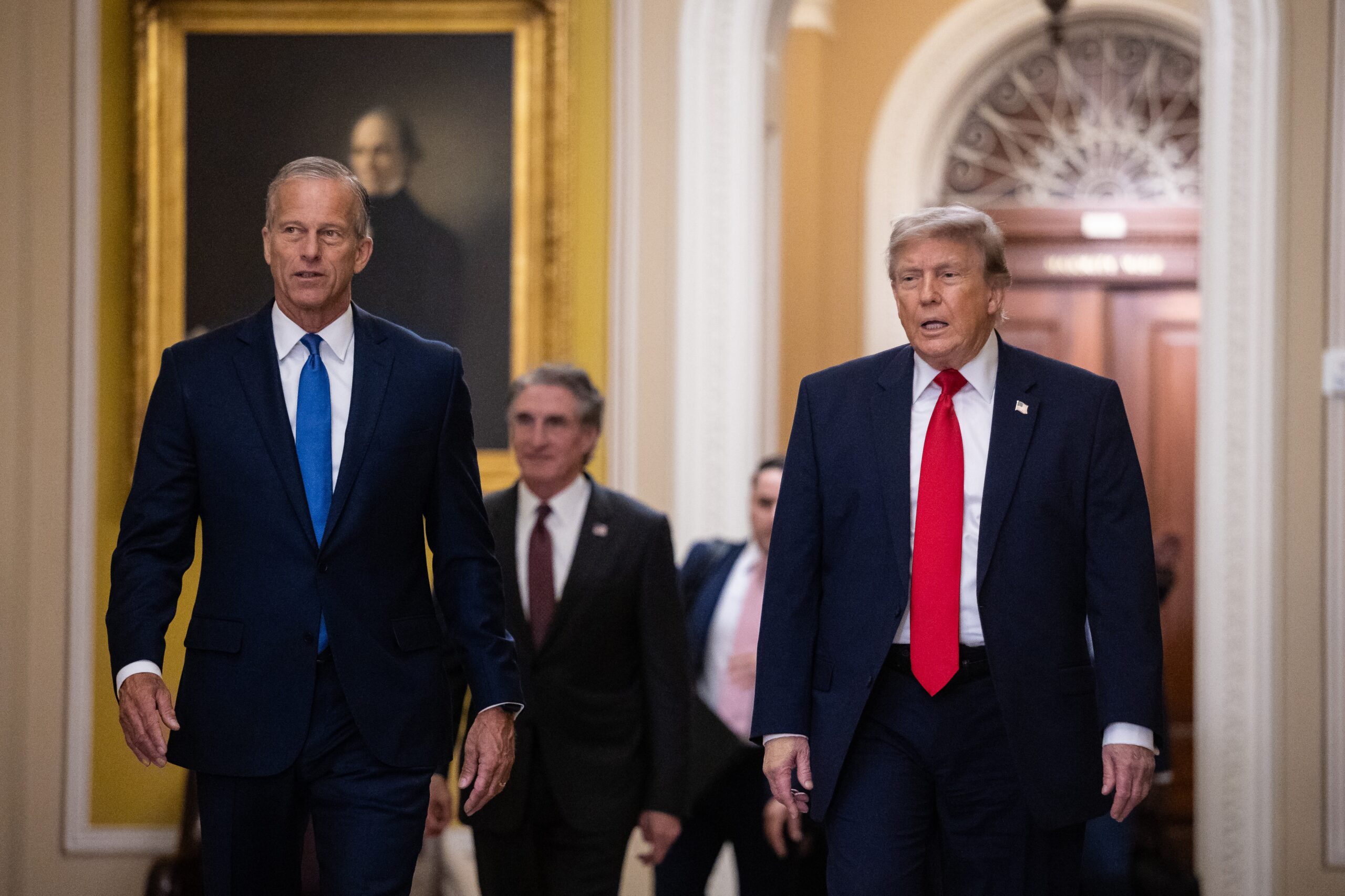
John Thune is eager to let GOP senators out of the Capitol and onto the campaign trail as Republicans fight to hold the Senate majority in November. First, he has to get through the next eight days.
The majority leader is hoping to fund the government, confirm dozens of President Donald Trump’s nominees and hand him new powers to punish Russia’s trading partners before letting his members leave for a five-week recess. But Trump has turned Thune’s exit strategy into a cascading political test.
The vise-like pressure campaign was playing out as Thune sat down with Blue Light News in his Capitol office Wednesday. At about the same moment, Trump was in the Oval Office insisting Thune “has the votes” to kill the Senate’s long-standing filibuster rule and pass a GOP elections bill. He went on to sow doubt as to whether he felt Thune was fit to lead the chamber’s Republicans.
“We will find out, and I will let you know,” Trump told reporters.
Unaware of Trump’s latest attacks, Thune in the interview nonetheless repeated that, no, he does not have anywhere near the votes to kill the filibuster or pass the SAVE America Act — the partisan elections bill Trump is pushing for. And he spoke frankly about the political risk Trump and other Republicans who are training their fire inward are assuming.
“I feel like we’re as well positioned as we can be,” Thune said of the midterm landscape, but “what we’ve got to do is just make the overarching narrative one that has us drawing contrast with our Democrat opponents rather than us shooting each other.” He held out hope that Trump would do just that as Election Day approaches.
The frustration with Trump’s intraparty attacks is widely shared among Thune’s colleagues but has been most frequently voiced by GOP members who are retiring or are otherwise insulated from Trump’s staggering political influence, like Sen. Thom Tillis of North Carolina.
Tillis downplayed Trump’s latest attacks Wednesday, chalking it up to the “typical tug and pull” among Republicans rather than a reflection of the president’s specific views on Thune.
Thune has up to this point acted more as a lightning rod for his conference, which is a traditional role for congressional leaders. But typically they attract bolts from the other party, not their own president.
In the interview Wednesday, Thune said he and Trump “get along” even as he acknowledged that he’s bearing the brunt of the president’s frustrations with the Senate’s inability to bend reality to his whims.
“He gets obviously frustrated with me because he sees me as the person that’s the impediment to some of the things he wants to get done. But as I continually point out … I don’t make this stuff up,” he said. “Math is math, arithmetic is arithmetic. … And part of it, too, is the active role he played in some of these primaries.”
“He thinks I can wave the magic wand,” he added. “I wish it were that easy.”
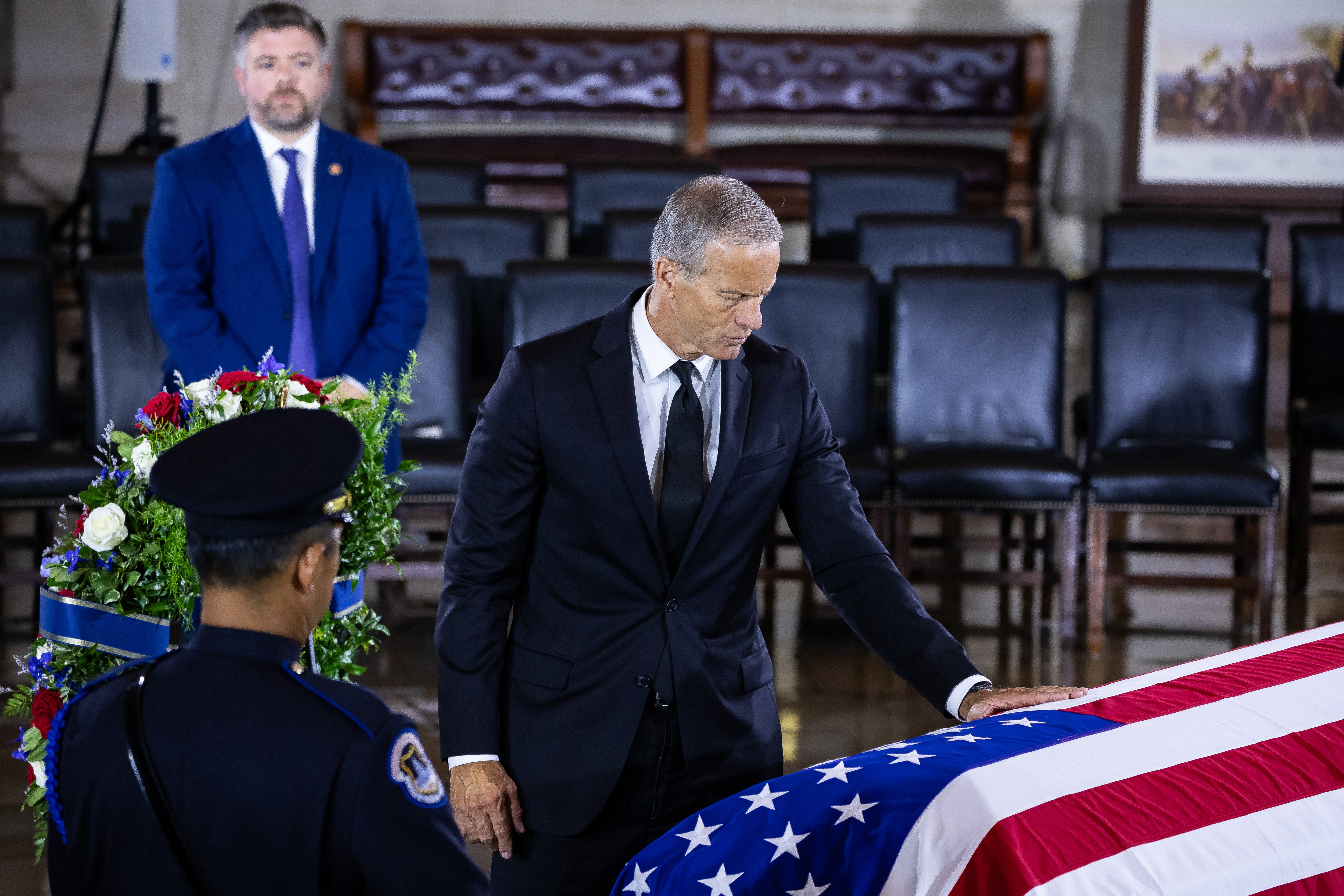
What has made things more challenging in recent weeks has been the sudden death of Sen. Lindsey Graham, a close Trump confidant who was able to have frank conversations with the president about the realities of the Senate.
“He was a great intermediary, whisperer, whatever you want to call it,” Thune said. “But yeah, it’s a real loss. I do think that he had the kind of relationship where he could speak bluntly, candidly, directly, and the president would accept it.”
He added there are conversations now happening about “how to better have a better line of communication” between Senate Republicans and Trump’s orbit. Just after sitting down with Blue Light News, he met with White House chief of staff Susie Wiles.
“We’ve got some people that can step into that role,” Thune said.
If the SAVE America Act was the only Trump-obsession Thune had to manage, it would be one thing, but the debate over the bill — which Thune supports — is also tied to Republicans’ attempt to enact a new party-line spending bill, which could include some election-related grant funding.
House Republicans managed to muscle through a $95 billion budget blueprint, but the path in the Senate is murky at best. Thune is dealing with deficit hawks who want at least part of the spending offset with cuts, defense hawks who want more Pentagon funding, and members who aren’t convinced there should be any bill at all.
But the White House is keeping the pressure on: Trump himself issued a public call for action on Truth Social Wednesday morning, and budget director Russ Vought pushed senators to move quickly in a private lunch just hours later.
Speaking in the interview shortly after the lunch, Thune said the budget blueprint Trump and his deputies are hoping to pass doesn’t currently have the votes to be approved. But he left the door open to a potential breakthrough before the end of next week while also acknowledging possible Plan Bs that could release at least some of the mounting pressure — possibly by putting pieces of the elections bill up for a vote.
“The question is, do we … trigger a vote on photo ID, put it on the floor, have a debate about it?” he said. “Those things are all kind of [things] we’re giving consideration to. But at the end of the day, does it change the outcome? I can’t see it.”
Thune also effectively ruled out holding a test vote on killing the filibuster. He warned that forcing what would essentially be symbolic votes would risk dividing Republicans while serving no practical end.
“You end up … basically for the 60 or 90 days heading into an election, fighting among Republicans, which to me seems really counterproductive, going into an election that’s pretty high-stakes,” Thune said.
Instead, Thune wants to make progress on other fronts. In addition to the sanctions bill, Thune wants to pass legislation funding the government past November — something virtually unheard of in July but something that he says is “trending in the right direction” nevertheless.
He’s also got nominees to confirm, and he’s looking to at least take an initial step on a cryptocurrency bill or college sports legislation. It’s an ambitious schedule for a month in the Senate, much less a week — especially when the president has his own priorities.
But Thune has consistently paid heed to his own constituency — the Republican senators who elected him to stay focused, put legislative wins on the board, and keep the GOP in the majority.
Thune has said he is planning to run for leader again in November, and most Senate Republicans believe he’s secure in his job.
Asked about the Oval Office comments later Wednesday evening, Thune initially danced around Trump’s equivocal assessment of whether he was “the man for the job” of leading the Senate GOP.
“That’s a decision that’s made by my colleagues,” he said.
But in subsequent comments, Thune joked that if Trump “could find somebody else to do this job, it might be a big relief.”
“It is what it is,” he added. “You just roll with it.”


The ranking Democrat on the House Oversight committee is demanding the White House answer questions related to President Donald Trump’s decision to ban BLN, MS NOW and Blue Light News from the White House, calling it the president’s “most blatant, assault on press freedom.”
In a letter sent Monday to White House Communications Director Steven Cheung, Rep. Robert Garcia (D-Calif.) requested that Cheung provide by Oct. 5 a detailed account of when and how he was informed of the ban, how he responded, who was consulted before the decision, the legal justification for it, the facts the White House relied on and whether the outlets had any opportunity to respond.
“The First Amendment guarantees freedom of the press, not freedom from criticism,” wrote Garcia. “The American people need to understand what consideration—if any—the White House gave to this serious and unprecedented decision to protect the President’s ego.”
Garcia also asked for all White House staff documents and communications about the ban and for any other relevant materials to be preserved.
The White House did not immediately respond to a request for comment.
Trump on Friday announced that he was seeking to block journalists from Blue Light News, MS NOW and BLN from the White House, complaining about “constant ‘reporting’” of what he called “FICTION and LIES.” The Trump administration first denied the media outlets entry into the White House grounds on Saturday morning.
The three news organizations are now jointly suing Trump, Cheung and two other top advisers in a bid to immediately restore access for their reporters, calling the ban a “direct assault on the First Amendment.”
Daniel Lippman contributed to this report.
Michigan Republican Senate nominee Mike Rogers said Monday that the war with Iran “needs to end” to bring prices down, making him the second Republican to break with the White House on the issue that day.
“The war with Iran needs to end, and end quickly,” Rogers said in a video published Monday to social media.
“Michigan families can’t afford to wait,” he added. “Here’s what we can do now: place a temporary embargo on Diesel exports. American energy should provide relief to American families first.”
Earlier Monday, Rep. Ashley Hinson, a Republican Senate candidate in Iowa, expressed similar frustrations about the war’s impact on Iowans’ pocketbooks. Both Rogers and Hinson called for a suspension of the state and federal gas tax in their statements.
Ahead of the midterms, GOP candidates have expressed concern about the war in the Middle East, saying it has made it difficult for them to run on affordability. The war with Iran, which began in February, has led to marked increases in gas and diesel prices. On Monday, regular gas was just over $4.45 per gallon, according to AAA; diesel prices hit a record of $6.50 per gallon.
Rogers, a former representative, is facing Democrat Abdul El-Sayed in the race for a Senate seat in battleground Michigan.
Senate Appropriations Chair Susan Collins warned Monday that President Donald Trump would be defying Congress if he moves forward with empowering top political appointees to decide who gets grant funding for health research.
“Any attempt to politicize grantmaking … is contrary to congressional intent,” the Maine Republican said in a statement.
Trump wants to issue an executive order to seat White House budget director Russ Vought and National Institutes of Health director Jay Bhattacharya on a board that would decide which grants the NIH should fund, according to two administration officials granted anonymity to describe a private meeting in the Oval Office last Friday.
Following reports of that meeting, Collins noted Monday that the stopgap funding patch Congress cleared this summer bars the White House from finalizing a separate proposed rule to put political appointees in charge of approving federal grants, or “any substantially similar” plan.
The Office of Management and Budget “should not be involved in agency decisions on the awards of grants,” Collins said, adding that “imposing a political review … undermines the long-standing principle that the government funds awards based on scientific need and merit, rather than political ideology.”
Connecticut Rep. Rosa DeLauro, the House’s top Democratic appropriator, called the White House’s latest idea an attempt to “take control over federal funding, so they can use it to punish their perceived enemies and reward their friends.”
Washington Sen. Patty Murray, the Senate’s top Democratic appropriator, warned that the move would mean “a single political appointee could kill a cancer study or an Alzheimer’s trial with no scientific reason at all.”
A spokesperson for House Appropriations Chair Tom Cole did not return a request for comment regarding the Oklahoma Republican’s position.
- Abbott slaps halt on Texas data center permits
- Top House Oversight Dem demands answers to Trump’s media ban
- Mike Rogers says Iran war needs to “end quickly” amid rising prices
- The art of dealing with Trump
- Collins slams Trump plan to ‘politicize’ grants as defying Congress
- Big Ag and Big Oil go head-to-head over diesel export ban
- Hinson calls for end to Iran war amid soaring diesel costs
- Senior GOP appropriator pours cold water on funding Trump’s arch
- Pritzker says he’s lost 80 pounds on GLP-1 since diabetes diagnosis
- Michigan’s Gary Peters to teach at USC after retirement
-

 Politics2 years ago
Former ‘Squad’ members launching ‘Bowman and Bush’ YouTube show
-
Uncategorized2 years ago
Bob Good to step down as Freedom Caucus chair this week
-

 Politics2 years ago
Former Kentucky AG Daniel Cameron launches Senate bid
-

 The Josh Fourrier Show2 years ago
DOOMSDAY: Trump won, now what?
-

 The Dictatorship2 years ago
Luigi Mangione acknowledges public support in first official statement since arrest
-

 The Dictatorship2 years ago
Pete Hegseth’s tenure at the Pentagon goes from bad to worse
-

 Politics2 years ago
Blue Light News’s Editorial Director Ryan Hutchins speaks at Blue Light News’s 2025 Governors Summit
-

 The Dictatorship1 year ago
Mike Johnson sums up the GOP’s arrogant position on military occupation with two words