
Congress
How 7 states could thwart GOP plans to overhaul Medicaid

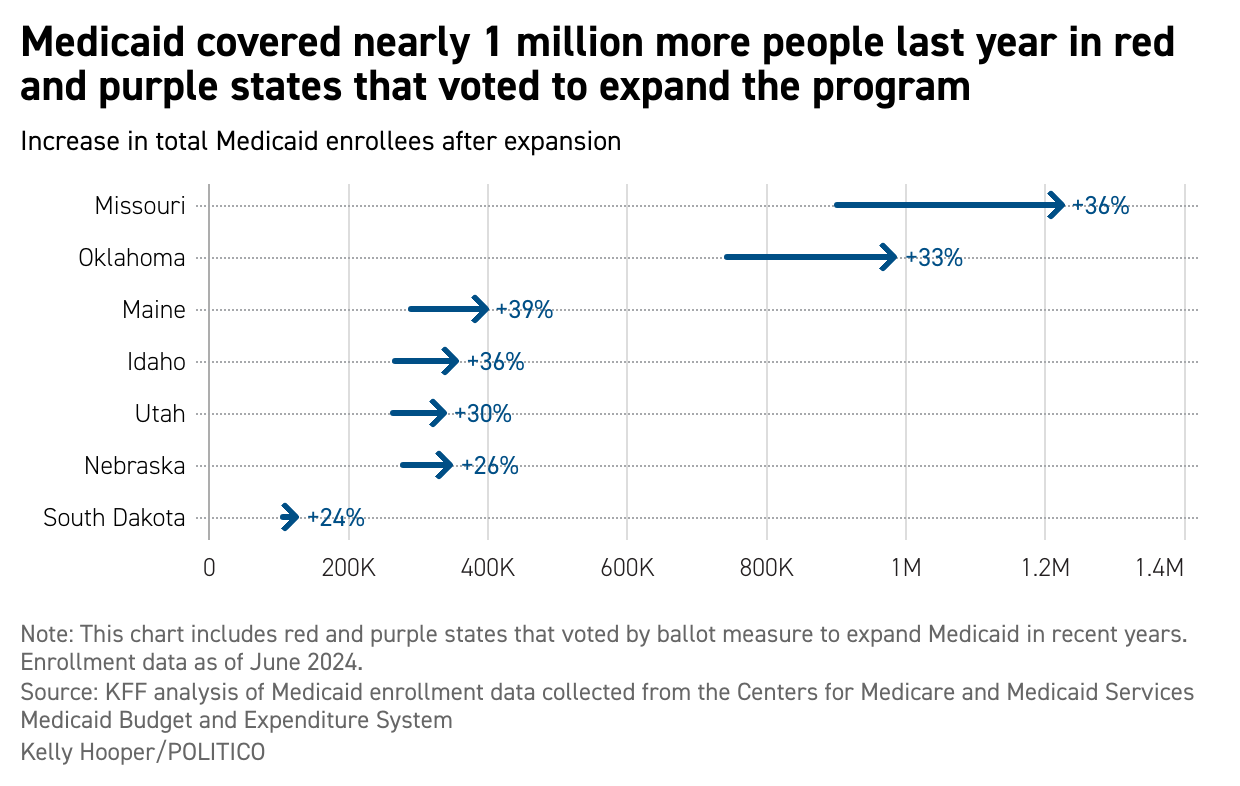
Republicans are facing a nationwide backlash over the fate of Medicaid — but the potential program cuts are most threatening in seven conservative-leaning states where voters have cast ballots to expand the entitlement in recent years.
It’s a growing problem as Republicans hunt for enough savings to pay for the White House’s proposed tax cuts.
Republican Sen. Mike Rounds of South Dakota, which has enrolled more than 24,000 people in Medicaid since voters expanded the insurance program for low-income people in 2022, told Blue Light News he’s been arguing against some of his own party’s proposals. One would reduce significantly how much funding for the program comes from the federal government.
“That’s not a cost cutting measure — that’s a cost transfer,” he said. “And when you’ve got partnerships with the states, you shouldn’t be doing that without having them involved in the discussion.”
Republicans face similar skepticism across red and purple swaths of the country where voters have used ballot initiatives to expand Medicaid since Congress last targeted the safety net health insurance program in 2017 – not only in South Dakota, but also in Idaho, Nebraska, Maine, Oklahoma, Missouri and Utah. President Donald Trump won all of those states except Maine. And even there, he won an electoral vote by defeating Kamala Harris in the state’s 2nd Congressional District, where nearly a third of people are enrolled in Medicaid.
The president’s conflicting guidance to Congress about whether and how much to cut from the program suggests he is aware of the political peril.
Additional states could expand Medicaid in the coming years, making future rollbacks even more challenging. There’s currently a campaign underway in Florida to put expansion on the ballot in 2026, underscoring the popularity of Medicaid even in the most MAGA-friendly states.
“Cutting Medicaid seems to be popular with some Republican elites and some right wing think tanks that are getting funded by some right wing billionaires, but they’re unquestionably not popular with the Republican voters,” Joan Alker, the executive director of the Center for Children and Families at Georgetown University’s McCourt School of Public Policy, told reporters at a briefing on Medicaid this week. “We’ve seen many polls recently asking voters to rank what they wanted … and cutting Medicaid was literally the last on the list for voters of all stripes.”
Coalitions on the ground in the seven states that passed Medicaid expansion initiatives — made up of powerful hospital associations, grassroots advocacy groups and other strange bedfellows — are now re-mobilizing to defend them. They’re sending people to town halls. They’re publishing op-eds in local newspapers. They’re flooding the phone lines of their members of Congress. And they’re mulling a revival of some of the more aggressive tactics activists used to protest attempts to repeal the Affordable Care Act in 2017.
“We’re going back to the old playbook,” said Matt Slonaker, the executive director of the Utah Health Policy Project who spearheaded the state’s ballot initiative campaign in 2018. “It’s always hard to get folks to act, but they seem to be really, really ready to do this right now.”
With pressure mounting to find hundreds of billions in savings, lawmakers who are usually on board with slashing government spending remain on high alert about the blowback they could face in their states over Medicaid. And as they struggle to keep their members united behind Trump’s budget plan, GOP leadership is taking notice.
House Speaker Mike Johnson on Wednesday night backed away from some of the most sweeping changes the GOP had been debating, including capping the funds states get for each Medicaid enrollee and rolling back federal support for expansion states, even as he dismissed outrage his members have recently faced over threatened cuts at fiery town halls across the country as the work of “paid protesters.”
“All this attention is being paid to Medicaid because that’s the Democrats’ talking point,” Johnson said. “We’re talking about finding efficiencies in every program, but not cutting benefits for people who rightly deserve them.”
Pro-expansion health care groups in these seven red and purple states mounted expensive and time-consuming ballot initiative campaigns to circumvent conservative state legislatures and governors who refused to expand Medicaid, and some of those same state officials are currently working to roll back the expanded coverage their constituents enacted.
That’s left Republicans on Capitol Hill from Medicaid-expansion states as the loudest — and in some cases the only — effective voices of opposition to the proposed cuts now that Democrats are locked out of power. And while some House Republicans who represent red districts are feeling the heat, senators will have to answer to their entire state.
“I don’t quite think Republicans know the backlash they’re in for,” said Brad Woodhouse, a former Democratic National Committee official who now runs the progressive health care advocacy group Protect Our Care. “And it’s going to be a particularly bitter pill in these states that have used ballot initiatives because in those cases, the voters have really spoken about their preference.”
Republican Sens. Josh Hawley of Missouri and Susan Collins of Maine — both of whom hail from states that expanded Medicaid by ballot measure — crossed the aisle earlier this week to support a Democratic amendment to the Senate budget resolution that would have blocked tax cuts for the wealthy if any Medicaid funding is cut.
Hawley, who represents about 326,000 people who became eligible for Medicaid under the state’s 2021 expansion, has said he wouldn’t support “severe” cuts to Medicaid — specifically cuts that would lead to reduced benefits — calling it a “red line” for securing his vote.
The politics are especially tricky for representatives of more rural states where Medicaid has been a lifeline for hospitals struggling to keep the lights on — hospitals that in some instances are among the state’s biggest employers.
In Idaho, for example, voters approved expanding Medicaid in 2018 with 61 percent support, extending coverage to about 90,000 more residents. But if federal funding for Medicaid decreases as a result of the current negotiations in Washington, the state legislature has the power to intervene and potentially repeal the expansion. Idaho House Minority Leader Ilana Rubel, a Democrat, is among those warning that such an outcome would threaten the state’s remaining rural hospitals.
“That’s a disaster, not only for the people on Medicaid, but for the people on private insurance,” Rubel said. “Because when you live in these rural areas, you know you can have the best insurance in the world, but if the hospital in your area has gone out of business and you fall off a ladder or have a heart attack, there will be nobody to help you.”
Yet not every Republican from an expansion state is worried about the sweeping reforms hardliners in their caucus are pushing for.
Sen. James Lankford of Oklahoma, where more than 245,000 people became eligible for coverage after the state voted to expand Medicaid in 2020, echoed Speaker Johnson’s argument that the final budget would not impact individuals’ health care benefits and said he hadn’t heard from concerned citizens about it.
“I have not heard anyone talking about cutting off Medicaid to people,” he said. “It has been dealing with formulas. It’s been dealing with fraud.”
Utah Sen. John Curtis told Blue Light News this week that after discussing the matter with Republican Gov. Spencer Cox, he’s not sweating the political implications.
He said he’s “not near as concerned” about cuts to the safety net program as he is “about the fiscal irresponsibility that we’re facing,” adding that he’s “in total harmony with our state leaders on this.”
Medicaid enrollment in Utah grew nearly 60 percent after a ballot measure expanding the program passed in 2018. But Utah is among the nine states that has a “trigger” law in place to automatically end Medicaid expansion or require major changes to the program if federal funds decline, threatening coverage for millions of people.
For Curtis, that’s a feature rather than a bug.
“Our state is one of more fiscally responsible states, in my opinion, and they saw this coming,” he said.


Sen. Chris Murphy wants Democrats to go big for Angie Nixon in Florida’s Senate race — and he’s pushing to raise some “serious money” to help.
“I do believe that we’d make a big mistake if we slept on Florida,” the Connecticut Democrat told Blue Light News on Friday. “I know it feels like a longer shot, but I just think this year is looking exceptional.”
Murphy plans to hit the trail with Nixon as part of a campaign swing for Senate candidates over the next three weeks that will take him through North Carolina and Florida, as well as events with Abdul El-Sayed in Michigan, Peggy Flanagan in Minnesota and Chris Pappas in New Hampshire. Murphy will serve as a surrogate for El-Sayed in the spin room at his next debate, and said he’s “just a big believer” in the Michigan Senate nominee.
Murphy’s bullishness about a blue wave comes as Senate Democrats are pushing the boundaries of a midterm battle map that is shifting further into red territory. The Chuck Schumer-aligned Senate Majority PAC has dropped roughly $5 million apiece into Texas and Kansas over recent days, and the minority leader has included Kansas and Mississippi in his pitches to donors.
“If I were in charge, I would definitely put some resources in Florida,” Murphy said. “When you have an exciting candidate like this, it’s a good long-term investment” in growing Democrats’ activist base.
Still, Murphy stressed he’s “not making any formal recommendations” on where Schumer or top Democratic campaign groups should move their money.
“They’ve got so many mouths to feed,” Murphy said. “That’s why I’m going to try to step up and do some work on my own.”
Murphy, who is considered a potential 2028 presidential contender, has spread roughly $2.5 million across candidates, campaign arms and other organizations this cycle. That includes transferring more than $500,000 to Democrats’ three top campaign arms and 25 state parties.
Prominent Democrats have been ramping up their attention on Florida. Sen. Bernie Sanders (I-Vt.) has funneled $250,000 toward Nixon’s campaign, along with other resources. Sen. Ruben Gallego (D-Ariz.) also told Blue Light News he hopes to campaign with Nixon.
But Democrats across suddenly competitive red states are clamoring for more cash and Florida is an expensive state, complicating the chances of a significant investment from national groups.
Nixon also faces an uphill battle against GOP Sen. Ashley Moody in the Sunshine State. A progressive state lawmaker, Nixon aligned herself with the Democratic Socialists of America over the summer in a state where many voters, especially those with ties to Cuba, reject such an ideology. Also, Republicans in Florida have a 1.5 million voter registration advantage over Democrats.
Senate Democrats’ top super PAC is pushing into Kansas.
The Chuck Schumer-aligned Senate Majority PAC is launching a $5 million statewide television ad blitz starting Saturday through Election Day — the latest sign that Democrats believe the Senate map is shifting onto red turf.
SMP had signaled in recent days it could get involved in the race, telling Blue Light News late last month it was “actively thinking” about whether to wade into the state where Democrats haven’t won a Senate seat in nearly a century but where Adam Hamilton narrowly leads GOP Sen. Roger Marshall in recent polls. Internal SMP polling that found an increasingly competitive race factored into the group’s decision to spend. It will also run digital ads.
“The gap is closing in Kansas,” SMP spokesperson Lauren French said in a statement. “We are committed to ensuring families understand Marshall’s real record of making health care and basic goods more expensive for working Kansans.”
Republicans are scrambling to shore up Marshall. Senate Leadership Fund, a top GOP super PAC aligned with Republican leadership, has booked over $10 million in ads through Election Day in the state, per ad tracking firm AdImpact.
SMP’s first ad attacks Marshall for joining Senate Republicans in voting to table a Democratic-led amendment last year to release the Jeffrey Epstein files. The Senate later approved legislation to release the files by unanimous consent. It’s the latest in a slate of ads from Democrats hitting their Republican rivals over the late, disgraced financier and convicted sex offender. Marshall’s campaign did not immediately respond to a request for comment.
Senate Democrats’ plunge into the state comes as the midterm battle map is undergoing a major realignment. Georgia and North Carolina — primed to be two of the cycle’s premiere battlegrounds — are tilting left to the point where national Republicans are retracting spending in both states and Democrats are starting to follow suit, freeing funds on both sides to shift elsewhere.
Republicans are racing to reinforce incumbents across what was once safer red turf. SLF has also pledged $5 million to bolster Sen. Darline Graham in South Carolina.
Democrats, meanwhile, are starting to spend more in red states. SMP has dropped over $2 million on digital ads in Texas. Schumer, the Senate minority leader, has included Kansas and Mississippi in his pitches to donors.
The Democratic Congressional Campaign Committee is begging for resources, and setting a hard deadline for donors to give $17 million in order to compete in a handful of districts that Republicans carried easily in 2024.
DCCC Executive Director Julie Merz said the committee needs the cash influx by Oct. 22 in order to “to take advantage of the opportunities we have” outside of the core battlefield, according to a memo shared with donors on Friday and obtained by POLITICO.
If they don’t pony up, Merz warns, the party “could be leaving winnable races on the table.”
Democrats have been clear that they have a fundraising disadvantage this cycle, but they have so far been reluctant to place a specific dollar amount on their needs, making the DCCC’s memo Friday a particularly surprising outlier.
“Here’s the tough reality though: the Republican ecosystem has amassed a massive war chest that is significantly greater than ours and is spending it,” Merz says in the memo after arguing that the members of the committee “remain confident that we will win back the majority in 25 days.”
Specifically, Merz dedicates significant portions of the memo to four districts where the committee is desperate for more money in order to compete — all of which President Donald Trump won by double-digit margins in 2024:
— Florida’s 27th District (Trump +14.6)
— Nevada’s 2nd District (Trump +13.9)
— South Carolina’s 1st District (Trump +13)
— New York’s 21st District (Trump +20.7)
The fundraising disadvantage has created headaches for both House and Senate Democrats over where, exactly, to deploy the resources they do have.
The committee tells donors that their internal polling shows all of those races within reach, but that Republicans’ big cash advantages — especially in the Trump-aligned super PAC MAGA Inc. — will make it harder to win those and other reach seats.
Merz also name drops a handful of other deep-red districts that are “worthy of additional investment in this environment,” including seats held by GOP Reps. French Hill (R-Ark.) and Richard Hudson (R-N.C.), the chair of the Republican National Congressional Committee.
The NRCC was quick to mock the DCCC’s memo.
“No amount of money fixes candidates voters don’t want. These seats are staying red, and Republicans are on offense across the map,” NRCC spokesperson Mike Marinella said in a statement.
- Chris Murphy plans midterm travel blitz, fundraising for Nixon in Florida
- Democrats drop $5M into Kansas Senate race
- House Democratic campaign arm says it needs $17 million, and fast
- Hegseth faces bipartisan backlash over public execution for Fort Hood shooter
- Capitol agenda: How Warren could link arms with Trump’s GOP
- Even some Republicans want this watchdog agency to sue Trump
- Grassley slams Democrats for ‘falling over themselves’ to defend Jack Smith
- This watchdog can bark. Congress wants it to bite.
- Byron Donalds says he is not a ‘yes man’ to Trump

- Mike Rogers opens the door for AIPAC support in Michigan Senate race
-

 Politics2 years ago
Former ‘Squad’ members launching ‘Bowman and Bush’ YouTube show
-
Uncategorized2 years ago
Bob Good to step down as Freedom Caucus chair this week
-

 The Josh Fourrier Show2 years ago
DOOMSDAY: Trump won, now what?
-

 The Dictatorship2 years ago
Pete Hegseth’s tenure at the Pentagon goes from bad to worse
-

 Politics2 years ago
Former Kentucky AG Daniel Cameron launches Senate bid
-

 The Dictatorship2 years ago
Luigi Mangione acknowledges public support in first official statement since arrest
-

 Politics2 years ago
Blue Light News’s Editorial Director Ryan Hutchins speaks at Blue Light News’s 2025 Governors Summit
-

 The Dictatorship1 year ago
Mike Johnson sums up the GOP’s arrogant position on military occupation with two words