
Congress
House Republicans shoot down possible housing-crypto trade with Senate

House Republicans are rejecting the prospect of accepting a Senate housing package in exchange for the upper chamber including a slate of community bank deregulatory bills in pending cryptocurrency legislation, dashing hopes that the trade could resolve a housing bill standoff between the two bodies.
“So our good stuff for their bad stuff — not sure I buy that,” said Rep. Bill Huizenga (R-Mich.), who serves as vice chair of the House Financial Services Committee.
Senate Banking Republicans discussed the possible trade at a closed-door meeting last week. Sen. Katie Britt, an Alabama Republican who chairs a Senate Banking subcommittee on housing, helped pitch the idea to other GOP senators. But House lawmakers say adding their bipartisan banking bills to the crypto market structure measure is not enough to get them to swallow a Senate-approved housing affordability package that they hope to amend.
“There’s other things in the housing bill that we need to look at,” said Rep. Mike Flood (R-Neb.), who chairs a House Financial Services subcommittee on housing.
A spokesperson for Senate Banking Chair Tim Scott did not immediately respond to a request for comment. Scott and Senate Banking ranking member Elizabeth Warren (D-Mass.) are pushing the House to accept their bill as-is.
The House included the community bank deregulatory measures in a housing bill it passed in February, but the provisions were left out of the housing measure that the Senate passed this month. The banking bills, which supporters say will increase access to mortgages, are a priority for House Republicans, but they say they have an array of outstanding issues with the Senate’s housing bill that need to be addressed.
“This needs to be part of a conversation,” said Rep. Zach Nunn (R-Iowa), who sits on House Financial Services. “Simply throwing something over from the Senate and expecting everybody to get on board with a half-baked idea doesn’t get us to where we need to be.”
Rep. Andy Barr, a senior Kentucky Republican on House Financial Services who is running for Senate, indicated he likes the idea of tucking bank deregulatory measures into the crypto legislation. But, he said, “we want some of our housing ideas included, too.”
“I don’t know why they wouldn’t entertain some of our bipartisan housing ideas,” he said.
Katherine Hapgood contributed to this report.


Congress
Ralph Norman under pressure from fellow South Carolina Republicans to campaign for Darline Graham
Rep. Russell Fry says fellow South Carolina Republican Rep. Ralph Norman should be doing more to help GOP Sen. Darline Graham win election to a full term in the Senate.
“As somebody who carried the conservative banner as long as he has, he should step into the arena,” Fry told reporters at a Monday campaign event in Myrtle Beach. “He didn’t win. I didn’t win either.”
Fry and Norman both competed against Graham in the Republican primary to be on the November ballot. Norman advanced to a runoff with Graham, who was appointed by Gov. Henry McMaster to fill out the remainder her late brother’s term and ultimately endorsed by President Donald Trump.
Now Graham is locked in a closer-than-expected race against Democratic nominee Annie Andrews, prompting national Republicans to flock to defend what is typically considered a safely red seat. Norman, who enjoys deep popularity among conservatives, said he plans to vote for Graham but not campaign with her.
Fry, appearing at an event Monday alongside House Judiciary Chair Jim Jordan (R-Ohio), described Andrews as “a far more dangerous result for the future of this country” and urged Norman to be “more vocal” in the last week before the midterms.
“I hope that he does, in the final eight days, step into the sunlight a little bit and help his Republican nominee,” Fry said.
Trump is expected to hold a rally in Norman’s district Thursday. A spokesperson for Norman did not immediately respond to a request for comment.
House Republicans will choose their leaders for the upcoming Congress on Nov. 10, one week after Election Day, according to a schedule obtained by Blue Light News.
A two-hour candidate forum is scheduled for that morning, with the afternoon reserved for the elections of a leader, whip, conference chair and other junior positions. If Republicans can hold on to their narrow majority, members will also nominate a speaker ahead of the Jan. 3 floor vote.
Members have until noon Nov. 6 to declare their candidacy for a leadership post, according to the schedule.
A forum and session on the GOP conference rules will follow on Nov. 11, with elections on those rules and the makeup of the conference steering committee to follow on the morning of Nov. 12. All of the events are scheduled to take place in the Capitol Visitor Center Auditorium.
Arizona Sen. Ruben Gallego has been banging the drum for Democrats to pay attention to the disenfranchised, working-class moderate Latino voters that helped push him to a statewide win in 2024 — the same bloc that helped boost President Donald Trump back to the White House.
Gallego has carved a lane as one of the party’s loudest voices on the future of the Latino coalition. He hasn’t shied away from carrying that message everywhere — and it’s one that could serve his admitted 2028 ambitions well.
Now Gallego’s kicking off a final push across several key gubernatorial and House battlegrounds, according to details shared exclusively with Blue Light News. And he’s tracing a map of where Latino voters could be most critical for Democrats’ path back to power.
“They’ve been left behind in the past by Democrats,” Gallego said in an interview. “Now they feel they’re left behind by Donald Trump.”
Gallego is heading to Las Vegas on Monday to campaign with Democrat Aaron Ford, one of the party’s top targets to flip a governor’s seat. Nevada’s a state where Latinos make up nearly 1 in 5 voters, with working-class roots and the major influence of groups like the Culinary Union — not to mention a key presidential swing state and an early one on the Democratic nominating calendar.
Gallego’s planning a canvass launch with the Culinary Union, a hit on Spanish radio and a roundtable with Latino veterans. On Tuesday, Gallego will be in Reno alongside Democrat Teresa Benitez-Thompson, who’s looking to beat Republican David Flippo in Nevada’s 2nd.
On Wednesday, the senator plans to travel to San Antonio to support Katy Padilla Stout in Texas’ vacant 23rd District, the red rural seat formerly occupied by GOP Rep. Tony Gonzales, and then to El Paso for his second appearance this cycle with Democratic gubernatorial hopeful Gina Hinojosa.
Rounding out the critical Latino voter races, Gallego’s final stop Thursday will be in Miami, stumping for Democrat Eliott Rodriguez, who’s taking on GOP Rep. Maria Elvira Salazar.
Gallego wants to build on the momentum from last year’s Miami mayor’s race, which he said showed Democrats could regain ground with Latinos, along with Virginia and New Jersey’s gubernatorial contests. “There was just this knee-jerk reaction that somehow the Latinos were responsible for 2024, and therefore we shouldn’t reward them with any type of investment,” Gallego said. But after those race results came in, “people finally realized like, ‘Oh God, there is something there.’”
Is this a kickstarter for Gallego’s own future?
The senator dodged on whether his final midterms swing is laying the groundwork for a 2028 bid. “We’re only focused on 2026,” he said. But he’s touting the more than half a million dollars he’s put behind Democratic candidates and committees, and Gallego’s visits will directly follow Trump’s rally in south Texas tomorrow and his planned trip to Florida later this week.
- Ralph Norman under pressure from fellow South Carolina Republicans to campaign for Darline Graham
- Blakeman’s bank statements don’t match his disclosure reports
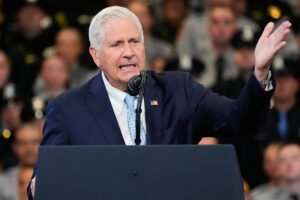
- House Republicans set leadership elections
- Raskin warns oil industry against Trump’s Russian diesel deal
- Gallego plans final midterm travel around Latino enclaves
- Asian voters are swinging toward Talarico in Texas. Dems still say more outreach is needed.
- Jeffries edges closer to Hegseth impeachment as he eyes the gavel
- Why Dems’ late House reaches don’t usually pan out
- The Epstein election?

- ‘We don’t need 50 more data centers.’ Arizona AG declares war on AI.
-

 Politics2 years ago
Former ‘Squad’ members launching ‘Bowman and Bush’ YouTube show
-
Uncategorized2 years ago
Bob Good to step down as Freedom Caucus chair this week
-

 The Josh Fourrier Show2 years ago
DOOMSDAY: Trump won, now what?
-

 The Dictatorship2 years ago
Pete Hegseth’s tenure at the Pentagon goes from bad to worse
-

 Politics2 years ago
Former Kentucky AG Daniel Cameron launches Senate bid
-

 Politics1 year ago
John Legend advises Trump to drop the ‘dictator s‑‑‑’ if he wants Nobel Peace Prize
-

 The Dictatorship2 years ago
Luigi Mangione acknowledges public support in first official statement since arrest
-

 Politics2 years ago
Blue Light News’s Editorial Director Ryan Hutchins speaks at Blue Light News’s 2025 Governors Summit