
Congress
House repeals Middle East war laws

A bipartisan coalition of lawmakers voted to repeal the decadesold laws that authorized the U.S. to go to war in the Middle East.
Lawmakers, in a 261-167 vote, approved an amendment to major defense legislation that would rescind the war powers laws — which passed in the run-up to the 2003 invasion of Iraq and the 1991 Gulf War.
The vote is a small win for war powers advocates, who contend the laws need to go to prevent abuses of presidential power and reclaim Congress’ authority over use of the military.
But the House defense bill won’t address broader concerns that President Donald Trump is freely wielding military force, including a strike last week on a suspected drug-smuggling vessel in the Caribbean.
The rollback will tower over negotiations between the House and Senate on a compromise defense policy bill. Both chambers have voted to repeal the Iraq War authorization in recent years under Democratic leadership, although no legislation has ever been enacted.
The amendment — sponsored by conservative Rep. Chip Roy (R-Texas) and House Foreign Affairs ranking member Gregory Meeks (D-N.Y.), along with other lawmakers in both parties — won the support of 49 Republicans and 212 Democrats.
The measure had an unlikely path to passage. The proposal was initially left out of a package of amendments to the defense bill proposed by the House Rules Committee. But Democrats won an incredibly rare vote in the committee to secure a debate on it. Reps. Ralph Norman (R-S.C.), Morgan Griffith (R-Va.) and Roy broke ranks with fellow Republicans to help make it possible.
“We don’t need to have Congress effectively modern-day declaring war and leaving it in place for a quarter of a freaking century, or in this case, 34 years,” Roy said. “We can do better.”
Meeks hinted at a future struggle in negotiations with the Senate, saying he was “prepared to fight … to get this over the finish line.”
Opponents of repealing the laws warned of unintended consequences. Rep. Joe Wilson (R-Fla.) argued doing so “would tie the president’s hands in going after Iranian puppet militias in Iraq.”
The House is expected to pass the bill Wednesday. But Republicans will likely do so largely on their own after adopting a series of culture war amendments that House Democrats warned they won’t support.


Sen. Bernie Sanders will hit the road for Troy Jackson in Maine starting Oct. 10, the first time the progressive leader will stump for the candidate this cycle.
The Vermont independent plans to hold three rallies with Jackson, according to an itinerary shared first with Blue Light News: first in Bangor on Oct. 10th followed by Lewiston and Biddeford on Oct. 11.
The Maine swing will kick off Sanders’ travel for the final stretch of the midterms, covering ground throughout October for House and Senate candidates, POLITICO reported.
“Bernie and Troy know that working people built this country and deserve a government that fights for them,” Jackson spokesperson Dan Gottlieb told Blue Light News. “Susan Collins has had nearly 30 years to deliver, and working Mainers are still getting squeezed while she serves the billionaires and corporate interests who bankroll her campaigns. Mainers don’t need another six years of excuses.”
Sanders campaigned ahead of major wins for progressives in the primary season, speaking at more than 60 rallies since last year’s Fight the Oligarchy tour and endorsing more than 90 candidates up and down the ballot.
He’s also opening his substantial $23 million campaign war chest, POLITICO reported, and contributing hundreds of thousands of dollars toMinnesota Lt. Gov. Peggy Flanagan’s Senate campaign and others including Angie Nixon in Florida and Minnesota Attorney General Keith Ellison,
Sanders will return to Maine after initially backing Graham Platner’s campaign for Senate. Allegations reported by POLITICO ultimately led him to call on the Democratic nominee to drop out of the race.
Sanders had not formally endorsed Jackson since he clinched the nomination from Platner, though he previously backed Jackson’s initial run for governor.
House Financial Services Chair French Hill said he has “no concerns” about winning back his Arkansas seat in the upcoming midterm elections, but the six-term House member acknowledged the political headwinds for his party.
“I consider the atmosphere a very tough political environment right now because of President [Donald] Trump’s lack of favorability at the top, and you know people are concerned about, as I say, what it’s like to live under an inflated economy the last four years,” Hill said in an interview.
Hill is in a solidly red district, according to the nonpartisan Cook Political Report, and said he is up against a “weaker candidate this time than I’ve had in past races.” Polling in the district, however, has shown a tighter race. The two polls done this year placed Democratic challenger Chris Jones ahead of Hill by a few percentage points. Any perceived polling victory for Jones is still well within the margin of error, and one of the polls had a Democratic sponsor.
Stephannie Lane Baker, a spokesperson for Jones, said that “of all the Republicans in Congress, the chairman of the Financial Services Committee doesn’t get to dodge responsibility for this economy. He’s in trouble, and he knows it.”
Additionally, Illinois Gov. JB Pritzker’s PAC, Ready for the Fight, committed more than $1 million in television ads through the next five weeks for Jones’ race in Arkansas’s 2nd District, Jordan Abudayyeh, a spokesperson for the PAC confirmed. Overall Democratic spending on advertising for the race was just over $1 million, primarily made up by contributions from the Ready for the Fight PAC, with Republicans spending almost $2.7 million on ad buys, according to AdImpact, an advertising tracking service.
Hill said he has addressed affordability concerns “head on” this Congress.
“My work on housing, my work on the Price Stability Act, my work to try to reduce waste, fraud, and abuse, and drop the federal budget deficit as a percentage of GDP,” Hill said. “All these things can contribute to a more affordable environment for people. So I’ve tried to make that a forefront of my campaign this year.”
Hill was a key architect of the 21st Century ROAD to Housing Act, a bipartisan housing affordability bill that became law in July. The Price Stability Act, which is unlikely to become law this year, would narrow the Federal Reserve’s current dual mandate of pursuing maximum employment and price stability to focus exclusively on containing inflation.
Rep. Alexandria Ocasio-Cortez (D-N.Y.) and Sens. Bernie Sanders (I-Vt.) and Jeff Merkley (D-Ore.) on Friday released text of legislation intended to ban the use of Flock surveillance cameras and other license plate readers.
Flock has faced severe public backlash against the surveillance technology following reports that police officers misused the technology to track women, and it has the largest network of license plate readers across the U.S. Sens. Josh Hawley (R-Mo.) and Dick Durbin (D-Ill.) hosted a hearing last month probing its potential misuses, although the company’s CEO Garrett Langley did not appear.
The latest bill, unveiled Friday and named the Ban Flock Act, would bar federal agencies from using automated license plate readers or accessing data from the technology and prevent federal grants from funding states and local governments that use automated license plate readers.
“At a time of growing concern about the unchecked power of artificial intelligence, Flock is eviscerating the very notion of privacy by installing tens of thousands of cameras in communities across America without their consent,” Sanders, who has positioned himself as a leading progressive voice on AI technology, said in a statement. “We cannot allow America to become a surveillance state where a handful of AI oligarchs profit by giving the government the power to track our every movement.”
Ocasio-Cortez similarly condemned the surveillance capabilities of the technology and said the bill would “enforce our constitutional right to privacy and protect Americans from both corporate and government surveillance.”
“No one should have this unchecked surveillance power at their fingertips,” Merkley added.
Republicans have introduced similar efforts to regulate license plate readers, such as Hawley’s Stop Flock Abuse Act, which would require audits and limits on unauthorized searches.
Flock did not immediately respond to a request for comment.
- Trump rules out diesel export ban after Europe agrees to tap stockpiles
- Sanders to rally for Troy Jackson in Maine
- Hill: Trump’s ‘lack of favorability’ creating challenging politics
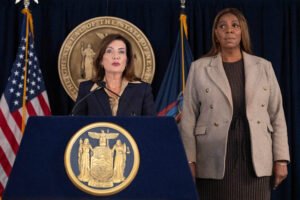
- Hochul eyes changes to state’s rape law amid Cornell crisis
- Kansas becomes a surprise Senate battleground
- Musk-led war commission triggers alarms in Pentagon
- ‘Blackmail’: Europe fumes against White House demand for more diesel
- Top GOP groups scale back North Carolina spending
- October
- Sanders, AOC, Merkley propose bill to ban Flock cameras
-

 Politics2 years ago
Former ‘Squad’ members launching ‘Bowman and Bush’ YouTube show
-
Uncategorized2 years ago
Bob Good to step down as Freedom Caucus chair this week
-

 The Josh Fourrier Show2 years ago
DOOMSDAY: Trump won, now what?
-

 Politics2 years ago
Former Kentucky AG Daniel Cameron launches Senate bid
-

 The Dictatorship2 years ago
Pete Hegseth’s tenure at the Pentagon goes from bad to worse
-

 The Dictatorship2 years ago
Luigi Mangione acknowledges public support in first official statement since arrest
-

 Politics2 years ago
Blue Light News’s Editorial Director Ryan Hutchins speaks at Blue Light News’s 2025 Governors Summit
-

 The Dictatorship1 year ago
Mike Johnson sums up the GOP’s arrogant position on military occupation with two words