
Politics
Hochul’s Dear Tom letter


DAYS THE BUDGET IS LATE: 30
ICE WATCH: Gov. Kathy Hochul wants assurances from President Donald Trump’s administration that a very specific federal immigration officer isn’t operating in New York: The ICE agent who fatally shot Renee Good.
The Democratic governor sent a letter this week to Trump border czar Tom Homan insisting he confirm whether the reportedly redeployed agent, Jonathan Ross, is now working in the Empire State.
“If Jonathan Ross has been reassigned to work in New York, I demand that he be immediately removed and not redeployed unless cleared after a full, independent investigation,” Hochul wrote in the previously unreported letter. “I have no confidence that Ross can be trusted to safely interact with the public. Nor should you.”
The White House did not immediately respond to a request for comment.
The notice is the latest effort by Hochul to place guardrails around Trump’s sweeping deportation policies — a push that includes direct White House outreach and expected legislative action to limit the reach of federal immigration agencies like ICE.
The two-track approach underscores how New York officials, including the governor, have been desperate to avoid a potentially destabilizing surge of federal immigration officers in the five boroughs, home to an estimated 560,000 undocumented immigrants.
The push also highlights how Hochul stands to benefit politically from taking an assertive posture against Trump’s immigration policies as she runs for reelection. The president rode back to the White House pledging to remove millions of people living illegally in the United States, only for voter support to quickly erode following the deaths of Good and Alex Pretti during January’s Minnesota crackdown.
A Siena University poll in February found 67 percent of New York voters believe federal immigration tactics had gone too far. The same survey found 59 percent of voters did not want to see more ICE agents flow into New York City.
Trump has dialed back the publicly aggressive deportation effort, but that’s done little to assuage the Hochul administration. The February death of Nurul Amin Shah Alam, a blind refugee who was left in front of a Buffalo coffee shop by federal agents, further inflamed New York officials.
“I have repeatedly stated that any agents involved in these types of incidents must be properly investigated and held accountable to the fullest extent of the law — not simply reassigned to administrative or investigative duties or shuffled to other states,” Hochul wrote in the letter.
Homan, who has become the Trump administration’s blue state ambassador following the deadly unrest in Minneapolis, met privately with her in Albany last month, and the governor urged him to not conduct a similar operation in the Big Apple.
To that end, Hochul and Democratic state lawmakers are also on the verge of approving a package of sanctuary-like measures meant to erect legal barriers around federal immigration enforcement in New York.
The measures would prohibit federal authorities from carrying out civil deportation warrants in sensitive locations like education facilities and houses of worship. It would also ban formal agreements between agencies like ICE and local police departments from coordinating operations and sharing equipment. And New York is poised to make it easier to sue federal officers if a person believes their constitutional rights have been violated.
The expected package of protections amounts to a sweeping blue state rebuke of Trump’s immigration and deportation policies. It also marks a change for Hochul, a moderate who as a local official two decades ago opposed allowing undocumented immigrants to obtain state driver’s licenses.
Yet some left-leaning state lawmakers worry that Hochul’s opposition to a strict ban on local police communicating with federal immigration authorities will leave undocumented immigrants exposed even as existing sanctuary protections will remain in place.
One legislator, granted anonymity to speak frankly, said the likely agreement is “really inadequate, arguably harmful, because her proposal would create an illusion of legal protections while still proactively permitting law enforcement to share info.” — Nick Reisman
FROM CITY HALL

FARE-LY AUTOMATIC: A majority of City Council members are pushing Mayor Zohran Mamdani’s administration to automatically enroll low-income New Yorkers in the city’s transit discount program.
Currently, New Yorkers need to furnish proof of identity, age, residence and taxable income to enroll in Fair Fares, which offers a 50 percent discount on subway, bus and paratransit rides for those at or below 150 percent of the federal poverty level.
In a Wednesday letter to Erin Dalton, Mamdani’s social services commissioner, 28 of the Council’s 51 members wrote that the application requirements needlessly keep people out of the program.
The letter, obtained by Playbook, says only about 370,000 of the city’s 1.4 million eligible residents benefit from Fair Faires, largely because many don’t know of its existence.
The city lawmakers, led by progressive Council Member Crystal Hudson, wrote to Dalton that the disparity can be fixed by automatically enrolling all eligible residents by using application information they’ve already provided while applying for SNAP, Cash Assistance, Medicaid and other city-administered public benefits.
“The City of New York has the information on hand and could easily enact automatic enrollment,” wrote the Council members, who included democratic socialist allies of the mayor like Tiffany Cabán and more moderate colleagues like Eric Dinowitz.
“Affordability is a top concern for New York City residents, and one in five New Yorkers struggles to pay the fare,” the lawmakers also wrote. “In short, we can help lower costs for New Yorkers by making it easier to enroll in the Fair Fares program.”
Asked about the letter, Mamdani spokesperson Dora Pekec said Thursday that the administration is “reviewing the automatic Fair Fares enrollment proposal.”
“The mayor remains deeply committed to collaborating with our city and state partners to make transit more affordable for all New Yorkers,” Pekec said.
Mamdani campaigned last year on a promise to eliminate fares on city buses so riding them would become completely free. But he acknowledged in an interview with POLITICO earlier this month that he won’t be able to make good on that pledge this year.
In the meantime, transportation advocates are ramping up pressure on him to find other ways to make transit more affordable. The letter from the Council members comes after a coalition of transit advocates earlier this month called on the mayor to usher in automatic Fair Fares enrollment.
Such a measure would likely come with a cost increase for the city-funded program. And that could prove tricky for Mamdani, who’s scrambling to address a multibillion-dollar city budget deficit.
Council Speaker Julie Menin, who’s in negotiations with Mamdani on the budget, did not sign Wednesday’s letter. “She doesn’t always sign on to colleague letters as speaker, but she is on record supporting automatic enrollment for Fair Fares,” her spokesperson Henry Robins said. — Chris Sommerfeldt
PIED-À-TERREABLE MATH: City Comptroller Mark Levine released a reality check for the mayor and governor, who are hoping to raise $500 million annually through a pied-à-terre tax to help the city’s ailing budget.
Levine found by using past proposals as a rubric that the tax would only reach those heights under the most ideal of scenarios. When factoring in otherwise eligible properties that are rentals — meaning they would be exempt — and pied-à-terre owners who would either sell or rent to avoid the tax, the yearly take-home for the city would be between $340 million to $380 million.
“As we continue to work toward budget agreements at the City and State levels, it’s imperative that government leaders, advocates and New Yorkers know how major new revenue proposals might reliably impact our budget,” Levine said in a statement.
The mayor’s office countered that the proposal is not yet fully baked, and that it will be designed in concert with the governor in a way that ensures it nets at least $500 million.
“The Comptroller’s report makes one thing very clear: thoughtfully crafting and implementing this legislation will do exactly that,” a spokesperson said. — Joe Anuta
VOUCHER FIGHT: Menin is playing to both sides of the debate over the costly rental subsidy known as CityFHEPS.
She joined advocates and Council members at a rally Thursday morning to urge Mamdani to drop a lawsuit fighting a voucher expansion — which the mayor pledged to do on the campaign trail. But Menin also agreed the costs “are not sustainable” and said a settlement the council has offered will contain them, while still expanding the program in some form.
“We have come in, with the leadership of Council member [Pierina] Sanchez and the advocates, with a responsible, reasonable settlement,” Menin said at the rally, where Council members and advocates chanted, “Mayor Mamdani, keep your promise!”
Menin declined to elaborate on the specifics of the settlement proposal since talks are ongoing.
The vouchers are already growing in cost at a rate of 4 percent per month, and the laws to expand eligibility — which the Council approved in 2023 — are estimated to increase costs further by somewhere between $6 and $22 billion over five years, according to the city comptroller’s office.
“We do agree that there has to be a change to the cost structure,” Menin told reporters at a press conference later Thursday. “We have been working very closely with the advocates on that. We have put forward a reasonable settlement, which is why we believe that continuing to litigate delays our ability to reach the settlement.”
Hochul has reportedly asked the mayor to look at the rental subsidies as one place where the city can find savings. Asked whether she’s spoken to the governor about the program, Menin said “she and I both agree we need to have cost containment.”
“We recognize the cost has grown exponentially,” Menin said. “I think we’re in a very good place on cost containment that literally contains the cost but also protects vulnerable New Yorkers.”
Mamdani has argued that if the city were to drop its appeal, it would be on the hook for billions in additional costs over just the next few years.
“Mayor Mamdani has been clear that CityFHEPS is an invaluable tool to prevent homelessness and support homeless New Yorkers,” City Hall spokesperson Matt Rauschenbach said in a statement on Thursday’s rally. “That is why our team is working hard to ensure that it is fiscally sound and sustainable for the long-term.” — Janaki Chadha and Gelila Negesse
IN OTHER NEWS
— COMMUNITY SAFETY: Advocates are worried Mamdani’s police reform efforts in cases involving mentally ill people may sideline the anti-domestic violence office at City Hall. (The New York Times)
— BOARD OF REJECTIONS: A candidate for an Albany assembly district seat is contesting the state election board’s decision to reject his bid after he was disqualified for allegedly failing to meet residency and party enrollment requirements. (Times Union)
— BEHIND THE BARS: New York state prisons are seeing a sharp rise in violence with staff and incarcerated people both sounding the alarm of increased assault rates. (NY 1)
Missed this morning’s New York Playbook? We forgive you. Read it here.


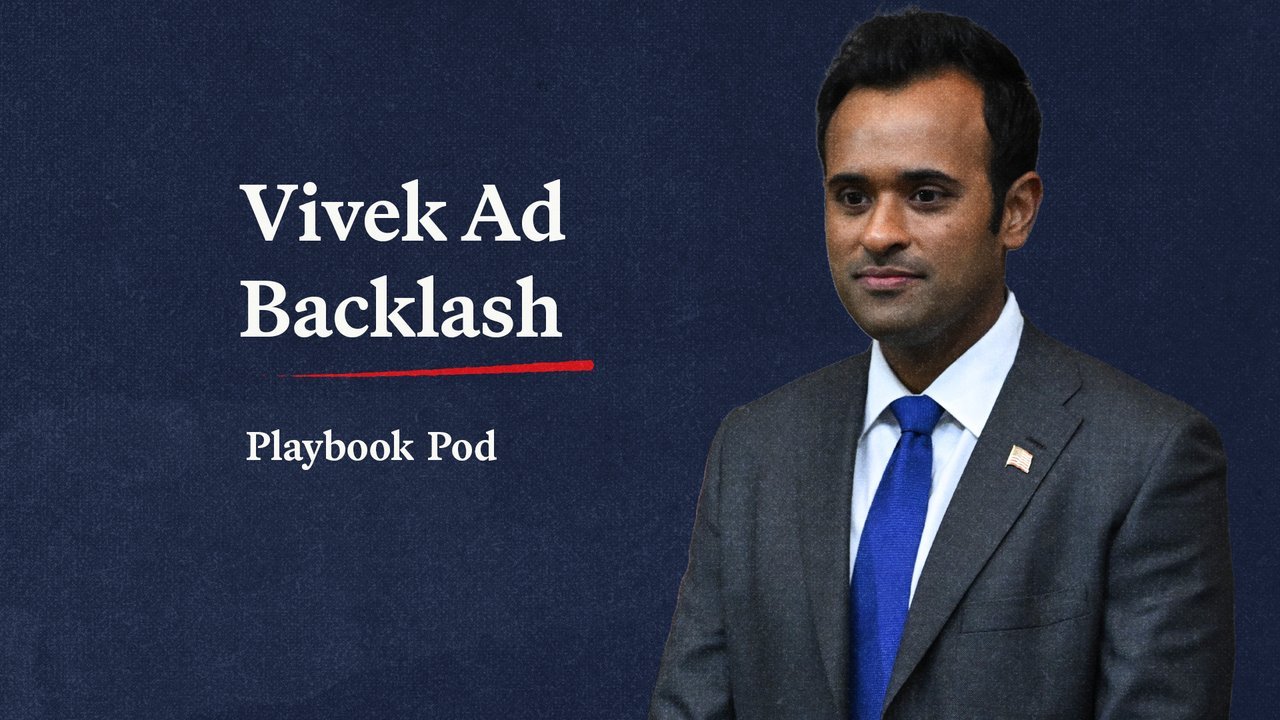
The GOP has a midterm messaging problem. Ramaswamy isn’t helping
lead image
Republicans are banking on a massive cash edge to help save their majority in Congress. But they are losing much of that advantage in an important arena: broadcast TV ads.
Republicans have spent $677 million on those ads across 10 key Senate battleground states, compared to $479 million by the Democrats. But the GOP’s money isn’t going nearly as far because they’re more dependent on outside groups that pay much higher rates than candidates.
The disparity has helped Democrats stay in the fight for Senate control amid an onslaught of GOP outside spending.
In Ohio’s Senate race, Republican groups make up 63% of the $218 million spent. But in spite of their nearly two-to-one spending advantage, they make up just over half of ads that are on the airwaves, according to data from the tracking service AdImpact. In Texas, Republicans have outspent Democrats by a three-to-one margin, but have aired just 58% of the ads. And in Michigan, the GOP accounts for 60% of the spending but just over half of the ads.
A large part of this discrepancy comes down to the mechanics of broadcast advertising. Candidates, and now political parties thanks to a recent Supreme Court ruling, are entitled to significantly lower rates. That has allowed Democratic candidates — who have posted bonkers fundraising hauls — to offset much of the GOP advantage in super PACs. Republican Senate candidates, on the other hand, struggled overall with their fundraising. And some GOP outside groups bought their ad time later, when it was even more expensive.
“There are limitations to the impact of ‘big money’ in politics,” said Sean Cooksey, a Republican former FEC commissioner. “It’s a good demonstration of the economics of campaign fundraising. Hard dollars really just go so much further.”
The disparity also shows “the Republican overreliance on outside groups,” said Ian Russell, a Democratic admaker.
“You get an eye-popping dollar amount, but it doesn’t actually translate into as many spots as you would think relative to a well-financed candidate,” Russell said. “[Republicans] were just hoping that they could spend their way out of everything that was going wrong for them. But the problem is, their issues run much deeper than a few ad buys can fix. Especially when you’ve got monster fundraising hauls from the Democratic side.”
Republicans in House and Senate races have long been more dependent on outside groups and megadonors, and for multiple cycles have seen their cash advantage undercut by fundraising strength from individual Democratic candidates. But that trend is particularly pronounced this year given the combination of Republican super PAC money and their candidates’ struggles.
In 2024, Republican outside groups spent only about 15% more than Democrats on TV ads across House and Senate general election contests, according to a Blue Light News analysis of AdImpact data. This cycle, GOP outside groups have spent 7% more.
In a few states, the discrepancy between dollars and airtime is less stark. Republicans account for 60% of the spending in Maine’s Senate race and an equal percentage of the ads, according to AdImpact. That’s in part because Sen. Susan Collins has outraised her Democratic opponent Troy Jackson over the whole cycle, although Jackson, who didn’t launch his campaign until July, raised far more in the third quarter.
The numbers show the shifting dynamics of campaign strategy after the Supreme Court opened the floodgates to more spending from parties by granting them the lower advertising rate.
Republicans have been faster to take advantage of the new rules: Major coordinated spending efforts from the NRSC and RNC have helped their side significantly this cycle.
Republicans have far outspent Democrats on Senate party-coordinated Senate advertising, $90 million to $34.6 million across TV, radio and digital ads, according to data from AdImpact.
“If I were the leader of either party, I would say you shouldn’t give a dollar, you shouldn’t give a single penny to these super PACs until you’ve maxed out to the party committee,” Cooksey said.
Some Republicans say that strategic errors have contributed to erasing their cash edge. A number of GOP strategists have also privately griped that MAGA Inc. — one of the major outside groups backing their candidates — bought TV airtime too late, forcing them to pay even higher rates and further draining resources and increasing the price of reaching voters. Republicans fretted for months about whether Trump’s well-financed super PAC, MAGA Inc., would get involved. The group has since spent heavily, but only launched its first general election ad buys in September.
“There is no question MAGA Inc. should have bought ads earlier in the cycle,” said one national GOP operative who was granted anonymity to discuss party strategy, noting that rates across the country increase as Election Day nears. Other top GOP outside groups, like the Senate Leadership Fund and the Congressional Leadership Fund, made their early advertising reservations much earlier in the cycle than MAGA Inc.
Trump allies waved away that criticism. A person familiar with the Trump operation’s midterm planning, granted anonymity to discuss strategy, said it’s “indisputable that the spending from the Trump political effort has kept us competitive in many Senate races.”
MAGA Inc. declined to comment.
Still, GOP outside groups are utilizing their cash advantage in some underappreciated ways.
Republican super PACs have massively outspent their Democratic counterparts on mail — roughly $157 million to $35 million for the general election — according to a Blue Light News analysis of independent expenditure filings submitted to the Federal Election Commission. That’s led by a whopping $44 million in spending on mail across 24 races from the Trump-aligned No Going Back PAC, along with $23.8 million across 20 races from Elon Musk’s America PAC.
GOP-aligned super PACs have also spent more than Democratic ones on phone calls and text messages, the data shows.
Georgia Republicans are counting on Rick Jackson to save them from a wipeout in November — if President Donald Trump doesn’t get in the way.
The billionaire health care executive and political newcomer has spent nearly $200 million since he entered the Georgia governor’s race earlier this year. That’s boosted GOP hopes as many in the party have all but given up on the state’s marquee Senate race, where Rep. Mike Collins is struggling to close the gap against a formidably well-funded Democratic Sen. Jon Ossoff. Republicans worry that their open contests for attorney general and lieutenant governor as well as control of the state general assembly could be in peril in a larger blue wave.
But Jackson’s deep pockets are being tested against a difficult political environment for Republicans, weighed down by unpopular Trump actions, including the war in Iran. And some in the GOP worry that the president’s repeated visits to Georgia could only make the situation worse.
“I don’t know that Trump coming helps Republicans more so than it excites Democrats, especially in a wave election year, and so becomes and becomes a catch-22 for Republican candidates,” said Jason Shepherd, a former Cobb County chair who is supporting Jackson.
One Georgia-based Republican strategist who is not involved in the gubernatorial race posited that Trump’s dual appearances in the state almost certainly did more harm than help. They, like others in this article, were granted anonymity to speak openly about the race to avoid reprisals.
“Every piece of data that I’ve seen, it is not MAGA Republicans that are unmotivated to vote in this election,” the person said. “All the data that I’ve seen is that the undecideds in our marquee races, and specifically in the governor’s race, have a very, very negative opinion of the president. So, I can’t really rationalize a case for how it would be helpful.”
Jackson, for his part, has carefully navigated his relationship with the president, and has not publicly broken with him on policy like other battleground Republicans. But he has not mentioned the president in any of the nearly 150 ads he’s run in the general election, according to an analysis of data from tracking firm AdImpact. Shortly after the RNC announced that Trump would return to the state this weekend, Jackson’s team said in a statement that the candidate will be campaigning in a different part of Georgia.
And during his only televised gubernatorial debate on Oct. 6 against Democrat Keisha Lance Bottoms, Jackson never name-dropped the president — despite his opponent invoking Trump’s name eight times. Instead, the Republican mentioned popular outgoing GOP Gov. Brian Kemp five times and focused on Bottoms’ tenure as mayor of Atlanta during the COVID pandemic.
“It’s been proven time and again that when the message is on Georgia, and the results under Brian Kemp and the conservative vision and roadmap that’s been laid out here, that we win in Georgia. When the focus is on D.C. and personal politics, we lose,” said Cole Muzio, president of the conservative Frontline Policy Action group.
The Jackson campaign declined to comment for this story.
“President Trump is the unequivocal leader, best messenger, and unmatched motivator for the Republican Party,” White House spokesperson Davis Ingle said in a statement.
Natalie Baldassarre, a spokesperson for the Republican National Committee, said in a statement that Republicans “are laser focused on winning, and our candidates will run the races necessary to best represent their districts and prevent Democrats from taking control.”
Jackson is one of several Republicans across the country who now must balance between keeping the president close enough to turn out Republican base voters, but not so closely as to alienate the center.
Though many Georgia Republicans see Jackson as their de-facto ticket-topper, they don’t see his win as a guarantee against Bottoms, the former Atlanta mayor, in a finicky battleground state like Georgia. Jackson has outspent Bottoms nearly five-to-one in the final stretch of the race, but still remains in a close race in public polling.
And yet, without him, Republicans fear the bottom would have already fallen out on races up and down the ballot, given how poorly Collins is performing in polls against Ossoff. Republicans’ top Senate super PAC, Senate Leadership Fund, was dark in Georgia last week, a sign the race may be slipping out of reach.
“If Rick Jackson weren’t running, we would all be in a lot of trouble,” said Stephen Lawson, a Georgia-based Republican strategist and Jackson ally. “He’s our best hope at keeping the state red.”
A second Georgia-based Republican strategist, who is working on other races in the state, underscored how Jackson’s money is keeping the party afloat. “There is no question in my mind that without the extra $150 million he spent in his general election, that the ticket would be lost,” this person said. “That is the only reason there’s still a fight to be had.”
But, this person cautioned, the race is still very much a toss-up, and Jackson’s victory will rely on a large share of Georgia voters choosing to split their ballots between Ossoff for Senate and Jackson for governor.
Jackson’s allies are optimistic that a significant number of voters will do just that. A private statewide poll reviewed by Blue Light News found that roughly 19% of Georgia voters say they are definitely or likely to cast a vote for at least one Democrat and one Republican — a potentially significant pool of crossover voters that could power two very different results in the marquee contests.
Whether the sheer force of Jackson’s spending will prove successful enough to overcome Trump is a microcosm of the larger issue his party is experiencing across the country: National Republicans, flush with cash, hold an enormous financial advantage over Democrats. But money alone may not be enough to insulate candidates in battlegrounds or even in traditionally red territory.
“I don’t know that Republicans across the country should feel as bullish about the cash influx that we’ve gotten because it didn’t work here,” said the first GOP operative. “In terms of actively moving races in our favor, it at least didn’t work here.”
In the last month, as Bottoms began to spend more heavily on the air amid Jackson’s spending advantage, her campaign has noted that polling has started to move marginally in her favor — even if the race remains largely within the margin of error. Her high name ID, as well as cash spent after the primary to define her early, are helping.
“Rick Jackson has spent $200 million in this campaign but all the money in the world can’t hide the fact that he would be a lackey for Donald Trump,” TaNisha Cameron, a spokesperson for Bottoms, said in a statement. “Despite being outspent, Keisha’s message is breaking through and she has the momentum in this race right when it matters.”
Jackson is making more of an effort to tie himself closely to Kemp, who won over moderates and independents in his 2022 reelection for governor and has an approval rating that sits 30 points higher than the president’s in Georgia, according to a recent poll by the Atlanta Journal-Constitution. Kemp, for his part, has continued to be a presence on the trail for Jackson, including joining him on a statewide tour earlier this month and appearing in at least three TV ads for the campaign.
But Jackson’s pathway to victory requires him to not only secure crossover voters that may support Ossoff in the Senate race or the type of voters who broke for Kemp, but also turn out the MAGA base who powered the president’s two presidential victories in the perennial battleground.
The president is intent on still showing up for him.
Shortly after Jackson dispatched Trump’s initially preferred candidate, Lt. Gov. Burt Jones, in June’s primary runoff, the president was quick to praise Jackson as standing “strong with ‘TRUMP.’” And in subsequent posts on Truth Social, Trump has called the health care executive a “good friend.”
Trump, onstage on Friday, called Jackson a “great businessman,” before adding: “I’ve been watching you, you are good, and he never did this before. Hedid it because he wants to straighten out things and he’s an amazing, an amazing story.”
Aaron Pellish contributed reporting.
- Trump releases heating oil to the northeast to reduce surging prices
- Sen. Whitehouse says wind attacks threaten permitting deal
- The other Michigan race corporate America is watching
- Scalise heads to Florida to boost several GOP candidates
- ‘Very limited choice’: Data centers confront new constraints
- The GOP has a midterm messaging problem. Ramaswamy isn’t helping
- This member is so frustrated with Congress he wants voters to sidestep it
- Capitol agenda: The unknowns of a Sherrod Brown return
- Rick Jackson is Georgia Republicans’ best hope. Donald Trump may get in the way.
- Why Republicans’ massive cash advantage is evaporating on the airwaves
-

 Politics2 years ago
Former ‘Squad’ members launching ‘Bowman and Bush’ YouTube show
-
Uncategorized2 years ago
Bob Good to step down as Freedom Caucus chair this week
-

 The Josh Fourrier Show2 years ago
DOOMSDAY: Trump won, now what?
-

 The Dictatorship2 years ago
Pete Hegseth’s tenure at the Pentagon goes from bad to worse
-

 Politics2 years ago
Former Kentucky AG Daniel Cameron launches Senate bid
-

 The Dictatorship2 years ago
Luigi Mangione acknowledges public support in first official statement since arrest
-

 Politics2 years ago
Blue Light News’s Editorial Director Ryan Hutchins speaks at Blue Light News’s 2025 Governors Summit
-

 Politics1 year ago
John Legend advises Trump to drop the ‘dictator s‑‑‑’ if he wants Nobel Peace Prize