Politics
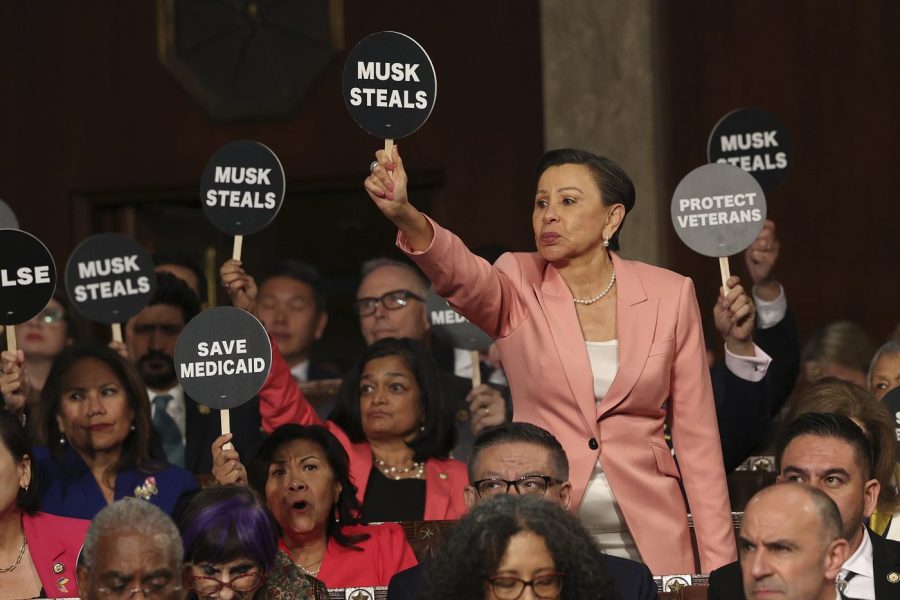
Here’s the only thing you need to take away from Trump’s speech to Congress
Politics
AIPAC front and center in Bell-Bush rematch
Cori Bush’s 2024 primary loss to Wesley Bell was heralded as a major defeat for the insurgent progressive movement.
Now, their rematch for Missouri’s 1st District two years later comes at a time when Bush and her allies seem to be winning the battle for the future of the Democratic Party.
The dueling factions in St. Louis highlight the growing tension over not just the domestic ideological divide in the Democratic Party, but the party’s — and country’s — stance on the U.S.’s longrunning relationship with Israel.
The former representative was among the first sitting members of Congress to call Israel’s actions in Gaza a “genocide” — and now she’s betting that her progressive bonafides and her criticism of the top U.S. ally will boost her to victory with the same electorate that punished her last cycle.
“One of us is of the people, by the people and for the people,” Bush said in a recent interview. “The other one is paid for by AIPAC. That’s the difference.”
Like two years ago, a group aligned with the American Israel Public Affairs Committee is the largest outside spender in the race. The organization’s super PAC, United Democracy Project, has spent at least $2.1 million on advertising in the primary, according to ad tracking firm AdImpact.
Roughly half of all adults who identify as Democrats believe that Israel has committed genocide against Palestinians, according to a July AP-NORC poll, an accusation that some human rights organizations have made but both the Israeli and American governments strongly deny.
And from Colorado to New York, several progressives have already tapped into voters’ frustrations with party leadership and successfully wielded their criticism of Israel’s government in order to win.
St. Louis is only one of several races on Tuesday testing the Democratic Party’s establishment: voters will also hit the polls in Michigan to cast their ballots for the progressive, Abdul El-Sayed, or the moderate Rep. Haley Stevens for an open Senate seat.
That race has also become a check for voters’ opposition to AIPAC. And some potential 2028 Democratic contenders have already sworn off accepting funding from AIPAC, another sign of the growing unwillingness to be aligned with the organization.
AIPAC and some Democrats have hit back, saying its critics within the Democratic Party have increasingly made the party inhospitable to those generally supportive of Israel.
In response to requests for comment, AIPAC shared a series of ads knocking Bush for her missed votes and her criticism of the Biden administration and former Vice President Kamala Harris’s 2024 presidential bid. (In a recent debate, Bush claimed Bell delayed his endorsement of Harris, but both endorsed the former vice president on July 21, 2024, the same day she announced her candidacy.)
Bell unseated Bush two years ago with heavy financial backing from AIPAC, the country’s preeminent pro-Israel lobby. They’ve once again spent heavily on his behalf, and this time, he also comes into the race with establishment support — including endorsements from House Minority Leader Hakeem Jeffries and the Congressional Black Caucus PAC.
Bell and his allies have absolutely swamped Bush on the airwaves this year. In addition to UDP’s $2.1 million in ad spending, Bell’s campaign has followed closely behind at over $2 million, according to AdImpact, with over $700,000 more from another super PAC called New Democrat Majority.
Bush, meanwhile, has spent less than $200,000, according to the ad tracker. She boasts the backing of a progressive coalition that includes the Democratic Socialists of America, Sen. Bernie Sanders (I-Vt.) and fellow “Squad” member Rep. Rashida Tlaib (D-Mich.).
Bell has brushed aside the attacks that he’s being bolstered by AIPAC money.
“I think we all can agree that there’s too much money in politics, and I’m a vocal and public supporter of campaign finance reform,” Bell said in an interview. “What I’m not a fan of or a supporter of is singling out certain Americans and saying that they should not participate in our democratic process. That is where I would absolutely draw the line.”
Bell added that the difference between himself and Bush is that he can offer both support and criticism of allies.
“While I’m not the biggest fan of [Israeli Prime Minister Benjamin Netanyahu], I still believe that we have to stand with our allies,” Bell said. “That doesn’t mean we’re not going to disagree at times with our allies.”
Bell’s and Bush’s showdown in 2024 was arguably the biggest ideological battlefield for the party that year, outside of the discontent surrounding Biden and then Harris’ presidential bids from progressives critical of Israel.
But two years later, it is just one of many fights that has sprawled across the country. Progressive candidates have been racking up primary victories against establishment figures in a trend that some are calling the “Mamdani effect” after democratic socialist New York Mayor Zohran Mamdani took down Andrew Cuomo in both the 2025 primary and general elections.
Still, this year’s St. Louis rematch isn’t quite the marquee fight it was in 2024. Spending has trended down: Collectively nearly $20 million was dropped on the 2024 contest on advertising, according to AdImpact. That’s roughly four times more than this year’s total.
Usamah Andrabi, spokesperson for Justice Democrats, the progressive group that endorsed Bush earlier this cycle, attributed the broader, nationwide ideological fight to a base that has been “pushed to the edge of desperation by the Democratic Party itself.”
“The Democratic Party’s base woke up in January 2025 realizing that their party’s establishment was unfit, unprepared and frankly unwilling to fight back against Donald Trump and Republican extremists with the urgency the moment demanded,” Andrabi said.
Now, as St. Louis voters head to the polls on Tuesday, Bush cast the eventual outcome in dire terms.
“What is at stake,” Bush said, “is the affordability and the peace of every single person in this country.”
Politics
We’re about to find out how powerful progressives really are
Michigan is ground zero for the Democratic Party’s ideological war.
Its marquee Senate race and two of its House primaries on Tuesday — in Michigan’s 7th and 13th Congressional Districts — will provide another crucial test of whether progressives can not only keep up their winning streak in safe-blue seats but also break through in battlegrounds crucial for control of Congress.
The stakes for the Democratic Party are huge: A strong progressive performance, especially a victory by Abdul El-Sayed in the high-profile Senate race, would significantly bolster the left’s argument that its message resonates widely — setting the stage for a bruising fight over the party’s ideological direction ahead of November.
And any Democrat eyeing a White House bid in 2028 will be watching closely for clues about what kind of message can win in Michigan, the perennial battleground that was recently selected as an early Democratic presidential primary state, giving it outsized influence on the nominating process.
“If Abdul El-Sayed is successful next Tuesday, this will mean the hyper-progressive socialist movement has percolated into one of the most crucial general election states,” said Adrienne Elrod, a longtime Democratic strategist who was senior adviser and spokesperson for former Vice President Kamala Harris’ presidential campaign.
“This means Democratic candidates running for President in 2028 will have to be even more mindful of how to approach this sector of the electorate.”
A critical Senate battleground
Buoyed by a string of primary victories this spring — in both safe and competitive districts from California to Colorado to Maine — progressives now face a major proving ground as they try and capture a statewide sweep.
Backed by progressive stalwarts like Sen. Bernie Sanders (I-Vt.) and Rep. Alexandria Ocasio-Cortez (D-N.Y.), El-Sayed faces moderate Rep. Haley Stevens in a bitter and costly feud for the Democratic nomination to take on former Rep. Mike Rogers, the unopposed Republican running for the open seat. The contest to replace retiring Democratic Sen. Gary Peters, is one of a handful of seats Democrats must defend in their longshot bid to take back control of the Senate.
A victory by El-Sayed, who has leaned into his image as a progressive firebrand on social media, could provide a new playbook for Democrats in battlegrounds.
“If El-Sayed wins the primary, there’s no real test case for a hard-edged, base-first, super online candidate succeeding at the state level — at least not in a swing state,” said Democratic strategist Matt McGrath, who was former President Barack Obama’s 2012 Michigan communications director.
Public polling in the closing stretch shows El-Sayed with a double-digit lead over Stevens. The contest has attracted millions in outside spending and intense attention from Washington, as the candidates spar over campaign finance, Israel and electability — and what that means in a state Harris lost by fewer than 100,000 votes in 2024, even as Democratic Sen. Elissa Slotkin beat Rogers, who is back for redemption, that same year.
“There’s all this handringing across the country about electability,” said Jeff Weaver, a progressive Democratic strategist. “The same people who are carping about electability have lost the White House twice to Trump.”
Progressive power in the purple 7th District
The fight for Michigan’s 7th District has parallels to the Senate contest: It’s a true battleground — it went for President Donald Trump by just over 1 percentage point in 2024 — that will be vital to Democrats’ bid to flip the lower chamber in November.
Sunrise Movement co-founder William Lawrence is rising in the polls, as two more-moderate Democrats fight over the future of that wing of the party and in turn risk splitting the vote. Whoever emerges from the primary will face GOP Rep. Tom Barrett.
Lawrence has received the backing of Sanders and El-Sayed and has centered much of his campaign on fighting data centers, an issue progressives think they can own in the run-up to 2028, when they’re betting the rapid rise of artificial intelligence will make policies around its growth crucial to a winning campaign.
The prospect of progressive wins in the battlegrounds has already unnerved some centrist Democrats: “If he wins, we’re done,” one operative told POLITICO recently, describing Lawrence’s chances of beating Barrett in the general election as “highly unlikely.”
Others warn that even without a sweep, having El-Sayed atop the ticket alone could be a boon for Republicans up and down the ballot in a deeply purple state.
Centrists are “quite concerned and they should be,” said Michigan-based Democratic strategist Adrian Hemond. “Regardless of whether Will [Lawrence] wins that primary or not, if Abdul is the Senate nominee for Democrats, [Republican Reps.] Tom Barrett and Bill Huizenga are getting reelected.”
Democratic splits roil safe-blue 13th District
Michigan’s 13th District has become another proxy between the party’s progressive and establishment wings, this time for a safe-blue seat.
The race pits the Sanders-backed state Rep. Donavan McKinney against the incumbent Rep. Shri Thanedar, who has the support of House Democratic leaders Hakeem Jeffries, Katherine Clark and Pete Aguilar.
The divide burst further into public view last week when some members of the Congressional Black Caucus, including progressive Reps. Ilhan Omar (Minn.) and Ayanna Pressley (Mass.), broke with party leadership and endorsed McKinney, who is Black.
Thanedar’s district was one of the first that Justice Democrats, a progressive group that challenges incumbents, decided to target this year. The group helped recruit McKinney and has spent nearly $1 million backing him.
“When we look at Michigan, its diverse voter base, its status as a Midwestern state with a big working class population, it’s a barometer of where the party is going and what voters want,” said Ravi Mangla, the spokesperson for the Working Families Party, a progressive group that has backed Lawrence and McKinney’s challenge of Thanedar.
Republicans, meanwhile, are eagerly watching on.
“The popcorn machine is warming up for next Tuesday night’s grand finale of Michigan Democrats’ messy, expensive primaries full of surging socialists,” NRCC spokesperson Zach Bannon said in a statement.
Lisa Kashinsky and Meredith Lee Hill contributed to this report.
Politics
Republicans want to talk about James Talarico’s manhood. Talarico says let them.
He’s eating barbecue. He’s winning over Joe Rogan. He’s challenging his opponent to mano-a-mano televised faceoffs.
James Talarico is determined not to let his GOP challenger Ken Paxton’s and Republicans’ attacks on his masculinity define him in what has emerged as one of the party’s loudest tactics in the crucial Senate race.
The Texas Democrat is working to position himself as a candidate focused on issues he says men actually care about instead of speculation about his diet, sexuality and religious beliefs.
“They’ve even called me a vegan, and those are fighting words in the state of Texas,” Talarico said at a San Antonio rally this summer.
“Nowadays our culture tells young men that greatness is tearing other people down, is trolling and owning and dominating. But my dad showed me what real greatness looks like. He inspired me to serve,” Talarico said at another rally in Houston, referencing how his dad often mowed the lawn of his elderly widowed neighbor without asking.
Talarico’s attempt to reclaim the masculinity narrative by confronting the issue head-on could help propel him to flip a seat Democrats haven’t held in nearly four decades, and which could determine control of the Senate next year.
It comes as both parties, in Texas and across the U.S., are fighting to win male voters — especially young, Black or Hispanic men — who in 2024 lurched to the right to help Republicans take control of the White House and Congress. The issue of masculinity has also been turbo-charged during Donald Trump’s second term, with the president hosting UFC fights on the White House lawn and his Secretary of Defense Pete Hegseth pushing for testosterone testing in the military.
If Talarico prevails, he could ultimately serve as a model for other Democratic candidates to connect with male voters or fend off Republicans who try to use issues of masculinity as a cudgel.
“Democrats need to be prepared for more of these attacks to come and understand how to handle them,” Lucas Holtz, a senior political adviser at the centrist think tank Third Way, said in an interview.
Republicans think they’ve hit a nerve with Texas voters about Talarico’s manhood. Members of the party have targeted the 37-year-old public school teacher-turned-state legislator for past statements endorsing a vegan lifestyle, suggesting that “God is nonbinary” and opposing legislation that erodes transgender rights.
“If you look at him, this is a guy who’s publicly stated pretty bizarre things — that God is nonbinary,” said Rep. Brandon Gill (R-Texas) in an interview. “He’s a total weirdo, and I think Texas voters recognize that.”
Talaricosaid recently his comment on God’s gender was meant to be “deliberately provocative” and that he meant God is beyond gender.
Republicans are also seizing on Talarico’s unmarried status and smaller physical build to paint the Democratic candidate as weak and effeminate. Some have falsely called him gay or transgender. Paxton’s very first ad of the general election campaign implied Talarico has low testosterone levels. And a conservative PAC released an AI-generated video of Talarico as an actress from “The Sound of Music” singing about wanting to give hormones to children.
Talarico opposes gender affirming care for minors, his spokesperson JT Ennis said.
“In Texas, there’s a certain level of tough guy-ness that we all pretend to have in ourselves, and that we like in our elected officials,” said Vinny Minchillo, a Texas-based Republican admaker who is not involved in the race. “If you push that the right direction, that especially does not sit well with Hispanic men and Black men.”
Paxton’s campaign and his allies think Talarico’s previous comments on these issues put him out of touch with voters in both parties.
“Texans can spot an audition for a new identity and they know he is weak and woke on core Texas values,” Paxton adviser Nick Maddux said in a statement. Maddux pointed to moves Talarico has made during the campaign he said shows flip-flopping, such as wearing a Texas flag shirt after calling the American flag a “complicated symbol.”
“He is undoubtedly hurting Democrats,” Republican Texas Sen. Ted Cruz said in an interview about Talarico.
Some Hill Democrats say Republicans’ fixation on Talarico’s manhood is an attempt to distract from Paxton’s weaknesses.
“They fear his strength, especially since he’s running against the most notorious scumbag in American politics,” Sen. Jon Ossoff (D-Ga.) said.
Paxton has faced an ethics complaint that was later dropped, a Justice Department corruption investigation for which he was not charged and securities fraud charges which were ultimately dismissed in an agreement. He was also impeached by the Texas GOP-led House for bribery and abusing his public office, which he called a “sham” coordinated by liberals, and was later acquitted by the Texas Senate.
Paxton also has a history of using cultural issues to his advantage, such as stoking anti-Muslim fears through campaign messaging.

Meanwhile, Talarico’s campaign says they’re not seeing evidence that the masculinity barbs are gaining traction, pointing to robust Democratic gains among Hispanic voters while also arguing that polling shows a toss-up general election contest. The campaign did not share specific data to support that its messaging to male voters was lifting Talarico’s polling with that demographic.
Talarico has focused on issues he says affect many men — like lowering housing costs, stopping corporate landlord rent manipulation and curbing the influence of billionaire mega-donors in politics.
“Ken Paxton is picking these fights no one cares about to distract from the fact that he has no solutions to lower the cost of gas, groceries, or healthcare,” Ennis said in a statement. “Real men serve others, weak men serve themselves.”
Talarico also has tried to appeal to young men and Hispanic voters by placing ads during World Cup and NBA Finals games. And he’s challenging Paxton to a series of televised debates, in which the two could spar on manhood and other issues. Paxton’s team said he’s agreed to the debates but they’re still negotiating logistics and terms.
The Democrat’s campaign also said it is trying to facilitate similar opportunities to Talarico’s pivotal appearance on Joe Rogan’s podcast last year, which boosted his national profile to millions of young men who make up Rogan’s core audience. The podcaster — who during the interview exclaimed “you need to run for president,” to Talarico — has continued to compliment the Texas Democrat and defend his views, including during a conversation with Vice President JD Vance last month.
Talarico has also fired back with his own jabs. He responded to Paxton calling him “Talafreako” by putting the phrase on T-shirts and selling them on his campaign website.
And Talarico turned on Paxton’s low-testosterone message by telling MS NOW “I don’t think guys my age are really concerned about that kind of thing,” adding, “You’ve got these old guys lathered up in their fake tans throwing cheesy nicknames at each other.”
Some public opinion research shows Talarico’s strategy fits the 2026 moment.
The growing cost-of-living crisis — exacerbated by the deeply unpopular military conflict in Iran — and Trump’s low approval ratings may mean the GOP’s masculinity attacks fall flat this cycle, Luke Warford, founder and director of Texas Public Opinion Research, a nonpartisan public opinion research firm, said in an interview.
The top issues for men and young men in Texas center on affordability, the cost of living, economic growth and job creation, according to an aggregate of data shared with Blue Light News from the group’s latest surveys in May and June.
“We’ve got a really different scenario now where the Republicans are in power in Texas and nationally, so they own the things that are broken,” Warford said. “There is a deep anti-establishment sentiment in this country and a deep frustration with the status quo particularly among men, and that could be a much stronger political force than the cultural attacks.”
Matt Angle, founder of the Lone Star Project, a Democratic-aligned political action committee in Texas, said “there’s no attack that should be ignored,” but that Democrats are in a good position.
“Ken Paxton is no he-man. He’s a thin-chested, soft spoken, weak guy,” Angle said.
One warning sign for Talarico: a swath of male voters perceive him as too progressive, said Holtz, the Third Way adviser. Holtz noted a recent poll of men by the group in which 49 percent of respondents said the candidate was “too far left.”
In focus groups held by the centrist think tank last year and this year, young men overwhelmingly pointed to the Republican Party as the better representative of men’s priorities. Respondents in those groups associated Democrats with more social and cultural issues while tying Republicans with financial independence, finding a partner and starting a family.
On Capitol Hill, some Democrats are calling the conversation in Texas an opportunity to revisit the party’s historic avoidance of issues that are important to men, which have made them more susceptible to criticism.
Rep. Marc Veasey, a moderate Texas Democrat, said in an interview that “Democrats, overall, need to do a better job of expressing some of the concerns that young men have.”
“When we have people on our side who are attacking things like nuclear family structure and expecting everybody to fall in line, that’s pure insanity,” Veasey said. “There’s this expectation with Democrats that men are just going to follow along, and they’re not. We haven’t figured out how to talk to them.”
Sen. Ruben Gallego (D-Ariz.) said in an interview that Democrats tend to display examples of “traditional masculinity” rather than the “stereotypical masculinity” Republicans are attacking them for not adhering to. He pointed out he served in the Marines, Sen. Cory Booker (D-N.J.) played football and Sen. Mark Kelly (D-Ariz.) was an astronaut.
“What voters know is truly masculine is a politician who is going to take care of their needs and be a protector and be a provider for the family,” Gallego added.
“When a man can’t support his family because inflation is so fucking high, they’re not going to care about who is on the ballot that is, quote unquote, ‘not masc enough.’”
-
The Josh Fourrier Show2 years agoDOOMSDAY: Trump won, now what?
-
Politics1 year agoFormer ‘Squad’ members launching ‘Bowman and Bush’ YouTube show
-
The Dictatorship1 year agoLuigi Mangione acknowledges public support in first official statement since arrest
-
Uncategorized2 years ago
Bob Good to step down as Freedom Caucus chair this week
-

Politics1 year agoFormer Kentucky AG Daniel Cameron launches Senate bid
-
The Dictatorship1 year agoPete Hegseth’s tenure at the Pentagon goes from bad to worse
-

Politics1 year agoBlue Light News’s Editorial Director Ryan Hutchins speaks at Blue Light News’s 2025 Governors Summit
-

The Dictatorship11 months agoMike Johnson sums up the GOP’s arrogant position on military occupation with two words