
Congress
GOP’s reconciliation hopes are easier dreamt than done

Republicans are hitting the gas on a new party-line policy bill. They are fully aware it might end up in the ditch.
The renewed push for budget reconciliation — spawned out of a Monday meeting between President Donald Trump and a group of GOP senators — marks the best shot Republicans have had in months to enact key agenda items without Democratic cooperation. House and Senate conservatives have clamored for a second attempt this Congress, following last summer’s tax-cuts-focused megabill, without much success.
But GOP leaders face a tall order in wrangling their thin margins and the hodgepodge of policy ideas already being pitched by their competing factions — or watching the effort collapse due to infighting.
Underscoring the massive challenge, some Republicans are stressing they aren’t committing to pass another bill under the reconciliation process — which could allow them to avoid a Democratic filibuster in the Senate — they are just promising to give it a try.
“The odds would be like 100 percent,” Sen. Ron Johnson (R-Wis.) said in an interview about the chances Republicans will attempt another reconciliation bill. “Now, do we pass it?”
The latest vision for a GOP reconciliation bill would build the legislation around new funding for immigration enforcement that Democrats are refusing to pass, plus parts of the SAVE America Act — the Republican elections overhaul that doesn’t have a path to passing the Senate. GOP lawmakers believe incentives for states to adopt new policies such as voter ID rules could comply with the Senate’s strict rules for reconciliation.
“I would keep it as simple as possible so it could pass,” Johnson said.
Sen. Thom Tillis (R-N.C.) said in an interview that keeping the bill narrow would help raise the odds that Republicans would be able to get something across the finish line.
“If you want to keep all of our members tight … we need to agree to the parameters and not allow scope creep,” Tillis said.
Keeping the scope of the reconciliation bill narrower would have an added political benefit for Senate Republicans — it would limit the slate of issues on which Democrats could force simple-majority votes as they try to squeeze vulnerable GOP incumbents just months before the midterms.
But there is already outright skepticism, and in some cases early signs of opposition, inside the Senate GOP. Republicans can lose up to three senators and still pass a party-line bill.
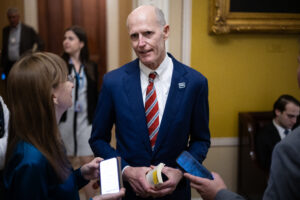
Sen. Susan Collins (R-Maine), who is facing a tough reelection bid, said she thought reconciliation was not a “good approach.” Sen. Rick Scott (R-Fla.), a Budget Committee member who chairs the Republican Steering Committee, predicted it would be “very difficult” to get the votes and compared it to a “pipe dream.”
“You know me, I’m not a big fan of reconciliation,” Sen. Lisa Murkowski (R-Alaska) added when asked if she wanted to pursue a new party-line bill.
It’s not just the Senate where GOP leaders are facing an uphill battle to pass both a budget resolution — a key prerequisite for reconciliation — as well as the bill itself.
A big risk of pursuing a second reconciliation bill is House conservatives seeking to include potentially billions of dollars in cuts to the social safety net and other long-brewing proposals that will “scare the hell out of” vulnerable Republican lawmakers ahead of the midterms, according to one senior House GOP aide granted anonymity to speak candidly about the dynamics.
Even House GOP chatter about trying to add in extra Pentagon funding is sparking warnings from their Senate counterparts. One GOP senator, also granted anonymity to speak candidly, predicted that a heavy injection of defense spending could “kill the whole thing.”
Several House Republicans granted anonymity to speak candidly about the dynamics said they do not believe GOP leaders will be able to muster the multiple near-unanimous GOP votes needed to get another reconciliation bill through the House.
At a leadership meeting Tuesday, senior House Republicans voiced concerns about whether adding the SAVE America Act to a reconciliation bill would be a futile exercise, according to two people in the room.
That’s because of procedural reality: Most of the contentious elections bill won’t pass muster with the Senate parliamentarian, whose guidance on the reconciliation process is typically final.
The House Freedom Caucus called the Senate GOP plan “gaslighting” Tuesday morning. And Sen. Mike Lee (R-Utah) said Tuesday that it’s “hard to imagine” how it could pass under the budget process.
“And by ‘hard’ I mean ‘essentially impossible,’” Lee added on X.
Republicans are discussing how they might induce states to implement some of the SAVE America Act’s voter ID requirements. Senate Budget Committee Republicans met Tuesday for what senators described as a meeting to “touch gloves” as members plotted how to enact ICE funding and parts of the election bill. Senate Republicans also discussed pursuing another reconciliation bill during a closed-door lunch Tuesday.
House Administration Chair Bryan Steil (R-Wis.) separately circulated a list of proposals with key GOP offices on his side of the Capitol that would mandate or financially incentivize states to implement voter ID laws, require proof of citizenship for voter registration, share voter data with federal agencies for verification and conduct post-election audits, among other items, according to a document obtained by POLITICO.
Some of those items appeared unlikely to pass scrutiny with the Senate parliamentarian, Elizabeth MacDonough, whose rulings tend to be the final word on the reconciliation process.
GOP senators could overrule her, but Majority Leader John Thune vowed Tuesday that they would comply with her guidance. Sen. John Kennedy (R-La.) also batted away a question about overruling her, calling it a “hypothetical.”
But Republican leaders are otherwise being careful not to make any pronouncements about where the latest reconciliation push will end up. House Majority Leader Steve Scalise said only that they are “looking at a lot of different options to see if we’ve got a consensus.”
Thune added that he would need to be “pretty sure” any proposal has the requisite 50 votes before the Senate embarked on the initial and time-consuming step of approving a budget resolution, which unlocks the reconciliation process.
“We’re just trying to make sure we keep our expectations realistic,” he said.


House Republicans are rejecting the prospect of accepting a Senate housing package in exchange for the upper chamber including a slate of community bank deregulatory bills in pending cryptocurrency legislation, dashing hopes that the trade could resolve a housing bill standoff between the two bodies.
“So our good stuff for their bad stuff — not sure I buy that,” said Rep. Bill Huizenga (R-Mich.), who serves as vice chair of the House Financial Services Committee.
Senate Banking Republicans discussed the possible trade at a closed-door meeting last week. Sen. Katie Britt, an Alabama Republican who chairs a Senate Banking subcommittee on housing, helped pitch the idea to other GOP senators. But House lawmakers say adding their bipartisan banking bills to the crypto market structure measure is not enough to get them to swallow a Senate-approved housing affordability package that they hope to amend.
“There’s other things in the housing bill that we need to look at,” said Rep. Mike Flood (R-Neb.), who chairs a House Financial Services subcommittee on housing.
A spokesperson for Senate Banking Chair Tim Scott did not immediately respond to a request for comment. Scott and Senate Banking ranking member Elizabeth Warren (D-Mass.) are pushing the House to accept their bill as-is.
The House included the community bank deregulatory measures in a housing bill it passed in February, but the provisions were left out of the housing measure that the Senate passed this month. The banking bills, which supporters say will increase access to mortgages, are a priority for House Republicans, but they say they have an array of outstanding issues with the Senate’s housing bill that need to be addressed.
“This needs to be part of a conversation,” said Rep. Zach Nunn (R-Iowa), who sits on House Financial Services. “Simply throwing something over from the Senate and expecting everybody to get on board with a half-baked idea doesn’t get us to where we need to be.”
Rep. Andy Barr, a senior Kentucky Republican on House Financial Services who is running for Senate, indicated he likes the idea of tucking bank deregulatory measures into the crypto legislation. But, he said, “we want some of our housing ideas included, too.”
“I don’t know why they wouldn’t entertain some of our bipartisan housing ideas,” he said.
Katherine Hapgood contributed to this report.
Congress
Epstein’s accountant and lawyer tell Congress they were never interviewed by federal investigators
Jeffrey Epstein’s lawyer Darren Indyke and accountant Richard Kahn told House lawmakers they were never interviewed as part of formal federal investigations into their late client’s sex crimes, according to videos of their depositions released Tuesday.
Their claims underscore the enormous gaps in the Justice Department’s efforts to hold Epstein and his inner circle accountable over multiple administrations of both parties.
It also could raise the stakes for the ongoing Epstein investigation being led by the House Oversight and Government Reform Committee, which is already being relied upon to gather new evidence after the Trump Justice Department signaled it would no longer be releasing additional Epstein case files in compliance with the law Congress passed last fall.
Both Indyke and Kahn sat for hours-long depositions with the Oversight panel earlier this month. They have denied knowing anything about Epstein’s crimes before the later allegations emerged. They also said their client told them, in the case of the 2008 sex crime conviction, he was unaware of his involvement with a minor.
Neither have been charged with a crime in connection with Epstein, though some lawmakers have portrayed them as key enablers of Epstein’s activities. Rep. David Min (D-Calif.), a member of the Oversight Committee, has gone so far to suggest Indyke perjured himself when he said he did not have knowledge of Epstein’s offenses.
The two men also explained their decisions to continue working for Epstein after the earlier allegation of sexual assault had been brought against him in the 2000s. Indyke said he was “very loosely” a member of Epstein’s defense team during the first sex crime case against him in the 2000s and said, back then, he “drank the Kool-Aid” and believed his client was misunderstood. He even provided a character reference for Epstein at the time.
Kahn told investigators he had considered dropping Epstein as a client and regretted believing Epstein in the wake of the 2008 case when the late financier said it “would never happen again.” But the financial upside proved too great to quit, Kahn said.
“We were in the middle of a financial crisis, and I had a family to support, so I made the wrong decision in staying,” Kahn said, according to the video of his testimony. “Because I later learned … that Epstein continued to abuse hundreds of minors and adults, so I made an improper decision.”
Both Indyke and Kahn are co-executors of Epstein’s estate, which has turned over a broad swath of materials to the Oversight panel including the so-called birthday book that included a lewd note allegedly written by President Donald Trump to Epstein. Trump has denied writing the letter.
They have also brandished their efforts to set up a compensation program for Epstein’s victims, which has doled out millions of dollars to dozens of women who have brought claims against the disgraced financier.
Lawmakers and the Justice Department are under heightened pressure to shepherd some kind of criminal accountability in the Epstein case amid lingering questions over why only one other person has been charged in connection with Epstein’s crimes — Ghislaine Maxwell, who is currently seeking clemency from Trump.
Attorney General Pam Bondi has indicated in congressional testimony that the DOJ is actively investigating potential conspirators related to Epstein, but she has not provided any details on who may be targets.
The Oversight panel has also asked a number of other witnesses to sit for interviews in the coming weeks, including billionaire tech tycoon Bill Gates and financier Leon Black. Both have suggested they are open to cooperating with the panel’s questioning in compliance with congressional subpoenas.
Key negotiators circulated a potential deal Tuesday to end a five-week standoff over Department of Homeland Security funding and, among other things, pay beleaguered transportation screeners as mounting security lines snarl airports.
Nobody in Washington, however, seems too excited about it.
The framework brokered by a handful of Senate Republicans and the White House Monday got a cool reception from Senate Democrats, who said it does nothing to rein in immigration enforcement abuses at the center of the DHS funding impasse.
Conservative Republicans pushed back on the idea that some Immigration and Customs Enforcement funds would be left out of the agreement and pursued separately under the party-line reconciliation process, calling it a capitulation to Democrats.
Even President Donald Trump, who has gone back and forth on the DHS shutdown talks but hosted the White House meeting Monday evening where the latest proposal was hatched, gave the plan only a tepid endorsement in his first public comments on it Tuesday.
“We’re going to take a good hard look at it,” he said in the Oval Office, later adding, “They are getting fairly close. But I think any deal they make, I’m pretty much not happy with it.”
The griping heard up and down Pennsylvania Avenue cast fresh doubt on whether Congress would be able to act this week to end the shutdown that started Feb. 14 — even as hourslong waits at some U.S. airports weighed heavily on lawmakers.
The Republican proposal would forgo about $5.5 billion in funding for Enforcement and Removal Operations under ICE, in lieu of agreeing to a series of constraints Democrats want to impose on DHS enforcement personnel.
Key Democrats rejected that tradeoff Tuesday. Washington Sen. Patty Murray, the Senate’s top Democratic appropriator, said the new GOP offer “contains no reforms to ICE or Border Patrol” and “that’s not acceptable.”
Republicans had hoped to isolate the point of greatest contention, the conduct of DHS agents carrying out Trump’s mass detention and deportation agenda, while funding the rest of the sprawling department. But GOP leaders said they would not put fetters on agents whose salaries were not being funded under the bill.
“A lot of the reforms are contingent on funding for ICE,” Senate Majority Leader John Thune told reporters Tuesday afternoon. “So if you’re not going to have funding, I don’t know how all of a sudden now they can demand reforms.”
ICE received $75 billion in last summer’s GOP megabill, leaving it largely immune from the funding lapse that has crippled other parts of DHS.
“The problem is that they have everybody at DHS right now doing immigration enforcement,” said Connecticut Sen. Chris Murphy, who is the top Democrat on the Homeland Security funding panel but not central to the negotiations.
By funding other DHS agencies, Murphy added, “you’re providing money for immigration enforcement.”
The qualms are not just coming from Democrats.
Conservatives are strategizing behind the scenes to kill the framework because it leaves out ICE funding in the uncertain hope of passing it through reconciliation, according to three people granted anonymity to describe the private effort.
Some Republicans expect their right-flank colleagues to try to lobby Trump to tank the deal or demand changes, two of the people said.
A White House spokesperson gave the emerging plan only a lukewarm blessing Tuesday before Trump made his public comments. The president made clear he remains more invested in passing a partisan elections bill, the SAVE America Act, than cutting a deal to end the DHS shutdown.
The framework would pair the leftover $5.5 billion in ICE funding with some provisions of the SAVE America Act, though the strictures of the reconciliation process would severely limit the GOP’s options.
“I want to support Republicans,” Trump said. “Sometimes it’s awfully hard to get votes when you have Democrats that don’t want to have voter ID, they don’t want to have proof of citizenship, they don’t want to do anything about men playing in women’s sports.”
Ultraconservatives in the House are also assembling to oppose the proposal negotiated by GOP senators, warning their leaders against going around them to pass the agreement. Speaker Mike Johnson could make such a move using fast-track procedures if he had the necessary support from a critical mass of Republicans and Democrats to vault a two-thirds-majority threshold.
And there is a significant swath of the House GOP, including mainstream leadership allies, who consider the idea of not fully funding ICE a nonstarter.
Senate Majority Leader Chuck Schumer said Democrats will offer a counterproposal to the GOP offer. House Minority Leader Hakeem Jeffries is expected to meet with Schumer Tuesday and gather with his caucus Wednesday morning before the offer is delivered.
“I can assure you it will contain significant reform in it,” Schumer told reporters Tuesday.
Murray, who has been meeting with White House officials, lamented that negotiations have been a moving target.
“It is awfully hard to find common ground with Republicans when it’s not clear that they have common ground amongst themselves,” she said Tuesday. “The only way we are going to get out of this mess is if we know that the president is on the same page as the Republicans.”
Top Republican senators are anxious to reach an accord to end the shutdown before the House and Senate are scheduled to adjourn later this week for a recess stretching into mid-April.
“We’re ready to go, OK? We’re ready,” North Dakota Sen. John Hoeven, a senior Republican appropriator, said Tuesday as he left Thune’s office. “So the Democrats need to join us now and get it done. I mean, we’ve bent over backward negotiating with them.”
Mia McCarthy, Meredith Lee Hill and Jordain Carney contributed to this report.
- GOP’s reconciliation hopes are easier dreamt than done
- DHS funding proposal falls flat as Democrats, conservatives and Trump raise doubts

- Rick Scott sues contractor over leaked tax returns
- How Jack Smith connected the dots between GOP lawmakers, Trump aides in 2020 election probe

- Trump: Unlikely to be happy with ‘any deal’ on DHS

- Introducing Sen. Alan Armstrong
- DHS funding proposal falls flat as Democrats, conservatives and Trump raise doubts
- DHS funding proposal falls flat as Democrats, conservatives and Trump raise doubts
- House Republicans shoot down possible housing-crypto trade with Senate
- New bill targets sports prediction markets: What are they, and why could some be banned?

-

 The Dictatorship1 year ago
Luigi Mangione acknowledges public support in first official statement since arrest
-

 Politics1 year ago
Former ‘Squad’ members launching ‘Bowman and Bush’ YouTube show
-

 Politics1 year ago
Former Kentucky AG Daniel Cameron launches Senate bid
-

 Politics1 year ago
Blue Light News’s Editorial Director Ryan Hutchins speaks at Blue Light News’s 2025 Governors Summit
-

 The Dictatorship7 months ago
Mike Johnson sums up the GOP’s arrogant position on military occupation with two words
-

 The Dictatorship1 year ago
Pete Hegseth’s tenure at the Pentagon goes from bad to worse
-
Uncategorized1 year ago
Bob Good to step down as Freedom Caucus chair this week
-

 Politics11 months ago
Democrat challenging Joni Ernst: I want to ‘tear down’ party, ‘build it back up’