
Congress
GOP leaders map out potential Obamacare extension as hard-liners warm to health talks

Republican leaders on Capitol Hill are quietly ramping up talks within their senior ranks and with White House officials over how to structure and advance a potential extension of key Affordable Care Act insurance subsidies before the end of the year, according to three people granted anonymity to describe the conversations.
One option under serious consideration is, once the government shutdown ends, attaching a revamped subsidy framework to a small bipartisan package of full-year funding bills or a long-term stopgap running through early next year, the people said. GOP leaders have been encouraged as some of their party’s most conservative members warm up to potentially passing an extension — albeit with major provisos.
Key Republicans have floated a list of possible ways to curb the subsidies without eliminating them entirely when they expire on Dec. 31. Those include imposing an income cap for beneficiaries, forcing some individuals to pay a minimum out-of-pocket premium or grandfathering in current enrollees while cutting off new enrollment.
The expiring health insurance subsidies are at the heart of Democrats’ shutdown demands, and extending them will require a bipartisan deal to get them enacted in Congress. But while some Republicans are quietly talking about options across party lines, GOP leaders are publicly insisting they will only seriously discuss an extension deal after Democrats agree to reopen the government.
Still, it’s significant that those leaders are sketching out what a deal might look like and how it might move through the House and Senate once agencies reopen. While the three people said the conversations remain high-level at this point, one option under early consideration is to pair a two-year extension of scaled-back subsidies with some other conservative health care policy provisions, then attach it to some of the annual spending bills that have so far been stuck in partisan limbo.
Passing that package through the House would be tricky for Speaker Mike Johnson, who would likely face opposition from hard-liners firmly opposed to any extension of the Democratic health law known as Obamacare. The three people said the plan would involve advancing it through the chamber under “suspension of the rules,” a procedure that would sidestep a tricky party-line procedural vote but would require a two-thirds bipartisan majority to pass.
Doing so, the people said, would require a public endorsement from President Donald Trump in order to build GOP support for the package.
White House officials have been involved in the internal discussions about structuring the extension of the subsidies and about what other GOP health policy priorities might be included alongside it.
House Majority Leader Steve Scalise has been publicly pushing to add provisions that could build more conservative support, including expanding association health plans and encouraging the use of tax-free Health Savings Accounts.
Senate Majority Leader John Thune also made clear in an interview last week he is seeking new restrictions on the subsidies as part of any extension — and possibly other conservative health policies as well.
Building GOP support in the House, where a major swath of Republicans oppose any ACA extension, is a huge task. But even some prominent hard-liners are now publicly saying they could possibly support a larger health care package — so long as any extension of the subsidies includes significant changes.
They’ve been privately signaling as much for weeks now and are eager to steer the talks to add more conservative policy items, especially as Trump himself has said he’s open to negotiating a larger health care deal after the shutdown ends.
They’re also hoping to shape how the deal moves through Congress. Rep. Andy Harris (R-Md.), chair of the House Freedom Caucus, said in an interview Monday that while leadership could move a health care package attached to a bundle of funding bills, he said he would prefer “a standalone bill.”
The spending bills, Harris said, “should be kept as clean as possible.” And he added that his support for the health care piece “depends on what the whole package is” and that he wants the ACA credits to be eventually sunsetted completely in any deal.
“If you had tremendous savings over 10 years and you were able to wind down the Covid-era enhancements — yeah, I mean, we’ll look at anything,” he added.
Rank-and-file Democrats have been warming to income caps and other new restrictions for the ACA subsidies themselves, but it’s not at all clear they would be willing to accept a total phase-out of the subsidies — let alone other GOP health policies.
In other words, finding middle ground with Republicans who want a more serious overhaul of the health care system could be impossible. But for now, GOP members such as Texas Rep. Chip Roy are sounding an upbeat note.
“If we have health care reforms on the table that protect and provide greater freedom and independence for patients and doctors, then I’m on board with things that would help build a package,” Roy, a Freedom Caucus member, said in an interview Monday.
He, too, said his support would depend on how quickly the expanded subsidies are phased out and the larger scope of health policy proposals — listing provisions that would boost “direct primary care, Health Savings Accounts” as items conservatives are interested in.
“You wrap that in then with whatever it takes to get the votes,” he said. “I’m always open to that.”
Benjamin Guggenheim contributed to this report.


Senate Minority Leader Chuck Schumer rolled out an energy and climate change agenda Wednesday as a preview of what Democrats have in store if they take the chamber’s majority in November’s elections.
Schumer’s five-point plan seeks to ride the national momentum on affordability, framing Democrats as the party not just of clean energy and fighting climate change, but of lower electricity bills and more jobs.
It touches on some longtime Democratic priorities — like bringing back the Inflation Reduction Act clean energy tax incentives that President Donald Trump and Republicans rolled back last year — and easing permitting hurdles for wind, solar and other zero-emissions energy sources.
“We can bring new voters and allies into the fight for a cleaner environment by showing how clean energy is affordable energy,” Schumer said.
“With this new expanded coalition, putting us back in the majority, we have an opportunity to put forward new policy solutions, strong policy solutions, that tell the American people we can both lower costs and make real progress on climate change,” he continued.
Schumer presented the plan at the League of Conservation Voters’ annual Capital Dinner, gathering hundreds of donors, lawmakers, environmental staff and others.
The group, long a major Democratic ally, is one of the nation’s top election spenders, and is poised to be a major part of Democrats’ attempts to recover from their 2024 losses.
Clean energy, Schumer said, is “the cheapest and fastest way to add energy to the grid, and reduces our emissions at the same time.”
The Democrats’ plan seeks to build out more electricity transmission and storage, make sure data centers pay their fair share for energy, and better protect consumers from electricity bill increases.
While many of the pillars are longtime priorities on the left, Schumer emphasized some new priorities. The plan puts geothermal and nuclear energy, including fusion, on a similar level to renewables like wind and solar.
Schumer is also promising “a thorough re-examination of the entire structure and incentives within our energy systems … to prioritize lowering costs,” and new efforts to make electricity bills “easier to understand.”
While Democrats have been engaging with Republicans toward bipartisan permitting legislation for all forms of energy, Schumer presented a more partisan permitting concept in his speech.
“Democrats will provide legislative certainty for clean energy projects, so that workers and investors can rebuild the clean energy project ecosystem that Trump has destroyed,” he said, adding that permitting legislation “never, never must come at the expense of our obligation to protect local communities and safeguard the environment.”
Democrats have not been particularly vocal on climate change in their drive to take the Senate and House majorities, as they reexamine the issue’s palatability with voters. Schumer’s rollout shows at least some willingness to focus on climate, but keeps the party’s priority on affordability.
Democrats currently hold 47 of the Senate’s seats, so they would need a net gain of four seats to get the majority. The party is focusing on candidates like former Gov. Roy Cooper in North Carolina, Gov. Janet Mills in Maine and former Rep. Mary Peltola in Alaska to get there, but it’s an uphill battle.
The party has also taken recent steps to push its energy agenda in the Senate. Earlier Tuesday, Democrats forced a vote on a resolution that sought to undo Trump’s implementation of clean energy tax policies. More such resolutions are forthcoming.
Florida has been viewed for months as the potential capstone of a GOP redistricting campaign, but now Sunshine State Republicans are growing wary after the dramatic flip of two legislative seats in the state — including one where President Donald Trump votes.
Republicans already hold a commanding 20-8 edge over Democrats in the Florida House delegation, and some in the GOP — including Gov. Ron DeSantis — believe they could pick up as many as five more seats with a rare mid-decade redraw of district lines.
Some Florida incumbents are now warning in stark terms it could backfire.
“I think the Legislature needs to be very cognizant of the fact that if they get too aggressive … you could put incumbent members at risk,” GOP Rep. Greg Steube said. Some seats that Republicans previously won by eight or nine points, he said, could instead have only a four- or five-point GOP advantage — putting them in reach for Democrats in a wave election.
DeSantis, citing a state Supreme Court decision from last year and a potential ruling from the U.S. Supreme Court, has already called a special session of the state Legislature in April to push ahead with new lines. So far there have been no official maps produced or any signs that lawmakers have started working on them.
Republican anxiety has only grown further after Democrats notched surprising wins in special elections Tuesday, including a Palm Beach County district that contains the Mar-a-Largo resort where Trump lives and votes.
While many in the GOP have brushed off the Democratic gains there and in other states as anomalies, private qualms are growing among the incumbents whose seats could be put at greater risk due to redistricting.
“We keep saying these are kind of one-off things that haven’t gone our way,” said one Florida House Republican granted anonymity to speak candidly. “But I’m not seeing any of the one-offs that are going our way.”
“To talk as aggressively as some of what we’ve heard, there’s no way to get there without significantly weakening some districts,” the member added.
House Democrats are hoping to capitalize on the opportunity. Minority Leader Hakeem Jeffries quickly sent a warning Tuesday night that redistricting could backfire.
“We will crush House Republicans in November if DeSantis tries to gerrymander the Florida congressional map,” Jeffries said in a post on X.
Others are openly objecting to redistricting on more high-minded grounds. Rep. Daniel Webster, a veteran Republican from central Florida, called it a “slippery slope.”
“I’ve been around enough reapportionments to know it can come back and bite you,” he said.
“I don’t like this redistricting stuff,” Jacksonville-area Rep. John Rutherford said, noting south Florida would likely bear the brunt of any changes. “But if they think they can get another two seats or something, have at it.”
Any significant redraw in Florida would likely focus on changing districts that were drawn based on racial considerations, the subject of the court rulings DeSantis has cited. While much of the focus has been on seats held by Democrats, Republicans concede it could lead to changes to the Miami-area district represented by GOP Rep. Mario Diaz-Balart.
Some incumbents are also worried that redistricting — still weeks away — is hindering their reelection campaigns as the midterms approach.
“Why would you knock on doors if you don’t know if those doors are gonna be in your district or not?” Steube said.
The hand-wringing over Florida comes as the fallout from Trump’s monthslong redistricting push continues to ripple through the House. Republicans kicked things off with a surprise effort to draw new maps in Texas, but Democrats countered with an effort to draw California’s lines in their favor.
After months of wrangling in about a dozen states, the whole effort looks to end up close to a wash — after some Republicans tried to warn party leaders the heavy-handed effort could backfire.
A group of House Republicans from Florida privately discussed their concerns about the fallout of yet another redistricting push in their state, several Republicans confirmed — especially amid rising anxiety that Hispanic voters could be turning away from the GOP.
House GOP leaders mostly brushed off the Florida special elections in public comments Wednesday, arguing that low-turnout, off-cycle races shouldn’t be considered midterm bellwethers. But some suggested there are lessons to be learned from Tuesday’s results.
“Surely you look at those and see, are there things we can learn and improve upon when the big election comes?” House Majority Leader Steve Scalise told reporters Wednesday. “And obviously, November is the election that we are focused on.”
The top leaders of the House GOP’s campaign arm, Reps. Richard Hudson of North Carolina and Brian Jack of Georgia, both deferred to the state Legislature on redistricting in Florida Wednesday.
Hudson, the NRCC chair, said Florida’s growing population means redistricting “makes sense to do,” but he said he was more concerned about turnout and other factors.
Jack, the group’s deputy chair for recruiting, similarly talked up the candidates Republicans would be fielding in Florida and elsewhere. As for redistricting, he said, “I defer to the Legislature.”
“It’s up to them,” he said, “not up to us.”
House Budget Committee Chair Jodey Arrington is making clear he will push for the “fraud prevention” spending cuts he wants across state and social safety net programs in order to pay for any Iran war funding in a second GOP reconciliation bill.
The Texas Republican is meeting soon this afternoon with Senate Budget Committee Chair Lindsey Graham (R-S.C.) in Graham’s office to discuss plans.
- Schumer rolls out Democrats’ midterm energy pitch
- No plan B: Trump is flailing to find an off-ramp for the Iran war
- Jury finds Meta and YouTube liable in landmark social media trial, awards $6 million

- Democrat vows to turn ‘Epstein files into Epstein trials’ after release of new depositions

- Trump’s Justice Department agrees to financial settlement with Michael Flynn

- Ukrainian energy official: Lifting Russia oil sanctions is ‘wrong approach’
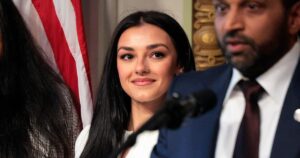
- Kash Patel’s girlfriend ignites conspiracy-based feud with MAGA influencers
- No plan B: Trump is flailing to find an off-ramp for the Iran war
- Arrington: Fraud cuts for war funding
- Gallego: Merrick Garland was a ‘coward’ over Jan. 6

-

 The Dictatorship1 year ago
Luigi Mangione acknowledges public support in first official statement since arrest
-

 Politics1 year ago
Former ‘Squad’ members launching ‘Bowman and Bush’ YouTube show
-

 Politics1 year ago
Former Kentucky AG Daniel Cameron launches Senate bid
-

 Politics1 year ago
Blue Light News’s Editorial Director Ryan Hutchins speaks at Blue Light News’s 2025 Governors Summit
-

 The Dictatorship7 months ago
Mike Johnson sums up the GOP’s arrogant position on military occupation with two words
-

 The Dictatorship1 year ago
Pete Hegseth’s tenure at the Pentagon goes from bad to worse
-
Uncategorized1 year ago
Bob Good to step down as Freedom Caucus chair this week
-

 Politics11 months ago
Democrat challenging Joni Ernst: I want to ‘tear down’ party, ‘build it back up’