
Congress
GOP earmark angst rears ahead of spending package votes

A conservative rebellion against earmarks is threatening to tank a key procedural vote Wednesday afternoon on a three-bill spending package as House GOP leaders scramble to avoid another intraparty meltdown on the chamber floor.
House leaders plan to strip out an earmark from Democratic Rep. Ilhan Omar, which could have major repercussions in a legislative body already plagued by partisan tensions and mistrust.
The community project funding at the center of hard-liners’ ire is $1 million for an organization in Minneapolis focused on “wraparound services” that include job training, addiction recovery and housing support. The organization describes itself as “youth-led East African recovery organization.”
The scrutiny over the earmark, which was also backed by Minnesota’s Senate delegation, comes as federal funding for childcare centers in Minnesota’s large Somali community is under fire by the Trump administration due to allegations of fraud. Some Republicans are claiming that this organization is also fraudulent.
“Earmarks are the currency of corruption, and they’re coming back in full force in these products,” Rep. Chip Roy (R-Texas) told reporters Wednesday morning about the spending package heading to the House floor later in the day. “And I just don’t support it.”
Following a GOP revolt inside the House Rules Committee late Tuesday night, House Republican leaders landed on a compromise to kill the earmark, according to four people granted anonymity to speak candidly about a private plan.
Leadership also agreed to split up the three-bill package that would fund Energy-Water, Interior-Environment and Commerce-Justice-Science when it comes to the floor for a vote.
That would give some Republicans the ability to vote against the CJS measure while backing the other two. The procedural gambit would then allow all three bills to be repackaged for the Senate to consider as one bundle.
House Appropriations Chair Tom Cole (R-Okla.), however, warned Wednesday the intense focus on one single earmark is a liability for carefully negotiated full-year funding bills, ahead of the Jan. 30 deadline to avoid a shutdown.
“I can’t afford to have a million dollar project jeopardize a $184 billion package of bills,” Cole told reporters. “If we have an individual project that can pose a political problem, I’ve had these in the past from our side before, where we had to tell a member, ‘look, there might be a way to do this, but our advice to you is to withdraw this.’”
Cole said the onus was on Democrats to convince Omar to abandon the request, or risk tanking the whole bipartisan spending package.
“It is under discussion and it will be resolved. That’s the way things go with these community projects. If there’s a difficulty, if there’s a problem, we try to work it out. Or it comes out,” Rep. Rosa DeLauro of Connecticut, the top Democratic appropriator in the House, said in an interview Wednesday afternoon.
The underlying language of the bill will not change, but the earmark is expected to be functionally neutered by making a change to report language that accompanies the bill text.
“It’s too late in the process,” for changes to funding levels or the bill text itself, Cole said.
Omar’s office did not immediately respond to a request for comment Wednesday.
Earmarks were banned under Republican leadership for more than a decade before being revived and rebranded by Democrats as “community project funding” in 2021. The new process has tighter restrictions for eligibility than the old one, which has calmed angst among most Republicans about frivolous hyperlocal projects.
Lawmakers from both parties request money for initiatives in their districts, but the vast number of earmark requests each appropriations season comes from House Republicans.
Roy and Freedom Caucus Chair Andy Harris (R-Md.) each stood up in Wednesday morning’s closed door House GOP Conference meeting to voice their frustration about the earmarks in the CJS funding bill and the lack of opportunity for rank-and-file members to offer amendments to the bill, according to four people in the room granted anonymity to speak candidly.
With these changes, and if Republicans have perfect attendance Wednesday, House GOP leaders – for now – believe they will have enough votes to narrowly clear the at-risk procedural hurdle on the floor late this afternoon.
This also would keep Republicans on track for final passage Thursday given strong support from Democrats, according to five people granted anonymity to share internal party dynamics.


The House Rules Committee advanced a procedural measure aimed at breaking an intra-Republican deadlock Monday night. But GOP leaders are still facing a major battle Tuesday to regain control of the House floor.
The panel approved on party lines a measure to set up Republicans’ $1.1 trillion defense policy bill, a government funding bill and other GOP bills for floor debate. It would then combine the Pentagon bill, once passed, with the contentious elections overhaul known as the SAVE America Act and send it to the Senate as one piece of legislation.
That maneuver, telegraphed by Speaker Mike Johnson earlier Monday, is aimed at appeasing House GOP hard-liners who have blockaded the floor, demanding the Senate pass the elections bill that has languished there for months.
However, Rep. Anna Paulina Luna of Florida, the Republican leading the blockade, said in an interview Monday before the Rules Committee acted that Johnson’s plan is not sufficient — raising the possibility she and allies could vote down the measure on the floor. Other House GOP hard-liners say there are other outstanding issues to battle over Tuesday.
Rep. James McGovern of Massachusetts, the top Rules Democrat, called the merger move “a big waste of time.” The panel voted down a motion by McGovern to remove the provision to combine the two bills in a party-line vote.
The Senate is set to debate its own version of the defense bill next month, and it is likely that the elections overhaul will be removed in negotiations between the two chambers — as McGovern acknowledged Monday and House GOP leaders privately concede.
“The Senate will just strip the SAVE Act out,” he said at the meeting. “There is a zero percent chance SAVE ends up in the [Pentagon bill] because of this rule today.”
The defense bill faces a tight vote if Republicans can pass the procedural measure. Most Democrats are expected to oppose the measure over its massive price tag, which they contend is wasteful.
The panel is set up debate on 312 amendments to the bill. The slate includes GOP measures to codify a Trump executive order to block transgender people from serving in the military, prohibit coverage of gender-affirming care, block aid to arm Ukraine and strip Democratic-backed protections for collective bargaining for Pentagon civilian workers.
The committee also voted down Democratic proposals to slash $150 billion from the bill’s topline and limit the war against Iran.
Mia McCarthy contributed to this report.
Speaker Mike Johnson said Monday he plans to deploy an unusual procedural maneuver in a bid to unfreeze the House floor this week, seeking to send the annual Pentagon policy bill and the GOP elections bill known as the SAVE America Act to the Senate in a single package.
That is likely a recipe for a continued standoff between the two chambers over the SAVE America Act, which has stalled in the Senate for months due to internal GOP divides. Under Johnson’s plan, the annual defense policy bill, which typically passes every year with large bipartisan majorities, could become a collateral victim of the impasse.
Asked in brief interview if he had talked to Senate Majority Leader John Thune about his plans, Johnson replied, “I have to do my job in the House, and they’ve got to do their job in the Senate, so we’ll see what happens.”
Johnson is seeking to placate House conservative hard-liners, led by Florida Rep. Anna Paulina Luna, who have threatened to oppose the procedural measures that give Republicans control of the floor unless they agree to tougher tactics meant to force the Senate into passing the elections bill.
House GOP leaders discussed the plan to merge the two bills over the weekend as Luna pushed to amend the defense bill directly.
She did not say in an interview Monday whether Johnson’s gambit would suffice: “We want it baked together, not able to be stripped out,” she said.
But the Senate is free to work its own will, and members of that chamber are likely to reject any defense bill that has the partisan elections bill attached. That would set the stage for GOP leaders to strip it out when the House and Senate hash out the differences between their competing Pentagon bills later this year.
Johnson, meanwhile, is pushing a separate plan to pass a slimmed-down version of the SAVE America Act through the party-line budget reconciliation process — an option hard-liners have all but rejected.
“I don’t think that that can be done,” Luna told reporters Monday.
He’s also facing another complication: The version of the SAVE America Act he is proposing to attach to the Pentagon bill doesn’t include the latest demands for the bill from President Donald Trump — including a near-total ban on mail voting that is opposed by many Republicans.
Jennifer Scholtes contributed to this report.
Lawmakers of both parties questioned Secretary of State Marco Rubio and top Middle East envoy Steve Witkoff Monday in the first broad congressional briefings on President Donald Trump’s Iran deal.
While Democrats asked some of the sharpest questions, participants in an afternoon conference call with House members said, Rep. Darrell Issa (R-Calif.) at one point pressed the administration officials on the fate of Iran’s stockpile of near-bomb-grade uranium.
According to two people granted anonymity to disclose the private remarks, Witkoff and Rubio repeated assurances the administration has privately made to select lawmakers in prior briefings — that the goal is to negotiate a final deal that would prohibit Iran from keeping its highly enriched uranium.
The memorandum of understanding Trump signed earlier this month, they said, was meant to launch those negotiations. Witkoff, the people said, added that the technical team involved in that part of the talks was traveling from Switzerland to Qatar, where talks between the U.S. and Iran are set to happen Tuesday.
Democrats, meanwhile, pushed the administration for more details on what financial benefits Iran could reap under the memorandum — including proceeds from previously sanctioned oil sales.
Rep. Debbie Wasserman Schultz (D-Fla.) went back and forth with Rubio and Witkoff over the lifting of the oil sanctions, two other people granted anonymity on the House call said. The officials eventually cut off the conversation and ended the call.
At another point, Rep. Madeleine Dean (D-Pa.) raised concerns about Witkoff’s business interests in the Middle East as he’s negotiating with Iran, prompting a sharp defense from Rubio, those people said.
Senate Minority Leader Chuck Schumer asked Rubio and Witkoff about the oil sanctions during a separate all-senators call Monday, saying in a statement afterward that they “confirmed to me that Iran will reap billions in oil revenue while retaining dangerous leverage over the Strait of Hormuz.”
“If this is the administration’s defense behind closed doors, Secretary Rubio should make it under oath, in public, before the Foreign Relations Committee,” Schumer added, calling the briefing “delayed, deficient, and devoid of details.”
An administration official granted anonymity to speak candidly countered on Schumer’s characterization, noting that he had previously gotten a briefing of the deal as part of a group of top leaders engaged on national security matters. Schumer, the official said, had the opportunity to ask multiple follow-up questions on the Senate call.
A separate group of White House officials briefed top congressional leaders and key committee chairs in a classified briefing in the Capitol later Monday.
The administration has faced bipartisan skepticism over multiple provisions of the memorandum of understanding — particularly the lifting of oil sanctions and a $300 billion reconstruction fund that many Senate Republicans fear will help fuel Iran’s military and regional proxies.
Rubio and Witkoff sought to ease concerns about the slow reopening of the Strait of Hormuz — the critical trade route whose closure has sparked higher fuel and fertilizer costs. Both officials said more mine removal is required, and Witkoff indicated that Iran broke the terms of the Trump-signed deal by launching a drone attack on a passing ship over the weekend.
They also sought to assure lawmakers that Iran has received no money under the memorandum — especially not directly from American sources. Administration officials have previously pledged in smaller briefings that the reconstruction fund won’t include U.S. funds.
Sen. Steve Daines (R-Mont.) called the Senate briefing a “productive conversation” but said “much of what I heard today is similar to what I heard last week” during a dinner at Vice President JD Vance’s residence.
- Johnson says he will send housing bill to Trump on Monday

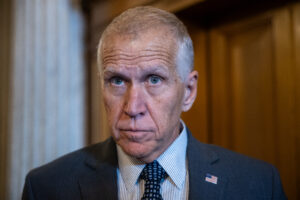
- Sen. Thom Tillis rails against Trump’s fixation on voting legislation
- Sen. Bill Cassidy on Trump: ‘Sometimes he acts as if Congress is merely an appendage’

- GOP leaders cancel Friday votes as House agenda hangs in balance

- Raskin launches discharge effort to formally block ‘Anti-Weaponization Fund’
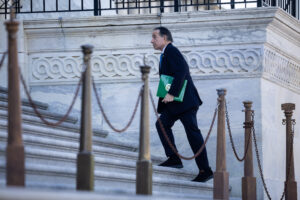
- Johnson-backed plan to combine Pentagon and election bills advances to floor
- Johnson says he will send housing bill to Trump on Monday
- Pentagon and elections bills could be combined in bid to unfreeze House floor
- Johnson says he will send housing bill to Trump on Monday
- Top Trump officials face bipartisan questions in first all-member Iran briefings
-

 Politics1 year ago
Former ‘Squad’ members launching ‘Bowman and Bush’ YouTube show
-

 The Dictatorship1 year ago
Luigi Mangione acknowledges public support in first official statement since arrest
-

 Politics1 year ago
Former Kentucky AG Daniel Cameron launches Senate bid
-
Uncategorized2 years ago
Bob Good to step down as Freedom Caucus chair this week
-

 The Josh Fourrier Show2 years ago
DOOMSDAY: Trump won, now what?
-

 The Dictatorship1 year ago
Pete Hegseth’s tenure at the Pentagon goes from bad to worse
-

 Politics1 year ago
Blue Light News’s Editorial Director Ryan Hutchins speaks at Blue Light News’s 2025 Governors Summit
-

 The Dictatorship10 months ago
Mike Johnson sums up the GOP’s arrogant position on military occupation with two words