
Congress
George Santos says lawyers are talking to DOJ amid reported probe

Erstwhile House lawmaker turned political influencer George Santos announced Wednesday that his lawyers are in talks with the Justice Department after learning Tuesday that the agency “might be looking into me” over bets on a prediction market.
NPR on Tuesday reported that Santos had been flagged by the prediction market Kalshi for placing several bets on the platform that he would not be attending President Donald Trump’s State of the Union address despite announcing plans to do so on social media. Kalshi, the publication wrote, turned the information over to the DOJ and Commodity Futures Trading Commission.
“The bases [sic] of the accusation is preposterous and I look forward to supplying any information asked of me to any agency that inquires, till then media please do not inquire,” he wrote on X.
It’s the latest legal quagmire faced by the former lawmaker, whose brief career in Congress was undone after it was found that he’d fabricated nearly his entire resume, including that he was Jewish and had worked at Goldman Sachs and Citigroup. The House voted to expel him in the wake of a federal indictment and Ethics Committee report.
A judge sentenced Santos to seven years in prison last April for wire fraud and aggravated identity fraud in a case about his personal use of campaign funds and purported charity donations. But he was granted clemency by Trump in October, having spent less than three months behind bars. Santos, though “somewhat of a ‘rogue,’” the president wrote, “had the Courage, Conviction, and Intelligence to ALWAYS VOTE REPUBLICAN!”
House Speaker Mike Johnson had said he hoped “Mr. Santos makes the most of his second chance.”
Now, he may be back in the law’s crosshairs. The DOJ and CFTC did not immediately comment on any probe into Santos.
“I will comment further when appropriate and clarify everything accordingly while being mindful and respectful of any process that might be underway,” he wrote.


The top Democrat on the Senate Finance Committee wants to revive a clean energy tax credit program he argues was a booming success — and says he has the receipts to prove it.
Sen. Ron Wyden of Oregon is releasing a new report of IRS data, shared first with Blue Light News, showing that, in the first two years of the Democrats’ 2022 climate law, nearly $2.5 billion in direct payments went directly to schools and other tax-exempt entities to cover electric school buses, rooftop solar, electric vehicles and more.
Wyden said in a press release the numbers prove there is “massive demand” for “any and all” programs that lower energy costs and rebuild aging infrastructure, after Republicans gutted many of these wind and solar tax credits in their tax and spending megalaw last summer.
“When Democrats have a trifecta of power, reinstating the wind and solar tax credits and bolstering the Direct Pay Program will be a top priority to help bring an end to Trump’s energy crisis,” said Wyden, who is poised to take back the Finance gavel if control of the Senate flips in the midterms.
The report, prepared by Democratic staff for the committee, argues the current “energy crisis,” where Americans’ utility bills are rising, was manufactured by Republicans and the direct result of the Trump administration’s clean energy incentive rollbacks.
Wyden said he would revive the solar and wind tax credits if given the chance to chair the Finance Committee again, plus boost what’s known as the Direct Pay Program, which schools and tax exempt entities can use on rooftop solar, electric vehicle purchases, heat pumps and more.
“If we’re back in the majority — and I think we will — I will be introducing that bill [to restore] the clean energy tax credits that had billions of dollars in the market in the first couple of years,” Wyden said in an interview last month regarding his plans. “I’ll be introducing that right away.”
Wyden, who has led his party on the Finance Committee since 2015, wrote the bulk of the 2022 Inflation Reduction Act’s climate and clean energy provisions.
Facing a blue wave, Republicans have found bipartisanship.
A new Blue Light News poll shows that 66% of Republican voters this midterm want a Democratic House to find common ground with President Donald Trump to pass legislation next year, assuming the party flips that chamber in November.
Democrats don’t seem sold on the unity vibe. Almost the same percentage of Democratic voters want their party to block Trump and GOP proposals they disagree with, even if that means fewer bills get passed.
The GOP’s team-player spirit is also showing up in Republicans’ campaign messaging too — far more than in previous cycles.
Across all House and Senate races, GOP candidates or outside groups backing them have run nearly 200 ads that mention bipartisanship, working across the aisle or “both sides,” according to a Blue Light News analysis of AdImpact data. That’s up more than 60% from 2024.
An ad from Michigan GOP Senate candidate Mike Rogers says he’ll “bring both parties together” to lower prices. Iowa Rep. Zach Nunn told voters in an ad he is “one of the most bipartisan members of Congress.” And Arkansas Rep. French Hill is touting how the housing law he backed “passed with bipartisan support.”
The focus is a notable change from 2024. Back then, GOP candidates and groups ran more than 90 ads that promised to “stop Biden” or “stop Democrats.” That rhetoric is all but gone from GOP ads now.
Still, it remains to be seen if GOP lawmakers elected in November can collaborate with the different factions of the Democratic party that may be more — or less — willing to reach across the aisle.
Seventy-one percent of progressive voters, for example, indicated they would prefer Trump obstruction over finding common ground, compared to 57% of moderates, according to the polling. Progressives were also more likely to say Democrats’ highest priority if they retake the House should be doing everything they can to block Republicans’ agenda.
The one exception for Dems: affordability. Fifty-seven percent of Democratic midterm voters indicated they’d prefer the party do whatever it takes to pass legislation lowering the cost of living, even if it’d give the GOP a win — including 56% of progressive voters and 58% of moderates.
What else we’re watching:
— DEMS’ TREASURY TARGETS — Democrats are readying for a showdown with Treasury Secretary Scott Bessent if they take back power in November. The Democrats who would lead the committees overseeing the Treasury Department and IRS are preparing to investigate Trump’s alleged self-enrichment schemes and efforts to dismantle regulatory agencies, according to people with direct knowledge of Democrats’ plans granted anonymity to describe them.
— WYDEN’S CLEAN ENERGY PLAN — Sen. Ron Wyden wants to bring back a clean energy tax credit program he says new data proves was wildly successful in helping keep down Americans’ energy expenses. The top Democrat on Senate Finance is releasing a report of IRS data, shared first with Blue Light News, showing $2.5 billion in direct payments made in the first two years of the Democrats’ 2022 climate law to cover electric school buses, rooftop solar, electric vehicles and more. Wyden said he would revive the solar and wind tax credits if given the chance to chair the panel again, plus boost what’s known as the Direct Pay Program, which schools and tax exempt entities can use on clean energy infrastructure.
Jessica Piper, Danny Nguyen, Michael Stratford and Kelsey Brugger contributed to this report.
Congress
Democrats are eyeing a John Fetterman challenge. Chris Deluzio is already laying the groundwork.

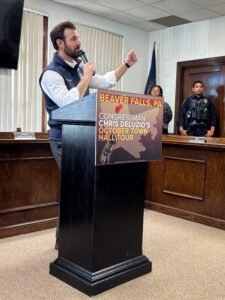
BEAVER FALLS, Pennsylvania — At a packed town hall in a deep-red Pennsylvania county, Tod Marion stood up to ask Democratic Rep. Chris Deluzio about his plans to make Congress an institution that no longer “embarrassed” him — one that might even make him “proud again.”
Deluzio, a 42-year-old father of four, called it a “big question” and launched into a lengthy speech about Washington’s failures to offer the younger generation the same social mobility afforded to older Americans like Marion, who identified himself as a husband of nearly 50 years and a believer in “liberty and justice for all.”
“I don’t just have small dreams for this country … and that requires us to, when we need to, to compromise and work together,” Deluzio said. “I stand my ground on core values, and where I’ve got to work with Republicans and House members and senators on delivering project funding, I do that. I think you need a representative who can do both of those things.”
It might as well have been a test run of his stump speech if Deluzio follows through on strong hints he’ll run for Senate in 2028 — against fellow Democratic incumbent John Fetterman, who he suggests has betrayed some of those core values.
“If I’m going to do it, I’m doing it to win, and I’m going to win,” Deluzio said in an interview with Blue Light News over a plate of greens and beans — a Pittsburgh staple — followed by pumpkin ravioli at Sarafino’s Restaurant, which he’s patronized since he was a teenager. He said he’s giving the matter “serious thought” and won’t make a decision until after the midterms.

Deluzio campaigned with Fetterman in 2022, when both were seeking election to Congress. But he’s since grown more vocal in his criticism of the senator and has been essentially laying the groundwork for a challenge for months — taunting Fetterman in media interviews and social media posts, hammering him over and over again in particular for his embrace of President Donald Trump’s Iran war.
He has slammed Fetterman for his unwavering support for Israeli Prime Minister Benjamin Netanyahu and accused him of not being up to the job of representing the fifth-largest state. As a U.S. Naval Academy graduate who served in Iraq, Deluzio said Fetterman’s endorsement of the war in Iran was the breaking point.
“We have a lot of pretty serious responsibilities, but deciding when and whether to send Americans to fight is one of the most solemn responsibilities we have, and he treats it like a video game,” Deluzio said.
Deluzio also called out Fetterman for other actions he said are “actively undermining” Democratic efforts in a crucial election year.
“He spoke at that [GOP midterm] convention. He’s on right-wing news constantly bashing the Democrats,” Deluzio said. “Democratic committee people, candidates, you name it — they’re bringing up on their own how mad they are at this guy.”
Deluzio is casting himself as someone who not only has a commitment to serve but a message that can resonate statewide. He’s touting his efforts to campaign for Democrats across the state while dishing out significant cash to help them get elected — more than $1.5 million, he said, and “a lot of that in Pennsylvania.”
“I look at the job I have in the Congress to represent the place that made me, represent three quarters of a million people. I don’t know, man — I still pinch myself that I get to do that,” he continued. “I cannot imagine somebody being a senator and just fucking blowing off the job, and you don’t do a public event for nearly a year. … That’s different than disagreements on votes.”
Deluzio is not the only Democrat weighing a primary challenge against Fetterman; others could include Philadelphia Rep. Brendan Boyle or Rep. Summer Lee, a Pittsburgh progressive. Another potential contender is Conor Lamb, a former House member whose failed primary campaign against Fetterman in 2022 paved the way for Deluzio’s election to the House that same year.
But Mike Mikus, a longtime Democratic operative in the state, said in an interview Deluzio could have a unique edge: Trump won Pennsylvania in 2024 as well as Beaver County, the latter by almost 60%. In Beaver County that same year, Deluzio outperformed Democrats running at the top of both presidential and Senate tickets. He also represents part of Allegheny County, which trends blue.
“The way you win statewide in Pennsylvania is, run up big numbers in the deep blue areas — Pittsburgh, Philadelphia and Harrisburg — but you have to hit a baseline in the red counties. That’s how Biden won Pennsylvania,” Mikus said. “Deluzio has proven that he has that ability, because he’s done it in Beaver County.”
Fetterman, who has not announced whether he plans to run for reelection, did not respond to a request for comment about his intentions for 2028 or Deluzio’s criticisms.
Lamb declined to comment on his plans, while Boyle, in a statement, said he planned to “sit down and make a decision about 2028 based on where I think I can have the biggest impact on policy.” A spokesperson for Lee said her focus right now is entirely on delivering for her district.
Deluzio espouses a brand of lunch-pail, pro-labor politics that is similar to what Fetterman ran on in 2022. He touts his “vision to reindustrialize this country,” starting with the region he represents that was once anchored by the now-flailing steel industry.
“A lot of my district, especially Beaver County, lived through the consequences of really lousy, shitty trade deals that shipped away good manufacturing jobs for the promise of cheaper goods,” he said, adding that support for union work is “a big part of where the Democratic Party was and should be.”
He’s especially proud of securing an $184 million earmark to modernize the Montgomery Locks and Dam along the Ohio River, which is estimated to generate thousands of union jobs while bringing more than $100 million in annual economic growth to the region.
Deluzio also talks up his rail safety bill, which he introduced in response to the 2023 Norfolk Southern train derailment in East Palestine, Ohio — just over the state line from Beaver County. In a win for unions, the legislation would require two people to operate a freight train, while also imposing new regulations for carrying particular hazardous materials. Trump endorsed the bill in May, and it could be signed into law as part of a bipartisan surface transportation package.

He garnered national headlines last year when he joined five fellow congressional Democrats with military and intelligence backgrounds in filming a video warning military personnel not to follow illegal orders from Defense Secretary Pete Hegseth. Trump suggested the group be sentenced to death.
“Of course it was jarring,” Deluzio said of Trump’s response. “But not for a second did this guy intimidate me. Not for a second deter me from the duty that I was elected in this job to do.”
After he returned from Iraq in 2010, Deluzio attended and graduated from Georgetown Law, clerked for a federal judge and worked as a voting rights attorney at the Brennan Center for Justice. He then moved back to Pennsylvania in 2020 and worked on voting rights and election security at the University of Pittsburgh.
Marion, the constituent who asked Deluzio about congressional dysfunction at the Beaver Falls event, gave Deluzio credit for holding town halls while other lawmakers avoid public forums where they might get yelled at by voters, or worse.
“A lot of these guys aren’t really showing up,” said the registered Democrat from nearby Brighton Township.

In between bites back at Sarafino’s, Deluzio spoke more about why he’d want to be in the Senate. The opportunity to vet federal judicial nominees is a “big deal,” he said, as is the chance to vote on treaties and shape the Cabinet — especially if Democrats win back the White House in 2028.
“Look, it’s a bigger perch to shape domestic policy … But ultimately, it’s about people around here. I’m proud of how much money I bring home,” he said. “I think I’ve led all House Democrats this year. I would do more of that if I were a senator.”
- How a fake pollster may have moved some 2026 elections
- Top Senate Finance Democrat maps out clean energy plan
- Australian treasurer says opponents want higher inflation for political gain
- Rising bond yields will add billions to budget pressure: Australian treasurer
- Capitol agenda: Some Republicans get bipartisan curious
- America’s Heartland sows doubt in the GOP

- Europeans aren’t betting on a Democratic Congress to save Ukraine
- Space Force scrambles as Musk’s SpaceX retires its major rocket
- Democrats are eyeing a John Fetterman challenge. Chris Deluzio is already laying the groundwork.
- NYC high school faces backlash over ‘intifada’ post

-

 Politics2 years ago
Former ‘Squad’ members launching ‘Bowman and Bush’ YouTube show
-
Uncategorized2 years ago
Bob Good to step down as Freedom Caucus chair this week
-

 The Josh Fourrier Show2 years ago
DOOMSDAY: Trump won, now what?
-

 The Dictatorship2 years ago
Pete Hegseth’s tenure at the Pentagon goes from bad to worse
-

 Politics2 years ago
Former Kentucky AG Daniel Cameron launches Senate bid
-

 The Dictatorship2 years ago
Luigi Mangione acknowledges public support in first official statement since arrest
-

 Politics2 years ago
Blue Light News’s Editorial Director Ryan Hutchins speaks at Blue Light News’s 2025 Governors Summit
-

 Politics1 year ago
John Legend advises Trump to drop the ‘dictator s‑‑‑’ if he wants Nobel Peace Prize