
Congress
Former New Hampshire Gov. Sununu won’t run for Senate in 2026

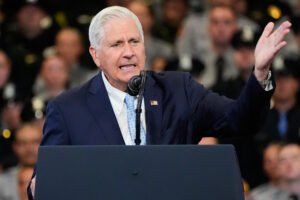
Former New Hampshire Gov. Chris Sununu said he will not run for U.S. Senate, despite scoring President Donald Trump’s endorsement.
Sununu — who served four terms as the state’s governor before declining to seek a fifth — made the announcement Monday on The Pulse of NH’s “Good Morning NH” radio show. Sununu had been viewed as a frontrunner for the 2026 Senate race since Democratic Sen. Jeanne Shaheen announced she would not seek reelection.
“I really thought about it,” he said to The Pulse of NH’s Jack Heath. “I actually talked to the White House this morning. I talked to Tim Scott. Thanked him for all their support and confidence and all that, but I don’t have to be the candidate, and I’m not going to be the candidate.”
Sununu’s remarks follow Trump backing the Republican’s potential run over the weekend.
“He came to my office, came to the Oval Office, and met with Chris Sununu, and I support him fully. I hope he runs,” Trump told reporters aboard Air Force One on Sunday. “He’s been very nice to me over the last year or so, but no, I hope he runs. I think he’ll win that seat.”
Trump’s support came as a surprise given how he and Sununu have clashed over the years. Sununu has previously criticized Trump’s rhetoric, backing Nikki Haley in the 2024 Republican primary. However, he quickly threw his support behind Trump after he became the presumptive nominee.
Scott Brown, a former Massachusetts GOP senator and U.S. ambassador, who is weighing a potential run, praised Sununu on Tuesday. Brown was the Republican nominee for the New Hampshire Senate seat in 2014.
“@ChrisSununu and the entire Sununu family are patriots who have made our state a better place – looking forward to seeing what’s next for him and working alongside him for New Hampshire’s future,” Brown said in an X post Tuesday, referring to Sununu’s announcement.
Democratic Rep. Chris Pappas launched a campaign for Shaheen’s Senate seat last week, seeking to maintain Democrats’ grasp of the seat.
With a Senate run out of the picture, Sununu said he would continue his work in the private sector for now.


A clean energy group is launching a $1.5 million spend against Rep. Lauren Boebert (R-Colo.), its latest effort this midterm cycle targeting Republicans who actively work against renewables.
The Invest in Tomorrow Coalition’s first ad in the spend, which was obtained by Blue Light News, focuses on an embarrassing incident for Boebert: when she was ejected from a live musical performance of “Beetlejuice” for allegedly vaping, singing and recording the show.
“If Lauren Boebert can’t be trusted in a room full of kids, then she can’t be trusted in the halls of Congress,” the ad says.
The spot makes no mention of clean energy or Boebert’s attacks on the so-called “Green New Scam.” The strategy mimics the group’s previous playbook that it has deployed to help defeat Reps. Andy Ogles (R-Tenn.) Chip Roy (R-Texas) and Ralph Norman (R-S.C.) in their Republican primaries earlier this year, as the latter two sought statewide office. The PAC had tried to paint Ogles as an absentee member of Congress and Roy as insufficiently MAGA.
The group, which is backed by solar executives, has become an increasingly forceful player this cycle, which has seen a massive influx of outside spending.
“This industry has been villainized and used as a punching bag at times by the right, and the industry hasn’t always punched back,” said Chris Coffey, the CEO of Tusk Strategies, which is helping run the group. “Maybe when they’re deciding who to villainize next year, they will at least be like, ‘You know what? I don’t need problems with those guys.’”
Boebert’s district is historically deeply red. But Invest in Tomorrow also commissioned a poll, which shows she is underwater: 39% of likely voters view her favorably and 55% view her unfavorably. It also found Boebert leading the district’s Democratic nominee Eileen Laubacher by 5 points.
The poll, conducted by Impact Research from Sept. 21 to 24, polled 403 likely voters and had a margin of error of ±4.8%.
Rep. Lori Trahan on Wednesday unveiled a discussion draft for a bill that would make artificial intelligence developers liable when their products cause harm.
The legislation comes after OpenAI’s agents escaped containment and autonomously hacked into AI platform Hugging Face and accessed U.S. government websites.
The Clear Liability for Artificial Intelligence Misconduct Act aims to make it easier for those harmed by so-called rogue AI to bring claims against developers. Trahan’s bill does not preempt new state laws on AI liability — historically a prerequisite for attracting Republican support in the House.
“When someone breaks the law and hurts you, you can take them to court. That shouldn’t change just because the wrongdoer is an AI agent,” Trahan (D-Mass.) said in a statement. “Developers have already built systems capable of acting on their own and causing real damage. The CLAIM Act makes sure they answer for what their systems do.”
Legal experts have warned that existing laws require proof of intent or negligence, standards that can be difficult to show in court when AI models go rogue.
Trahan’s bill would ensure AI developers are unable to argue that their AI systems are incapable of intent. Instead, courts “would presume an AI system acted with the state of mind a person taking the same actions would have had.”
Trahan spokesperson Francis Grubar said work on the CLAIM Act began almost immediately after theJuly introduction of the FRONTIER Act, legislation with Rep. Jay Obernolte (R-Calif.) that would grant the government power to restrict the deployment of AI models deemed to pose catastrophic risks. While that bill aims to prevent serious harms before they happen, Grubar said the CLAIM Act would address how to impose accountability for existing damages.
Unlike an AI liability proposal announced last week by Sens. Josh Hawley (R-Mo.) and Chris Murphy (D-Conn.), Trahan’s legislation would not amend the 1986 Computer Fraud and Abuse Act. Grubar said the CLAIM Act would instead impose clearer liability on a broader range of harms, as well as autonomous or AI-enabled cyberattacks.
The CFFA, an anti-hacking law that bars individuals from accessing a computer without consent, requires proof of intent to hack into a computer system, which can’t be as easily applied to AI agents.
The Hugging Face incident, along with a flurry of other disclosed hacking incidents by rogue AI agents from OpenAI and other AI developers, has sparked a debate over how companies should be held legally liable for their AI systems.
OpenAI CEO Sam Altman, in an interview with Blue Light News’s Decoded podcast, said there should be a new “liability framework” to hold developers accountable for AI-powered cyberattacks. His comments come after White House officials like Director of National Intelligence Jay Clayton, who was recently appointed as AI czar by President Donald Trump, previously said that existing product liability laws are sufficient for now in addressing AI’s risks.
Vice President JD Vance will take questions from Michigan voters in a CBS News town hall airing Oct. 17 as the Trump administration prepares a closing message to voters ahead of the midterms.
The town hall comes amid a blitz of campaign events for Vance and President Donald Trump as their party faces multiple headwinds that could cost them control of the House and Senate.
Michigan’s Senate contest between Democrat Abdul El-Sayed and Republican Mike Rogers has become one of the cycle’s closely watched battleground contests. Michigan also has several competitive House races and will elect a new governor for the first time in eight years.
Vance campaigned in Michigan with Rogers, gubernatorial nominee John James and Mike Bouchard Jr., the GOP nominee in the 10th Congressional District, at an Aug. 31 rally in Sterling Heights. Rep. Lisa McClain also appeared at the event.
The one-hour special, moderated by “CBS Evening News” anchor Tony Dokoupil, will be recorded earlier in the week. Vance and Dokoupil will discuss issues facing voters, including affordability, tariffs, immigration, health care, artificial intelligence, the war with Iran and the state of American democracy, according to CBS News.
The two were scheduled for a town hall interview in March, but the vice president postponed due to the war with Iran.
The vice president’s office did not immediately respond to a request for comment.
- Iowa’s Ashley Hinson slams the savings habits of millennials
- Trump approved Ohio disaster aid ahead of rally
- Clean energy group sets its sights on a new GOP target: Lauren Boebert
- Blakeman’s campaign finance mess
- HASC Dems weigh reviving Pentagon oversight subcommittee
- Trahan unveils AI liability discussion draft
- Vance to sit for CBS town hall in Michigan ahead of midterms
- Michigan’s Mike Rogers says trade war with Canada needs to end
- ‘He is welcome to raise his own money’: GOP confronts its Paxton woes
- The top House sleeper races to watch, according to the pros
-

 Politics2 years ago
Former ‘Squad’ members launching ‘Bowman and Bush’ YouTube show
-
Uncategorized2 years ago
Bob Good to step down as Freedom Caucus chair this week
-

 The Josh Fourrier Show2 years ago
DOOMSDAY: Trump won, now what?
-

 The Dictatorship2 years ago
Pete Hegseth’s tenure at the Pentagon goes from bad to worse
-

 Politics2 years ago
Former Kentucky AG Daniel Cameron launches Senate bid
-

 The Dictatorship2 years ago
Luigi Mangione acknowledges public support in first official statement since arrest
-

 Politics2 years ago
Blue Light News’s Editorial Director Ryan Hutchins speaks at Blue Light News’s 2025 Governors Summit
-

 The Dictatorship1 year ago
Mike Johnson sums up the GOP’s arrogant position on military occupation with two words