
Congress
Florida Democrat Frederica Wilson not running for reelection

MIAMI GARDENS, Florida — Rep. Frederica Wilson, a Democrat from Florida known for championing education causes and expanding opportunities for Black communities, announced Friday she will not seek reelection.
During a street-naming ceremony in her honor next to the elementary school where she once served as principal, the 83-year-old said, “This has been a journey. But it’s time. It’s time.”
“I know all of you are saying, ‘What is the congresswoman going to do?’ Well, the congresswoman is going to not seek another term,” she said to a collective “aw” from the crowd gathered.
Wilson’s announcement makes her the latest in a line of aging members of Congress to choose not to run again ahead of November’s midterm elections. It also comes amid growing challenges to Black political power in the wake of the Supreme Court’s ruling gutting the Voting Rights Act. As Republicans rush to redraw congressional maps ahead of this year’s midterm elections, the Congressional Black Caucus — of which Wilson is a member — is poised to lose up to one-third of its members.
Florida earlier this month approved a new map heavily favoring Republicans, though Wilson’s Miami-based district remains a blue stronghold. State Sen. Shevrin Jones, a Democrat from Miami Gardens, announced Wednesday he wouldn’t be running for reelection for the Legislature in November. He is seen as one of the lead contenders for Wilson’s seat and would be the first openly gay member of Congress from Florida if elected.
Wilson is one of the most recognizable members of the House, known for a distinctive style that includes brightly colored clothing and matching cowboy hats. She had previously denied rumors that she was retiring, calling them “crazy.”
“I’m almost distraught,” she told Axios last week. “It’s not true. I am still planning on running.”
Wilson then conducted an exclusive interview with the Miami Herald that published Friday, in which she explained she’d tried to be “politically strategic” about her announcement given GOP redistricting. She added that she felt the weight of the decision given that her predecessor was Carrie Meek, a Black leader, saying, “I didn’t want to gamble on this seat being taken away from us.”
“I figured if I announced that I was retiring, what would the Legislature and the governor do? What would they say? Would District 24 be an easy target because Frederica is no longer there? I’m a strong candidate,” she said. “With me not here, would that weaken the survival of District 24?”
She also told the Herald that she wasn’t ready to endorse a successor yet but indicated she would be vetting candidates to make a decision.
The street-naming ceremony honoring Wilson on Friday featured numerous Miami-Dade County officials from both parties, with a packed audience gathered under a tent next to an elementary school named after the lawmaker. She wore a light pink suit with rhinestone embellishments and a cowboy hat to the event and said when she took the stage that the ceremony represented a “bookend” to her political career.
She also joked that the elementary school named after her would be easy to find now because it was on a street also named after her.
Speakers repeatedly raised her mentoring program for boys of color, which began when she was a school board member and is known as the “5000 Role Models of Excellence Project.” It has helped thousands of men obtain higher education degrees. Wilson said Friday she would be traveling across the U.S. to spread the program in other parts of the country.
“A street just isn’t enough,” said Miami-Dade County Commissioner Oliver Gilbert, who is also among the names talked about for the seat, while praising her work on youth mentorship in the state. “We’re here because you’re not just an elected official — there are a lot of elected officials — not just a leader; you’re a living legend.”
Miami-Dade County Commission Vice Chair Kionne McGhee also took the stage and talked about how Wilson’s mentorship program changed his life. “It was this woman who looked at young boys who were told that they would never amount to anything and told them that they too can walk the halls of Congress — and not only walk the halls of Congress but effectuate policies that would dictate the future of their children,” he said.
Wilson, whose district encompasses parts of Miami-Dade and Broward counties, has served since first winning election in 2010. She previously worked as a teacher, principal, school board member and in the Legislature, where she overlapped with now-Secretary of State Marco Rubio — whom she called a “dear, dear friend” — and pushed to require Florida public schools to teach African American history. She spoke extensively about her experience during Friday’s event.
She has served as the ranking Democrat on the House Transportation Water Resources and Environment Subcommittee and as a member of the House Education and Workforce Committee.
Following the murder of George Floyd by Minneapolis police officers in 2020, Wilson introduced legislation to create the U.S. Commission on the Social Status of Black Men and Boys and later served as the agency’s chair.
During President Donald Trump’s first term, Wilson criticized the president as insensitive after a call he made to the widow of a South Florida soldier killed in Niger.


House Minority Leader Hakeem Jeffries inched closer to calling for embattled Defense Secretary Pete Hegseth’s impeachment over the weekend, pledging to take action if President Donald Trump doesn’t remove him.
“It means that we’re going to hold him accountable in the same way that we held Pam Bondi and Kristi Noem accountable,” Jeffries said to MS NOW on Saturday. “And Pete Hegseth needs to be pushed aside by the president, or we’re going to have to deal with that situation if he is not.”
The House minority leader, however, stopped short of explicitly committing to launching or supporting an impeachment of Hegseth, who has drawn ire from lawmakers in both parties.
The House could vote on articles of impeachment filed by the outgoing Rep. Thomas Massie (R-Ky.) as soon as lawmakers return to Washington after the midterms. Asked about his support, Jeffries said he will “act consistently” with his repeated calls for Trump to fire Hegseth.
Massie pledged to reintroduce articles of impeachment against Hegseth when Congress returns to Washington in a post on the social media site X on Monday morning.
Jeffries’ office did not immediately respond to a request for comment.
Democrats, who are favored to take control of the House after the midterms, have vowed to go after Trump officials and allies using their oversight powers. The Pentagon has been a particularly prominent target, including over the war in Iran and allegations of war crimes, scrutiny of Pentagon business dealings and the removal of senior military officers.
“Hegseth and crew better buckle up and lawyer up because we are coming at them full on,” Rep. Pat Ryan (D-N.Y.) told Blue Light News last month. “It’s incredibly aggressive oversight because this is by far the most corrupt and least transparent Pentagon, I think, we’ve ever had.”
The secretary is also in hot water with the American public. Nearly two-thirds of 2024 Democratic voters and 20% of Republicans support his impeachment, according to data from The POLITICO Poll released earlier this month. Even 18% of MAGA Republicans say they favor Hegseth’s ouster.
“Hakeem Jeffries cheered on Joe Biden as he prioritized DEI and woke ideology at the Pentagon,” White House spokesperson Anna Kelly said in a statement. “Secretary Hegseth is doing a great job leading the Pentagon — and the results of Operations Epic Fury, Absolute Resolve, and Midnight Hammer [speak] for themselves.”
The Pentagon did not immediately respond to a request for comment.
Leo Shane III contributed to this report.
Bernie Sanders is already the most prominent voice on the American left. Now he’s on the brink of getting a powerful perch to do something about it.
Sanders is poised to lead Senate Health, Education, Labor and Pensions if Democrats flip the chamber next week — a chance to push the party further left and shape the next presidential contest in which he’s signaled he’s unlikely to be a candidate.
“If I have anything to say about it … the agenda of the Democratic Party is going to be extremely bold,” the 85-year-old independent said. “We’re going to do what the American people want.”
Sanders’ term runs through 2030, and with President Donald Trump in the White House for at least two more years, it’s unlikely many of his sweeping legislative dreams will be fulfilled anytime soon. But with a role atop the health panel, Sanders could leverage any Trump veto of his legislation along with his own oversight powers to paint the party’s priorities for voters heading into 2028.
He’s already signaling he would make a “Medicare for All” universal health plan a signature push next year.
As for labor matters, Sanders has said he would try to raise the minimum wage, advance legislation that would expand employees’ ability to unionize and also protect workers from artificial-intelligence-driven job loss.
On education, Sanders has called to make four-year public college tuition-free and to raise teacher pay.
During his first round with the HELP gavel in 2023 and 2024, Sanders’ legislative plans were stymied by a GOP-controlled House and more moderate Democratic colleagues.
But the Senate Democratic Caucus and the party writ large have moved closer toward Sanders since then, and several of the Senate’s 2028 White House hopefuls are from the left.
Sanders may also find himself with a GOP counterpart more willing to play ball to hold administration officials accountable. Sen. Lisa Murkowski — who has raised concerns about Health Secretary Robert F. Kennedy Jr. — could become the top Republican on HELP if Sen. Rand Paul continues to lead Homeland Security.
Joseph Geevarghese — the executive director of Our Revolution, which Sanders founded but is now an independent organization — added that a Chair Sanders “would put the affordability crisis at the center of what an opposition party should be doing” while extracting concessions from the Trump administration for working families.
“In that sense, he could become the party’s de facto leader,” Geevarghese added.
What else we’re watching:
— DEMS PLAN TRUMP TARGET FOR EPSTEIN PROBE — House Democrats are making increasingly clear they have no plans to abandon their line of inquiry into whether Trump was involved in Jeffrey Epstein’s sex trafficking ring, should they retake the majority in the midterms. A new report, titled “The Case Against Donald Trump Emerging in the Epstein Files and DOJ’s Desperate Efforts to Cover It Up,” lists five women who have accused Trump “of raping or sexually assaulting them” in the company of Epstein.
— BLANCHE ON ALASKA: ‘THERE COULD BE A CRIME’ — Attorney General Todd Blanche defended the newly filed lawsuit to prevent Alaska state officials from certifying November’s election results if Republican Sen. Dan Sullivan loses. In a Sunday BLN interview, host Dana Bash asked what crime the administration was arguing was being committed, Blanche replied, “It depends.” “There could be a crime,” said Blanche. “But the real wrong here is that Alaskans are going to be confused and will not have their vote heard.”
Jordain Carney, Chris Marquette, Cheyanne M. Daniels contributed to this report.
Bernie Sanders probably isn’t going to be president. But he might be about to get one last chance to define his legacy in Washington.
The Vermont independent is poised to lead the Senate Health, Education, Labor and Pensions Committee if Democrats can flip the Senate next month — giving the 85-year-old leftist icon a powerful perch he could use to promote his political movement and shape a 2028 presidential contest in which he has indicated he’s unlikely to be a candidate.
He will also have to balance his colleagues’ strong desire to hold President Donald Trump’s administration to account, particularly the Department of Health and Human Services under Secretary Robert F. Kennedy Jr. But he is making clear he plans to use his power to highlight systemic issues that go beyond the workings of any one agency.
“If I have anything to say about it … the agenda of the Democratic Party is going to be extremely bold. It is going to take on high costs,” Sanders said when asked about how he plans to use his prospective gavel. “The super PACs are not going to run the agenda anymore. We’re going to do what the American people want.”
Sanders’ term runs through 2030, and with Trump in the White House for at least two more years, it’s unlikely many of his sweeping legislative dreams will be fulfilled anytime soon. But he has long been comfortable using his power in the Senate to push Democrats — with whom he caucuses — further to the left.
During Joe Biden’s presidency, Sanders led the Budget Committee as Democrats pursued major party-line domestic policy bills. As part of a $1.9 trillion Covid relief package he helped shepherd, he tried unsuccessfully to include a $15 minimum wage hike.
He pushed the party to go bigger in what ultimately became the Inflation Reduction Act by backing a $6 trillion plan that would have beefed up the social safety net by adding, among other things, vision, hearing and dental coverage to Medicare. That vision was curtailed significantly as Biden and Democratic leaders struggled to secure the needed votes.
All the while, Sanders called hearing after hearing on big national issues that touched only indirectly on the federal budget — including climate change, income inequality and Amazon’s labor practices.
He also promoted a “Medicare for All” universal health plan. And now, with the possibility of gaining direct oversight of health matters, Sanders is signaling he intends to make it a signature push.
“The current system is broken, dysfunctional, and wildly expensive,” he told reporters last month. He followed up this month with a social media post warning Democrats that if they win back power there can be “no more failed establishment status quo policies.”
“If the Democratic Party thinks that they can just tinker around the edges once they take control of Congress, guess again,” he said.
The Senate Democratic Caucus and the party writ large have moved closer toward Sanders since his earlier tussles under the Biden administration. The moderates who forced Sanders and fellow progressives to scale back their ambitions have departed, and several of the Senate’s 2028 White House hopefuls are from the left.
Sen. Chris Van Hollen (D-Md.), who is flirting with a 2028 presidential bid and has been floated by some progressives as a future Senate leader, said “Medicare for All” is something a Democrat-controlled Senate should pursue.
“The reality is people are facing huge increases in premiums and copays. … So we need a Medicare-for-All-type solution,” Van Hollen said. “This is the kind of debate we need to have.”
In addition to health care — the oversight of which HELP shares with the Finance Committee — Sanders would have a big role to play in labor matters. He has said he would try to raise the minimum wage, advance legislation that would expand employees’ ability to unionize and also protect workers from artificial-intelligence-driven job loss.
“If I have anything to say about it, we’ve got to slow it down big time, “ Sanders said of AI. “The American people want us to pause.”
On education, Sanders has called to make four-year public college tuition-free and to raise teacher pay. But many Democrats are also eager to delve into Trump’s ongoing effort to downsize and ultimately eliminate the Education Department.
Sanders’ office produced an often-cited report showing that the department’s civil rights enforcement has plummeted. But some of the high-profile actions to rein in the Trump administration’s efforts to dismantle the department have been taken by other panel members.
Sen. Tim Kaine (D-Va.) struck a deal with outgoing the committee chair, Sen. Bill Cassidy (R-La.), tovote on legislation to block the offloading of certain key programs to other federal agencies. And it was Kaine who publicly prodded Cassidy to call a hearing with Education Secretary Linda McMahon.
During Sanders’ first round with the HELP gavel, in 2023 and 2024, his legislative plans were stymied by a GOP-controlled House. But he put a spotlight on rising health care costs by bringing in health care company CEOs to testify. He and Cassidy, then the top Republican on the panel, also led an effort to hold the CEO of a large hospital network that had declared bankruptcy in contempt of Congress after declining to testify.
Cassidy is leaving the Senate at the end of the year, and it’s not yet clear who will be his replacement as HELP’s top Republican. Sen. Rand Paul of Kentucky is next in line, but he could choose to continue leading the GOP on the Senate’s Homeland Security and Governmental Affairs panel instead, in which case the job could fall to Sen. Lisa Murkowski of Alaska.
Murkowski has raised pointed concerns with Kennedy’s leadership at HHS, which could generate some promising bipartisan oversight opportunities. Sanders could also find overlap with some committee Republicans who are AI-skeptical, like Sen. Josh Hawley of Missouri.
But Sanders’ supporters of the left see his potential ascension to HELP chair as an opportunity to push a progressive vision that could frame the future of American politics — not to pare down ambitions and cooperate with Republicans.
“He’s worked his entire life … on getting everybody health care as a human right and winning everybody a living wage,” Rep. Greg Casar (D-Texas) said in an interview, adding that Sanders is “going to make a huge difference next year.”
Joseph Geevarghese — the executive director of Our Revolution, which Sanders founded but is now an independent organization — added that a Chair Sanders “would put the affordability crisis at the center of what an opposition party should be doing” while using Trump administration oversight “to extract concessions and secure concrete gains for working families.”
“In that sense, he could become the party’s de facto leader,” Geevarghese added, “helping define Democrats as a party prepared to fight for working people while taking on Trump.”
Mackenzie Wilkes and Riley Rogerson contributed to this report.
- Jeffries edges closer to Hegseth impeachment as he eyes the gavel
- Why Dems’ late House reaches don’t usually pan out
- The Epstein election?

- ‘We don’t need 50 more data centers.’ Arizona AG declares war on AI.
- Capitol agenda: Sanders could soon get a Senate bully pulpit
- Electric vehicle tax credits losing their luster for Democrats
- House Judiciary Democrats want a special counsel to investigate Trump’s ties to Epstein
- Bernie Sanders could soon get a powerful perch to help shape 2028
- Spurned by Trump, these outgoing Republicans aren’t helping their potential successors
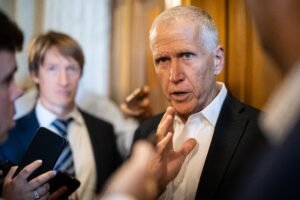
- Iowa’s Senate rivals pitch independence from their parties
-

 Politics2 years ago
Former ‘Squad’ members launching ‘Bowman and Bush’ YouTube show
-
Uncategorized2 years ago
Bob Good to step down as Freedom Caucus chair this week
-

 The Josh Fourrier Show2 years ago
DOOMSDAY: Trump won, now what?
-

 The Dictatorship2 years ago
Pete Hegseth’s tenure at the Pentagon goes from bad to worse
-

 Politics2 years ago
Former Kentucky AG Daniel Cameron launches Senate bid
-

 Politics1 year ago
John Legend advises Trump to drop the ‘dictator s‑‑‑’ if he wants Nobel Peace Prize
-

 The Dictatorship2 years ago
Luigi Mangione acknowledges public support in first official statement since arrest
-

 Politics2 years ago
Blue Light News’s Editorial Director Ryan Hutchins speaks at Blue Light News’s 2025 Governors Summit