
Congress
Elise Stefanik is Johnson’s latest challenge as he struggles to keep control of the House

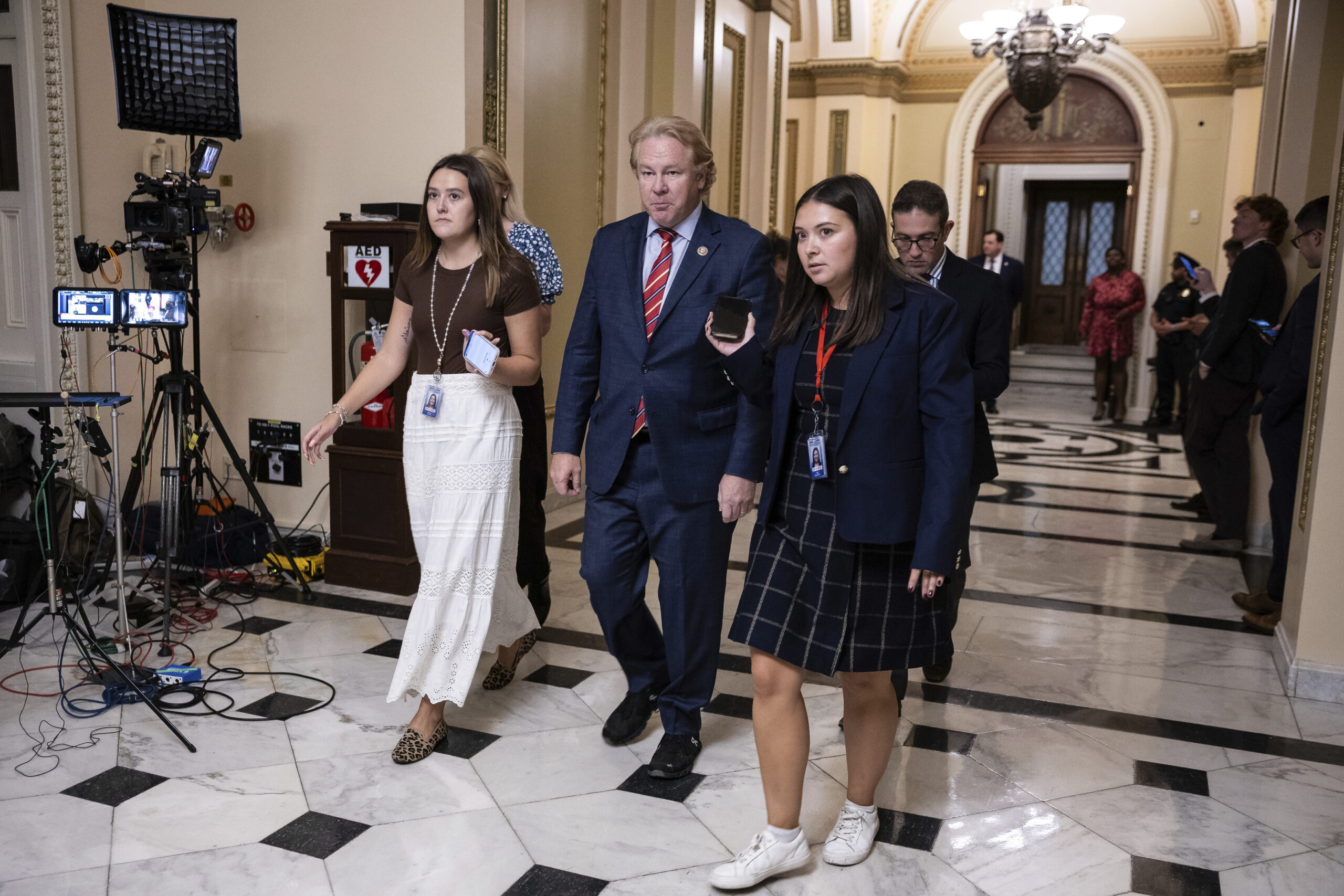
Even by the high standards of chaos for the 119th Congress, Speaker Mike Johnson being accused Tuesday by a member of his own leadership team of protecting the “deep state” was a remarkable development.
Rep. Elise Stefanik’s rare move to publicly accuse the speaker of being a liar and then, in a separate provocation, signing on to an effort to force a vote on legislation Johnson has kept bottled up is the latest symptom of a House Republican Conference seemingly on a razor’s edge.
Increasingly, rank-and-file House Republicans are bringing their spats with Johnson into the open, suggesting the speaker is losing further control over his restive members as his already slim majority threatens to narrow further and potentially devastating midterm elections loom.
Rep. Kevin Kiley (R-Calif.), who openly challenged Johnson’s decision to keep the House out of session for seven weeks this fall and criticized him for not pushing back on the GOP’s mid-decade redistricting campaign, said in a brief interview Tuesday that he saw Stefanik’s anger as part of broader trend.
“I do think that there’s a lot of frustration right now in the House with the effectiveness or lack thereof of this body in recent months,” he said. “The House has … in some cases ceded its own authority, hasn’t taken the lead on a lot of important policy measures and has even taken steps now to limit the agency of individual members.”
For much of his two-year tenure, Johnson has been able to keep a handle on the infighting thanks to President Donald Trump’s stranglehold on the Republican Party, with the president personally intervening at key points this year to settle internecine disputes.
But many sense that is changing as the speaker suffers public setbacks — such as his recent failure to prevent passage of a bill mandating the release of Justice Department files related to the late convicted sex offender Jeffrey Epstein. Things could fray further depending on how the GOP fares in Tuesday’s special election in Tennessee.
“That model only works if no one challenges him and gets away with it,” said one senior House Republican granted anonymity to speak frankly about conference dynamics. “And that’s not what’s happening now. … People are less willing to stay quiet.”
In particular, several high-profile GOP women have clashed with the speaker over various issues in recent months. Reps. Marjorie Taylor Greene of Georgia, Nancy Mace of South Carolina and Lauren Boebert of Colorado were instrumental in pushing through the Epstein bill. Rep. Anna Paulina Luna of Florida filed her second discharge petition of the year Tuesday, seeking to force a vote on a bill banning member stock trading that the speaker has so far declined to advance. And several women in the House GOP raised concerns about leaders’ handling of Rep. Cory Mills (R-Fla.), who is facing multiple accusations regarding his conduct and ethics.
Stefanik is in another category altogether. A year ago, she was the No. 4 House GOP leader before relinquishing her post in anticipation of her confirmation as ambassador to the United Nations. But Trump withdrew her nomination amid concerns about the thin GOP majority — a move for which Stefanik has privately faulted Johnson.
Johnson granted her an unelected junior leadership role as a consolation prize, but she has decided her political future will not lie in the House, launching a campaign for New York governor instead of seeking re-election. And now she appears to be all-in on a scorched earth campaign against the speaker.
“Elise is running for governor and frankly does not give a fuck anymore about playing nice,” said a second House Republican granted anonymity to speak frankly about the dispute.
The precipitating cause for Stefanik’s public outburst, in her telling, was a leadership-level decision to exclude legislation requiring that Congress be informed of counterintelligence probes into candidates for federal offices from the annual defense policy bill — a must-pass measure to which lawmakers are keen to attach their personal priorities.
After Stefanik posted her displeasure to her X account, Johnson tried to tamp down the furor Tuesday. The speaker, who sometimes jokes he’s more of a mental health counselor, told reporters he couldn’t understand why Stefanik “didn’t just call me” and that the two could have handled the dispute in private.
“Just more lies from the Speaker,” Stefanik retorted, again on X, mocking Johnson’s claims of ignorance. “This is his preferred tactic to tell Members when he gets caught torpedoing the Republican agenda.”
House Republicans close to Stefanik argue there are more GOP members who are upset about the congressional notice provision falling out of the Pentagon bill. Notably, House Judiciary Chair Jim Jordan (R-Ohio) said he had not yet thought about whether he would join Stefanik in withholding his support for the bill over its exclusion.
“We want this protection in there,” he told reporters. “I think it makes sense.”
Just hours after Stefanik’s comments, Johnson faced down a brief revolt over a procedural measure on the House floor led by hard-line Rep. Chip Roy (R-Texas) and other incensed Republicans that would have derailed GOP leaders’ floor plans for the week.
As that crisis was still unfolding, Luna launched her discharge petition to force a vote on a congressional stock trading ban — and Stefanik quickly announced she was signing on to the move undermining the speaker’s authority.
Members of Johnson’s leadership circle and other senior Republicans were privately shocked by Stefanik’s sharp public criticism of the speaker — and that she didn’t later decide to delete them — according to three people granted anonymity to describe conversations that unfolded Tuesday.
Johnson’s staff have reached out to Stefanik’s team and are seeking to resolve the spat privately, according to two other people with direct knowledge of the matter.
The speaker’s allies argue the disgruntled Republicans are just that — people with axes to grind against Johnson.
But Stefanik is getting backup from other malcontents inside the House GOP, including Greene, who was once seen as being on the opposite pole of the Republican conference. Both women were kept in close consultation by the previous speaker, Kevin McCarthy, and have since fallen out with Johnson.
After helping to engineer the successful Epstein files vote, Greene announced her imminent resignation — itself a slap at Johnson, given the tight GOP majority — and publicly railed against the House’s diminished power and Johnson’s speakership. She weighed in again Tuesday after Stefanik aired her accusations about the Pentagon bill.
“No surprises here,” Greene said in her own X post. “As usual from the Speaker, promises made promises broken. We all know it.”


The vast majority of congressional Republicans are publicly supportive of President Donald Trump’s decision to launch a war on Iran. But many are harboring private misgivings about the risks to American troops and global stability — as well as their own political fortunes — should the military campaign drag on indefinitely.
Trump’s comments this week that the bombing could last “four to five weeks” or more, that he doesn’t care about public polling and that the U.S. will do “whatever” it takes to secure its objectives are among the factors that have put lawmakers on edge.
Some of the anxieties have started emerging publicly.
“The constitutional sequence is, you engage the public before you go to war unless an attack is imminent. And imminent means like, imminent — not like something that’s been over a 47-year period of time,” Rep. Warren Davidson (R-Ohio), a former Army ranger, said Tuesday.
Rep. Eli Crane (R-Ariz.), a combat veteran who served in the Iraq War and has cautioned in the past against regime change efforts, called it “a very dicey, a very dynamic situation right now” on the Charlie Kirk Show Monday while also making clear he would give Trump deference.
“I hope it works out,” he added. “Military operations like this can go sideways so fast, you know, it will make your head spin.”
But a wider group of House Republicans granted anonymity to speak candidly shared deeper concerns about the strikes. All said they would stand with Trump and Speaker Mike Johnson this week to oppose a largely Democratic effort to force votes on restraining the president. But they said their support was not guaranteed over the long term.
“Most Republicans want clear objectives, clearer than they are now,” said one House Republican, who added members have pressed GOP leaders and White House officials to be more consistent in articulating the administration’s military goals.
Another was troubled by Trump’s own shifting statements on when the bombing campaign might wrap up, whether he is seeking the fall of the Islamic regime and whether ground troops might ultimately be necessary.
“Sounds a little bit like President Lyndon Johnson going into Vietnam, doesn’t it?” the lawmaker said.
Trump officials and top House GOP leaders have already moved to ease potential member concerns. Johnson, for instance, said leaving a classified briefing Monday that “the operation will be wound up quickly, by God’s grace and will.”
“That is our prayer for everybody involved,” he added.
A White House memo sent to congressional Republicans Monday outlined several military objectives for the bombing campaign and said Trump should be “commended” for taking on a hostile state sponsor of terrorism.
But despite denying that Trump had acted in pursuit of regime change, the document also said the Iranian regime “would be defeated” and included other contradictory statements about the reasons for the strikes — while trying to sidestep the question of whether the strikes constituted a “war,” a word Trump himself has used.
Beyond the fears of a prolonged military engagement that could be costly in dollars and American lives, Republicans are also facing the prospect of a stock market tumble and rising gas prices that could fall hardest on vulnerable incumbents ahead of the midterms. Many of those members promised their constituents, much as Trump did, that they would not engage in endless war.
The planned Thursday vote on a bipartisan war powers resolution has surfaced some of the GOP discomfort, even as party leaders and White House officials whip members against it — including those most at risk of losing their seats.
Rep. Thomas Massie (R-Ky.), who is co-leading the war powers push with Rep. Ro Khanna (D-Calif.), pointed to the White House memo as further evidence of incoherence on the administration’s part.
“So they’re going to defeat a terrorist regime that rules a country of 90 million people, but that’s not war?” he said in an interview.

Also raising concerns in advance of the vote is Davidson, who has long railed against extended U.S. wars abroad. He said in a social media post Monday it was “troubling” that Secretary of State Marco Rubio said Monday that an imminent Israeli attack on Iran forced the U.S. to strike. He also raised concerns to reporters Tuesday about some of the administration’s claims.
House Intelligence Chair Rick Crawford (R-Ark.) said in an interview Tuesday he didn’t think the war powers vote was necessary and that Trump was operating within his legal authority.
The vote, he said, was “a way for individuals to sort of register their displeasure or make a political statement.”
Even if the war powers measure is defeated, some Republicans say an effort to restrain Trump could reemerge if the conflict drags on or Trump commits ground troops to the conflict. “If we’re talking months, not weeks, then you will see another vote,” said a third House Republican who added that Trump had some “leeway” for now.
Johnson, meanwhile, is channeling any intraparty concerns about Trump’s war into another vote this week on a stalled Homeland Security spending bill — an attempt to keep the focus on Democrats’ opposition to funding for TSA, FEMA and other agencies as a department shutdown approaches the three-week mark.
He is also arguing, as he told reporters after a classified briefing Monday, that the war powers vote is “dangerous” at a moment when U.S. troops were in harm’s way and that Republicans would act to “put it down.” The strikes, Johnson added, did not need advance congressional approval because they were “defensive in nature.”
Those arguments have resonated with most House Republicans, who say they’re willing to give the president time.
“I think so far, the Pentagon seems to have a good plan,” said Rep. Jeff Crank (R-Colo.), a member of the Armed Services Committee who said he would give Trump “six weeks or … eight weeks or whatever we need to accomplish the missions that we set out.”
“The worst thing we could do is go in and then … to pull back or cut short, whatever our objectives are,” he added. “We’re there. We need to get the objectives finished.”
Congress
Former White House counsel Kathryn Ruemmler called to testify in House Oversight’s Epstein investigation
The House Oversight and Government Reform Committee is requesting that Kathryn Ruemmler, the former White House counsel under President Barack Obama and the exiting top lawyer at Goldman Sachs, speak with investigators about her relationship with convicted sex offender Jeffrey Epstein.
Ruemmler will soon resign from Goldman Sachs amid the mounting scrutiny over her close relationship with Epstein. Material released by the Justice Department revealed that Epstein called her when he was arrested for sex crimes.
“Due to public reporting, documents released by the Department of Justice, and documents obtained by the Committee, the Committee believes you have information that will assist in its investigation,” said Oversight Chair James Comer in a letter to Ruemmler obtained by Blue Light News.
He requested that she appear for a transcribed interview on the morning of April 21, but that date could be subject to change.
Goldman Sachs declined to comment. Ruemmler, through a spokesperson, has said she regrets knowing Epstein. She has not been charged with any misconduct.
The letter was reported earlier by The Wall Street Journal.
Ruemmler is one of a number of powerful public figures in the U.S. who has faced consequences for their relationships with Epstein.
Brad Karp, the former chair of the legal giant Paul Weiss, left his post atop the firm amid the fallout over his communications with Epstein.
Earlier Tuesday, Comer announced Commerce Secretary Howard Lutnick has agreed to speak with his panel after correspondence released by DOJ showed that Lutnick maintained ties to Epstein following the disgraced financier’s 2008 sex crime conviction.
Lutnick has not been charged with any wrongdoing.
President Donald Trump on Tuesday accused the banking industry of holding up landmark cryptocurrency legislation, writing on social media that Wall Street firms “need to make a good deal with the Crypto Industry” to unstick a pending digital asset bill in the Senate.
His post comes as White House officials are working to resolve a lobbying spat between the banking and crypto sectors over whether digital asset exchanges should be able to offer rewards programs that pay yield to users who hold dollar-pegged digital tokens known as stablecoins. The dispute has stalled pending crypto market structure legislation in the Senate.
“The Banks are hitting record profits, and we are not going to allow them to undermine our powerful Crypto Agenda that will end up going to China, and other Countries if we don’t get The Clarity Act taken care of,” he said, referring to the market structure bill, which would establish a new regulatory framework favorable to crypto companies.
Trump’s post is a win for the crypto industry, which is fighting against a lobbying effort by the banking industry to bar any type of yield payments on stablecoins. He effectively sided with the crypto industry’s position, writing that “Americans should earn more money on their money” — a line that crypto executives have used to argue in favor of their rewards programs. Banks warn that allowing consumers to earn yield on stablecoins could spark deposit flight from traditional financial institutions and threaten lending.
Despite Trump’s new position, the stalled market structure bill likely still does not have the votes to advance in the Senate without a resolution to the stablecoin yield fight that banks are satisfied with.
The talks over the issue, which are being mediated by White House crypto adviser Patrick Witt, have dragged on past an unofficial March 1 deadline by which administration officials hoped to resolve the dispute. The White House convened a series of meetings featuring representatives from the two industries, but an agreement has remained elusive.
“The U.S. needs to get Market Structure done, ASAP,” Trump wrote.
He also said a previously signed law dubbed the GENIUS Act, which created new rules for how stablecoins are regulated, “is being threatened and undermined by the Banks, and that is unacceptable — We are not going to allow it.”
The crypto industry “cannot be taken from the People of America when it is so close to becoming truly successful,” he wrote.
- House Republicans are publicly cheering Trump’s Iran war. Privately, many are worried.
- Democrats reject ‘ridiculous’ GOP demand to fund DHS after Iran attack
- Former White House counsel Kathryn Ruemmler called to testify in House Oversight’s Epstein investigation
- Trump takes aim at banks over crypto bill talks
- Trump is running out of time to sell his rationale for Iran war
- House Ethics trial for Cherflius-McCormick postponed as lawmaker seeks new lawyer
- House Democrats introduce alternative war powers resolution
- Mike Rounds seeks Pentagon briefing on Anthropic spat
- Lutnick agrees to testify in House Oversight’s Epstein probe
- Noem defends her leadership of DHS amid sharp questioning from senators
-

 The Dictatorship1 year ago
Luigi Mangione acknowledges public support in first official statement since arrest
-

 Politics1 year ago
Former ‘Squad’ members launching ‘Bowman and Bush’ YouTube show
-

 Politics1 year ago
Blue Light News’s Editorial Director Ryan Hutchins speaks at Blue Light News’s 2025 Governors Summit
-

 The Dictatorship6 months ago
Mike Johnson sums up the GOP’s arrogant position on military occupation with two words
-

 Politics1 year ago
Former Kentucky AG Daniel Cameron launches Senate bid
-

 The Dictatorship1 year ago
Pete Hegseth’s tenure at the Pentagon goes from bad to worse
-
Uncategorized1 year ago
Bob Good to step down as Freedom Caucus chair this week
-

 Politics11 months ago
Democrat challenging Joni Ernst: I want to ‘tear down’ party, ‘build it back up’