
Congress
Eleanor Holmes Norton is facing her most serious political threat in decades

Longtime Washington congressional Del. Eleanor Holmes Norton garnered her most serious political challenge in 35 years Thursday when Robert White, a third-term D.C. Council member and former aide to Norton, announced he would challenge her in next year’s Democratic primary.
Norton, 88, has faced mounting questions about her ability to serve in Congress that have been heightened in recent weeks by her absence from the public eye as President Donald Trump and congressional Republicans targeted the District of Columbia for a federal law enforcement takeover.
She has made some public appearances in recent weeks, including at a House Oversight and Government Reform Committee hearing Thursday where D.C.’s top elected officials testified about the city’s crime record. But she has largely stuck to reading written statements in an often halting voice. Amid doubts about whether she’s up for another term — including a public plea for retirement this week from her closest political adviser — Norton has repeatedly said she will seek re-election in 2026.
White, who was attending the House hearing, praised Norton’s political legacy in a brief interview. But, he added, “like most people in D.C., we recognize that she can’t do the things that she once did.”
“Right now, the District is vulnerable, and we’re losing ground,” White continued, “and with only one elected member in this entire Congress, we need somebody with the fight, the energy, and the know-how.”
Norton is already facing a primary challenge from former DNC official Kinney Zalesne, and additional candidates are expected to enter the race if Norton steps aside. But White is the first credible opponent with a citywide political profile to challenge Norton since she was first elected in 1990.
White has occupied the progressive lane in city politics, staking out political ground to the left of Mayor Muriel Bowser, whom he challenged in the 2022 Democratic primary. White fell just over 10,000 votes short in a four-person field and had been widely seen as likely to launch another mayoral campaign in 2026.
White sat in the back row of the Capitol Hill hearing room during the four-plus-hour House Oversight hearing with D.C.’s top elected officials: Bowser — who called Norton as “mighty warrior” in her prepared testimony — as well as D.C. Council Chair Phil Mendelson and D.C. Attorney General Brian Schwalb.
Norton, during her questioning time, defended the District’s right to self-government and asked the three officials to weigh in on why the city deserved statehood.
Most Republicans, however, pressed the city officials on their handling of crime in the District. GOP lawmakers have joined Trump in painting an image of the nation’s capital as rife with crime to justify an August presidential order commandeering the city police and flooding federal agents and National Guard troops into the city.
As local officials came under siege from Republicans on the Oversight panel, Norton sat silent at her dais. She entered and left the hearing room several times flanked by an aide, sometimes appearing to lean on the person for support.
Speaking outside the hearing room, White said that he had informed Norton of his intention to run for her seat, although he declined to detail Norton’s response in what he called a private conversation.
“We in the District who love the congresswoman and respect the work that she’s done — we know that she can’t fight the fight that we need right now,” White said, adding that he had met with 30 congressional offices since the presidential enforcement surge to discuss the need for a nationwide fight on behalf of the city.
That message largely echoes what Norton’s longtime adviser Donna Brazile wrote in a Washington Post op-ed this week urging her not to run. Norton, Brazile wrote, “is no longer the dynamo she once was, at a time when D.C. needs the kind of energetic representation in Congress she provided for decades.”


Congress
Trump apparently shares Tom Cotton’s phone number in push to make Daylight Saving Time permanent
President Donald Trump appeared to share Sen. Tom Cotton’s phone number in a Saturday morning social media post imploring the Arkansas Republican to get behind a bill to make Daylight Saving Time permanent.
“Almost everybody wants “The Sunshine Protection Act” to pass, except for Tom Cotton,” Trump wrote on Truth Social. “To the Great People of Arkansas, please let your Senator know it would be a GREAT Bipartisan WIN for the United States Senate, and for America, itself.”
The president has spent months personally pushing Senate Republicans to end the practice that sees Americans change their clocks twice a year, cementing more sunlight hours in the evening for all twelve months of the calendar. Cotton, whom Trump called “a friend of mine” in the Saturday post, has long argued that making daylight saving time permanent would leave children, farmers and other early risers in the dark for hours on winter mornings.
One of Trump’s key selling points on Saturday: the PGA tour.
“The PGA TOUR, as an example, needs more Daylight in the afternoon in order to finish their Tournaments,” he said, attaching a letter from PGA Tour CEO Brian Rolapp endorsing the bill. ”Likewise, regular Golfers, Tennis Players, Hunters and, perhaps most importantly, Farmers who want more Daylight to play or work.
A Blue Light News call to the cellphone number went to voicemail. A spokesperson for Cotton did not respond to a request for comment. The White House did not immediately respond to a request for comment.
The current version of the bill was introduced in the House in January 2025 by Rep. Vern Buchanan (R-Fla.), with Sen. Rick Scott (R-Fla.) leading the Senate version. The legislation would make daylight saving time permanent across most of the country, ending the twice-yearly clock changes. The legislation has been stalled in the Senate since July.
The president encouraged supporters of the bill, dubbed the “The Sunshine Protection Act,” to call Cotton to “let your Senator know it would be a GREAT Bipartisan WIN for the United States Senate, and for America, itself.”
During the 2016 Republican presidential primary, he publicly gave out the personal cellphone number of then-rival Sen. Lindsey Graham after the South Carolina Republican criticized him. Trump, who came to count on Graham as a reliable Senate ally after he won the presidency, revisited the moment during Graham’s funeral in July, acknowledging that sharing the number was something he “shouldn’t have done.”
Kelsey Brugger contributed to this report.
Sen. Bernie Sanders will hit the road for Troy Jackson in Maine starting Oct. 10, the first time the progressive leader will stump for the candidate this cycle.
The Vermont independent plans to hold three rallies with Jackson, according to an itinerary shared first with Blue Light News: first in Bangor on Oct. 10th followed by Lewiston and Biddeford on Oct. 11.
The Maine swing will kick off Sanders’ travel for the final stretch of the midterms, covering ground throughout October for House and Senate candidates, POLITICO reported.
“Bernie and Troy know that working people built this country and deserve a government that fights for them,” Jackson spokesperson Dan Gottlieb told Blue Light News. “Susan Collins has had nearly 30 years to deliver, and working Mainers are still getting squeezed while she serves the billionaires and corporate interests who bankroll her campaigns. Mainers don’t need another six years of excuses.”
Sanders campaigned ahead of major wins for progressives in the primary season, speaking at more than 60 rallies since last year’s Fight the Oligarchy tour and endorsing more than 90 candidates up and down the ballot.
He’s also opening his substantial $23 million campaign war chest, POLITICO reported, and contributing hundreds of thousands of dollars toMinnesota Lt. Gov. Peggy Flanagan’s Senate campaign and others including Angie Nixon in Florida and Minnesota Attorney General Keith Ellison,
Sanders will return to Maine after initially backing Graham Platner’s campaign for Senate. Allegations reported by POLITICO ultimately led him to call on the Democratic nominee to drop out of the race.
Sanders had not formally endorsed Jackson since he clinched the nomination from Platner, though he previously backed Jackson’s initial run for governor.
House Financial Services Chair French Hill said he has “no concerns” about winning back his Arkansas seat in the upcoming midterm elections, but the six-term House member acknowledged the political headwinds for his party.
“I consider the atmosphere a very tough political environment right now because of President [Donald] Trump’s lack of favorability at the top, and you know people are concerned about, as I say, what it’s like to live under an inflated economy the last four years,” Hill said in an interview.
Hill is in a solidly red district, according to the nonpartisan Cook Political Report, and said he is up against a “weaker candidate this time than I’ve had in past races.” Polling in the district, however, has shown a tighter race. The two polls done this year placed Democratic challenger Chris Jones ahead of Hill by a few percentage points. Any perceived polling victory for Jones is still well within the margin of error, and one of the polls had a Democratic sponsor.
Stephannie Lane Baker, a spokesperson for Jones, said that “of all the Republicans in Congress, the chairman of the Financial Services Committee doesn’t get to dodge responsibility for this economy. He’s in trouble, and he knows it.”
Additionally, Illinois Gov. JB Pritzker’s PAC, Ready for the Fight, committed more than $1 million in television ads through the next five weeks for Jones’ race in Arkansas’s 2nd District, Jordan Abudayyeh, a spokesperson for the PAC confirmed. Overall Democratic spending on advertising for the race was just over $1 million, primarily made up by contributions from the Ready for the Fight PAC, with Republicans spending almost $2.7 million on ad buys, according to AdImpact, an advertising tracking service.
Hill said he has addressed affordability concerns “head on” this Congress.
“My work on housing, my work on the Price Stability Act, my work to try to reduce waste, fraud, and abuse, and drop the federal budget deficit as a percentage of GDP,” Hill said. “All these things can contribute to a more affordable environment for people. So I’ve tried to make that a forefront of my campaign this year.”
Hill was a key architect of the 21st Century ROAD to Housing Act, a bipartisan housing affordability bill that became law in July. The Price Stability Act, which is unlikely to become law this year, would narrow the Federal Reserve’s current dual mandate of pursuing maximum employment and price stability to focus exclusively on containing inflation.
- Ted Cruz blasts JD Vance as ‘insecure,’ says he’s focused on helping GOP win midterms
- Republicans don’t have a clear boogeyman for this year’s midterms
- Republicans tried to punt health care cuts until after the midterms. It didn’t work.
- Trump apparently shares Tom Cotton’s phone number in push to make Daylight Saving Time permanent
- ‘A slow-moving car crash:’ Republicans are wary of the $200 million-plus price tag to save Ken Paxton
- Trump rules out diesel export ban after Europe agrees to tap stockpiles
- Sanders to rally for Troy Jackson in Maine
- Hill: Trump’s ‘lack of favorability’ creating challenging politics
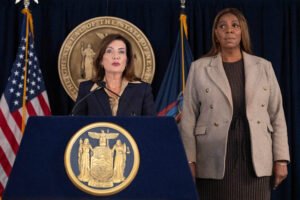
- Hochul eyes changes to state’s rape law amid Cornell crisis
- Kansas becomes a surprise Senate battleground
-

 Politics2 years ago
Former ‘Squad’ members launching ‘Bowman and Bush’ YouTube show
-
Uncategorized2 years ago
Bob Good to step down as Freedom Caucus chair this week
-

 The Josh Fourrier Show2 years ago
DOOMSDAY: Trump won, now what?
-

 The Dictatorship2 years ago
Pete Hegseth’s tenure at the Pentagon goes from bad to worse
-

 Politics2 years ago
Former Kentucky AG Daniel Cameron launches Senate bid
-

 The Dictatorship2 years ago
Luigi Mangione acknowledges public support in first official statement since arrest
-

 Politics2 years ago
Blue Light News’s Editorial Director Ryan Hutchins speaks at Blue Light News’s 2025 Governors Summit
-

 The Dictatorship1 year ago
Mike Johnson sums up the GOP’s arrogant position on military occupation with two words