
The Dictatorship
Don’t be fooled by the ’SAVE Act.’ It threatens our democracy.

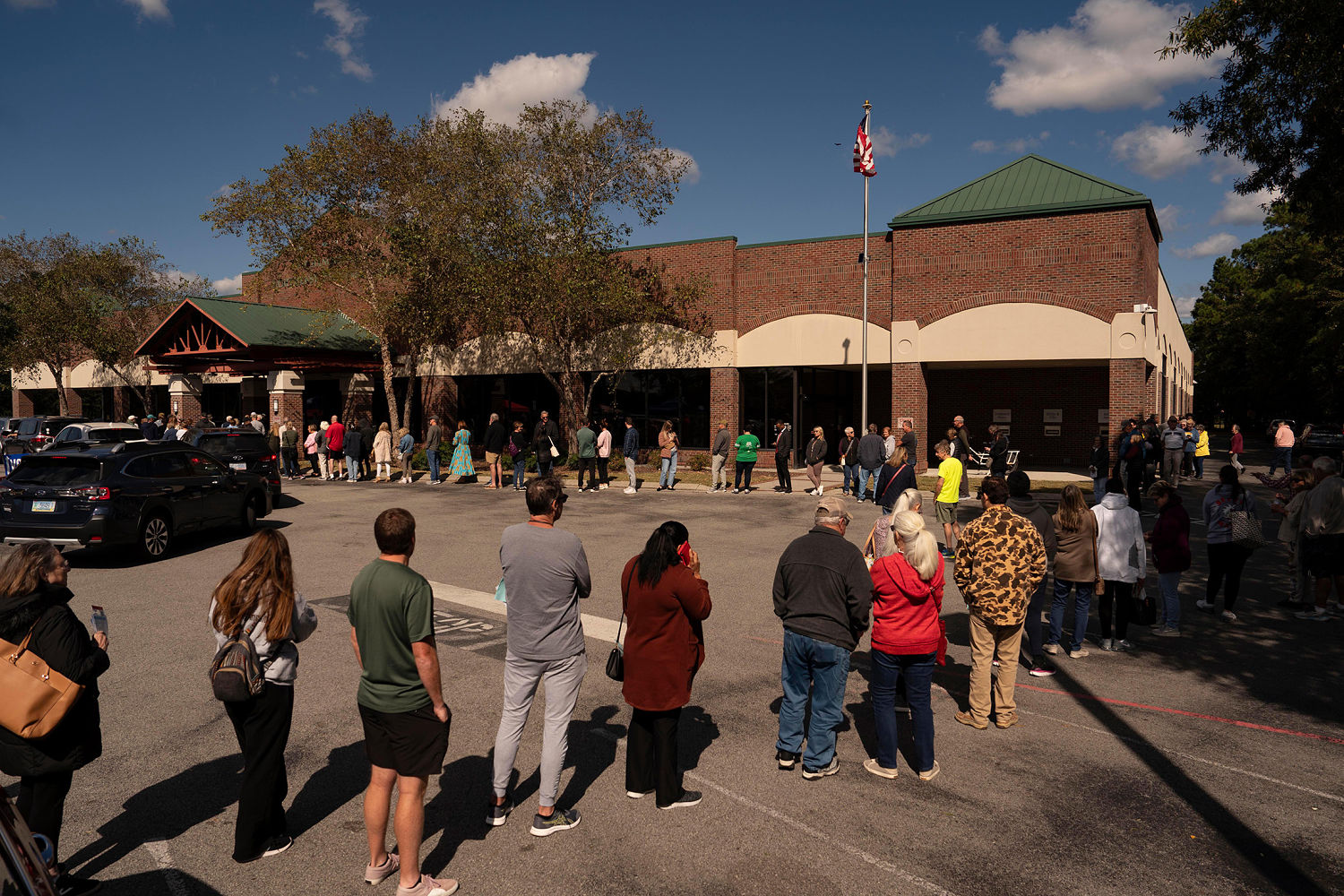
Americans have come to rely on the promise that every citizen has the right to have their voice heard. But the U.S. House of Representatives largely erased that promise last week when, in a 220-208 vote, it passed the Safeguard American Voter Eligibility (SAVE) Act. Don’t be fooled by its heroic-sounding name. This legislation aims to disenfranchise millions of voters, many of them people of color and women, and further concentrate power among those who are already powerful.
This legislation aims to disenfranchise millions of voters, many of them people of color and women.
The law would require people looking to register to vote to provide passports or birth certificates — and, for citizens who don’t have those documents at their disposal, acquiring them costs both money and time. Thus, the so-called SAVE Act would undermine voting rights and block some citizens from the ballot box. The Center for American Progress reports that approximately 146 million American citizens don’t own a passport. But that’s not all. The bill would make it harder for the tens of millions of spouses who have changed their last names through marriage to vote because, for example, the name on their birth certificate won’t match the name they use to vote. And the SAVE Act’s in-person registration requirement would force roughly 60 million rural residents to drive far from home to become eligible to vote.
What will be next? Will we soon be forced to take literacy tests to prove our right to vote? Will voters be forced to pay a poll tax to cast their ballots?
Despite the lies that some elected leaders have told, the SAVE Act would do nothing more than legalize voter suppression.
Let’s be clear. Voter fraud is a myth. There is little, if any, credible evidence that widespread voter fraud exists. The justification for the law is rooted in a divisive lie — a dog whistle — that our elections are not secure. They are.
The SAVE Act is the latest in a string of voter suppression efforts that have been growing longer in recent years.
Last-minute polling place changes, polling place closures that result in predictably long lines, and voter roll purges — the kinds of things that the Voting Rights Act used to protect against — are all forms of voter suppression, and those acts of suppression disproportionately affect communities of color. The obvious goal? To deter Black and brown voters from casting their ballots.
All around the country, the NAACP has been fighting attempts to silence voters. We refuse to sit idly by as the House tries to return this country to a time when the right to vote depended on being white, being male, and owning property.
For the last three months, Congress and the Trump-Musk administration have shown the American people it cannot be trusted.
Americans have watched political leaders recklessly gut key jobs from our federal workforcethreaten Social Security and Medicaid and bully our allies around the world. Trump posting “This is a great time to buy,” and then announcing a suspension of certain tariffs that caused the stock market to spike, prompted questions about whether he was manipulating the stock market. Meanwhile, millions of American families are struggling to put food on the table.
The SAVE Act is not being proposed in isolation. It’s part of a larger undoing of our democracy.
So it’s not surprising that the House passed this legislation that, under the pretense of preserving democracy, would have the effect of silencing millions of voters across the country. The SAVE Act is not being proposed in isolation. It’s part of a larger undoing of our democracy.
We cannot allow the right to vote — our means of shaping policies and our future — to be taken away from us. There is still time to protect voting rights.
The John R. Lewis Voting Rights Advancement Actwhich Rep. Terri Sewell, D-Ala., has already reintroduced, would ensure American citizens have an equal opportunity to participate in our democracy. And it would prevent states with a history of discriminatory voting practices from implementing new laws or changes that could harm voters.
The NAACP calls on Congress to ditch the SAVE Act and pass the John R. Lewis Voting Rights Advancement Act instead.
The Lewis act aims to restore and strengthen protections against voter discrimination that were eroded by the Supreme Court in 2013. By restoring key elements of the Voting Rights Act of 1965 and addressing loopholes exploited to undermine fair elections, the act will ensure everyone has an equal opportunity to participate in our democracy instead of blocking American citizens from voting.
The SAVE Act would not result in fair elections. But the John Lewis Voting Rights Act, named for the late U.S. representative from Georgia and civil rights activist who put his life on the line in Selma, Ala., for voting rights for all, would. Lewis correctly believed that every citizen — regardless of political party or background — has a voice that deserves to be heard at the ballot box. The right to vote is one of the most sacred principles of our nation. Protecting voting rights is not a partisan issue — it’s an American one.
The SAVE Act furthers a partisan lie that voter fraud is threatening our democracy. The John R. Lewis Voting Rights Advancement Act, by contrast, recognizes that voter suppression is the threat and promotes the nonpartisan idea that more people voting is the path to more democracy.
Rather than passing a bill that pretends to save our democracy, let’s actually do something to save it before it is too late.

Derrick Johnson
Derrick Johnson serves as president and CEO of the NAACP, a title he has held since October 2017. Under hisleadership, the NAACP has undertaken such efforts as the 2018 “Log Out” Facebook Campaign after reports of Russian hackers targeting African Americans, the Jamestown-to-Jamestown Partnership, marking the 400th year enslaved Africans touched the shores of America and 2020’s We are Done Dying Campaign, exposing the inequities embedded into the American healthcare system and the country at large. He is dedicated to advocating on behalf of the Black community and all those who are affected by systemic oppression and prejudice.


WASHINGTON (AP) — The House narrowly rejected a resolution Thursday to curb President Donald Trump’s powers in the Iran war, an early sign of unease in Congress over the rapidly widening conflict that is reordering U.S. priorities at home and abroad.
It’s the second vote in as many days, after the Senate defeated a similar measure. Lawmakers are confronting the sudden reality of representing wary Americans in wartime and all that entails — with lives lostdollars spent and alliances tested by a president’s unilateral decision to go to war with Iran.
While the tally in the House, 212-219, was expected to be tight, the outcome provided a clarifying snapshot of political support for, and opposition to, the U.S.-Israel military operation and Trump’s rationale for bypassing Congress, which alone has the power to declare war. At the Capitol, the conflict has quickly carried echoes of the long wars in Afghanistan and Iraq, and many Sept. 11-era veterans now serve in Congress.
“Donald Trump is not a king, and if he believes the war with Iran is in our national interest, then he must come to Congress and make the case,” said Rep. Gregory Meeks, the top Democrat on the House Foreign Affairs Committee.
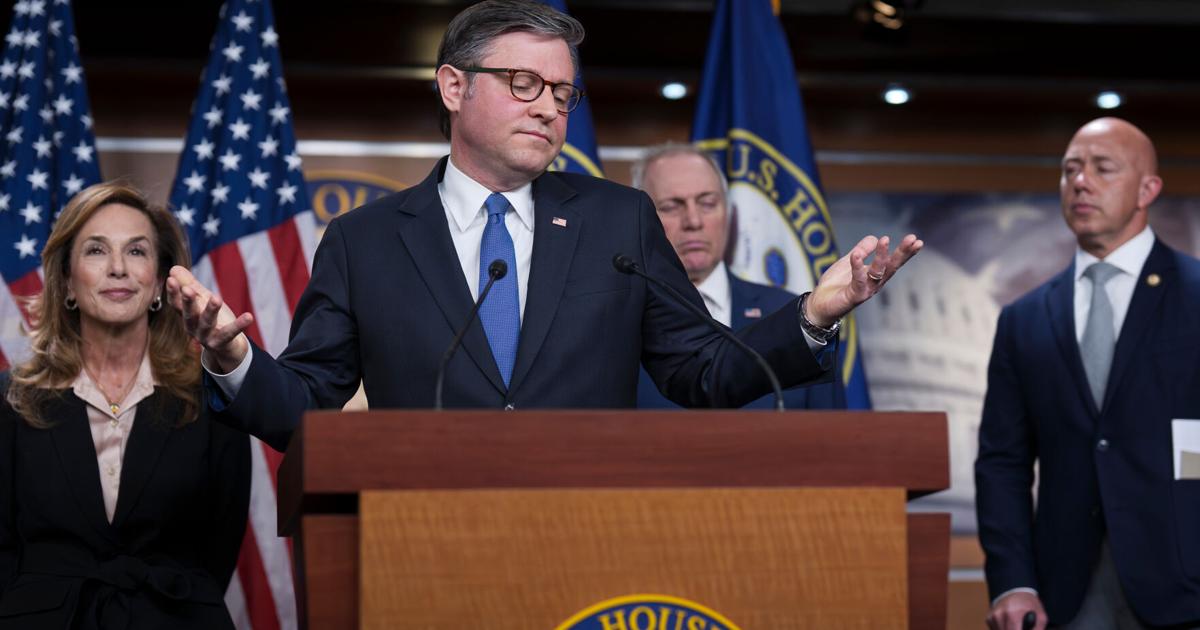
House Speaker Mike Johnson warned that it would be “dangerous” to limit the president’s authority while the U.S. military is already in conflict.
“We are not at war,” said Johnson, R-La., a close ally of Trump, contradicting others. He said the operation is limited in scope and duration, and the “mission is nearly accomplished.”
Republicans largely back Trump, and most Democrats oppose the war
Trump’s Republican Party, which narrowly controls the House and Senate, largely sees the conflict with Iran not as the start of a new war, but the end of a government that has long menaced the West. The operation has killed Iran’s Supreme Leader Ayatollah Ali Khameneiwhich some view as an opportunity for regime change, though others warn of a chaotic power vacuum.
Speaker of the House Mike Johnson, R-La., gestures as he and the GOP leadership talk about the war against Iran, during a news conference at the Capitol in Washington, Wednesday, March 4, 2026. (AP Photo/J. Scott Applewhite)
Speaker of the House Mike Johnson, R-La., gestures as he and the GOP leadership talk about the war against Iran, during a news conference at the Capitol in Washington, Wednesday, March 4, 2026. (AP Photo/J. Scott Applewhite)
Republican Rep. Brian Mast of Florida, chairman of the House Foreign Affairs Committee, publicly thanked Trump for taking action against Iran, saying the president is using his own constitutional authority to defend the U.S. against the “imminent threat” the country posed.
Mast, an Army veteran who worked as a bomb disposal expert in Afghanistan, said the war powers resolution was effectively asking “that the president do nothing.”
For Democrats, Trump’s attack on Iran, influenced by Israeli Prime Minister Benjamin Netanyahuis a war of choice that is testing the balance of powers in the Constitution.
“The framers weren’t fooling around,” said Rep. Jamie Raskin, D-Md., arguing that the Constitution is clear that only Congress can decide matters of war. “It’s up to us.”
Crossover coalitions emerged among those in Congress. Two Republicans joined most Democrats in voting for the war powers resolution, while four Democrats joined Republicans to reject it.
The war powers resolution, if signed into law, would have immediately halted Trump’s ability to conduct the war unless Congress approved the military action. The president would likely veto it.
Trump officials provide shifting rationale for war
Senate Majority Leader John Thune, R-S.D., center, joined at left by Sen. John Barrasso, R-Wyo., the GOP whip, speaks to reporters at the Capitol in Washington, Tuesday, March 3, 2026. (AP Photo/J. Scott Applewhite)
Senate Majority Leader John Thune, R-S.D., center, joined at left by Sen. John Barrasso, R-Wyo., the GOP whip, speaks to reporters at the Capitol in Washington, Tuesday, March 3, 2026. (AP Photo/J. Scott Applewhite)
Trump has scrambled to win support for the nearly week-old conflict as Americans of all political persuasions take stock. Administration officials spent hours behind closed doors on Capitol Hill this week trying to reassure lawmakers that they have the situation under control.
Six U.S. military members were killed over the weekend in a drone strike in Kuwait, and Trump has said more Americans could die. Thousands of Americans abroad have scrambled for flightsmany lighting up phone lines at congressional offices as they sought help trying to flee the Middle East.
Trump said Thursday he must be involved in choosing Iran’s new leader. Yet JohnsonR-La., said this week that America has enough problems at home and is not about to be in the “nation-building business.”
Defense Secretary Pete Hegseth said that the war could extend eight weeks, twice as long as the president first estimated. Trump has left open the possibility of sending U.S. troops into what has largely been a bombing campaign. More than 1,230 people in Iran have died.
The administration said the goal is to destroy Iran’s ballistic missiles that it believes are shielding its nuclear program. It has also said Israel was ready to act, and American bases would face retaliation if the U.S. did not strike Iran first. The U.S. said Wednesday it torpedoed an Iranian warship near Sri Lanka.
“This administration can’t even give us a straight answer of as to why we launched this preemptive war,” said Rep. Thomas Massie, the Republican from Kentucky, an outlier in his party.
Massie and Rep. Ro Khanna, D-Calif., who had teamed up to force the release the Jeffrey Epstein files, also pushed the war powers resolution to the floor, past objections from Johnson’s GOP leadership. Republican Rep. Warren Davidson of Ohio, a former Army Ranger, also voted for it. Democratic Reps. Henry Cuellar of Texas, Jared Golden of Maine, Greg Landsman of Ohio and Juan Vargas of California voted against.
“Congress must stand with the president to finally close, once and for all, this dark chapter of history,” said Rep. Michael McCaul, R-Texas.
Rep. Yassamin Ansari, D-Ariz., said that as the daughter of Iranian immigrants who fled their homeland, she opposes the regime but is concerned that a democratic transition for the people of Iran never seems to a priority for Trump or the officials who briefed Congress.
“War carries profound and deadly consequences for our troops, for the American people and for the entire world,” she said. “It’s the most serious decision that a nation can make.”
Other Democrats have proposed an alternative resolution that would allow the president to continue the war for 30 days before he must seek congressional approval. The House also approved a separate measure affirming that Iran is the largest state sponsor of terrorism.
Senators sit in their desks for solemn vote
Sen. Tim Kaine, D-Va., center, and Sen. Patty Murray, D-Wash., left, arr ive to speak with reporters at the Capitol in Washington, Tuesday, March 3, 2026. Kaine is leading an effort to advance a swift vote on a war powers resolution that would restrain President Donald Trump’s military attack on Iran. (AP Photo/J. Scott Applewhite)
Sen. Tim Kaine, D-Va., center, and Sen. Patty Murray, D-Wash., left, arrive to speak with reporters at the Capitol in Washington, Tuesday, March 3, 2026. Kaine is leading an effort to advance a swift vote on a war powers resolution that would restrain President Donald Trump’s military attack on Iran. (AP Photo/J. Scott Applewhite)
In the Senate, Republican leaders have successfully, though narrowly, defeated a series of war powers resolutions pertaining to several other conflicts during Trump’s second term. This one, however, was different.
Underscoring the gravity Wednesday, Democratic senators sat at their desks as the voting got underway.
Senate Democratic leader Chuck Schumer of New York said that every senator will pick a side. “Do you stand with the American people who are exhausted with forever wars in the Middle East?” he asked. Or with Trump and Hegseth “as they bumble us headfirst into another war?”
Sen. John Barrasso, second in Senate Republican leadership, said, “Democrats would rather obstruct Donald Trump than obliterate Iran’s national nuclear program.”
The legislation failed on a 47-53 tally mostly along party lines, with Sen. Rand Paul, R-Ky., in favor and Sen. John Fetterman, D-Pa., against.

WASHINGTON (AP) — Some two dozen states challenged President Donald Trump’s new global tariffs on Thursday, filing a lawsuit over import taxes he imposed after a stinging loss at the Supreme Court.
The Democratic attorneys general and governors in the lawsuit argue that Trump is overstepping his power with planned 15% tariffs on much of the world.
Trump has said the tariffs are essential to reduce America’s longstanding trade deficits. He imposed duties under Section 122 of the Trade Act of 1974 after the Supreme Court struck down tariffs he imposed last year under an emergency powers law.
Section 122, which has never been invoked, allows the president to impose tariffs of up to 15%. They are limited to five months unless extended by Congress.
The lawsuit is led by attorneys general from Oregon, Arizona, California and New York.
“The focus right now should be on paying people back, not doubling down on illegal tariffs,” said Oregon Attorney General Dan Rayfield. The suit comes a day after a judge ruled t hat companies who paid tariffs under Trump’s old framework should get refunds.
White House vows vigorous defense
The White House said Trump is acting within his power. “The President is using his authority granted by Congress to address fundamental international payments problems and to deal with our country’s large and serious balance-of-payments deficits,” said spokesman Kush Desai. “The Administration will vigorously defend the President’s action in court.”
The new suit argues that Trump can’t pivot to Section 122 because it was intended to be used only in specific, limited circumstances — not for sweeping import taxes. It also contends the tariffs will drive up costs for states, businesses and consumers.
Arizona Attorney General Kris Mayes pointed to a New York Federal Reserve Bank study that found Americans largely bear the cost of the tariffs, which has been estimated at $1,200 a year per household. “That is money out of the pockets of American families trying to buy groceries, pay rent and keep their small businesses afloat,” Mayes said.
Many of the plaintiff states also successfully sued over Trump’s tariffs imposed under a different law: the International Emergency Economic Powers Act (IEEPA).
Four days after the Supreme Court struck down his sweeping IEEPA tariffs Feb. 20, Trump invoked Section 122 to slap 10% tariffs on foreign goods. Treasury Secretary Scott Bessent told CNBC on Wednesday that the administration would raise the levies to the 15% limit this week.
The Democratic states and other critics say the president can’t use Section 122 as a replacement for the defunct tariffs to combat the trade deficit.
The Section 122 provision is aimed at what it calls “fundamental international payments problems.’’ At issue is whether that wording covers trade deficits, the gap between what the U.S. sells other countries and what it buys from them.
Section 122 arose from the financial crises that emerged in the 1960s and 1970s when the U.S. dollar was tied to gold. Other countries were dumping dollars in exchange for gold at a set rate, risking a collapse of the U.S. currency and chaos in financial markets. But the dollar is no longer linked to gold, so critics say Section 122 is obsolete.
Awkwardly for Trump, his own Justice Department argued in a court filing last year that the president needed to invoke the emergency powers act because Section 122 did “not have any obvious application’’ in fighting trade deficits, which it called “conceptually distinct’’ from balance-of-payment issues.
Still, some legal analysts say the Trump administration has a stronger case this time.
“The legal reality is that courts will likely provide President Trump substantially more deference regarding Section 122 than they did to his previous tariffs under IEEPA,’’ Peter Harrell, visiting scholar at Georgetown University’s Institute of International Economic Law, wrote in a commentary Wednesday.
The specialized Court of International Trade in New York, which will hear the states’ lawsuit, wrote last year in its own decision striking down the emergency-powers tariffs that Trump didn’t need them because Section 122 was available to combat trade deficits.
Trump does have other legal authorities he can use to impose tariffs, and some have already survived court tests. Duties that Trump imposed on Chinese imports during his first term under Section 301 of the same 1974 trade act are still in place.
Also joining the lawsuit are the attorneys general of Colorado, Connecticut, Delaware, Illinois, Maine, Maryland, Massachusetts, Michigan, Minnesota, Nevada, New Jersey, New Mexico, North Carolina, Rhode Island, Vermont, Virginia, Washington, Wisconsin, and the governors of Kentucky and Pennsylvania.
___
This story has been edited to correct the spelling of the name of Treasury Secretary Scott Bessent, not Bessant.
The Dictatorship
Trump fires Homeland Security Secretary Noem after mounting criticism over her leadership
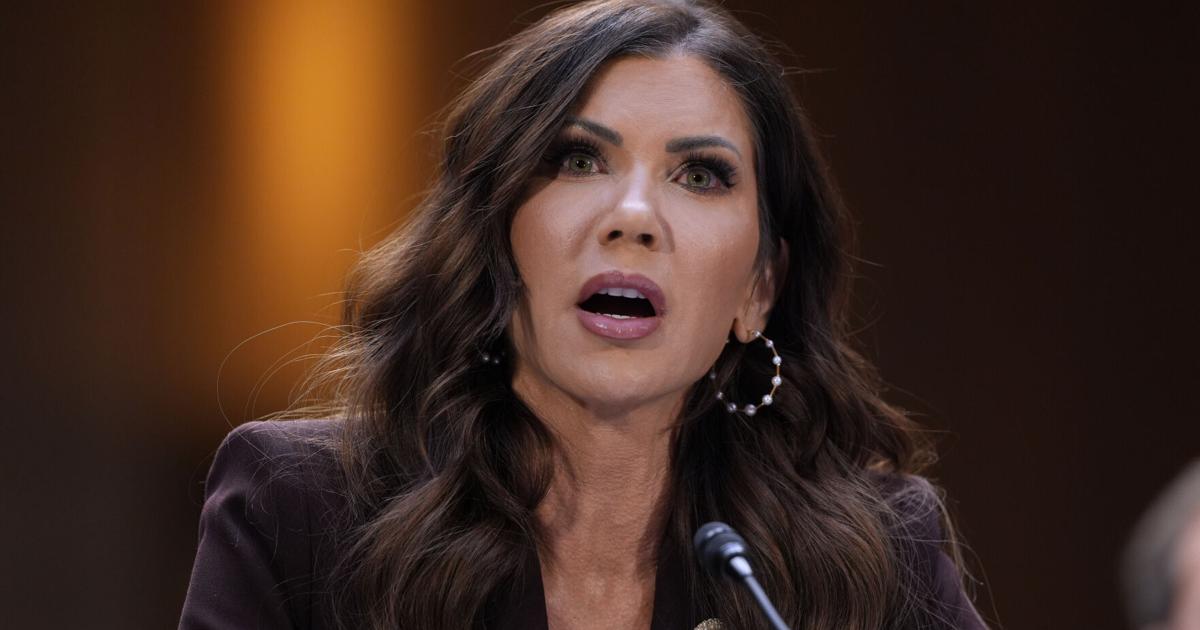
WASHINGTON (AP) — President Donald Trump on Thursday fired his embattled Homeland Security Secretary Kristi Noemafter mounting criticism over her leadership of the department, including the handling of the administration’s immigration crackdown and disaster response.
Trump, who said he would nominate Oklahoma Republican Sen. Markwayne Mullin in her place, made the announcement on social media after Noem faced a two-day grilling on Capitol Hill this week from GOP members as well as Democrats.
Noem’s departure marks a stunning turnaround for a close ally to the president who was tasked with steering his centerpiece policy of mass deportations. But she appeared to increasingly become a liability for Trump, with questions arising over her spending at her department and over her conduct in the aftermath of the shooting deaths of two protesters in Minneapolis earlier this year.
Trump said Noem “has served us well, and has had numerous and spectacular results (especially on the Border!).” He said he was making her a “Special Envoy for The Shield of the Americas,” a new security initiative that he said would focus on the Western Hemisphere.
Noem, who appeared at a law enforcement event in Nashville, Tennessee, moments after Trump’s announcement, did not address her ouster there. She read from prepared remarks and was not asked by attendees about the development.
Republican presidential nominee former President Donald Trump and South Dakota Gov. Kristi Noem dance to the song “Y.M.C.A.” at a campaign town hall at the Greater Philadelphia Expo Center & Fairgrounds, Oct. 14, 2024, in Oaks, Pa. (AP Photo/Matt Rourke, File)
Republican presidential nominee former President Donald Trump and South Dakota Gov. Kristi Noem dance to the song “Y.M.C.A.” at a campaign town hall at the Greater Philadelphia Expo Center & Fairgrounds, Oct. 14, 2024, in Oaks, Pa. (AP Photo/Matt Rourke, File)
Later, in a social media post, she thanked Trump for the new appointment and touted her accomplishments as secretary.
“We have made historic accomplishments at the Department of Homeland Security to make America safe again,” she wrote.
White House press secretary Karoline Leavitt said the administration will work with the GOP-led Senate to get Mullin, whom she called “extraordinarily qualified,” confirmed to lead DHS “as soon as possible.”
The administration’s immigration crackdown faced criticism, especially in Minnesota
Homeland Security Secretary Kristi Noem appears for an oversight hearing before the Senate Judiciary Committee, at the Capitol in Washington, March 3, 2026. (AP Photo/J. Scott Applewhite, File)
Homeland Security Secretary Kristi Noem appears for an oversight hearing before the Senate Judiciary Committee, at the Capitol in Washington, March 3, 2026. (AP Photo/J. Scott Applewhite, File)
Noem is the first Cabinet secretary to leave during Trump’s second term. Her tenure looked increasingly short-lived after hearings in Congress this week where she faced rare but blistering criticism from Republican lawmakers. One particular point of scrutiny was a $220 million ad campaign featuring Noem that encouraged people in the country illegally to leave voluntarily.
Noem told lawmakers that Trump was aware of the campaign in advance, but Trump disputed that in an interview Thursday with Reuters, saying he did not sign off on the ad campaign.
Noem has faced waves of criticism as she’s overseen Trump’s immigration crackdown, especially since the shooting deaths of the two protesters in Minneapolis at the hands of immigration enforcement officers. In the immediate aftermath of the deaths of Renee Good and Alex PrettiNoem portrayed both of them as aggressors, contradicting widely viewed videos and descriptions of their deaths from bystanders. She declined to apologize for her description over two days of Congressional testimony.
The former South Dakota governor was also criticized over the way her department has spent billions of dollars allocated to it by Congress.
Her department, DHS, has been at the center of a funding battle in Congress over immigration enforcement tactics and has been shut down for 20 days, although many of the employees are continuing to work, often without pay.
Even before Noem’s appearance before key congressional committees this week, Republican lawmakers had been anticipating the secretary’s eventual ouster, particularly after her handling of the immigration enforcement crackdown in Minneapolis.
As they tried to end the ongoing Homeland Security shutdown, Senate Republicans had noted privately to Democratic senators that Noem was likely on her way out and that that should prompt Democrats to move forward with agreeing to fund the department again, according to two people familiar with the discussions.
Democrats did not see that as an actual concession by Republicans, considering Noem was becoming a political liability for the GOP, said the people, who spoke on condition of anonymity to discuss private negotiations.
Aside from immigration, Noem also faced criticism — including from Republicans — over the pace of emergency funding approved through the Federal Emergency Management Agency and for the Trump administration’s response to disasters.
Critics welcomed Noem’s departure. Minneapolis Mayor Jacob Frey wrote “good riddance” on social media, a sentiment echoed by Senate Democratic Leader Chuck Schumer.
Some immigration activists questioned whether her departure would change the execution of an immigration agenda that they fundamentally disagree with.
“This is not accountability, just a reshuffling of the enablers of the agenda of President Trump,” said Vanessa Cárdenas, Executive Director of America’s Voice, an advocacy group. She said Noem’s tenure was “marked by cruelty.”
Gregory Bovino, a Border Patrol official who was elevated under Noem’s watch to lead immigration crackdowns in cities including Los Angeles, Chicago and Minneapolis, was one of the few who applauded Noem’s tenure.
“She is the best Secretary I ever worked for, period. The others weren’t even close. Noem is the ultimate patriot,” Bovino told The Associated Press.
DHS leadership changes come at a pivotal time
Sen. Markwayne Mullin, R-Okla., speaks with reporters on the steps at the Capitol in Washington, Thursday, March 5, 2026. (AP Photo/J. Scott Applewhite)
Sen. Markwayne Mullin, R-Okla., speaks with reporters on the steps at the Capitol in Washington, Thursday, March 5, 2026. (AP Photo/J. Scott Applewhite)
Mullin would need to be confirmed by the Senate, but under a federal law governing executive branch vacancies, he would be allowed to serve as an acting Homeland Security secretary as long as his nomination is formally pending.
Voting in the Senate just after Trump’s announcement, Mullin said he has “no idea” how quickly his nomination will move.
“The president and I are good friends. So we look forward to working closer with the White House, and obviously I’m gonna be over there a lot more,” he said.
Mullin would take over the third-largest department in government that has responsibility for carrying out Trump’s hardline immigration agenda. And he would assume the role at a pivotal time for that agenda.
Sen. Markwayne Mullin, R-Okla. speaks during a Senate Armed Services Committee hearing, Jan. 14, 2025, on Capitol Hill in Washington. (AP Photo/Jacquelyn Martin, File)
Sen. Markwayne Mullin, R-Okla. speaks during a Senate Armed Services Committee hearing, Jan. 14, 2025, on Capitol Hill in Washington. (AP Photo/Jacquelyn Martin, File)
Immigration enforcement during the first year of Trump’s administration was largely defined by high-profile, made-for-social-media operations with flashy names, often led by Bovino, who reported directly to Noem. Noem herself often went out on those operations, riding along with officers when they went out to make arrests.
But those high-profile operations in places like Los Angeles, Chicago and Minneapolis often led to clashes with activists and protesters that were captured on video and drove opposition to the president’s immigration agenda.
That culminated with the shooting deaths in Minneapolis after which Trump shuffled leadership of the operation. The number of officers there was drawn down shortly after.
___
Associated Press writer Mary Clare Jalonick contributed.
- Crude prices make record jump as Trump’s measures fail to calm markets
- House will vote on an Iran war powers resolution in a test of Trump’s strategy

- States sue over Trump’s new global tariffs

- FDA vaccines chief who ran afoul of pharma to depart
- Trump fires Homeland Security Secretary Noem after mounting criticism over her leadership

- Former President Barack Obama speaks during final public tribute to the late Rev. Jesse Jackson
- House committee advances kids’ online safety and privacy proposals
- Kristi Noem’s ouster isn’t moving Democrats off their Homeland Security funding demands

- Why Kristi Noem’s ouster could mean trouble for Pam Bondi
- House committee advances kids’ online safety and privacy proposals
-

 The Dictatorship1 year ago
Luigi Mangione acknowledges public support in first official statement since arrest
-

 Politics1 year ago
Former ‘Squad’ members launching ‘Bowman and Bush’ YouTube show
-

 Politics1 year ago
Blue Light News’s Editorial Director Ryan Hutchins speaks at Blue Light News’s 2025 Governors Summit
-

 The Dictatorship6 months ago
Mike Johnson sums up the GOP’s arrogant position on military occupation with two words
-

 Politics1 year ago
Former Kentucky AG Daniel Cameron launches Senate bid
-

 The Dictatorship1 year ago
Pete Hegseth’s tenure at the Pentagon goes from bad to worse
-
Uncategorized1 year ago
Bob Good to step down as Freedom Caucus chair this week
-

 Politics11 months ago
Democrat challenging Joni Ernst: I want to ‘tear down’ party, ‘build it back up’