
Politics
Donald Trump’s transition starts now. Here’s how it will work
WASHINGTON (AP) — Donald Trump ‘s impending return to the White House means he’ll want to stand up an entirely new administration from the one that served under President Joe Biden . His team is also pledging that the second won’t look much like the first one Trump established after his 2016 victory. The president-elect

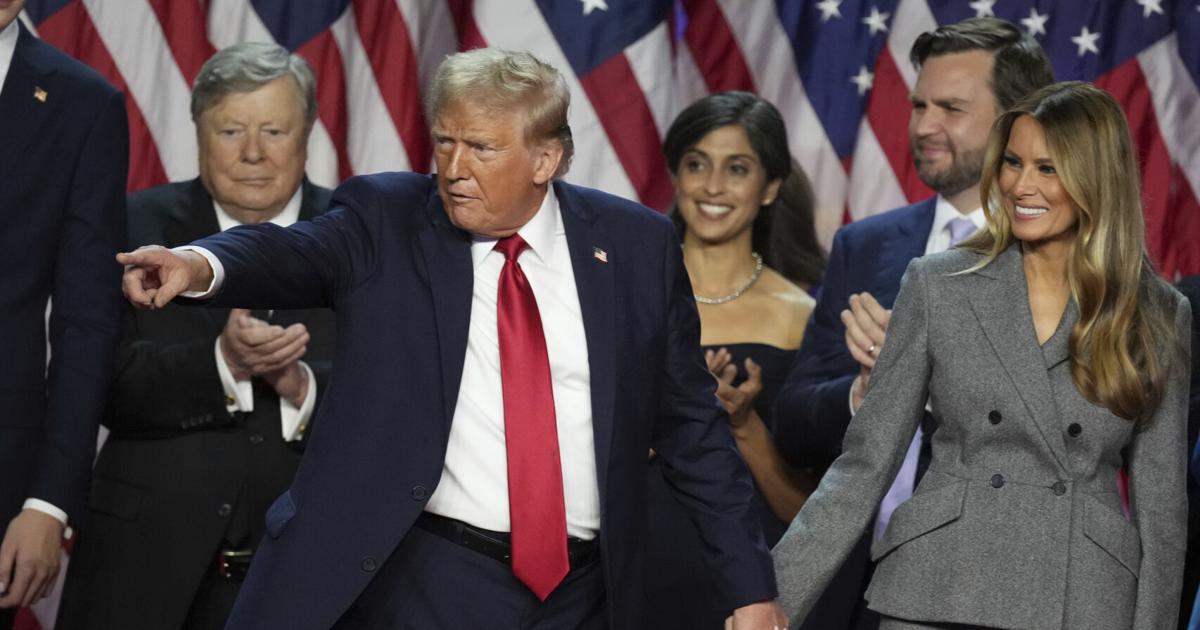
Donald Trump ‘s impending return to the White House means he’ll want to stand up an entirely new administration from the one that served under President Joe Biden. His team is also pledging that the second won’t look much like the first one Trump established after his 2016 victory.
The president-elect now has a 75-day transition period to build out his team before Inauguration Day arrives on Jan. 20. One top item on the to-do list: filling around 4,000 government positions with political appointees, people who are specifically tapped for their jobs by Trump’s team.
That includes everyone from the secretary of state and other heads of Cabinet departments to those selected to serve part time on boards and commissions. Around 1,200 of those presidential appointments require Senate confirmation, which should be easier with the Senate now shifting to Republican control.
Here’s what to expect:
What will the transition look like?
Though the turnover in the new administration will be total, Trump will be familiar with what he needs to accomplish. He built an entirely new administration for his first term and has definite ideas on what to do differently this time.
He’s already floated some names.
Trump said at his victory party early Wednesday that former presidential hopeful and anti-vaccination activist Robert Kennedy Jr. will be tapped to “help make America healthy again,” adding that “we’re going to let him go to it.” Ahead of the election, Trump didn’t reject Kennedy’s calls to end fluoridated water. Trump has also pledged to make South African-born Elon Muska vocal supporter of the Trump campaign, a secretary of federal “cost-cutting,” and the Tesla CEO has suggested he can find trillions of dollars in government spending to wipe out.
The transition is not just about filling jobs. Most presidents-elect also receive daily or near-daily intelligence briefings during the transition.
In 2008, outgoing President George W. Bush personally briefed President-elect Barack Obama on U.S. covert operations. When Trump was preparing to take office in 2016, Obama’s national security adviser, Susan Rice, briefed Michael Flynn, her designated successor in the new administration. In 2020, Trump’s legal challenges of the election’s results delayed the start of the transition process for weeks, though, and presidential briefings with Biden didn’t begin until Nov. 30.
Who is helping Trump through the process?
Trump’s transition is being led primarily by friends and family, including Kennedy Jr. and former Democratic presidential candidate Tulsi Gabbardas well as the president-elect’s adult sons, Donald Trump Jr. and Eric Trump, and his running mate, JD Vance. Transition co-chairs are Cantor Fitzgerald CEO Howard Lutnick and Linda McMahon, the former wrestling executive who previously led the Small Business Administration during Trump’s first term.
Lutnick said this year’s operation is “about as different as possible” from the 2016 effort, which was first led by Chris Christie. After he won eight years ago, Trump fired Christie, tossed out plans the former New Jersey governor had made and gave the job of running the transition to then-Vice President-elect Mike Pence.
At the start of his first term, Trump assembled an original Cabinet that featured some more mainstream Republicans and business leaders who ultimately disappointed, or broke publicly with him, or both. This time, Trump has promised to value loyalty as much as possible — a philosophy that may ensure he makes picks that are more closely aligned to his ideological beliefs and bombastic professional style.
Unlike the campaign of Democratic Vice President Kamala HarrisTrump’s team didn’t sign any pre-Election Day transition agreements with the General Services Administration, which essentially acts as the federal government’s landlord. He has therefore already missed deadlines to agree with GSA on logistical matters like office space and tech support and with the White House on access to agencies, including documents, employees and facilities.
New transition rules
In 2020, Trump argued that widespread voter fraud — which hadn’t actually occurred — cost him the election, delaying the start of the transition from his outgoing administration to Biden’s incoming one for weeks.
Four years ago, the Trump-appointed head of the GSA, Emily Murphydetermined that she had no legal standing to determine a winner in the presidential race because Trump was still challenging the results in court. That held up funding and cooperation for the transition.
It wasn’t until Trump’s efforts to subvert election results had collapsed across key states that Murphy agreed to formally “ ascertain a president-elect ” and begin the transition process. Trump eventually posted on social media that his administration would cooperate.
To prevent that kind of holdup in future transitions, the Presidential Transition Improvement Act of 2022 mandates that the transition process begin five days after the election — even if the winner is still in dispute. That is designed to avoid long delays and means that “an ‘affirmative ascertainment’ by the GSA is no longer a prerequisite for gaining transition support services,” according to agency guidelines on the new rules.
The uncertainty stretched even longer after the 2000 election, when five weeks elapsed before the Supreme Court settled the contested election between Republican George W. Bush and Democrat Al Gore. That left Bush with about half the usual amount of time to manage transitioning the government from the outgoing Clinton administration. That ultimately led to questions about national security gaps that may have contributed to the U.S. being underprepared for the Sept. 11 attacks the following year.


President Donald Trump is blaming fellow Republicans as his endorsed candidate, Ken Paxton, appears to be in a fierce struggle for a Senate seat in Texas with Democratic challenger James Talarico in a state the GOP has long taken for granted.
Trump, in a lengthy post to Truth Social Thursday, singled out longtime Republican strategist Karl Rove and Sen. John Cornyn, the incumbent who failed to secure the president’s endorsement in a heated primary.
Rove and Cornyn, Trump said, are doing “everything possible” to make it harder for Paxton to defeat Talarico, a state lawmaker and Presbyterian seminarian who is making a suprisingly strong run for Senate in deep red Texas.
“They are hurting Texas and, more importantly, hurting the United States of America!” Trump wrote. “If Ken Paxton loses, it will be because of WEAK and INEFFECTIVE Political Hacks like John Cornyn and Karl Rove, who have ineffectively opposed me for my entire political career.”
Cornyn, a longtime fixture in Texas politics, lost his bid for reelection in a contentious Republican primary in which he and his supporters portrayed Paxton as a deeply flawed candidate. As Election Day approaches, public polling over the past two months has shown Talarico with a narrow edge against Paxton, the state’s attorney general.
Trump urged his supporters to back Paxton.
“Your favorite President (ME!) is asking all of those who supported Senator John Cornyn to UNITE, and immediately switch your support to Ken Paxton,” Trump said. “He will be a Great Senator, just like he is a Great Attorney General. “
The race has also become one of the most expensive non-presidential battles. Talarico raised $64 million this summer — the largest third-quarter haul of any Senate candidate in history. He has raised more than $134 million since launching his campaign last year.
Paxton raised $18 million in the third quarter of 2026 and last month announced a new $20 million ad buy. Earlier this month, though, a Trump operative told POLITICO that MAGA Inc. and its affiliates are could spend nearly $45 million on direct mail, TV and digital advertising in Texas through Oct. 12.
Already, $235 million has been spent by outside conservative groups and party committees against Talarico as national Republicans scramble to boost Paxton.
Some Republicans have grown concerned that the cost of the Texas race is diverting money needed in other states and have expressed frustrations with Paxton after leaked audio showed him blaming Trump for his woes.
Trump easily won Texas in 2024, winning just over 56% of the vote. But concerns about Republicans’ chances this November have surged as the president’s approval rating plummets.
Former Indiana Gov. Mitch Daniels said he thinks Vice President JD Vance and other Republicans are wrong to move away from the party’s traditional embrace of free-market economics — and that their shift could create an opening for a “pro-freedom” movement.
“I think they are in error,” Daniels said in an interview when asked about Vance’s criticism of economist Milton Friedman, who championed free-market capitalism.
“I think what Vance is saying is that there are aspects to the free market which can be disruptive of culture and tradition. I mean, that’s what the free market does. It’s dynamic,” he told Blue Light News. “It’s the only mechanism, in my view, for preserving the American dream, and that’s the most important element of our culture.”
The vice president’s intra-party critics have argued that Vance has been moving away from free-market economics and toward a larger role for the government in shaping the economy in his defense of the Trump administration’s economic policies, especially its wide-ranging tariffs.
“What the president is doing is changing 40 years of a failed bipartisan consensus in Washington, D.C., that has sold out American workers and destroyed the underlying economic strength of the United States of America,” Vance said in a Fox News interview last year.
The move is seen by some as Vance testing a more populist and protectionist message as he eyes the Republican presidential nomination in 2028.
But the two men were at one point closer politically. In Vance’s bestseller “Hillbilly Elegy,” Vance described Daniels as his “political hero.” Daniels has said that Vance sought his counsel on running for office in 2018 and Daniels advised against it because it was likely to be a bad year for Republicans.
The vice president’s office did not immediately respond to a request for comment on Daniels’ remarks.
Daniels recently released his new book, “Impatience Is a Virtue.” In it, the veteran of Indiana politics — who also led the Office of Management and Budget under President George W. Bush — detailed his career championing the free market.
Daniels told Blue Light News that President Donald Trump was both a “symptom” and “a propellant” of voters’ discontent, pointing to their “feeling of being patronized, condescended, looked down on, ignored, disrespected.” And Trump’s political success came from his ability to unite and represent these discontented voters.
Still, Daniels argued the evolution of the Republican Party under Trump has created room for a “pro-freedom party” that champions economic freedom and individual autonomy.
“Whether that is the next iteration of this Republican Party or you find some other vehicle, I don’t know,” he said. “But I think that there’s a need, and as I say, there’s certainly, I think, a market for that viewpoint waiting to be expressed by somebody.”
The former governor, now back at Purdue University as the interim president after leading the school for a decade until 2022, sidestepped a question about his party identification and another one on whether he sees Vance emerging as the “pro-freedom” candidate.
“It’s all TBD; I don’t know,” he said of Vance.
Daniels also defended his view on another 2028 hopeful, Democrat Pete Buttigieg, who was the mayor of South Bend, Indiana, during the tail end of Daniels’ governorship.
In his book, Daniels said Buttigieg is smart, but his principal asset that excites Democratic activists is his sexual identity.
Buttigieg became the first openly gay person confirmed to be a Cabinet secretary when he was tapped to lead then-President Joe Biden’s Transportation Department. A spokesperson did not immediately respond to a request for comment.
“This differentiates him in a way that would be appealing to large portions of the core Democratic electorate,” he said. “Absent that, he would be a less likely national figure.”
TALLAHASSEE, Florida — Two women this week sued former GOP Florida Rep. Matt Gaetz and two others — including a former state legislator — in federal court and accused the men of engaging in an alleged sex trafficking scheme during a time when Gaetz was still in Congress.
The lawsuit, which seeks damages from Gaetz and other defendants, was filed in Orlando by two women who were in their early 20s when they first met Gaetz. The women are not named in the lawsuit. The details mirror allegations that were at the center of a House Ethics Committee probe that found Gaetz had sex with a minor, solicited prostitutes and used illegal drugs.
“The defendants collectively used their public office, power, and wealth to prey on the economic vulnerability of the plaintiffs to commit the acts outlined below,” states the 38-page lawsuit.
That House probe helped derail Gaetz’s bid to become attorney general under President Donald Trump. He resigned from his Northwest Florida congressional seat to seek the post but decided to withdraw his name ahead of a potentially messy confirmation battle in the Senate.
Gaetz, who has repeatedly denied he ever had sex with a minor, said he would vigorously contest the allegations in the lawsuit.
“I look forward to taking the plaintiffs’ depositions because much of the conduct alleged against me is false,” Gaetz said in a text message. “The lawsuit relies almost exclusively on a Congressional committee report that didn’t allow me to confront my accusers. Now I will finally have that chance.”
The civil suit is the latest development in the long-running scandal involving Gaetz, a former ally of Trump who has continuously denied any involvement in underage sex or trafficking of women after news broke in 2021 that the Justice Department was investigating him.
The lawsuit this week by Jane Doe 1 and Jane Doe 2 was first reported by the Miami Herald. It alleges that Gaetz and former Seminole County Tax Collector Joel Greenberg “coordinated the recruitment, payments, drugs and travel to obtain commercial sex acts from young women.” The lawsuit includes former Florida legislator and lobbyist Chris Dorworth because his Central Florida home was the site of a party where he allegedly “participated in the activities alleged there.”
Greenberg is serving an 11-year federal sentence after he pleaded guilty to multiple federal offenses including underage sex trafficking of a minor and wire fraud. Greenberg cooperated with federal investigators who were probing Gaetz but the U.S. Department of Justice closed the investigation without filing charges.
The lawsuit says it “arises from the recruitment and sexual exploitation” that occurred from 2017 through January 2019 and included trips to various locations such as Las Vegas, New York City and the Bahamas. It accuses Gaetz and Greenberg of making promises to help the two women financially or with college bills.
“They led her to believe they would resolve her financial needs as long as she continued to perform sexual acts for them and their associates,” the lawsuit states about Jane Doe 1. “They used the age, wealth and political power gap between themselves and Jane Doe 1 to keep her compliant and silent.”
Jane Doe 2, the lawsuit states, was “paid less” than promised and “through this pattern defendants caused Jane Doe 2 to believe she would lose her education and serious financial harm if she stopped performing sexual acts.”
Stencer Kuvin, a West Palm Beach attorney representing the two women, said in an email that federal law designed to protect sex trafficking victims has a 10-year statute of limitations “which potentially could run [out] next year based upon the allegations in the complaint.”
Gaetz, a firebrand and ally of Trump, was once seen as a potential candidate for Florida governor or attorney general. Since he left Congress, he has hosted his own show on the One America News Network and he was appointed to the board of a nonprofit charged with distributing proceeds from a settlement Florida received after the 2010 Deepwater Horizon oil spill along the Gulf Coast.
-

 Politics2 years ago
Former ‘Squad’ members launching ‘Bowman and Bush’ YouTube show
-
Uncategorized2 years ago
Bob Good to step down as Freedom Caucus chair this week
-

 The Josh Fourrier Show2 years ago
DOOMSDAY: Trump won, now what?
-

 The Dictatorship2 years ago
Pete Hegseth’s tenure at the Pentagon goes from bad to worse
-

 Politics2 years ago
Former Kentucky AG Daniel Cameron launches Senate bid
-

 The Dictatorship2 years ago
Luigi Mangione acknowledges public support in first official statement since arrest
-

 Politics2 years ago
Blue Light News’s Editorial Director Ryan Hutchins speaks at Blue Light News’s 2025 Governors Summit
-

 The Dictatorship1 year ago
Mike Johnson sums up the GOP’s arrogant position on military occupation with two words