
Congress
Democrats dig in on shutdown after White House layoff threat

If the White House thought its threat to fire federal workers during a government shutdown would spark a Democratic retreat, so far, it’s not happening.
Instead, multiple congressional Democrats brushed off the prospect of mass layoffs — floated in an Office of Management and Budget memo first reported by POLITICO — as a negotiating tactic and vowed not to bend as a midnight Sept. 30 shutdown deadline approaches.
Among the Democrats still standing firm against a Republican-led seven-week funding punt include those representing many of thousands public employees who would be most at risk if President Donald Trump and OMB director Russ Vought follow through on their threats.
“President Trump is engaged in mafia-style blackmail, with his threats ultimately harming the American people,” Sen. Chris Van Hollen of Maryland said in a statement, calling the potential layoffs “likely illegal” and pledging that Democrats will be “fighting back with every tool we have.”
Said Rhode Island Sen. Sheldon Whitehouse in a succinct social media post, “These weird sickos enjoy cruelty.” Sen. Patty Murray of Washington, the top Democrat on the Appropriations Committee, added that Trump is a “petty wannabe tyrant.”
“President Trump will try to abuse a shutdown — just like he’s trampled our laws for months — but that doesn’t mean he gets whatever he wants as a result,” Murray said in a statement.
Democrats are pushing Trump and GOP leaders in Congress to negotiate on a bipartisan shutdown-averting funding bill, noting that Senate Republicans will need a handful of Democratic votes to vault the chamber’s 60-vote filibuster threshold. Senate Minority Leader Chuck Schumer and House Majority Leader Hakeem Jeffries say they want health care to be the centerpiece of those talks.
But it’s not only Democrats who are showing signs of unease with the layoff gambit spearheaded by Vought. It’s emerging as the latest crack in what had been, until this week, a united GOP messaging front.
“No I don’t support mass firings,” Rep. Mike Lawler (R-N.Y.) said in a brief interview. “But there’s a very simple way to avoid it … pass the CR, which Schumer and Jeffries have repeatedly supported in the past.”
Top Republican leaders, meanwhile, have stayed mum on the layoff threats and largely stuck to their previous messaging.
“Democrats are holding the AMERICAN government HOSTAGE — in an attempt to give FREE health care to NONCITIZENS, which was just outlawed by Congress. This isn’t governing. It’s putting illegal aliens FIRST and Americans LAST,” Speaker Mike Johnson posted on X on Thursday.
Johnson’s reference to “illegal aliens” is connected to a Democratic proposal to roll back parts of the recently enacted GOP megabill that would create new roadblocks to prevent states from enrolling undocumented immigrants in public benefit programs.
A spokesperson for Johnson didn’t respond to an inquiry about if he supports permanently laying off federal employees during a shutdown. Spokespeople for Senate Majority Leader John Thune also did not immediately respond to requests for comment on the same question.
The OMB memo told agencies to start drafting “reduction-in-force” plans for agencies and programs that do not have an alternative funding source after Oct. 1, when the government would shutter, and are “not consistent with the President’s priorities.”
The layoff threat comes as Congress and the White House barrel toward the deadline without a clear off-ramp. Trump initially agreed to — and then backed out of — a meeting with Schumer and Jeffries to discuss a path forward.
The OMB memo aligns with concerns Schumer outlined earlier this year when he enraged the Democratic base by shoring up the votes to advance a GOP funding bill — that a shutdown would only empower Vought and Trump to take a sledgehammer to the federal government. But the New York Democrat signaled Wednesday night that Vought’s latest threat was nothing more than an “attempt at intimidation” that would not change his strategy.
“This is nothing new and has nothing to do with funding the government,” Schumer said in a statement, adding that the actions would be challenged in courts or that the administration would ultimately backtrack and bring workers back on the job — as Trump has already done.
Other Democrats have joined Schumer in arguing that, shutdown or not, Trump is determined to wage war against federal employees and would pursue mass firings in any event.
“We know that Republicans wouldn’t stand up to Trump for doing any of these things at any other time anyway,” said Rep. Mark Pocan (D-Wis.). “That’s part of the problem is because they’ve shown to have no spine, no ability to stand up to a rogue administration. These threats just aren’t as strong as they could be.”
Every Senate Democrat save for Pennsylvania’s John Fetterman voted last week to reject the GOP-led funding bill, which would fund the government until Nov. 21. Senate Republicans, meanwhile, rejected a Democratic alternative that would reverse portions of the megabill, restore some funding cut by the Trump administration and also extend health insurance subsidies that are set to lapse on Dec. 31.
Meredith Lee Hill contributed to this report.


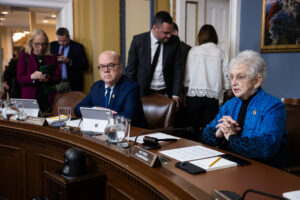
The House Rules Committee advanced a measure Friday evening that would fund the entirety of the Homeland Security Department through May 22 — without setting up debate or a separate vote on the funding bill itself.
The panel, after a raucous meeting that devolved into shouting at multiple points, voted 8-4 on party lines to advance the measure to the floor.
The rule includes a “deem and pass” provision, a tactic that allows legislation to be passed by the House automatically once the rule itself is adopted. While there will be one hour of floor debate and a vote on the rule, there will not be a standalone House vote on the DHS spending bill.
Rep. Jim McGovern (D-Mass.) described himself as needing “a neck brace” from the whiplash of hearing Republicans argue for hours that the Senate’s early-morning voice vote on a different DHS funding measure was “shameful” for lack of transparency and accountability.
House Appropriations Chair Tom Cole (R-Okla.) accused the Senate of moving their bill “in the middle of the night, with the smell of jet fumes in the air,” lamenting that the House was left “to take it or leave it.”
House leaders, McGovern suggested, have chosen a similar path by fast-tracking the eight-week DHS stopgap.
“You’re in charge,” he told Rules Chair Virginia Foxx (R-N.C.). “You can do whatever the hell you want to do.”
Sen. Rand Paul (R-Ky.) is considering a bid for president in 2028, as Republicans jockey for the future of the GOP post-Trump.
In a “CBS Sunday Morning” interview airing Sunday, a reporter asked Paul about an article that implied he would be running for president.
“We’re thinking about it,” Paul said. “I would say fifty-fifty,” adding that he would make a final decision after the midterm elections.
Paul ran for the Republican nomination for president in 2016 with a libertarianism-focused campaign but ultimately dropped out after a poor performance in the Iowa caucuses and a shortage of cash. He instead ran for reelection to the Senate.
Paul has had a complex relationship with his own party and with President Donald Trump, often finding himself the lone Republican on certain issues. More recently, he was the only Republican to support a joint resolution that would limit Trump’s war powers in Iran.
His father, former Rep. Ron Paul, also ran for president three times: first as a Libertarian in 1988, and twice as a Republican in 2008 and 2012.
House Republicans moved Friday to further extend the six-week shutdown of the Department of Homeland Security by rejecting a Senate bill that would fund the vast majority of DHS agencies through September.
Instead, Speaker Mike Johnson proposed a temporary extension of DHS funding through May 22 — a plan that has uncertain prospects in the House and certainly won’t pass the Senate before the shutdown becomes the longest funding lapse in U.S. history Saturday.
But Johnson said House Republicans simply could not swallow the Senate bill, which omits funding for Immigration and Customs Enforcement as well as Border Patrol and some other parts of Customs and Border Protection.
“The Republicans are not going to be any part of any effort to reopen our borders or to stop immigration enforcement,” he said. “We are going to deport dangerous criminal illegal aliens because it is a basic function of the government. The Democrats fundamentally disagree.”
The move toward an eight-week stopgap creates a tactical gulf between Johnson and Senate Majority Leader John Thune, who called an end to weeks of abortive bipartisan talks Thursday and pushed through the funding bill in hopes of tacking on funding later for ICE and CBP in a party-line budget reconciliation bill.
President Donald Trump has largely stayed out of the GOP infighting on Capitol Hill, keeping his criticism trained on Democrats. He ordered DHS to pay TSA officers Thursday as long security lines snarls more U.S. airports.
Johnson played down the split with his Senate counterpart, saying the Democratic leader there bore more blame for the impasse.
“I wouldn’t call John Thune the engineer of this,” he said. “Chuck Schumer and the Democrats in the Senate have forced this upon the Senate. I have to protect the House. … Our colleagues on this side understand this is not a game. We are not playing their games.”
Thune said early Friday morning he did not speak directly to Johnson in the final hours leading up to the Senate’s voice vote, but he said they had texted. He acknowledged he did not know in advance how the House would handle the Senate bill.
“Hopefully they’ll be around, and we can get at least a lot of the government opened up again, and then we’ll go from there,” he said.
Johnson made his game plan clear with House Republicans on a private call just minutes before addressing reporters in the Capitol, according to four people granted anonymity to describe the call. He warned that a failure to advance the short-term DHS stopgap would upend GOP plans for a reconciliation bill, the people said.
He suggested the Senate could quickly clear the stopgap measure once it passes the House. Most senators have left Washington for a recess running through April 13, but Johnson said the chamber could approve the House measure by unanimous consent at a planned pro forma session Monday.
But some House Republicans on the private call, including Rep. Carlos Gimenez of Florida, aired doubts it could pass the Senate — or even the House. Some fellow GOP centrists argued that the House should just swallow the Senate bill and end the standoff.
The House plan for a 60-day stopgap won a cold reception in the Senate, with even Republicans warning it will only prolong the partial government shutdown.
The plan is instead fueling frustration among both Republicans and Democrats who view House Republicans as essentially throwing temper tantrum. Three people granted anonymity to speak candidly each described the House as having a “meltdown.”
Schumer publicly slammed the House GOP plan Friday, saying it was “dead on arrival” across the Capitol, “and Republicans know it.”
A Senate GOP aide granted anonymity to speak candidly added that the quickest way to end the shutdown is for the House to pass the Senate bill.
Five people granted anonymity to comment on Senate dynamics said there was no possibility that Democrats would let the House GOP plan pass during the Senate’s brief pro forma sessions over the next two weeks. It would only take one Democratic senator to show up and object to any attempt to pass it.
The bill, according to the five people, also can’t get 60 votes in the Senate once the chamber returns. Democrats have previously rejected even shorter stopgaps, leaving some to privately question why House Republicans would ever think their plan would work.
- A month into Iran, the GOP’s political reality sinks in
- She was one of AIPAC’s top targets last election. Now she wants back in Congress.

- One month into Iran, the GOP’s political reality sinks in
- ‘We love you!’: The MAGA base gives RFK Jr. a rousing welcome
- DHS stopgap set for quick House action after Rules Committee vote
- Rand Paul weighs a 2028 presidential bid

- Trump to send Congress his budget request April 3

- ‘Meltdown’: DHS shutdown set to drag on after House GOP rejects Senate deal

- Troop deployments test Republicans’ nerves on Capitol Hill

- Trump’s overlapping troubles are starting to resemble a set of political Russian nesting dolls
-

 The Dictatorship1 year ago
Luigi Mangione acknowledges public support in first official statement since arrest
-

 Politics1 year ago
Former ‘Squad’ members launching ‘Bowman and Bush’ YouTube show
-

 Politics1 year ago
Former Kentucky AG Daniel Cameron launches Senate bid
-

 Politics1 year ago
Blue Light News’s Editorial Director Ryan Hutchins speaks at Blue Light News’s 2025 Governors Summit
-

 The Dictatorship7 months ago
Mike Johnson sums up the GOP’s arrogant position on military occupation with two words
-

 The Dictatorship1 year ago
Pete Hegseth’s tenure at the Pentagon goes from bad to worse
-
Uncategorized1 year ago
Bob Good to step down as Freedom Caucus chair this week
-

 Politics11 months ago
Democrat challenging Joni Ernst: I want to ‘tear down’ party, ‘build it back up’