
Congress
Democratic socialist Valdez wins open Brooklyn-Queens primary

NEW YORK — State Assemblymember Claire Valdez prevailed in the tumultuous primary to succeed retiring Rep. Nydia Velázquez, notching the Democratic Socialists of America a win in one of the left’s most high-profile proxy wars.
Valdez, who has served in the Assembly representing Queens since last year, was boosted by the city chapter of the DSA and Mayor Zohran Mamdani. Her major competitor was Brooklyn Borough President Antonio Reynoso, who had the backing of the state Working Families Party and Velázquez.
The dynamics of those competing interests loomed over the campaign, exposing tensions among progressive Democrats.
The 7th District, which covers parts of Brooklyn and Queens, has been dubbed the “Commie Corridor.” That’s a nod to the DSA’s electoral power there — which it flexed during last year’s June mayoral primary when Mamdani enjoyed some of his strongest results in that district.
While the candidates agreed on most policy positions, Valdez and Reynoso spent months sparring over who had the most ironclad progressive values. Complicating matters further for them was New York City Council member Julie Won, who had the support of notable Asian American organizations and elected officials but struggled to gain enough traction to emerge as a real threat. Public defender Vichal Kumar was also on the ballot.
Even though the contenders all referred to Israel’s actions in Gaza as a “genocide,” Valdez repeatedly criticized Reynoso for how long it took him to use that label. She also attacked him for accepting campaign donations from people affiliated with the real estate industry.
In the waning days of the campaign, Valdez sought to tie Reynoso to the American Israel Public Affairs Committee — a tactic progressive candidates have long employed to mobilize their base, especially as the public’s view of Israel has grown increasingly negative. AIPAC said it was not involved in this race, and its independent expenditure arm did not appear to spend money on the contest.
Reynoso, meanwhile, tried to use Mamdani’s endorsement against Valdez, accusing her of being “beholden” to the mayor — a strategy that evidently did not land with an electorate that views Mamdani so positively. One significant flashpoint unfolded when the NYPD faced accusations of collaborating with Immigration and Customs Enforcement during a chaotic incident in Brooklyn, a charge Mamdani has denied. Reynoso said that when things “get complicated with the NYPD,” he doesn’t have “any bosses telling me to slow down and wait and work on messaging.”
A super PAC supporting Reynoso also attacked Valdez for not having as much political experience as Reynoso, who served in the City Council and as a community organizer prior to becoming borough president.
Valdez’s win is a boon for Mamdani, who put his political capital on the line in a handful of races this cycle — and angered Democratic power brokers in the process. Velázquez, a 16-term incumbent known as “La Luchadora” who’s served as a mentor for younger progressives in the city, was an early supporter of Mamdani in the mayoral election. But the two ended up on opposite sides in races up and down the ballot this year, stress-testing how the new mayor navigates relations with powerful, well-respected party figures.
Reynoso emphasized his “underdog” status in the race, despite his backing from Velázquez, the Working Families Party and major unions, pointing to Mamdani’s involvement and the district becoming more gentrified. Like Velázquez, Reynoso also endorsed Mamdani in the mayoral primary. But during the campaign, he accused the mayor of being “disloyal” to the veteran lawmaker.
Super PACs emerged as a major point of contention in the race as well. Reynoso and Won both criticized Valdez for putting public messaging on her campaign site — a common tactic viewed as a cue to PACs known as “redboxing” — where she presented talking points contrasting herself with Reynoso. Reynoso posted a redbox on his site too, but said he “had to do it” after Valdez put one up. After super PACs began supporting both candidates, Won touted herself as the only contender keeping their promise not to accept super PAC spending.
Throughout the campaign, Valdez leaned on her background as a union organizer. Originally from Texas, she moved to New York over a decade ago to be an artist. She is all but certain to win in the fall, when she will face Republican Melvin Rivera. Reynoso has not said if he will decline the Working Families Party ballot line for the general election.


Senate Republicans’ campaign arm took out $20 million in loans in September, a significant cash infusion as the party looks to fight an increasingly challenging map ahead of November’s midterm elections.
The National Republican Senatorial Committee incurred a $17 million loan on Sep. 1 and another $3 million on Sep. 22, according to a filing submitted to the Federal Election Commission on Tuesday.
The need for cash comes after months of the NRSC and other GOP groups boasting about their large cash advantage over Democrats, as the party floods the airwaves in an effort to win core battlegrounds in an unfavorable environment.
The organization framed the loan as part of continuing that cash advantage.
“The NRSC has raised record-breaking resources, consistently maintained one of the lowest burn rates across all committees, and furthered the efficacy of every dollar by immediately acting on the fall of unlimited coordinated spending with our candidates,” NRSC communications director Joanna Rodriguez said in a statement. “We’re going to throw everything we can at protecting our Republican Senate Majority, and we’re going to win.”
It’s not unusual for campaign arms to take out loans late in an election cycle. In 2024, the NRSC took out $17 million in loans, and it borrowed $20 million during the 2022 cycle as well, according to FEC reports.
The NRSC has raised $228 million this cycle compared to $188 million for the Democratic Senatorial Campaign Committee, but Democratic Senate candidates have far outraised Republican ones.
The NRSC had $28 million in the bank, including the loan, at the end of September after raising $31 million and spending $41 million in the month, although a slight majority of the funds raised — $18 million — came via transfers from the Republican National Committee.
The DSCC, by comparison, ended September with just under $25 million in the bank. It had not taken out any loans this cycle as of that point.
Unlike past cycles, political parties can now more freely pay for advertising in coordination with candidates — and at a much cheaper rate. That will allow the party to stretch the $20 million further than in past election cycles.
In September, the NRSC put just under $34 million into coordinated spending, all of it on advertising, according to the Tuesday FEC filing.
Democrats’ money machine is on its way to Mississippi.
Senate Majority PAC is putting an initial $1.2 million on television statewide through Election Day to boost Scott Colom, the group announced Tuesday — another plunge into deep-red territory for Democrats as they take advantage of a dismal environment for Republicans.
Colom, a local prosecutor, has gained on GOP Sen. Cindy Hyde-Smith in recent public polling, and has started to gain the attention of national Democrats. Some Senators, including Georgia Sen. Raphael Warnock and Arizona Sen. Ruben Gallego, have pushed for more party investment in the race, which they believe in the right environment could flip a traditionally red seat.
But until now, Democrats said their resources were stretched too thin across a widening map that would allow them to play in the Magnolia State.
SMP is launching its first ad Wednesday attacking Hyde-Smith as a “do-nothing” senator and is planning a digital program as well. Lauren French, a spokesperson for SMP, said in a statement that “it is clear Colom is running a competitive race that has put Hyde-Smith on her heels.”
Hyde-Smith’s campaign downplayed the race’s competitiveness while tying Colom to Senate Minority Leader Chuck Schumer.
“It took Chuck Schumer and his Super PACs thirteen months to run a single ad for Scott Colom,” Hyde-Smith campaign spokesperson Nathan Calvert said in a statement. “Chuck knows what Mississippians know, Scott Colom is too liberal, supports transgender surgeries for children, men in women’s restrooms and locker rooms, open borders, and higher taxes. Team Cindy is confident that voters will reject this radical agenda at the ballot box on November 3rd.”
Colom’s campaign didn’t immediately reply to a request for comment.
Other national Democrats have started paying attention to the race too, with several set to descend on Mississippi ahead of Election Day. Former Vice President Kamala Harris will campaign alongside Colom later this week, and former Secretary of Transportation Pete Buttigieg will hit the trail next week.
The state has the highest proportion of Black people in the nation, giving Democrats a high base of support in most elections — and has long left Democrats dreaming they could win statewide, having invested some resources in recent Senate and governor’s races over the past decade. Hyde-Smith did not top 55% of the vote in either of her previous elections, and Colom has seized on an interview clip when she was asked about the high price of beef: “You know, you have so many proteins to choose from.”.
Still, despite the overall positive environment for the party, flipping the seat remains a steep uphill battle. Republicans control all levers of state government, and Trump handily won by 24 points in 2024. The last time Mississippians elected a Democrat statewide was 2015, and the last time the state sent a Democrat to the Senate was 1982.
SMP’s investment in Mississippi follows multimillion-dollar dives into Kansas and Texas that collectively show how far the Senate map has shifted onto red turf in the midterm’s closing weeks. The Chuck Schumer-aligned group has also cut back on spending on television in North Carolina and Georgia in recent weeks amid increasingly bullish outlooks for Democrats Roy Cooper and Sen. Jon Ossoff, respectively.
House Democrats’ campaign arm is launching its first ad buy against seven-term GOP Rep. Mike Turner in his western Ohio district as they seek to turn up the pressure on Republicans in once-safe red seats.
The DCCC is dropping separate six-figure buys on two coordinated television ads boosting challenger Kristina Knickerbocker, spokesperson Riya Vashi said — a remarkable investment considering Turner won in 2024 by over 18 percentage points, overperforming President Donald Trump.
Ohio adopted a new redistricted congressional map last year that was expected to favor Republicans. Turner’s 10th District voted for Trump by 6 points in 2024; under the new lines it would have been closer to 8 points.
The first ad airing this week opens with a woman saying, “It’s time we had someone in Congress who actually stands up for us” as Knickerbocker jogs through a neighborhood.
Democrats are eyeing Turner’s Dayton-area seat as a reach opportunity. A new internal DCCC poll of 535 likely general election voters reviewed by Blue Light News shows Knickerbocker running three percentage points ahead of Turner. Polling from this summer showed Turner leading the race.
Another Democratic group, House Majority PAC, has already poured more than a million dollars into the race against Turner and has reservations planned through Nov. 3. Knickerbocker is not on the DCCC’s “Red to Blue” roster of candidates who get the bulk of its resources.
“Alarm bells should be ringing for Mike Turner,” Vashi said in a statement. “Kristina Knickerbocker has the momentum in this race, and the DCCC will make sure every voter in this district knows exactly how Turner has betrayed them.”
But the NRCC has been spending in the district for several weeks to boost Turner. House Republican campaign operatives are so far dismissing efforts to flip the seat.
NRCC spokesperson Zach Bannon called Turner “a life-long Ohioan who has a record of cutting taxes, lowering costs, and making Ohio streets safer.”
“While Congressman Turner delivers commonsense conservative wins, out of touch Democrat Kristina Knickerbocker supports a radical far-left agenda,” Bannon said. “This November, Ohioans will reject liberal Knickerbocker and send Congressman Mike Turner back to Congress.”
- NRSC takes on $20M in loans
- Blakeman’s uptown fracking fiesta
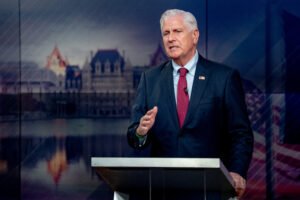
- FEMA chief tells states to prepare to handle disasters on their own
- Trump is promising farmers $8B. Republicans are praying it will save their campaigns.
- Senate Democrats start spending in Mississippi
- Poll: Voters see Republicans as the party of Big Tech tax breaks
- Two Dans, four choices, one big headache for GOP in Alaska Senate race
- Democrats’ Musk-ask questions

- DCCC launches ads against Mike Turner in red Ohio district
- Capitol agenda: Dem gavels are coming for Elon Musk
-

 Politics2 years ago
Former ‘Squad’ members launching ‘Bowman and Bush’ YouTube show
-
Uncategorized2 years ago
Bob Good to step down as Freedom Caucus chair this week
-

 The Josh Fourrier Show2 years ago
DOOMSDAY: Trump won, now what?
-

 The Dictatorship2 years ago
Pete Hegseth’s tenure at the Pentagon goes from bad to worse
-

 Politics2 years ago
Former Kentucky AG Daniel Cameron launches Senate bid
-

 The Dictatorship2 years ago
Luigi Mangione acknowledges public support in first official statement since arrest
-

 Politics2 years ago
Blue Light News’s Editorial Director Ryan Hutchins speaks at Blue Light News’s 2025 Governors Summit
-

 Politics1 year ago
John Legend advises Trump to drop the ‘dictator s‑‑‑’ if he wants Nobel Peace Prize