
Congress
Clock resets on Obamacare talks as Congress fails to act on subsidies

Hopes for a quick patch saving millions of Americans from sharply higher health insurance premiums have given way to expectations of a long slog on Capitol Hill.
It is now all but certain that enhanced Obamacare subsidies first implemented by Democrats as a Covid relief measure will expire Dec. 31 after the Senate voted down competing partisan health plans Thursday and House GOP leaders indicated they had no plans to bring an extension up for a vote this year.
Less certain is when lawmakers might begin to pick up the pieces — or if they have any hope of finding a solution. A bipartisan group of lawmakers continues to talk about a possible 11th-hour path forward, hoping that the failed votes this week can give them some badly needed momentum. But most of their colleagues are convinced the discussions won’t bear fruit until 2026.
A major obstacle is that leaders in both parties are, at least so far, prioritizing plans that don’t bridge existing political gaps. Top Republicans are putting forward proposals that would not extend the expiring Affordable Care Act subsidies, while Democrats are sticking to proposals that most in the GOP say they cannot accept.
“We don’t have a lot of time,” said Sen. Lisa Murkowski, an Alaska Republican who voted for both parties’ proposals Thursday. She said she was “talking to people of good will and good faith about how we might be able to sketch” out a compromise.
But Murkowski also said in a subsequent statement that Congress needs to reach an agreement by Jan. 15 — a concession talks are likely to slip into next year.
Sen. Mike Rounds (R-S.D.), who has been involved in loose bipartisan health care discussions for months, said he hoped the failed votes would lead negotiators to “bridge the impasses.” But asked if there was any way to prevent the subsidies from lapsing, he said, “I honestly don’t know.”
The stakes for American families are considerable. Independent analysts say those who purchase insurance directly from the ACA exchanges could see their premiums spike by an average of about $1,000 a year. For some, it could be considerably more. The political stakes are also vast, with many moderate Republicans fretting that a lapse would threaten their reelection campaigns and endanger the GOP’s congressional majorities.
That sense of panic has not trickled up to Republican leaders, who appear ready to send lawmakers home next week until Jan. 6. By that time, the enhanced subsidies will have lapsed — returning the tax credits to prepandemic levels that assist a much narrower swath of Americans. The Congressional Budget Office has estimated millions of Americans will go without insurance as people drop their plans to avoid having to pay higher premiums.
Senate Majority Leader John Thune left the door open Thursday to an 11th-hour deal but also acknowledged the obvious: They don’t have a lot of time.
“We’ll see where the discussions go,” Thune told reporters after the failed votes. “I think we’ll get a sense for that here pretty soon.”
Speaker Mike Johnson, meanwhile, is plowing forward with a plan to hold a vote next week on a House GOP-authored health care framework that, according to three people granted anonymity to describe internal discussions, will not include a subsidy extension. Instead it is likely to mirror aspects of the Senate proposal that mostly united Republicans Thursday but failed to leapfrog the chamber’s 60-vote legislative threshold.
Yet to weigh in is President Donald Trump. While he voiced support this week for giving federal money “to people,” not insurance companies, he also has avoided taking a firm stance for or against an extension of the subsidies.
The White House appears to be tacitly on board with Johnson’s decision not to pursue an extension, with administration officials believing that path unifies the GOP.
“The idea is to put together a package before Christmas that has unity with 218 Republican votes in the House,” said a person familiar with health care discussions on Blue Light News and in the White House who was granted anonymity to discuss them.
“The biggest threat these days is the discharge petition,” the person said, adding that the only way to avoid it is to “put together a consensus plan” among House Republicans.
It was a reference to ongoing bipartisan effort to circumvent leadership and force floor votes on legislation that would temporarily extend the expiring Obamacare subsidies while imposing new eligibility requirements. Two such petitions have been filed and received Republican sign-ons in recent days.
Neither petition has yet to garner the sweeping support from Democrats needed to succeed, however. Instead, Democratic leaders are pushing to discharge a bill that would simply extend the current subsidy framework for three years — to the doorstep of the next presidential election.
“Every single House Democrat is supportive of a straightforward extension of the Affordable Care Act tax credits,” House Minority Leader Hakeem Jeffries told reporters Thursday. “All we need are four Republicans to join us.”
With nothing likely to make it to Trump’s desk by the end of the year, lawmakers are increasingly turning their attention to January. Many view the Jan. 30 government shutdown deadline as the real cutoff for a bipartisan health care deal.
Some conservative Republicans are pushing their party to simply pursue a partisan health care bill under the budget reconciliation process, which can skirt the Senate’s 60-vote supermajority requirement. They argue that Democrats are not actually interested in compromising and instead want to run their midterm campaigns on the expired subsidies.
“I know there are some on my side who say 60-vote bills stand the test of time, yadda yadda yadda,” Sen. John Kennedy (R-La.) said. “There are not going to be 60 votes. The Democrats think this is a great political issue for them.”
But others are talking about paths to compromise, even as bipartisan negotiations have struggled to gain traction over months of attempts before, during and after the 43-day government shutdown where Democrats made extending the subsidies the centerpiece of their demands.
One idea already floating around the Senate Thursday was to merge the GOP plan, which expands health savings accounts, with an extension of the subsidies accompanied by the kinds of restrictions contemplated in the House bills subject to discharge petitions. Thune said he is being kept in the loop on the bipartisan and bicameral conversations about how to quickly come up with a deal before the holidays.
Few, however, thought that approach could come together that quickly.
“It would be great if we could get it done next week, but realistically I think we’ve got to look at it as next week but also January,” said Sen. John Hoeven (R-N.D.).
Among Republicans, the pressure posed by the subsidy cliff is rivaled by the anxiety they are feeling about the approaching midterms. GOP lawmakers in both chambers are warning that they are handing Democrats’ a political cudgel to use against them next year if the tax credits expire.
Democrats will pick “sympathetic cases” to use against Republicans, retiring Sen. Thom Tillis (R-N.C.) predicted, “and there will be plenty of them.” Sen. Jim Justice (R-W.Va.) added that if Republicans are not concerned about the midterm implications, “then you’re living in a cave.”
But Senate Minority Leader Chuck Schumer warned it might already be too late.
“The toothpaste is out of the tube,” he said Thursday. “Once Jan. 1 comes and everyone is locked into their insurance proposals, you can’t put the toothpaste back in the tube.”
Megan Messerly and Nicholas Wu contributed to this report.


SpaceX CEO Elon Musk gave another $76 million to boost Republicans in the first two weeks of October, bringing his total giving this cycle to more than $442 million.
The additional funds, which Musk gave to his super PAC, America PAC, make the group one of the biggest super PACs this cycle. America PAC has already spent tens of millions of dollars on digital advertising, mailers and text messages as it targets competitive House and Senate races across the country.
Musk — the world’s wealthiest man — is by far the biggest single donor this cycle, with his political giving this year far exceeding even the roughly $290 million he spent in 2024. There is no precedent in modern American history for any donor spending as much as he has.
While the Tesla CEO and former DOGE lead has spent significantly to help Republicans, he has not been joining GOP candidates on the campaign trail this fall like he had in the past. Republicans privately acknowledged Musk could be politically toxic after the party lost a major Wisconsin judicial race in the spring of 2025 where Musk had become both the biggest funder and a campaign issue.
Still, Musk’s money has been instrumental for Republicans this fall. His earlier giving this cycle includes $158 million for Senate Republicans’ campaign arm, which was transferred to a super PAC boosting Texas Attorney General Ken Paxton, who is locked in a tight Senate race against Democrat James Talarico. Democrats have looked to make his money a campaign issue: Talarico recently responded to an attack from Musk on the Musk-owned X social media site by saying that there was “deeply wrong with a political system that allows one trillionaire to buy his own personal U.S. Senator.”
Musk has also given to House Republicans’ super PAC arm, President Donald Trump’s MAGA Inc. super PAC, and a group seeking to repeal Alaska’s ranked-choice voting system, along with a smattering of GOP candidates.
Senate Democrats have taken out a $15 million loan as they hope to expand their map in the final days before the midterms.
The party’s campaign arm took out the loan earlier this month, according to a report submitted Thursday to the Federal Election Commission.
The Democratic Senatorial Campaign Committee spent $32 million in the first two weeks of October, with half of those funds going toward coordinated expenditures in 10 states. That includes: $4.7 million Ohio; more than $1 million in each of Iowa, Michigan, Kansas, Alaska and Maine; and additional funds in Texas, Georgia, North Carolina and New Hampshire.
The committee reported just over $20 million cash on hand as of Oct. 14, according to its FEC report.
Its GOP counterpart, the National Republican Senatorial Committee, previously took out $20 million in loans in September, according to an FEC report filed earlier this week. The DSCC has slightly trailed the NRSC in fundraising for most of the cycle, but Democratic candidates have largely outraised GOP ones across the map — in some cases, several times over.
Democrats’ candidate fundraising advantage has helped offset the GOP’s massive super PAC cash advantage since candidates, and parties working with them, get better rates for broadcast ads.
It’s not unusual for party committees to take out loans late in an election cycle to power last-minute spending. In 2024, the DSCC took out $20 million in loans.
“In the face of being outspent by GOP megadonors, Senate Democrats remain in the best position yet to win the majority, after we strategically and effectively expanded the map and sent Republicans scrambling to play defense in red states everywhere,” DSCC spokesperson Maeve Coyle said in a statement. “We will continue to use every tool at our disposal and we will win in November.”
Former Speaker Kevin McCarthy predicted Republicans will lose the House in two weeks, citing historical midterm trends while also criticizing the sitting GOP leadership for how they’ve managed the chamber.
“In the last 100 years, all off-year elections, whoever is the party in power has the White House, has lost seats, and it’s only a few seats for the majority,” McCarthy said in an interview with Bloomberg TV Thursday.
Democrats, he added, will “get a majority” in the House: “I’m not quite sure how big it is, but they will probably win the majority.”
The former speaker, who ushered in the current GOP House majority in 2022 but only led the conference for less than a year before being booted from the speakership, went on to fault his own party for giving the election away.
“It’s not that the Democrats are going to win this election,” he said. “Republicans are going to lose it.”
He pointed to the skimpy House legislative calendar as a factor. Speaker Mike Johnson and his deputies have routinely canceled scheduled session days amid member revolts that have undermined his grip on the razor-thin majority.
“You’re only given 24 months in a majority to manage it. They were in the fewest amount of days. They let the Democrats dictate,” McCarthy said. “You have to give a reason why to win. What are the three things Republicans will do if they win the majority? I can’t tell you what that is.”
Still, McCarthy cautioned that if Democrats win the House, it won’t be because they have laid out their own agenda and warned that he believes that Democrats will face their own hurdles.
“Democrats are not popular. They haven’t laid out an agenda on what they’ll do,” McCarthy said. “So they’ll have a really hard time governing in the next Congress.”
- Elon Musk pours another $76 million into boosting Republicans
- Senate Democrats’ campaign arm takes out $15M loan
- Democrats’ top Senate super PAC has raised $354M this year
- Biotech investment is the new front in the U.S.-China trade fight
- A final farewell to NYC’s horse carriage industry

- Kevin McCarthy predicts GOP will lose House majority
- Trump plans to fast-track arch despite legal challenge
- GOP senator questions Elon Musk’s influence over military assets
- The good, the bad and the unruly from over two dozen candidate debates
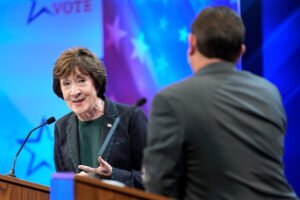
- How a fake pollster may have moved some 2026 elections
-

 Politics2 years ago
Former ‘Squad’ members launching ‘Bowman and Bush’ YouTube show
-
Uncategorized2 years ago
Bob Good to step down as Freedom Caucus chair this week
-

 The Josh Fourrier Show2 years ago
DOOMSDAY: Trump won, now what?
-

 The Dictatorship2 years ago
Pete Hegseth’s tenure at the Pentagon goes from bad to worse
-

 Politics2 years ago
Former Kentucky AG Daniel Cameron launches Senate bid
-

 The Dictatorship2 years ago
Luigi Mangione acknowledges public support in first official statement since arrest
-

 Politics2 years ago
Blue Light News’s Editorial Director Ryan Hutchins speaks at Blue Light News’s 2025 Governors Summit
-

 Politics1 year ago
John Legend advises Trump to drop the ‘dictator s‑‑‑’ if he wants Nobel Peace Prize