
The Dictatorship
Changing the meaning of ‘harm’ in the Endangered Species Act will harm endangered species


ByDerrick Z. Jackson
On Tuesday the Trump administration officially published in the Federal Register what may be a mortal blow to the Endangered Species Act, the key law that aided the spectacular recovery of birds like the bald eagle and the peregrine falcon. The administration’s new rule, which was issued by the Interior and Commerce departments and becomes effective Sept. 14, deletes a critical definition of what constitutes “harm” to species on the brink of extinction.
Under the old definition, harm wasn’t limited to actions that directly killed or injured wildlife. Developers, industrial polluters and landowners were also prohibited from rolling out bulldozers and backhoes and causing “significant habitat modification or degradation” that damaged or destroyed endangered species’ “breeding, feeding or sheltering” areas.
There is a whole world of lesser-known toads, salamanders, turtles, bees, butterflies and fishes that could blink out before we know it.
There are 2,300 species listed under the Endangered Species Act. Some of the more widely known species are the northern spotted owlthe California condorthe Florida pantherthe whooping cranethe manatee and some species of wolves. But there is a whole world of lesser-known toads, salamanders, turtles, bees, butterflies and fishes that could blink out before we know it.
It is obvious who benefits from this outrageous change. Oil and gas drillers, building contractors, mining companiesroad construction groups, ranchers and the U.S. Chamber of Commerce have all chafed at the appropriately broad interpretation of “harm.” In one statementthe Independent Petroleum Association of America claimed the Endangered Species act was “destroying economic growth and job creation.” In a bald-faced press release hailing the change, Interior Secretary Doug Burgum called the old rules a “regulatory trap.” The new ones, he said, will “reduce unnecessary permitting, cut compliance costs, and eliminate confusion for landowners, small businesses, energy producers, farmers, ranchers and local governments.”
Now it is wildlife that will be confused, trapped and possibly exterminated with unfettered development. Environmental groups are suing the administrationbut the odds of blocking the new rule are long given our ultraconservative Supreme Court, which has robotically rolled back even environmental protections that have a direct impact on wildlife.

In 2023 the Supreme Court drastically limited the definition of a wetland. In more sane days, the Environmental Protection Agency called wetlands a “biological supermarket.” More than one-third of all the nation’s endangered and threatened species live full time in wetlands, and more than half of such species spend some time in them.
The court ruled against a generous definition of a wetland even though between 2009 and 2019according to the Interior Department under the Biden administration, the nation lost an area of vegetated wetlands larger than the size of Rhode Island. By the way, groups that filed briefs to reduce the scope of wetlands included agricultural interestsmining interests, the U.S. Chamber of Commercethe American Petroleum Instituteand the National Association of Home Builders.
This latest rule is a neon green light inviting developers to plow through the wetlands that are left, cut down more forests, build along sensitive coastlines, cast fishing nets into precious feeding grounds for migratory birds and whales, and dump more pesticides and chemicals. The rule is changing despite many studies showing that the biggest threat to threatened creatures is, in fact, habitat loss. Globally, a 2022 study found that habitat destruction affects 9 of 10 species threatened with extinction. In the United States, a 2019 study published in the journal Conservation Science and Practice found that habitat modification was the most common threat to species listed under the Endangered Species Act. The study said current federal and state regulations “are not adequate enough to prevent habitat loss.” Yet the Trump administration has set up the nation to accelerate the loss.
I am writing and photographing on islands where one of the lesser-known endangered species, the roseate tern, nests.
On the day the administration posted the rule change, I was, to borrow from Otis Redding, literally sittin’ on the dock of the bay, watching these protections roll away. I am writing and photographing on islands where one of the lesser-known endangered species, the roseate ternnests. It is a beautiful bird with sharp, elegant plumage. Like most tern species in North America, that plumage made them a target for gunners in the late 1800s and early 1900s to provide feathers for women’s hats. Even with federal protections, the tern population grew back slowly, partially because of habitat loss in the 20th century.
They are long-distance migrants that zoom from the Northeast to South America for the winter. But before they get there, most roseates make a major pit stop on Cape Cod. They roost at night on strips of beaches and sandbars. “It’s an area for parents to refuel after spending the summer raising their young, and it is a training ground for young, inexperienced birds to work on their hunting skills,” said Don Lyons, director of conservation science at the National Audubon Society’s Seabird Institute, based in Bremen, Maine.
The institute is an outgrowth of Project Puffin, which restored Atlantic puffins to islands in Maine after hunting caused about a century’s absence of the birds. I am the co-author, with the project’s founder, Steve Kress, of two books on that restoration.
Lyons said he was not aware of any major planned development on the Cape where the roseates go, but he warned that all coastal areas where birds either nest, rest or winter are at major risk of many threats with increased development. “More people also mean more raccoons, skunk, coyotes, dogs and domestic cats that could predate on the birds,” he said.
Lyons, who himself migrates to Oregon State University every fall to be a seabird science professor, talked about another bird on the West Coast that is not a household name: the marbled murrelet. It is a small, blocky cousin of puffins seen in Pacific waters. The marbled murrelet, which is listed as threatened in Washington, Oregon and California, is one of the most mysterious and difficult seabirds in North America to study, Lyons said. Unlike many seabirds that nest in dense, noisy colonies, the marbled murrelet flies from the ocean into dense, dark old-growth coastal forests to nest in solitude on the branch of a redwood or Douglas fir, hidden by the tree canopy.
The bird is such a recluse that the first murrelet nest was not discovered until 1974 — and only then by a maintenance worker who was climbing a redwood in a state park. The bird’s breeding habits make it a potential casualty for developers or loggers who could easily claim they didn’t know the bird was in a tree they just cut down. Even if a developer missed a tree with a nest, any thoughtless fragmenting of the forest could allow easier access for nest predators, such as jays, ravens, crows, owls and hawks. According to a Washington state wildlife report last yearnesting habitat losses due to logging have been so “substantial” that the state population of marbled murrelets fell from 7,500 birds in 2015 to 4,400 in 2023.
If puffins nested in trees, we’d probably do a better job of protecting trees.
Don Lyons, director of conservation science at the National Audubon Society’s Seabird Institute
“They’re susceptible to habitat loss because they’re a specialized bird in a resource that has real economic value to people,” Lyons said. He said the bird was symbolic of many species that do not have much of a constituency outside of the conservationists who study them. “They don’t have the charisma of other birds,” Lyons said. “If puffins nested in trees, we’d probably do a better job of protecting trees.”
My colleague Kress, the man who brought puffins back to two islands in Maine, starting in the 1970s with chicks translocated from Canada, said the Trump administration’s elimination of habitat protections was particularly egregious. It was only in the last 15 years that the wintering home of Maine’s puffins started to be understood. As it turned out, some puffins spend the late winter in the Northeast Canyons and Seamounts, 130 miles southeast of Cape Cod.
Because of its wealth of deep-sea corals, and terrain that concentrates nutrients and smaller fish for terns, puffins, turtles, dolphins, rays, sharks and whales, President Barack Obama declared the area a national marine monument in 2016, closed to commercial fishing and oil and gas drilling. This year, Trump reopened the monument to commercial fishing. In a press release touting the potential bounty of tuna, swordfish, mackerel, squid and red crab, Commerce Secretary Howard Lutnick said“Restoring fishing in the Northeast Monument sends a signal that our fishermen are valued in the United States.”
To Kress, the signal is that wildlife no longer has a value. “This is a case of actively causing a species to decline and disappear,” he told me. “This is not a case of mere neglect. You don’t have to kill a bird to harm it. Take habitat away, they’re doomed.”

Derrick Z. Jackson
Derrick Z. Jackson is a Union of Concerned Scientists fellow in climate and energy at the Center for Science and Democracy. A former columnist for The Boston Globe, he’s the co-author of “Project Puffin: The Improbable Quest to Bring a Beloved Seabird Back to Egg Rock.”


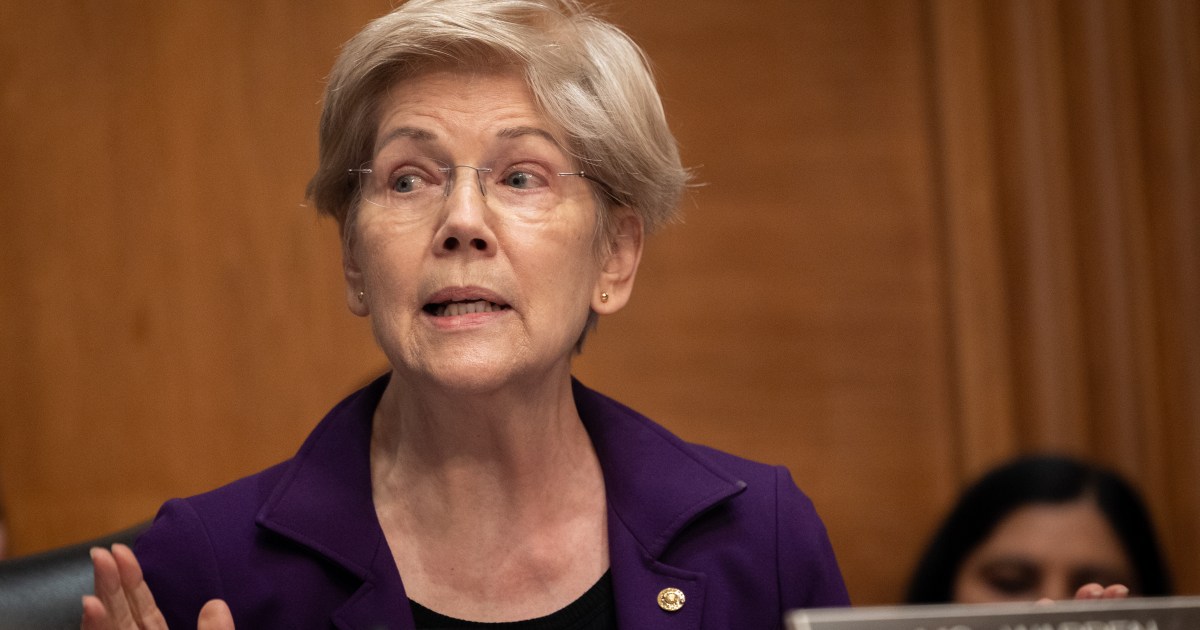
Democratic Senator Elizabeth Warren is endorsing Michigan Democratic Senate hopeful Abdul El-Sayed, MS NOW has learned.
“He’s growing a movement of working people all across Michigan,” Warren says of El-Sayed in a video announcing the pick. “Michiganders deserve a senator who will fight for you, not for special interests running millions of dollars in TV ads to buy this seat.”
The announcement makes Warren the latest high-profile progressive leader to pick a side in the El-Sayed versus Rep. Haley Stevens race that is both a marquee primary battle for a must-win seat ahead of November, and one that’s increasingly framed as a test of establishment versus outsider with big implications for the Democratic Party’s future.
The primary has seen millions pour in already — with pro-Stevens groups having a multimillion-dollar advantage on the airwaves.
Warren and El-Sayed are set to make two stops in the Mitten State next weekend — one week before Election Day and one week after Sen. Bernie Sanders, I-Vt., and Rep. Alexandria Ocasio-Cortes, D-N.Y., barnstormed the state for El-Sayed.
“Eventually, we have to ask ourselves: Is the answer to our problems to turn to the same playbook over and over again?” the New York congresswoman asked a crowd in Detroit over the weekend.
For Warren, it’s a change of heart, after initially backing State Sen. Mallory McMorrow in the primary. McMorrow dropped her bid earlier this month and is not expected to endorse in the primary.
“Senator Warren’s vision for our future — one where corporations can’t buy politicians and people can afford to put food on the table — speaks to Americans everywhere,” El-Sayed told MS of Warren’s endorsement, calling her “a generational voice for Americans who are tired of the status quo.”
The primary is August 4th.
Ali Vitali is MS NOW’s senior congressional correspondent and the host of “Way Too Early.” She is the author of “Electable: Why America Hasn’t Put a Woman in the White House … Yet.”
The Dictatorship
‘It’s a circus’: Republicans have big doubts about their newest reconciliation bill
With just four legislative days until the House breaks for its long August recess, Republicans are racing against the clock to advance their latest reconciliation bill this week. Lawmakers are skeptical they can get it done.
In the House, Republicans are struggling to unite their razor-thin majority on such a tight timeline. In the Senate, the questions about whether the GOP can pass this reconciliation bill are more like doubts.
On both sides of the Capitol, Republicans are naming their price for supporting the package — spending cuts, a stronger version of the SAVE America Act, provisions to defund Planned Parenthood and plenty of parochial asks — making an already difficult effort even harder.

“I do not think it’s likely to get done by next week, but we’ll see,” one House Republican told MS NOW, requesting anonymity to discuss the internal deliberations. “I really don’t think it’s going to happen by next week. I’d be very surprised.”
This lawmaker said Republicans are being pulled in multiple directions.
“Moderates want one thing. The budget hawks want another. And then you have the independent ones that are kind of just everywhere in between,” this GOP lawmaker said. “And it makes it a lot harder with such a slim majority.”
Senate Republicans were even blunter. Asked if there was a good chance the GOP could get the package done with the little time they have left in Washington, Sen. Lisa Murkowski, R-Alaska, wasn’t very hopeful.
“Nope,” she said, making it clear she’s “not a fan” of what Republicans are currently considering.
The House kicked off the effort last week, unveiling a $95 billion budget resolution aimed at funding the Iran war, implementing parts of the SAVE America Act and addressing some affordability concerns nationwide.
It’s the party’s latest attempt at passing the GOP voting bill after the measure twice failed to overcome the Senate’s 60-vote filibuster and the Senate parliamentarian ruled that its current language isn’t compliant with the strict reconciliation rules.
The next hurdle is getting the budget resolution passed on the House floor, where Republican opposition is already mounting.
Rep. Thomas Massie, R-Ky., who frequently breaks from the GOP, told MS NOW last week he’s “probably a no,” raising concerns that the ultimate package would become “a slush fund for funding the war in Iran.” And Rep. Kevin Kiley of California, who left the GOP to become an Independent earlier this year, told MS NOW that Republicans shouldn’t count on his vote.
“I’m very skeptical of this approach,” he said.
If all Democrats vote against the budget resolution, as expected, Republicans can only afford to lose three votes and still adopt the measure, assuming full attendance. With two of those spots likely already accounted for, Speaker Mike Johnson, R-La., will need to keep the rest of his conference on board.

The White House, for its part, is running a full-court press to get the reconciliation package to President Donald Trump’s desk. Vice President JD Vance met with House Republicans last week to discuss the effort, relaying that the president supports the package and urging lawmakers to get as much of the SAVE America Act passed as possible, according to three members at the meeting.
Even if Republicans clear the House, they would still have to pass a Senate budget resolution, draft legislation, survive another review by the Senate parliamentarian and assemble a majority in the chamber before sending the package back to the House for final approval.
With just about 20 legislative days planned for the House and Senate before the midterms, Republicans are fairly pessimistic about their chances of passing the package.
“We’ve got a lot of work to do — it’s a pretty significant lift.” Rep. Steve Womack, R-Ark., told MS NOW. “We’ve got a lot of convincing to do on our side for a lot of reasons.”
Another House Republican put the odds of this third reconciliation bill passing at 50-50.
“It’s just doing a lot,” the lawmaker said. “The fiscal conservatives are concerned, some people are concerned about the war… So that combination, I think, will prove to be difficult.”
Rep. Eric Burlison, R-Mo., a member of the conservative House Freedom Caucus, said he needs the spending in the reconciliation bill to be offset by cuts, which is not part of House GOP leadership’s current plan.
Burlison was less optimistic about the bill’s odds.
“I would say probably it’s a 40% chance,” he told MS NOW.
Even Senate Majority Leader John Thune, R-S.D., has been cautious. When MS NOW asked him how realistic it is to get the bill passed, he said, “If I had to handicap it on a scale of one to 10, I don’t know what to say at this point.”
His members have been even more frank about their gripes with reconciliation 3.0.
After it was reported that House GOP leadership wasn’t planning to include cuts in the bill, Sen. Bill Cassidy, R-La., said the package “should be fully paid for,” pointing to the ballooning debt.
“Our national debt is a runaway train,” he wrote on X.
Sen. Josh Hawley, R-Mo., told reporters “there needs to be a ban on funding for Planned Parenthood” in the final product, while also saying he didn’t want to see “any federal taxpayer money go to transgender treatment, surgeries, hormone therapies, etc., for minor children.”
Sen. Thom Tillis, R-N.C., meanwhile, took aim at the proposal potentially including language pertaining to the SAVE America Act. If the package includes any language related to the voting bill, Tillis told reporters he’ll “absolutely” vote against it.
“And I’ll slow other things down, too,” he said. “It’s a waste of time. It’s an exercise in futility, and those are the only positive things I can think of to say about it.”

The inclusion of the SAVE America Act is causing problems for other Republicans — just for a different reason.
After the Senate parliamentarian ruled against including the SAVE America Act in reconciliation, Johnson floated a workaround. He proposed creating a federal fund that states could draw from to implement voter ID and proof of citizenship requirements.
To some Republicans, however, that’s not a suitable option.
“If it’s really gonna be language that just is bribing the states, like with a few million bucks, I don’t think that’s strong enough,” Burlison told reporters.
Another House Republican said the SAVE America Act provisions were “100% snake oil.”
“Nothing in the bill is enforceable when it comes to the SAVE Act,” the lawmaker said. “It’s a complete falsehood. It’s very troubling.”
Beyond the policy, some Republicans have gripes with the process.
Murkowski, who said there’s little chance Republicans get the bill passed, said she’s not in favor of “multiple reconciliations.” (The GOP has passed two other party-line bills in the past year.)
Murkowski also took issue with Republicans seeming to subvert the normal appropriations process through these party-line bills.
“I don’t like to appropriate through reconciliation,” Murkowski said. “That’s the direction that we’re going here.”
Still, there are some Republicans who are optimistic.
Asked by MS NOW last week if he was confident this latest reconciliation bill would pass, Johnson gave a definitive “Yes.”
And other members are backing him up.
“It’s more likely than not,” a House Republican said. “There are plenty of issues to still iron out, but people kind of said we couldn’t get the first reconciliation package done as well. Now, in hindsight, it seems inevitable.”
But the pessimism within the Republican ranks seems to be outweighing the optimism. From the tight legislative timeline and competing policy demands to the razor-thin majorities and difficult Senate rules, the GOP’s luck on reconciliation bills may have finally run out.
Asked about the reconciliation push, one member summed it up this way: “It’s a circus.”
Jack Fitzpatrick and Nora McKee contributed to this report.
Mychael Schnell is a reporter for MS NOW.
The Dictatorship
3 U.S. troops killed in Middle East and 1 missing after Iranian attacks, CENTCOM says

Three American service members — two in Jordan and one in Iraq — were killed in action and one remains missing after Iranian attacks over the past few days, U.S. Central Command said.
The U.S. military on Sunday carried out new airstrikes in response to “swiftly punish” Iran’s Revolutionary Guard.
The names of the killed service members were being withheld until 24 hours after their families were notified, CENTCOM said. Four others were taken to hospitals and have since been discharged, according to CENTCOM. Others were evaluated for minor injuries and have returned to duty. Another service member was wounded and continues to receive medical treatment for a minor injury.
CENTCOM announced on Sunday that a third U.S. service member in northern Iraq was killed in action July 18 following an attempt to detonate unexploded ordnance from an Iranian drone.
The latest fatalities bring the United States’ combat death toll related to the Iran war to 17. In addition, a soldier died from a noncombat-related incident in Kuwait. Hundreds of other troops have been injured.
In a social media post on Saturday afternoon, Defense Secretary Pete Hegseth wrote, “Godspeed, heroes,” adding: “Their sacrifice only stiffens our resolve.”
The U.S. and Iran have traded strikes for the past week, with Iran hitting neighboring nations where American military bases are located. Iran has again closed the Strait of Hormuz — access to which has been a major factor in the war — and the U.S. restored its blockade on Iranian ports.
At least 50 people have been killed and more than 500 injured in Iran since the U.S. resumed its bombing campaign, according to Iran’s Ministry of Health.
A senior Iranian government official told MS NOW on Saturday that the memorandum of understanding between the U.S. and Iran is “no longer valid” after days of fighting. The official, who spoke on condition of anonymity to be able to discuss sensitive issues, said the U.S. had consistently breached the ceasefire and added that Iran had no plans to negotiate while it’s under attack.
A senior foreign diplomat inside Tehran who is linked to Iran-U.S. negotiations told MS NOW that “there is no hope of peace in the near future.” The diplomat, who did not want to be identified due to the sensitive nature of the topic, said it would “take a miracle” to return to negotiations.
The renewed hostilities threaten to upend the fast-deteriorating agreement that the two countries signed last month. Deputy Foreign Minister Kazem Gharibabadi told state TV that Iran is suspending its commitments to the memorandum of understanding with the U.S., The Associated Press reported Saturdayaccusing the U.S. of violating its own commitments under the deal.
It’s unclear where mediation efforts stand at the moment. Ayatollah Mojtaba Khamenei said in a statement Saturday that the U.S. violation of the MoU proved the “worthlessness and invalidity” of President Donald Trump’s signature and warned of heavy repercussions for the U.S., state broadcaster IRIB reported.
Clarissa-Jan Lim is a breaking news reporter for MS NOW. She was previously a senior reporter and editor at BuzzFeed News.
Inzamam Rashid is a MS NOW contributor and Monocle’s Gulf Correspondent based in Dubai. He has previously reported for Sky News and the BBC
- Cornyn and Tillis in discussions with White House to get Blanche across the finish line
- Democrats search for options to halt Trump’s renewed attacks on Iran
- White House sends Congress stopgap exception wishlist
- Democrats accuse Kathy Ruemmler of lying about her ties to Jeffrey Epstein

- Booker challenges Blanche on claims he can’t meet with Epstein victims
- Nancy Mace won’t run for Lindsey Graham’s Senate seat
- Senators explore separate stopgap spending bill as House moves ahead
- Booker challenges Blanche on claims he can’t meet with Epstein victims
- Thune withholds a South Carolina Senate endorsement while complimenting Graham
- Cruz and Blackburn meet Trump to discuss tech policy
-

 Politics1 year ago
Former ‘Squad’ members launching ‘Bowman and Bush’ YouTube show
-

 The Josh Fourrier Show2 years ago
DOOMSDAY: Trump won, now what?
-

 The Dictatorship1 year ago
Luigi Mangione acknowledges public support in first official statement since arrest
-

 Politics1 year ago
Former Kentucky AG Daniel Cameron launches Senate bid
-
Uncategorized2 years ago
Bob Good to step down as Freedom Caucus chair this week
-

 The Dictatorship1 year ago
Pete Hegseth’s tenure at the Pentagon goes from bad to worse
-

 Politics1 year ago
Blue Light News’s Editorial Director Ryan Hutchins speaks at Blue Light News’s 2025 Governors Summit
-

 The Dictatorship10 months ago
Mike Johnson sums up the GOP’s arrogant position on military occupation with two words