
Politics
Centrist WelcomePAC charts path for Dems, with help from Axelrod, Plouffe and others

Centrist Democrats have a plan for their party to win again: Talk more about the economy and less about democracy. Reject corporate interests and ideological purity tests. Keep the progressive policies that are popular — like expanding health care and raising the minimum wage — and moderate on issues like immigration and crime.
Those are among the takeaways laid out in an expansive report Monday from WelcomePAC, which supports center-left candidates, on how Democrats can rebound from last year’s electoral wipeout in 2026 and 2028.
The 58-page prescription comes as Democrats continue to war over the direction of their party nearly a year after their national shellacking. And it drops a week before a slate of gubernatorial and mayoral contests that will serve as the first major temperature check of the electorate since 2024 and President Donald Trump retaking the Oval Office.
It features input from a who’s who of top Democratic consultants — including David Axelrod; James Carville; David Plouffe, a top adviser to former Vice President Kamala Harris’ campaign; Lis Smith; and former Biden White House spokesperson Andrew Bates — as well as analysts and strategists like Nate Silver, Sarah Longwell and former Rep. Cheri Bustos of Illinois.
The report is less an autopsy of the 2024 election — it spends a scant five pages on former President Joe Biden’s and Harris’ campaigns — and more so an indictment of the party’s leftward shift since the Obama administration and the donors, campaign operatives and progressive advocacy groups the authors blame for putting Democrats in an unwinnable position.
It largely echoes what moderate Democrats have been saying loudly for months — that the party should be running to the center and focusing on kitchen table issues.
It uses polling data to reinforce the message many centrist Democrats believe voters sent the party in 2024: that voters felt Democrats were prioritizing democracy, abortion and identity over top-of-mind issues like the economy, immigration and crime. It argues that moderate candidates tend to overperform progressive ones, citing centrist Sen. Ruben Gallego (D-Ariz.) and Rep. Jared Golden (D-Maine) as models for how the party should message on border security and the economy.
And Democrats “should distance ourselves from the Biden administration,” the authors write, “particularly by critiquing the Biden administration’s approach to border security and the cost of living.” Harris, they posit, lost in part because of her failure to do so — and because voters couldn’t let go of her past progressive policies even as she ran a more moderate campaign.
The report doesn’t call for a wholesale rejection of progressive stances. Expanding access to public health care, making the wealthy “pay their fair share” in taxes and raising the minimum wage are all popular with voters, and WelcomePAC believes the party should continue to focus on them. Democrats, the authors say, should emulate Sen. Bernie Sanders (I-Vt.), Rep. Alexandria Ocasio-Cortez (D-N.Y.) and Democratic nominee for New York City mayor Zohran Mamdani’s “relentless focus” on affordability.
But they also say Democrats should focus less on “lower-salience issues where our views are unpopular,” such as transgender athletes. They insist that running against the establishment — as is en vogue these days — doesn’t have to mean running toward the left. And they contend that simply running younger candidates “is not a panacea.”
WelcomePAC made no mention of next week’s gubernatorial contests in New Jersey and Virginia. But their strategy will undergo an early test in both states, where the party has put forward a pair of moderate lawmakers with military and national security backgrounds who are running campaigns centered on affordability. Democrats are favored to win both races, though Rep. Mikie Sherrill’s contest in New Jersey is expected to be far closer than former Rep. Abigail Spanberger’s in Virginia.
WelcomePAC warned against drawing conclusions from the elections heading into 2028 in its report, insisting that “doing well in midterms and special elections does not guarantee Democrats anywhere close to the same results in a presidential race” because less-engaged voters tend to skip those intermediate contests.
But Democrats across the ideological spectrum will undoubtedly be scanning the results of next week’s elections in two states that stayed blue in 2024 but shifted toward Trump for signs of what is — and isn’t — working for the party heading into a high-stakes midterm election and the critical presidential contest to follow.


This is an adapted excerpt from the March 24 episode of “All In with Chris Hayes.”
Donald Trump’s war on Iran is in its fourth week. Gas prices are up $1 a gallon in much of the country. Stocks continue to fall on fears of global supply shortages.
The death toll is growing. Thirteen American service members have lost their livesand more than 1,200 Iranians have been killed, along with upward of 1,000 people in Lebanonmore than 150 in the surrounding Gulf states and 17 Israelis. That’s not accounting for the millions who are displaced and the thousands who have been injured, including hundreds of U.S. troops.
But according to the president who launched the war, it’s all over.
It is becoming increasingly clear that Trump expected a fast and easy win.
“We’ve won this. This war has been won,” he told reporters Tuesday in the Oval Office. “The only one that likes to keep it going is the fake news.”
However, during those same remarks, Trump was all over the place — talking about an epic victory, ongoing peace negotiations and personal gifts.
It was all completely counter to his posture over the weekend, when he threatened to “obliterate” Iranian civilian power plants — essentially teasing a war crime — if Iran did not stop blocking oil tankers in the Strait of Hormuzsomething Iran was not doing before Trump attacked them.
But now, he has supposedly pressed pause on that bombing plan for five days because, he said, the negotiations are going well.
When he first announced that in a social media post Monday, it sent oil prices down 10% and boosted stocks.
However, those markets reversed themselves Tuesday after the Iranians said they have not engaged in any serious high-level negotiations with the Americans, and they claimed Trump was making things up to help oil prices. The Israelis said the same thing. (That’s not to say you should take Iran’s word for it, or Israel’s, but you shouldn’t take the White House’s word, either.)
It is becoming increasingly clear that Trump expected a fast and easy win. He had no plan B, and now he is flailing to find some kind of fallback position.
On Monday, sources from the administration told Politico that they have their eyes on a future U.S.-backed leader of Iran: Mohammad Bagher Ghalibaf, speaker of the Iranian parliament.
“He’s a hot option,” one unnamed U.S. source — who seems to really wants a deal — told Blue Light News. “He’s one of the highest. … But we got to test them, and we can’t rush into it.”
But on Tuesday, that “hot option” trolled Trump for what he called a “jawboning campaign” to stabilize oil prices. In a social media postGhalibaf wrote: “[L]et’s see if they can turn that into ‘actual fuel’ at the pump — or maybe even print gas molecules!”
Call it the fog of Trumpian war: a million contradictory messages flying around, constantly wildly pinging bits of news that don’t make sense together.
Right now, we have reports that Trump’s negotiators, including his envoy Steve Witkoff and Vice President JD Vance, are traveling to Pakistan for informal talks with an Iranian official.

At the same time, unnamed U.S. officials have told The New York Times that the Saudi crown prince is pushing Trump to continue the war until Iran’s government collapses — something the Saudis publicly deny.
In fact, The Wall Street Journal is reporting that Saudi officials are holding talks in Riyadh with their Arab counterparts to find a diplomatic off-ramp from the war.
On Tuesday evening, U.S. officials said the Pentagon was poised to deploy 3,000 troops of the 82nd Airborne Division to the Middle East. That is in addition to two Marine expeditionary units on their way to the region and the 50,000 U.S. troops already stationed there.
Also on Tuesday, Iranian-backed militias in Iraq are claiming that U.S. strikes there killed 30 of their members.
But, according to Trump, the peace talks are going great, right?
All eyes everywhere have been on the Strait of Hormuz, where Iran responded to the U.S. attack by striking oil tankers and shutting down 20% of the world’s supply of oil and liquefied natural gas. It is now essentially running a toll operation in the strait.
Some countries, such as China, Japan and India, are negotiating deals with Iran to get its oil out. Which is to say, Iran is shipping more oil and making more money than it was under the U.S. sanctions in place before Trump attacked it.
It’s clear the president sees what’s happening, so now he is trying to share control of the strait with Iran. Trump told reporters the strait would be “jointly controlled” by “maybe” him and “the next ayatollah.”
The administration really thought this was going to be another Venezuela. They told themselves that, and they were egged on to believe it by the staunchest advocates of the war, such as Israeli Prime Minister Benjamin Netanyahu and Sen. Lindsey GrahamR-S.C.
But in Iran, a decapitation strike did not lead to mass uprisings. It did not lead to regime change. It led to the situation in which Iran’s regime is intact, even if militarily degraded, and they now have explicit control of the Strait of Hormuz — a huge pressure point.
It really looks like the U.S. is backed into a corner: It can sue for peace because of the oil tanker situation, but they do not have much leverage, or it can escalate the war. That may be why we’re seeing all these contradictory developments.
In Iran, a decapitation strike did not lead to mass uprisings. It did not lead to regime change. It led to the situation in which Iran’s regime is intact.
Trump issued an ultimatum he had to walk back from because he said there were deep peace negotiations, which then later proved to be completely fabricated.
Now, more U.S. troops are set to be deployed for a possible ground invasion in the Middle East, despite reports that the U.S. has supposedly sent a 15-point plan to Iran through Pakistan to end the war.
It almost looks as if Trump is trying to wave the peace card to keep a lid on oil futures and financial marketsjust long enough to have ground troops in position — and just in time for the markets to close for the weekend on Friday, when Trump’s “pause” on bombing Iranian power plants is set to end.
That could be the plan Trump now settles on, weeks into a deadly war where there was obviously, very clearly, no real plan at all.
Allison Detzel contributed.
Chris Hayes hosts “All In with Chris Hayes” at 8 p.m. ET Tuesday through Friday on MS NOW. He is the editor-at-large at The Nation. A former fellow at Harvard University’s Edmond J. Safra Foundation Center for Ethics, Hayes was a Bernard Schwartz Fellow at the New America Foundation. His latest book is “The Sirens’ Call: How Attention Became the World’s Most Endangered Resource” (Penguin Press).
House Budget Committee Chair Jodey Arrington is making clear he will push for the “fraud prevention” spending cuts he wants across state and social safety net programs in order to pay for any Iran war funding in a second GOP reconciliation bill. The Texas Republican is meeting soon this afternoon with Senate Budget Committee Chair Lindsey Graham (R-S.C.) in Graham’s office to discuss plans…
Read More
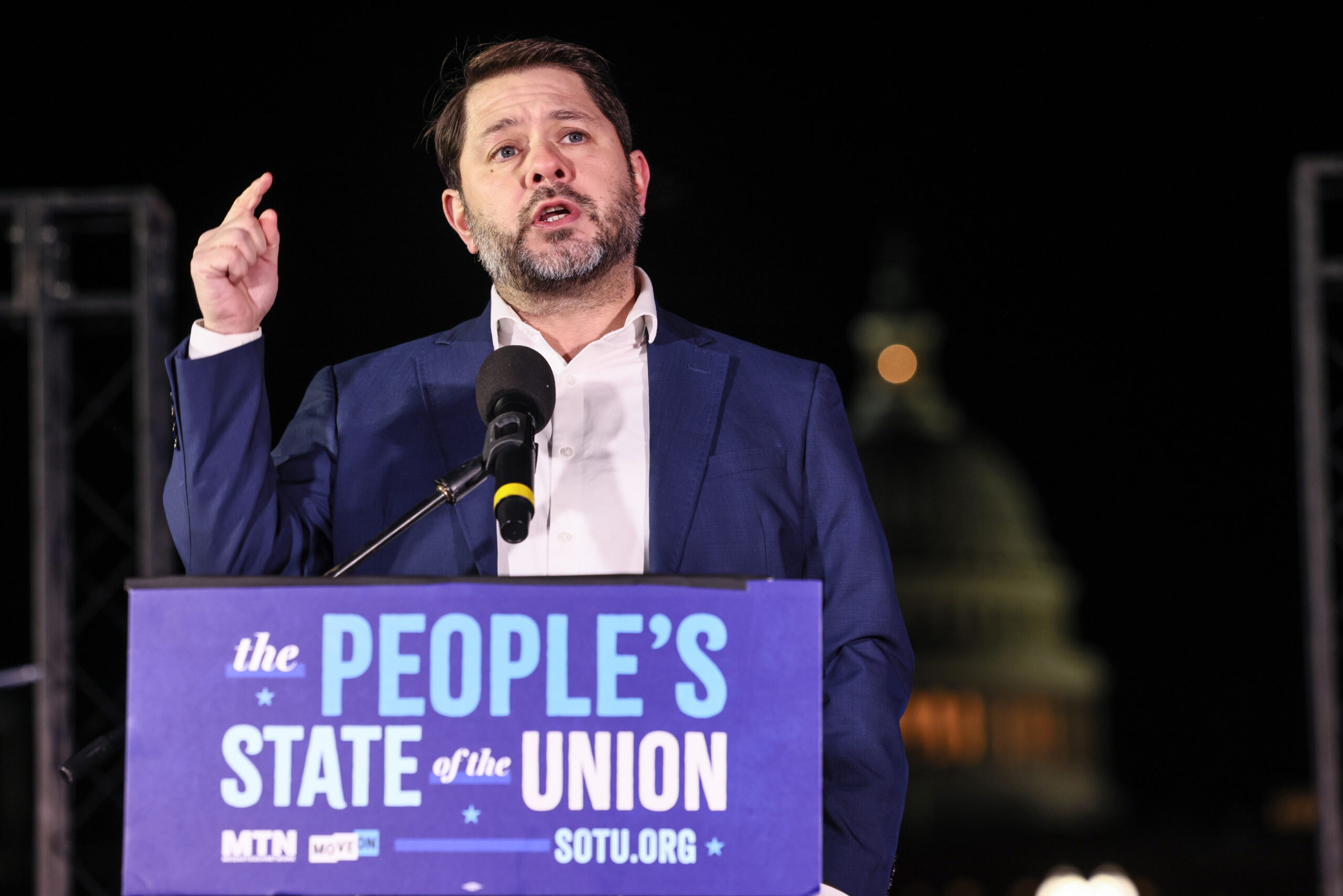
The Arizona senator said the former attorney general was “willing to sacrifice our democracy” to protect the institution of the Justice Department…
Read More
- Schumer rolls out Democrats’ midterm energy pitch
- No plan B: Trump is flailing to find an off-ramp for the Iran war
- Jury finds Meta and YouTube liable in landmark social media trial, awards $6 million

- Democrat vows to turn ‘Epstein files into Epstein trials’ after release of new depositions

- Trump’s Justice Department agrees to financial settlement with Michael Flynn

- Ukrainian energy official: Lifting Russia oil sanctions is ‘wrong approach’
- Kash Patel’s girlfriend ignites conspiracy-based feud with MAGA influencers

- No plan B: Trump is flailing to find an off-ramp for the Iran war
- Arrington: Fraud cuts for war funding
- Gallego: Merrick Garland was a ‘coward’ over Jan. 6
-

 The Dictatorship1 year ago
Luigi Mangione acknowledges public support in first official statement since arrest
-

 Politics1 year ago
Former ‘Squad’ members launching ‘Bowman and Bush’ YouTube show
-

 Politics1 year ago
Former Kentucky AG Daniel Cameron launches Senate bid
-

 Politics1 year ago
Blue Light News’s Editorial Director Ryan Hutchins speaks at Blue Light News’s 2025 Governors Summit
-

 The Dictatorship7 months ago
Mike Johnson sums up the GOP’s arrogant position on military occupation with two words
-

 The Dictatorship1 year ago
Pete Hegseth’s tenure at the Pentagon goes from bad to worse
-
Uncategorized1 year ago
Bob Good to step down as Freedom Caucus chair this week
-

 Politics11 months ago
Democrat challenging Joni Ernst: I want to ‘tear down’ party, ‘build it back up’